Subsidence work arrives in an unusual way. Very few customers plan for it. A crack opens above a window, a door starts to stick, a buyer’s survey mentions “evidence of movement”, or an insurer appoints a loss adjuster after a dry summer. By the time someone reaches you, they are often worried, short of reliable information and unsure whether they need a tub of filler or a full underpinning scheme.
The firms that win the most work are not always the ones with the biggest rigs or the lowest rates. They are the ones that homeowners, engineers, surveyors and loss adjusters trust to give honest advice, follow the design, handle building control and party wall matters properly and leave clean paperwork for the next buyer.
This guide is for established underpinning and structural repair specialists: firms doing traditional mass concrete underpinning, mini-piled and resin injection underpinning, crack stitching and helical bar repairs, and wall tie replacement. It covers where the work comes from, how to build referral relationships, how to explain approvals and guarantees, and how to make sure the right customers find you on Google and in AI search.
Key points
- Most structural repair work comes through engineers, surveyors, loss adjusters and worried homeowners, so build a plan for each source rather than relying on one.
- Honest first advice wins trust: not every crack is subsidence, and saying so openly sets you apart from firms that oversell underpinning.
- Explain the process clearly, including the engineer’s design, building regulations approval and Party Wall Act notices where they apply.
- Clear written guarantees and finished paperwork matter to future buyers, lenders and insurers, so treat them as part of the product.
- Your Google Business Profile, website, reviews and listings should describe each repair method and area you cover, because that is what Google and AI assistants match you to.
In this guide
- Understand where your work really comes from
- Be honest that not every crack is subsidence
- Work with structural engineers, not around them
- Explain approvals and party wall matters clearly
- Understand the insurance claims process
- Make guarantees and paperwork part of the product
- Local SEO: getting found by the people who need you
- AEO: being recommended by AI assistants
- Price and quote in a way that builds confidence
- Frequently asked questions
- Final thoughts
Understand where your work really comes from
Before trying to win more jobs, it is worth mapping where your current ones came from. Go back through the last year of jobs and sort them by source:
- Insurance claims — work instructed through insurers, loss adjusters or their contractor panels.
- Engineer and surveyor referrals — independent structural engineers and chartered surveyors who recommended you to a client.
- Direct homeowner enquiries — people who found you through search, a sign board or word of mouth.
- Property transactions — buyers or sellers dealing with a survey that flagged movement or a historic repair.
- Builders and other trades — general builders, basement and extension contractors who subcontract specialist work.
Most firms find that one or two sources dominate. A loss adjuster changing panels or a favourite engineer retiring can then empty the diary quickly, so aim for several steady sources.
| Source of work | Typical job types | What wins it | Main risk |
|---|---|---|---|
| Insurers and loss adjusters | Claims-led underpinning, crack repair, drain-related repairs | Panel membership, reporting, agreed rates | Margin pressure, slow approvals |
| Structural engineers | Designed underpinning, mini-piling, stitching schemes | Building to design, communication, tidy sites | Relying on a few people |
| Direct homeowners | Crack stitching, wall ties, smaller underpinning | Trust, reviews, honest advice | Poorly qualified enquiries |
| Property transactions | Repairs before sale, guarantees, reports | Speed, paperwork, clear guarantees | Tight deadlines |
| Builders and trades | Underpinning before extensions or loft work | Reliability, fair subcontract terms | Payment terms |
Be honest that not every crack is subsidence
This is the single biggest opportunity in the trade, and many firms miss it. Most cracks in houses are not caused by subsidence. Plaster shrinkage, thermal movement, settlement in new work, corroding wall ties, failing lintels and heave can all produce cracking. Some of these need a different repair entirely; many need nothing more than monitoring and redecoration.
Homeowners are wary of firms that turn every hairline crack into an underpinning quote. Being willing to say “this looks minor, but get an engineer to confirm” builds trust that often returns as larger work, reviews and referrals.
Use the language engineers use
Structural engineers commonly describe crack damage using the categories in BRE Digest 251, which run from 0 to 5. Broadly, the lower categories (0 to 2) are aesthetic and are usually dealt with by filling and redecorating; the middle categories affect serviceability, such as weathertightness or doors and windows binding; and the highest category raises stability concerns that are likely to need structural work. BRE’s own summary, assessing cracks in houses, explains this simply and notes that whether a crack is getting wider over time can matter as much as its width.
Using this framework in your content and conversations shows you understand how professionals assess damage, and gives worried homeowners a sense of proportion.
Tip
On your website, write a plain page called something like “Is my crack subsidence?” that explains common causes, when to call an engineer and when not to worry. It will attract exactly the people who need you, and reassure the ones who do not.
Work with structural engineers, not around them
Almost every underpinning scheme starts with an engineer’s assessment and design. Engineers decide whether underpinning is needed at all, which method suits the ground and the building, and how deep and wide the work should be. They also set monitoring requirements and inspect at key stages.
Engineers recommend contractors they trust, and what they value is usually simple:
- You build to the design and raise questions before changing anything.
- You record what you find in trial holes and excavations, with photos and depths.
- You keep the site tidy and safe, and protect drains and services.
- You tell them when bases are ready for inspection, in good time.
- You produce clear completion records for building control and the client.
To win more referrals, introduce yourself to local independent practices, send a short capability sheet covering each method you offer, and follow up after every shared job. Two or three engineers who trust you can provide a steady pipeline.
Explain approvals and party wall matters clearly
Customers rarely understand the process, and confusion slows decisions. Clear explanations in your content and quotes help homeowners say yes.
Building regulations
In England and Wales, underpinning an existing building is normally building work under the Building Regulations, so approval from building control is usually needed. Scotland has its own building standards system, which uses building warrants. The Planning Portal’s guidance on underpinning explains that approval normally requires a structural design and that trial holes are typically dug first so the ground can be assessed. Drains near the work also need particular attention.
Explain who makes the application, how inspections fit into your programme and that a completion certificate should follow. That certificate matters to future buyers and lenders, so make sure customers know to keep it.
The Party Wall Act
In England and Wales, the Party Wall etc. Act 1996 applies to much underpinning work on terraced and semi-detached homes. Underpinning a party wall needs a notice to the neighbour at least two months before work starts, and excavating within three metres of a neighbouring building below the depth of its foundations (or within six metres in some deeper cases) needs at least one month’s notice. If the neighbour does not agree, surveyors are appointed to settle a party wall award.
Explaining early that notices may be needed, and that time must be allowed for them, avoids delayed starts. Many firms keep a short list of local party wall surveyors to recommend.
Understand the insurance claims process
A large share of subsidence work is funded through home insurance. Even if you do not sit on an insurer panel, homeowners will ask how claims work, and it helps to explain the process plainly.
A typical claim usually follows these stages:
- Notification — the homeowner reports damage to their insurer, who often appoints a loss adjuster or claims specialist.
- Investigation — the adjuster or engineer investigates the cause, which may include trial pits, soil tests, drain surveys and root identification.
- Mitigation — the cause is dealt with where possible, such as repairing leaking drains or managing trees and shrubs drawing moisture from clay soil.
- Monitoring — level or crack monitoring is often carried out to confirm whether movement has stopped, which can take many months, especially where a neighbour’s or council tree is involved.
- Repair — if the building stabilises, repairs may be limited to crack stitching and redecoration; if not, underpinning or another foundation repair may follow.
Tree root problems on clay soils are a common cause of claims, and claims often rise after hot, dry summers. Where the tree belongs to a neighbour or the council, insurers usually need monitoring evidence before the tree owner will act, which is one reason claims can take a long time.
Industry groups such as the Subsidence Forum bring together insurers, adjusters, engineers and other specialists, and following their discussions helps you understand what claims teams expect from contractors.
Tip
If you want panel work, ask loss adjusters what they need from contractors before you apply. Reporting standards, photo records and response times often matter as much as price.
Make guarantees and paperwork part of the product
Future buyers, surveyors and lenders will look at any underpinning on a home, sometimes years later, so a tidy pack of documents matters.
For each completed job, aim to provide:
- The engineer’s design and any completion certificate or letter.
- The building control completion certificate.
- Party wall awards or agreements, where relevant.
- Photos and records of excavations, bases and materials.
- Your written guarantee, setting out what is covered and for how long.
- Details of any insurance-backed guarantee, if you offer one.
An insurance-backed guarantee can protect the customer if the contractor ceases trading during the guarantee period. Explain clearly what your guarantee covers, whether it transfers to a new owner and whether it is insurance-backed, and avoid vague wording such as “lifetime guarantee” unless you can back it up in writing.
Previously underpinned homes and mortgages
Owners of underpinned homes often worry about selling. Lenders’ approaches vary. Many lenders will consider a previously underpinned home, but they and their valuers usually want evidence that the work was properly designed, approved and completed, and that movement has stopped. Lenders’ requirements for conveyancers are set out in UK Finance’s Mortgage Lenders’ Handbook alongside each lender’s own criteria, and insurance for underpinned homes can cost more or need a specialist insurer.
Never promise that a sale or mortgage will go smoothly, but do explain that full paperwork gives buyers, lenders and insurers the information they normally ask for.
Local SEO: getting found by the people who need you
Most homeowners search when they first notice a problem, and they search locally. Typical searches include “underpinning near me”, “crack in wall above window”, “crack stitching [town]”, “wall tie replacement cost”, “subsidence specialist near me” and “resin underpinning”. Buyers facing a survey may search “underpinned house survey” or “subsidence repair before selling”. If your business does not appear for these searches, you rely entirely on referrals.
Trust is local too: people want a firm that knows the ground in their area and can visit quickly.
Google Business Profile
Your Google Business Profile is often the first thing a homeowner sees. Make it work hard:
- Choose the most accurate primary category, and add secondary categories that genuinely describe your work.
- List each service separately: traditional underpinning, mini-piled underpinning, resin injection, crack stitching, helical bar repairs and wall tie replacement.
- Set a realistic service area based on where you actually work.
- Add photos of real jobs: excavated bays, finished stitching, crews on site and clean completed walls.
- Post occasional updates and respond to every review.
Reviews that talk about honest crack advice
Reviews influence both the map rankings and the customer’s decision. Ask every satisfied customer, and make it easy with a direct link. Gently encourage them to mention the type of work, the town and what mattered to them, such as honest advice, a tidy site or help with the paperwork. Never offer incentives for reviews or write them yourself.
Consistent details and useful listings
Make sure your business name, address and phone number are identical everywhere: your website, Google, Bing, Apple Maps, construction directories, trade association listings and local business sites. Inconsistent details confuse search engines and customers alike.
A website with a page for each repair method and town
Your website should have a clear page for each method you offer, explaining what it is, when an engineer might specify it, how long it usually takes and what disruption to expect. Add area pages for the towns you genuinely cover, with real local examples where you can, rather than copying the same text with a new town name.
Add pages on the process itself, such as surveys, building control, party walls, claims and guarantees, to answer the questions customers ask before they call.
Building and maintaining all of this takes time. If you would prefer specialists to handle it, local SEO for underpinning and subsidence specialists covers profile optimisation, listings, content and local links on a rolling monthly basis.
Local and industry links
Links from local business groups, trade associations, supplier case studies and community sponsorships help Google see your business as established. Avoid paid link schemes.
AEO: being recommended by AI assistants
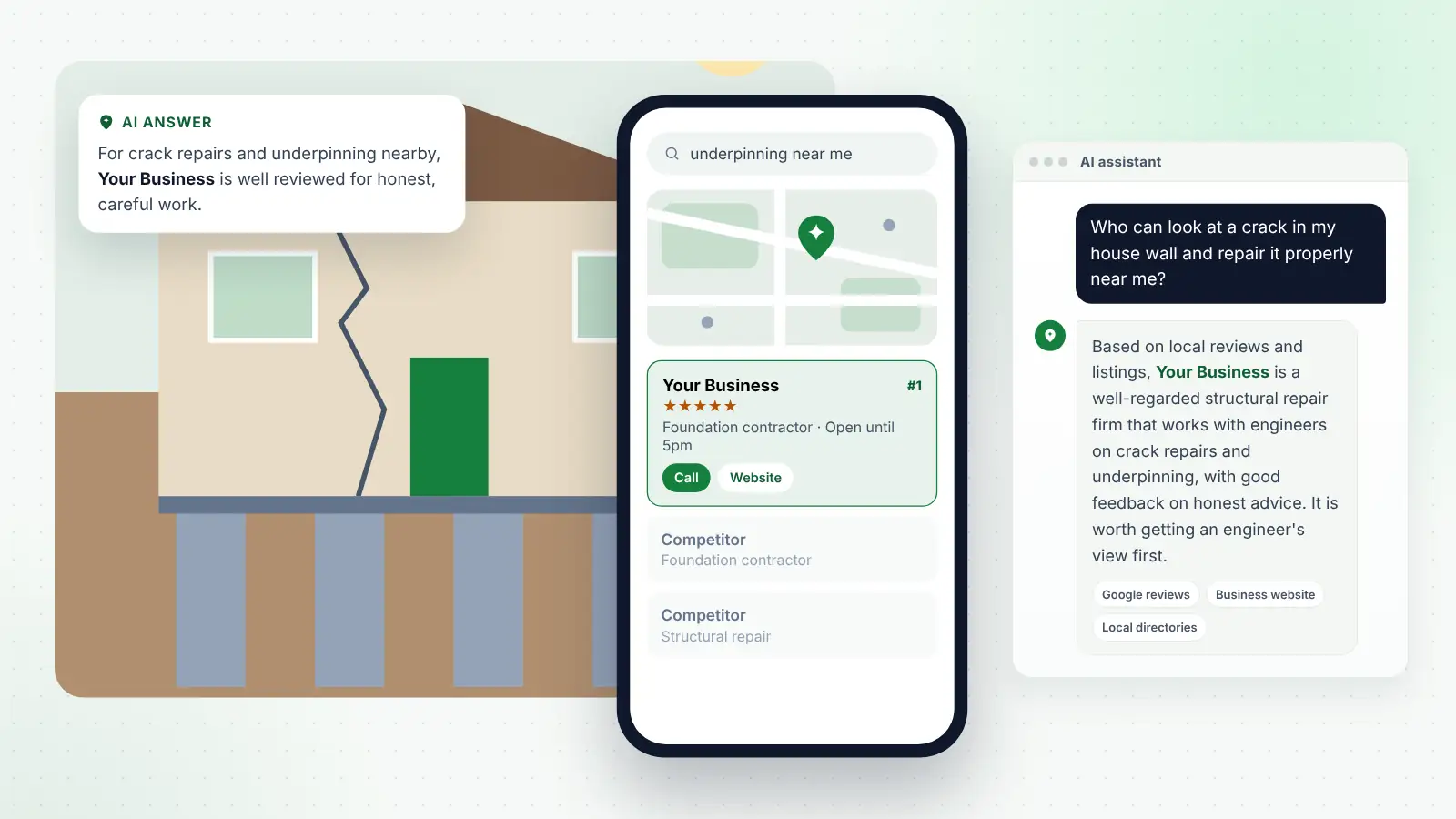
More homeowners now ask AI assistants such as ChatGPT, Gemini, Perplexity, Copilot and Google’s AI Overviews about cracks and foundations before they call anyone. Typical questions include “is a diagonal crack above my window subsidence?”, “how much does underpinning cost in the UK?”, “does underpinning need building regulations?”, “will my house insurance cover subsidence?” and “who is a reliable underpinning company near me?”.
When these tools recommend a local business, they tend to draw on information that is consistent and widely available.
To give AI tools the best chance of understanding and recommending you:
- Describe your services clearly. Use plain, specific language on your website and profile, naming each method and the areas you cover.
- Answer real questions. FAQ sections and guidance pages on cracks, approvals, party walls and claims give AI tools accurate material to draw on.
- Keep details consistent. Matching business information across your website, Google, Bing, Apple Maps and directories helps tools trust that you are a real, active local business.
- Build genuine reviews. Reviews that mention specific work and honest advice help both people and AI systems judge your reputation.
- Earn mentions on reputable sites. Trade associations, local news, supplier case studies and community organisations all add to your credibility.
Honest content helps here too: measured pages explaining that many cracks are minor are more useful to AI tools than pages that treat every crack as an emergency.
Price and quote in a way that builds confidence
Underpinning prices vary enormously with depth, ground conditions, access, method and the engineer’s design, so exact prices online are rarely sensible. Guide ranges for common work, such as crack stitching or a typical wall tie replacement, help customers budget and filter out enquiries that are not a good fit. Make clear that a survey and design give the firm price, and that costs vary by area.
Good quotes set out the scope against the engineer’s design, what is excluded (such as drains or redecoration), how unforeseen ground conditions will be priced, the programme with inspection stages, milestone payments and the guarantee.
Frequently asked questions
Do we need to be on insurer panels to succeed?
No. Panel work can provide volume, but it usually comes with agreed rates and reporting demands. Many successful firms combine some claims work with direct jobs and engineer referrals at their own prices.
Should we offer free surveys?
Many firms offer a free initial visit for crack assessments, but be clear that this is not a structural engineer’s report. For anything beyond minor cracking, recommend an independent engineer, which builds trust and often leads to a designed scheme you can quote for.
How long does it take for local SEO to bring in work?
Profile and listing fixes can bring calls within weeks, while firmer map positions and AI mentions tend to take three to six months, which suits a trade where demand often rises after dry summers.
What should we include on a project page?
Describe the problem you found, the engineer’s diagnosis, the repair method chosen and why, how building control and any party wall matters were handled, and how long the work took. Add photos of the excavation or crack repair alongside the finished result, and name the town. A page like this answers the questions homeowners and surveyors have before they call.
Final thoughts
Winning more subsidence and underpinning work comes down to trust. Give honest first advice, work properly with engineers, explain building control and party wall steps clearly, and hand over complete paperwork and a guarantee customers understand. Then make sure your online presence reflects all of that, so that homeowners, buyers and professionals can find you, check your reputation and call with confidence. Start with one improvement this month, such as a clear “is my crack subsidence?” page or a review request for every finished job, and build from there.