Oven cleaning is one of the more approachable home service businesses to start. You need a van, a heated dip tank, the right chemicals and a lot of patience. Demand comes from homeowners, tenants moving out, landlords and letting agents between tenancies, and sellers preparing a kitchen for viewings, and it rises sharply before Christmas.
The result speaks for itself, which is why satisfied customers review and rebook. But you are also working with strongly alkaline chemicals in someone else’s kitchen, taking apart an appliance that may have cost thousands of pounds. A scratched enamel finish, a chemical splash or a tank emptied into the wrong drain can undo a reputation quickly.
This guide covers franchise versus independent, services, chemical safety, waste disposal, insurance, range cookers and AGAs, pricing, letting agent work, repeat bookings, and getting found on Google and in AI search.
Key points
- Compare franchise and independent routes honestly, and have a solicitor review any franchise agreement before you sign.
- Caustic chemicals and heated dip tanks need a COSHH assessment, proper gloves and eye protection, and safe handling in the van.
- Never empty spent dip tank solution or rinse water into a surface water drain or roadside gully, because those drains lead straight to rivers and streams.
- Follow manufacturer advice for range cookers and AGAs, some of which specifically warn against caustic cleaners and oven sprays.
- Before-and-after photos, detailed reviews and a complete Google Business Profile are what most new customers check before booking.
- Yearly reminders and letting agent relationships turn one-off cleans into regular work.
In this guide
- Franchise or independent
- Decide what services to offer
- Training and skills
- Chemicals, dip tanks and COSHH
- Waste water and waste disposal
- Insurance and damage to appliances
- Range cookers and AGAs
- Pricing and quoting
- Letting agents, estate agents and end-of-tenancy work
- Repeat reminders and before-and-after photos
- Local SEO: getting found by people nearby
- AI search: how customers now ask for recommendations
- Common mistakes to avoid
- Frequently asked questions
- Next steps
Franchise or independent
Oven cleaning has an established franchise sector in the UK alongside many independent owner-operators.
| Franchise | Independent | |
|---|---|---|
| Upfront cost | Franchise fee, often with equipment and van livery | Your own equipment and branding, bought as needed |
| Ongoing cost | Management or royalty fees, sometimes a marketing levy | No franchise fees, but you fund your own marketing |
| Training | Usually included, with a set method and products | You choose and pay for your own |
| Brand | Recognised name from day one | You build your reputation from scratch |
| Freedom | Prices, products and marketing may be set for you | Full control |
A franchise can shorten the learning curve, but you pay for it every month for the life of the agreement. Speak to several existing franchisees, not just those the franchisor suggests, and ask how much work the brand generates compared with what they find themselves. Have a solicitor who understands franchising check the fees, performance targets, restrictive covenants and exit terms.
Going independent costs less and keeps every pound of profit, but you must learn the trade and win every customer yourself.
Decide what services to offer
Most cleaners start with domestic ovens and add appliances as their skills grow:
- Single and double ovens, including racks, trays, glass and door seals.
- Range cookers, larger and more varied in design, so they need more care.
- AGAs and other heat storage cookers, best treated as a specialism.
- Hobs and extractors, including grease-laden filters that are often overlooked.
- Microwaves, and occasionally fridges.
- Barbecues, useful income in spring and summer when oven demand is lower.
- End-of-tenancy and pre-sale cleans for tenants, landlords, agents and sellers.
Commercial kitchen cleaning is a different market with different equipment and standards. Treat it as a separate service needing its own training and insurance.
Training and skills
No specific licence is needed to clean domestic ovens in the UK, but there is real skill involved. Good training should cover:
- Removing and refitting doors, inner glass, fan covers, runners and racks for different makes.
- Recognising enamel, stainless steel, catalytic liners and pyrolytic ovens, and what each tolerates.
- Using a dip tank safely, including soaking times and lifting heavy parts.
- Cleaning the cavity without damaging enamel, seals, thermostats or wiring.
- Protecting floors and worktops, and checking the appliance works afterwards.
One firm boundary: in Great Britain, disconnecting, moving or reconnecting a gas appliance is gas work that must be done by a Gas Safe registered engineer. Clean gas cookers where they stand, put that in your terms, and suggest an engineer if a customer wants one moved.
Tip
Practise taking apart and rebuilding second-hand ovens before you take paid work. Learning how a door comes apart is much cheaper on an oven you own.
Chemicals, dip tanks and COSHH
Most oven cleaning chemicals are strongly alkaline, often based on caustic soda (sodium hydroxide), because that is what breaks down carbonised fat. They can cause serious skin burns and eye damage, and heating them in a tank adds splash risk. The Control of Substances Hazardous to Health Regulations (COSHH) apply from your first job.
The Health and Safety Executive’s COSHH guidance for the cleaning industry highlights the risks of corrosive products and the need for suitable gloves, aprons and eye protection. In practice that means:
- Keeping the safety data sheet for every product you carry.
- Writing a simple assessment of how you mix, heat, apply and rinse each product.
- Wearing long-cuffed chemical-resistant gloves and eye protection whenever you handle caustic products.
- Carrying eye wash and clean water on the van.
- Training anyone who works for you and reviewing assessments when products change.
Secure the dip tank so it cannot move or spill, keep the lid closed when travelling and never overfill it. Lower parts in slowly, use hooks or a basket rather than reaching in, and let heavy parts drain before lifting. In the home, keep children and pets out of the kitchen, ventilate the room and never leave chemicals unattended.
Waste water and waste disposal
Spent dip tank solution and rinse water contain caustic chemicals, grease and carbon. Where they go matters.
The key rule: surface water drains lead directly to rivers and streams. Roadside gullies and many driveway and car park drains are surface water drains. Government pollution prevention guidance for businesses in England says only clean water should go to surface water drains or soakaways. Contaminated water should go to the foul sewer with your water company’s permission, be collected for reuse or treatment, or be removed by a registered waste carrier. For you, that means:
- Never emptying a tank or rinse bucket into a gully, garden, driveway drain or soakaway.
- Asking your water company, or your water retailer if you are a business customer in England, whether and on what conditions you can discharge spent solution to the foul sewer. Some publish position statements for low-risk oven cleaning discharges, but these typically exclude corrosive material, so check the conditions before relying on one.
- Treating strongly corrosive waste carefully, because it can damage sewers and may be classed as hazardous waste, with its own storage, transport and paperwork rules.
- Using a registered waste carrier that takes it to a permitted site if you cannot dispose of it lawfully another way, and checking whether you need to register as a waste carrier yourself to transport your own waste.
Keep records of how you dispose of waste. A van caught emptying a tank into the street is exactly what ends up on social media.
Insurance and damage to appliances
You are handling expensive appliances and corrosive chemicals in people’s homes. Discuss these covers with a broker:
- Public liability insurance for injury and property damage, such as chemical damage to a floor. Not a legal requirement, but customers and agents expect it.
- Cover for the appliance you are working on. Some policies exclude damage to property in your care, custody or control. Ask specifically about cracked glass, damaged enamel or faults after cleaning.
- Employers’ liability insurance, a legal requirement in most cases once you employ anyone.
- Equipment and business vehicle cover.
Inspect every appliance before starting, point out chips, cracks, worn seals and existing faults, and take photos. Older glass and worn hinges can fail during removal, so explain the risk first and note that you did.
Range cookers and AGAs
These are higher-value jobs, but cleaning advice varies by manufacturer. AGA’s care guidance says its cast-iron ovens help keep themselves clean by carbonising spills, and advises against abrasive pads, caustic cleaners, oven cleaners, metal scrapers and steam cleaners on AGA and Rayburn cookers. Rangemaster advises checking products are safe for vitreous enamel, testing strong or caustic cleaners on an inconspicuous area first, and using only hot soapy water and a soft cloth on coloured panels.
So check the care advice for each make you clean, do not apply one method to every appliance, tell customers which parts you will hand clean rather than dip, and recommend a qualified engineer for servicing or repairs. Customers with these cookers often search for specialists, so if you build genuine expertise, say so clearly.
Pricing and quoting
Most oven cleaners price by appliance: single oven, double oven, range cooker by width, AGA, hob, extractor, microwave and barbecue, with a minimum charge and often a multi-appliance discount. Say exactly what is included, such as racks, inner glass, door seals and extractor filters, and what might change the price, such as very heavy carbon build-up.
If you agree a job with a consumer in their home, by phone or online, they usually have a 14-day cancellation period and must ask expressly if they want you to start within it. Put your terms and cancellation information in a short written booking confirmation.
Letting agents, estate agents and end-of-tenancy work
Letting agents and portfolio landlords need ovens cleaned between tenancies, often at short notice. They value reliability, quick turnaround, dated before-and-after photos for check-out records and simple invoicing.
In England, the Tenant Fees Act 2019 stops landlords and agents requiring tenants to pay for a professional clean, although they can still claim reasonable cleaning costs from the deposit if a property is returned dirty. So many tenants book their own oven clean, while agents and landlords book directly between lets. Market to both, and make every invoice name the address, appliances and date, as tenants may need it as evidence.
Estate agents are another source: sellers want kitchens looking their best for photos and viewings. Introduce yourself to local branches and leave a simple leaflet.
Tip
After every agent job, send two photos and the invoice in one message. Making their check-out paperwork easier keeps you on their supplier list.
Repeat reminders and before-and-after photos
Most households only think about their oven once or twice a year, so a well-timed reminder is valuable. Record each customer’s appliances and last clean date, and ask permission to contact them when the next one is due or before Christmas. Marketing emails and texts are covered by electronic marketing rules: you can usually contact existing customers about similar services if you offered a clear opt-out when collecting their details, and you include one in every message.
Before-and-after photos are your most persuasive marketing. Take them in good light from the same angle, ask permission before using them online, and never edit them to exaggerate the result.
Local SEO: getting found by people nearby
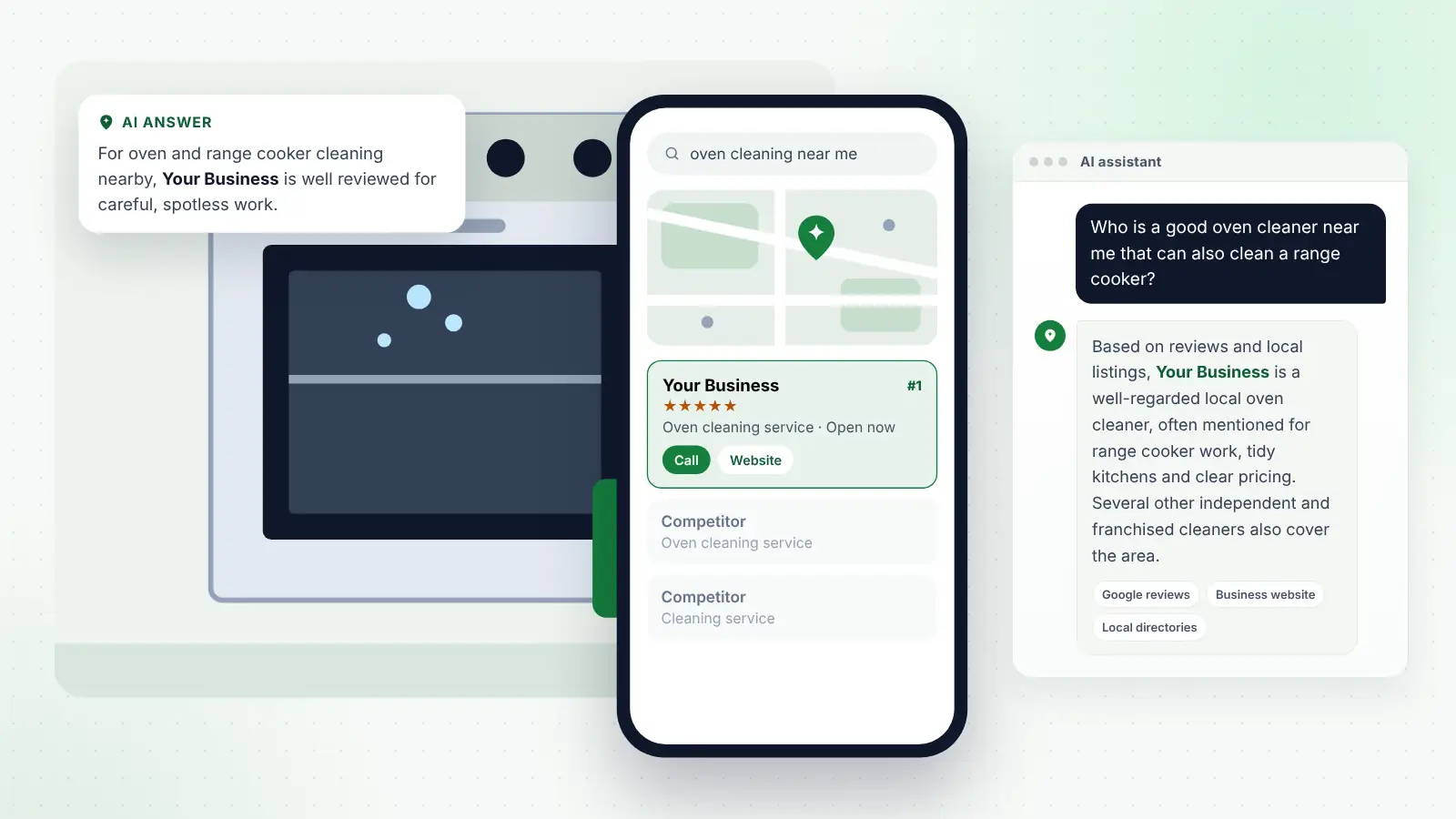
When someone wants their oven professionally cleaned, they search phrases such as “oven cleaning near me”, “oven cleaner [town]”, “range cooker cleaning” or “end of tenancy oven clean”. The map pack at the top gets much of the attention, and those positions are earned through local SEO. Independents often find franchise brands appearing above them, which makes their own visibility more important.
Set up your Google Business Profile
Set your profile up as a service-area business, which hides your home address. Then:
- Choose the most accurate primary category, with relevant secondary ones.
- List each service separately: ovens, range cookers, AGAs, hobs, extractors and barbecues.
- Add the towns you genuinely cover.
- Upload real before-and-after photos, plus your van and dip tank.
- Post occasional updates, such as Christmas availability.
Franchisees should check what their agreement allows before changing profiles or listings.
Reviews
Ask every customer while they are looking at the clean oven, and send a direct link. Reviews mentioning the appliance, how tidy you left the kitchen and how long the job took are especially useful. Reply politely to every review.
Consistent details, a useful website and local links
Keep your name, phone number and website identical across your profile, website, social media and directories. Give each main service its own page explaining what is included, how long it takes and guide prices. Links from letting agents’ supplier pages, local business groups and community sponsorships show search engines you are an established local business.
Many owners start doing this themselves; if you would rather have specialists handle it, you can read about our approach to local SEO for oven cleaners. Results usually build over three to six months.
AI search: how customers now ask for recommendations
More people now ask ChatGPT, Gemini, Perplexity, Microsoft Copilot and Google’s AI Overviews for help with household jobs. They ask full questions, such as:
- “Is it worth paying someone to clean my oven, and who does it near me?”
- “Which oven cleaners in Leeds can clean a range cooker?”
- “Who does end of tenancy oven cleaning in Bristol at short notice?”
These tools build answers from information they can cross-check across the web. That is why answer engine optimisation, or AEO, matters. What helps most:
- Consistent information about your name, services and areas everywhere you appear.
- Reviews describing the cooker, its condition and how tidy the kitchen was afterwards.
- Clear service descriptions saying which appliances you clean and where.
- Website FAQs on how long a clean takes, when the oven can be used and whether you clean AGAs.
- Mentions on reputable sites, such as local news and community websites.
Common mistakes to avoid
- Handling caustic products without gloves and eye protection because the job is quick.
- Emptying the tank into the nearest drain without checking where it goes.
- Using the same products on every appliance without checking manufacturer advice.
- Skipping the pre-inspection, then disputing a chip that was already there.
- Touching gas connections instead of leaving them to a Gas Safe registered engineer.
Frequently asked questions
Do I need a licence to start an oven cleaning business?
No specific licence is needed. You will need to register with HMRC, follow health and safety and COSHH rules, dispose of waste lawfully and hold employers’ liability insurance if you take on staff.
Is a franchise better than starting independently?
It depends on your experience, budget and how much support you want. A franchise offers training and a known brand but comes with ongoing fees and rules. Independents pay less and keep full control, but build everything themselves.
How long does a typical oven clean take?
A single oven often takes a few hours, while range cookers and heavily carbonised appliances take longer. Give an honest estimate when booking and say when the oven can be used again.
Can I clean self-cleaning and catalytic ovens?
Often, yes, with care. Catalytic liners can be damaged by some products and abrasive tools, and pyrolytic ovens have their own guidance. Check the manual and tell the customer what you will and will not clean.
Is oven cleaning seasonal?
Demand usually rises before Christmas and around busy moving periods, and can dip in January. Barbecue cleaning and letting agent work help smooth out the year.
Next steps
Decide whether a franchise or the independent route suits you, get properly trained, and put COSHH assessments, waste disposal arrangements, insurance and clear terms in place before your first booking. Then make sure local customers can find you, with a complete Google Business Profile, honest before-and-after photos, detailed reviews and a website that answers their questions.


