Many surveyors reach a point in their career where working for a national firm or a lender panel no longer feels like the best use of their skills. You might want more time on each inspection, the freedom to set your own fees, or simply a practice that reflects the way you like to look after clients. Independent surveyors remain in steady demand, because buyers, homeowners and executors often prefer a named, local professional they can speak to directly.
Setting up on your own gives you that control, but it also makes you responsible for professional regulation, insurance, report quality, complaints handling, cash flow and finding every instruction yourself. The decisions you make in the first few months, especially about which professional body you work under and which services you offer, shape almost everything that follows.
This guide works through those decisions in order: the services to offer, your professional route, the standards that apply to home surveys and valuations, party wall work, insurance, setting up the business, pricing, and how clients now find surveyors through Google and AI assistants. It is general information rather than legal or financial advice, so check the detail with RICS or your chosen body, your insurance broker and an accountant.
Key points
- “Chartered surveyor” is a designation awarded by RICS, and only firms registered with RICS can describe themselves as “Regulated by RICS”.
- RICS members and regulated firms carrying out residential surveys in the UK must follow the RICS Home Survey Standard, which sets out three survey levels.
- RICS valuations generally have to follow the Red Book, and valuers must be registered under the RICS Valuer Registration scheme.
- RICS-regulated firms need professional indemnity insurance at or above minimum limits set by turnover, plus a complaints procedure with an approved redress provider.
- Most clients look for a surveyor near the property, so an accurate Google profile, genuine reviews and clear explanations of each survey type belong in your launch plan.
In this guide
- Choose your surveying niche and business model
- Choose your professional route
- Understand the standards for home surveys
- Valuations, the Red Book and Help to Buy
- Party wall surveying
- Insurance, complaints and compliance
- Set up the business
- Setting survey fees buyers understand
- Local SEO: how clients find a surveyor near them
- How buyers ask AI tools to pick a surveyor
- Build referrals and partnerships
- Frequently asked questions
- Next steps
Choose your surveying niche and business model
Start by being clear about the work you want to do and who it is for. Surveying covers a wide range of services, and a sole practitioner rarely does all of them well. The services you choose affect your qualifications, insurance premium, equipment and marketing.
Common services for independent practices include:
- Home surveys. Condition-based reports for buyers of residential property, from a basic condition report to a detailed survey of an older or altered home. This is the most common starting point.
- Building surveys of complex or historic property. Period, listed, thatched or heavily extended homes, where specialist knowledge sets you apart.
- Valuations. Probate and inheritance tax valuations, matrimonial valuations, shared ownership staircasing and Help to Buy equity loan valuations, and valuations for private lending.
- Party wall surveying. Acting for building owners or adjoining owners when extensions, loft conversions or basements affect a shared wall.
- Commercial work. Schedules of condition, dilapidations for landlords and tenants, and pre-acquisition surveys of commercial premises.
Look closely at your local market before you decide. Note which practices appear when you search for each service, how well reviewed they are and what they appear to charge. Gaps are often easy to spot: no local specialist in period property, few party wall surveyors in an area full of loft conversions, or practices with slow turnaround times and poor reviews.
Choose your professional route
The professional body you work under affects what you can call yourself, the standards you follow and which instructions you can accept.
Becoming chartered and regulated by RICS
The Royal Institution of Chartered Surveyors (RICS) awards the “chartered surveyor” designation. Members use the letters MRICS or FRICS, and associates use AssocRICS. The title is what is protected, rather than the act of surveying itself, but in practice many clients, lenders and solicitors expect an RICS surveyor.
If you set up a firm, you will need to decide whether to register it with RICS. Only registered firms can use the “Regulated by RICS” designation, and RICS expects it to appear on your terms of engagement. The rules on firm names are specific: a sole practitioner who is a chartered member can use “chartered surveyor”, while a partnership or company generally needs at least half of its partners or directors to be chartered members before it can use “chartered surveyors” in its trading name. Read the current RICS rules on firm designations before you choose a business name.
The RPSA route
The Residential Property Surveyors Association (RPSA) represents independent residential surveyors and offers an alternative professional home for those who are not RICS members. It publishes its own survey inspection and reporting standards. If you take this route, be aware that some work, such as Red Book valuations and Help to Buy equity loan valuations, requires RICS membership, so check the requirements for each service you plan to offer.
| Factor | RICS-regulated firm | RPSA member |
|---|---|---|
| Professional title | Chartered surveyor (MRICS or FRICS) or AssocRICS | RPSA membership |
| Home survey standard | RICS Home Survey Standard (mandatory) | RPSA’s own standards |
| Red Book valuations | Possible with Valuer Registration | Not available |
| Firm-level regulation | Annual return, PI rules, complaints and redress | Set by the association’s scheme |
| Client recognition | Widely recognised by lenders and solicitors | Less widely recognised by lenders |
Understand the standards for home surveys
If you are an RICS member or run an RICS-regulated firm, the RICS Home Survey Standard is mandatory for residential surveys in the UK. It has applied in full since September 2021 and sets out three survey levels, with Level 2 available either as a survey only or as a survey with a valuation.
In broad terms:
- Level 1 is a concise condition report for conventional, modern homes in reasonable condition.
- Level 2 suits most conventional homes in reasonable condition and gives more detail on defects and what to do about them, with an optional valuation.
- Level 3 is the most detailed survey, suited to older, larger, altered or unusual properties and to buyers planning major work.
The standard does not require you to use RICS-branded report templates, but whatever format you use must comply with it. Many independents design their own reports, which can be a real point of difference if they are clear, well illustrated and easy to read.
RICS has been working on a second edition of the standard. As of October 2026 it is still in draft, with RICS indicating it intends to publish in 2027, and members are advised to keep working to the current edition until changes are formally announced. Keep an eye on RICS updates so your templates and terms of engagement are ready when it arrives.
Tip
Write a short, plain-English page explaining the difference between each survey level, with examples of the properties each suits. It is one of the most useful pages a surveying website can have, both for buyers and for search engines.
Valuations, the Red Book and Help to Buy
Valuation work can be a steady source of income that is less dependent on the number of house sales. RICS members carrying out valuations are generally expected to follow RICS Valuation – Global Standards, known as the Red Book, together with the UK national supplement. The current global edition took effect on 31 January 2025. Valuers doing work within the scope of the Red Book must also be registered under the RICS Valuer Registration scheme, which includes monitoring of valuation quality.
Some specific valuation work has its own requirements:
- Probate and inheritance tax. Executors need a realistic market value at the date of death for HMRC. A clear, well-reasoned report with good comparable evidence protects your client and you.
- Help to Buy equity loans. Help to Buy has closed to new buyers in England, but many homeowners still need valuations to repay or partly repay their equity loan. Government guidance on repaying an equity loan sets out who can carry out the valuation, including RICS qualification and registration and independence from the estate agent, along with the report format and how long it remains valid.
- Shared ownership. Staircasing valuations are usually commissioned by the owner, with requirements set by the housing provider.
Read each client’s requirements before you accept the instruction. A valuation that is rejected because it does not follow the rules is a poor experience for the client and can lead to a complaint.
Party wall surveying
The Party Wall etc. Act 1996 applies in England and Wales and gives surveyors a defined role when building work affects a shared wall, a boundary or nearby foundations. When a building owner serves notice and the adjoining owner does not consent, a dispute arises under the Act. Section 10 of the Act then provides two options: both owners agree on a single “agreed surveyor”, or each owner appoints their own surveyor and the two surveyors select a third surveyor.
The surveyors then make an award setting out the work that can be carried out, how and when it is done, and who pays the reasonable costs. An award can be appealed to the county court within 14 days of being served.
A few points are worth knowing if you plan to offer this service:
- The Act does not require a party wall surveyor to hold a particular qualification, so trust signals matter. Membership of a relevant professional body, experience and clear explanations help clients choose you.
- Your duty is to the Act rather than to whichever owner appointed you, and clients often misunderstand this. Explain it clearly in your terms and on your website.
- Much party wall work comes from homeowners planning extensions, loft conversions and basements, so architects, designers and builders are valuable relationships.
Insurance, complaints and compliance
Professional indemnity (PI) insurance is essential for any surveyor and, for RICS-regulated firms, it is a regulatory requirement. Under the RICS PI requirements that took effect in July 2024, the minimum limit of indemnity depends on the firm’s turnover in the previous year:
| Previous year’s turnover | Minimum limit of indemnity |
|---|---|
| Up to £100,000 | £250,000 |
| £100,001 to £200,000 | £500,000 |
| £200,001 and above | £1,000,000 |
These are minimums, and many surveyors choose higher cover, particularly for valuation or higher-value property. RICS also requires run-off cover when a firm stops trading. Speak to a broker who specialises in surveyors, because premiums vary widely depending on the work you do and your claims history.
Other areas to put in place before you take your first instruction:
- Complaints handling. RICS-regulated firms must publish a complaints procedure that names an approved alternative dispute resolution provider, keep a complaints log and offer free redress for consumer complaints.
- Terms of engagement. Clear terms that set out the survey level, what is and is not inspected, fees and limitations. Many PI claims start with a mismatch between what the client expected and what was agreed.
- Anti-money laundering. Check with your professional body and HMRC whether any of your services bring you within the money laundering regulations, and register if they do.
- Data protection. You will hold client and property details, so register with the Information Commissioner’s Office if required and keep records secure.
- Health and safety. Lone working, loft and roof access, and asbestos awareness should all be covered in your own written procedures.
Set up the business
Most independent surveyors start as a sole trader or a limited company. A limited company can offer some protection and tax flexibility, but it brings more administration, and your professional liability remains a matter for your PI insurance rather than your company structure. Take advice from an accountant who understands professional practices.
Typical start-up costs vary widely by area and specialism, but usually include:
| Item | Notes |
|---|---|
| Professional subscriptions and regulation | RICS or RPSA membership, firm registration and Valuer Registration if needed |
| PI and public liability insurance | Usually one of your largest annual costs |
| Vehicle | Reliable, with space for ladders and equipment |
| Equipment | Ladders, damp meter, torch, binoculars, camera, drone if you hold the CAA registrations needed to fly one commercially |
| Report-writing software | Templates, photo handling and scheduling |
| Website and branding | Clear service pages, quote form and trust signals |
| Comparable data | Subscription data for valuation evidence |
Keep at least a few months of running costs in reserve. Instructions can be slow at first, and survey work often follows the housing market.
Setting survey fees buyers understand
Survey fees usually depend on the property’s value, size, age, type and location, and on the survey level. Buyers are often working to tight deadlines and comparing several quotes, so speed and clarity make a big difference.
- Offer a quick quote. An online form that asks for the address, property type, approximate value and survey level lets you reply within hours.
- Explain what affects the price. A short explanation reduces haggling and helps buyers compare like with like.
- Show what is included. A follow-up call to talk through the report, photographs and a clear summary of urgent issues are all worth highlighting.
- Avoid racing to the bottom. Panel and comparison sites can bring volume but often at lower fees. Many independents use them at first, then shift towards direct work as their reputation grows.
Tip
Phone every client after they receive their report to answer questions. It takes ten minutes, reduces misunderstandings and is the moment clients are most likely to agree to leave a review.
Local SEO: how clients find a surveyor near them
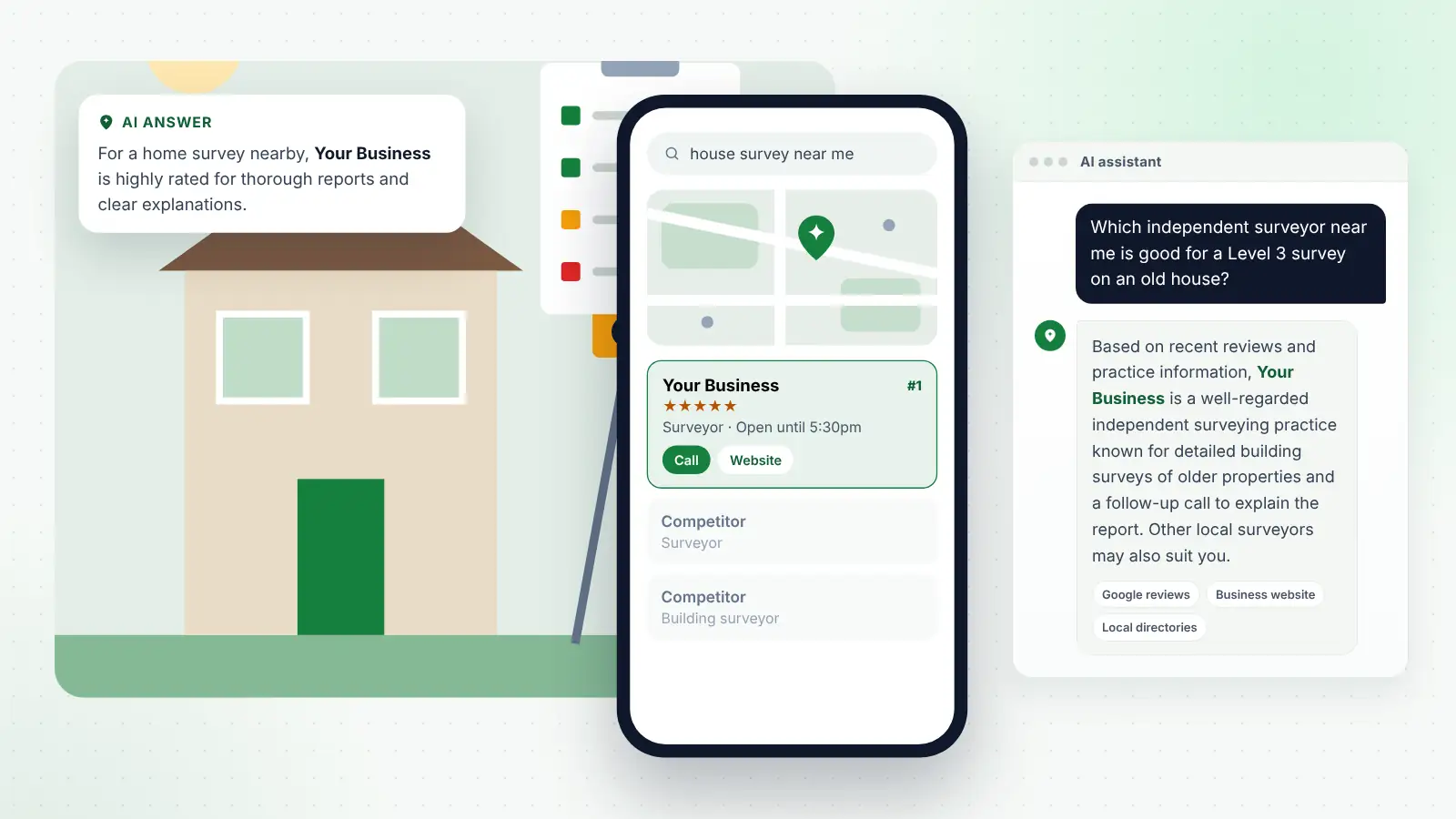
When a buyer’s offer is accepted, they often have only a few days to book a survey. Many go straight to Google and search for something like “house survey near me”, “level 3 survey [town]” or “party wall surveyor near me”. The practices at the top of the map results are far more likely to receive a quote request.
Local SEO is how a surveying firm earns a place, and a buyer’s confidence, in those map results. For a surveying practice, the essentials are:
- Google Business Profile. Choose “Surveyor” or a close match as the primary category, add relevant secondary categories, and list each service, your coverage area, opening hours and a quote link. Add real photos from inspections, with client permission and without showing anything personal.
- Reviews. Ask every client for a review after you have talked them through their report. Reviews that mention thoroughness, clear explanations and quick turnaround are particularly persuasive. Reply to every review politely, without discussing any property details.
- Consistent details. Your practice name, address and phone number should match exactly across your website, Google, Apple Maps, Bing and professional directories such as the RICS firm search.
- A website with service and area pages. Create separate pages for each survey level, building surveys of older homes, party wall services, probate valuations, Help to Buy valuations and any commercial work. Add pages for the main towns you cover, with genuinely local detail such as common property types and construction issues.
- Local links and mentions. Conveyancing solicitors, architects, builders, local property websites and community organisations can all lead to genuine mentions and links.
If you would rather spend your time inspecting and writing reports, some practices bring in specialist SEO for surveyors and surveying practices to handle profiles, listings and content. Either way, give it three to six months for map positions to firm up, longer if several practices already cover your towns.
How buyers ask AI tools to pick a surveyor
More buyers and homeowners are asking AI assistants for help before they book a survey. They type full questions into ChatGPT, Gemini, Perplexity, Microsoft Copilot or Google’s AI Overviews and receive a short answer that often names a few local practices.
The questions are usually more detailed than a typical search:
- “Which independent surveyor near me is good for a Level 3 survey on an old house?”
- “Do I need a Level 2 or Level 3 survey for a 1930s semi in [town]?”
- “Who can do a party wall award near [area] for a loft conversion?”
- “Where can I get an RICS valuation to repay my Help to Buy loan?”
- “Which surveyors near me do probate valuations quickly?”
An AI assistant recommending a surveyor pieces its answer together from sources it can compare. Answer engine optimisation (AEO) is about supplying dependable material about your practice for it to draw on:
- The same practice details everywhere. Keep your firm name, office address, survey types, RICS or RPSA status and the postcodes you cover identical on your site, Google profile and surveying directories.
- Clear service descriptions. Explain each survey and valuation in plain English, including who it is for and what it does not cover.
- Helpful FAQs. Answer the questions clients actually ask, such as how long a survey takes, when the report arrives and what happens if serious defects are found.
- Real client reviews. Assistants tend to pull out recurring points, so a regular flow of reviews mentioning clear reports and follow-up calls carries weight.
- Mentions on reputable sites. Professional directories, local news, property websites and partner firms all help AI tools treat your practice as an established local option.
You can check where you stand by asking a few AI assistants the questions above for your own area. Note which practices are named and what information the tools seem to rely on.
Build referrals and partnerships
Online search finds you one-off buyers; professional contacts tend to supply repeat instructions year after year. Useful partners include conveyancing solicitors, probate and estate administration firms, mortgage brokers, architects, builders and loft conversion specialists.
Be careful about relationships with estate agents. Many buyers want a surveyor who is clearly independent of the agent selling the property, and independence is a strong selling point for a small practice. Whatever arrangements you have, be transparent with clients and follow your professional body’s rules.
Tip
Write a short guide for local architects and builders explaining when party wall notices are needed and how the process works. It is useful to them, positions you as the expert and often leads to direct instructions.
Frequently asked questions
Do I need to be a chartered surveyor to carry out home surveys?
No. The protected element is the title and the RICS designations, not surveying itself. However, many clients, lenders and solicitors expect an RICS member, and some work, such as Red Book valuations and Help to Buy equity loan valuations, requires RICS qualification. The RPSA offers an alternative route for residential surveyors who are not RICS members.
What is the difference between a Level 2 and Level 3 survey?
A Level 2 survey suits most conventional homes in reasonable condition and can include a valuation. A Level 3 survey is more detailed and suits older, larger, altered or unusual homes, or buyers planning significant work. Explaining this clearly on your website helps buyers choose the right service.
How much professional indemnity insurance do I need?
RICS-regulated firms must hold at least the minimum limit of indemnity set by RICS, which depends on the previous year’s turnover and starts at £250,000 for firms with turnover up to £100,000. Many surveyors choose higher cover, and a specialist broker can advise on the right level for your work.
Can anyone act as a party wall surveyor?
The Party Wall etc. Act 1996 does not set out a formal qualification, but the surveyor cannot be one of the owners involved. Clients increasingly look for experience, membership of a relevant professional body and clear explanations of the process before they appoint someone.
How long does it take to build a steady flow of direct instructions?
It varies by area and specialism. Many independents rely on panels or referrals at first while they build reviews and visibility. Improvements to your Google profile and listings can help within weeks, but stronger map rankings and AI visibility usually build over three to six months.
Next steps
Starting a surveying practice is about getting the foundations right: choosing your professional route, understanding the standards that apply to each service, arranging insurance and complaints handling, and setting clear terms and fees. Once those are in place, steady growth usually comes from a combination of good reports, reliable turnaround, strong relationships and being easy to find.
Set up your Google profile, write clear pages for each service and ask every client for a review. Do that consistently and your practice will be well placed to appear when local buyers, homeowners and executors search for a surveyor they can trust.