Car wrapping, paint protection film and window tinting have grown from a niche enthusiast trade into a mainstream service. Owners wrap cars to change the colour without a respray, protect the paint on a new car with clear film, or add rear privacy tints. Businesses wrap vans in their livery so every journey works as advertising. The skills are learnable, the starting kit is modest compared with many motor trades, and good installers can earn well.
The challenge is that quality is hard to see at first glance. Poor preparation, overstretched film and badly finished edges often look fine on handover day and fail months later, while cheap installers using unbranded film set low price expectations. The studios that last are well trained, honest about what is legal, clear about films and warranties, and easy to find when people search locally.
This guide covers the practical steps, from training and setting up a unit to tint law, DVLA and insurance points your customers need to know, commercial fleet work, portfolio photography and winning bookings through local search and AI tools.
Key points
- Get proper hands-on training and consider manufacturer certification, because film warranties and customer trust often depend on it.
- A clean, warm, well-lit and dust-controlled unit makes a bigger difference to wrap and PPF quality than almost any tool.
- Front window tints are tightly limited in law: for most vehicles the windscreen must let through at least 75% of light and the front side windows at least 70%.
- Remind customers that a colour change wrap should be recorded on the V5C with DVLA and declared to their insurer.
- Fleet livery can bring steady repeat work, but it needs reliable scheduling, artwork approval and clear terms.
- A strong portfolio, a complete Google Business Profile and detailed reviews are what most customers check before they book.
In this guide
- Decide what kind of studio you want to run
- Get trained and consider manufacturer certification
- Set up your business and premises
- Understand UK window tint law
- Tell customers about DVLA and insurance after a wrap
- Win and manage commercial fleet livery work
- Pricing and quoting
- Build a portfolio that sells your work
- Local SEO for wrap and tint studios
- AI search and AEO for wrap and tint studios
- Keep customers and grow referrals
- Frequently asked questions
- Next steps
Decide what kind of studio you want to run
Most businesses in this trade offer a mix of services, but it helps to decide where your focus will be, because the training, equipment and customers differ.
Colour change and styling wraps
Full colour changes, partial wraps such as roofs and mirrors, and dechroming are the most visible work. A full wrap typically takes a few days including preparation, and this is where your portfolio matters most.
Paint protection film
PPF is a thick, clear urethane film applied to the front end or the whole car to protect against stone chips and light scratches. It is less forgiving than vinyl, needs precise cutting or pre-cut patterns, and is often sold alongside ceramic coatings to owners of new and high-value cars.
Window tinting
Tinting is quicker per job and often booked at short notice. Most automotive work is rear privacy tint, and it is the service where you most need to understand the law.
Commercial livery
Van and fleet graphics range from cut vinyl lettering to full printed wraps. It needs design and print capability or a trusted print partner, and can bring regular work from local businesses.
| Service | Typical customers | What it needs | Watch out for |
|---|---|---|---|
| Colour change wraps | Enthusiasts, new car owners | Skilled installers, clean unit, good lighting | Edges, seams and long jobs tying up space |
| PPF | New and prestige car owners | Precise cutting or pattern software, dust control | Contamination, expensive film waste |
| Window tinting | Everyday drivers, van owners | Clean bay, tint meter, heat gun | Front window legal limits |
| Fleet livery | Trades, local businesses | Design, print or print partner, scheduling | Artwork approval, payment terms |
Get trained and consider manufacturer certification
There is no legal qualification needed to wrap or tint vehicles in the UK, but this is a hands-on skill. A structured course with experienced trainers, real panels and feedback on your technique saves expensive mistakes on customers’ cars.
Several of the major film manufacturers run training and certification programmes for installers. These usually involve practical tests on panels and a written element, and successful installers may be listed in the manufacturer’s installer finder. Some brands only offer their full or extended film warranties when the film has been fitted by a certified or approved installer, so check the terms for each film you plan to use.
When you choose films, look at:
- Warranty terms. What is covered (fading, cracking, peeling, adhesive failure), for how long, whether it covers horizontal and vertical surfaces differently, and whether labour is included.
- Registration. Whether you need to register each installation with the manufacturer for the warranty to apply.
- Removability. How cleanly the film comes off after a few years, which matters to customers protecting their paint.
Tip
Keep a simple job record for every installation: the vehicle, the film brand and batch, the panels covered, the date and any existing paint defects you noted. It makes warranty claims straightforward and protects you if a customer disputes damage later.
Set up your business and premises
Business structure and insurance
Many installers start as sole traders registered for Self Assessment with HMRC, while others set up a limited company. An accountant can help you weigh up the differences and when VAT registration applies.
Insurance needs careful attention. You will usually need public liability insurance, cover for customers’ vehicles while they are in your care (including damage, fire and theft), and motor trade road risks if you or your staff will drive customers’ cars. Standard liability policies may not cover the vehicle you are working on, so use a broker who understands the motor trade.
Choosing a unit
Dust, cold panels and poor light all show up in the finished work. A good unit has:
- Enough space to walk fully around the car with doors open.
- Bright, even lighting, ideally with additional light you can move around the car.
- Heating, because films are harder to work with and adhesives behave differently in a cold workshop.
- Sealed floors and walls that can be cleaned to keep dust down, plus secure storage.
Check with your local council planning team that vehicle work is a permitted use for the unit before signing a lease, and confirm with your landlord what alterations you can make.
Equipment and running costs
Starting kit is modest: squeegees, knives and knifeless tape, heat guns, an infrared thermometer, preparation products and a tint meter. PPF studios often add plotter cutting and pattern software. The bigger ongoing costs are film, waste while learning, rent and insurance, which vary by area.
Understand UK window tint law
This is the area where a responsible installer stands out. In Great Britain, for vehicles first used on or after 1 April 1985, the front windscreen must let at least 75% of light through and the front side windows (the windows either side of the driver and front passenger) must let at least 70% through. The rules do not apply to the rear windscreen or rear passenger windows, which is why most legal automotive tinting is to the rear.
Police and vehicle examiners can check tints with a light meter. If the front windows are too dark, the driver can be given a prohibition notice that stops the vehicle being used on the road until the tint is removed, and may face a fixed penalty or a court summons.
Many customers miss that factory glass already blocks some light, so even a light film can take front glass below the limit. Measuring before quoting is part of doing the job properly.
Licensed taxis and private hire vehicles are a separate case. Many councils set their own window tint policies as part of vehicle licensing, and some are stricter than the general rules. If a driver asks you to tint a licensed vehicle, ask them to check their council’s licensing policy first.
Tip
Put a short, plain explanation of front window tint limits on your website and quote sheets. Customers trust a studio that tells them what is legal, and it gives you a clear, polite reason to turn down work that would put their car off the road.
Tell customers about DVLA and insurance after a wrap
When a vehicle’s main colour changes, the keeper should update the colour on the vehicle log book (V5C), and DVLA lists colour among the changes you must report on the GOV.UK page about changing vehicle details on your V5C. The guidance does not mention wraps specifically, but if a wrap changes the main colour of the vehicle, the safest course is for the keeper to update the V5C, even though the wrap can be removed later. Partial wraps, roof wraps, PPF and tints that leave the main colour unchanged do not usually change what is shown on the V5C.
Insurance is just as important. Many insurers treat a colour change wrap as a modification, and window tints, livery and other changes may also need declaring. A customer who does not tell their insurer risks problems with a claim.
Updating the V5C and insurance is the customer’s responsibility, but a short note on your invoice or aftercare sheet is a simple, helpful touch.
Win and manage commercial fleet livery work
Fleet work can steady your income in a way that one-off private jobs cannot. A local plumber, electrician or delivery firm adding vans to their fleet, or rebranding their whole fleet, may come back to you for years.
To win and keep it:
- Make artwork approval formal. Send a clear proof showing every side of the vehicle and get written sign-off before printing. Spelling mistakes in phone numbers are expensive on twelve vans.
- Plan around the customer’s working week. Businesses lose money when vans are off the road, so offer early drop-offs, weekend slots or work in batches.
- Agree terms up front. Deposits, payment terms and what happens with removal of old graphics should be agreed in writing before work starts.
- Offer removal and replacement. Leased vans often need graphics removed before they go back, which is useful additional work.
- Keep templates. Saving each vehicle’s artwork and measurements makes repeat orders quick and consistent.
Partnerships with local sign makers, print companies and van dealers can bring livery referrals, especially if you offer services they do not.
Pricing and quoting
Explaining what each quote includes helps you win on quality rather than price alone.
- Quote by vehicle size and complexity. A small hatchback and a large SUV with complex bumpers involve very different amounts of time and film.
- Name the film. State the brand and range, the finish and the warranty in every quote.
- Inspect before confirming. Existing paint chips, poor resprays and failing lacquer can be lifted by film on removal. Note them and agree how they will be handled.
Prices vary widely by area, vehicle and film, so research local competitors and calculate your own costs rather than copying a national price list.
Build a portfolio that sells your work
Photos do most of the selling, and careful buyers look closely at the details.
- Shoot in good light. Overcast daylight or diffused studio lighting shows colour accurately. Harsh sunlight and dark corners hide the finish.
- Show the details. Close-ups of tucked edges, door shuts, mirror caps and bumper recesses prove your standard better than wide shots alone.
- Take before-and-after pairs. Photograph each car from the same angles before and after the work.
- Name the film and finish. Captions such as “satin dark grey, full colour change” help customers choose and help search engines and AI tools understand what you do.
- Use your own photos, with permission. Check customers are happy for their car to appear, and never present other studios’ images as your work.
Short installation videos and time-lapses also help customers understand the skill involved.
Local SEO for wrap and tint studios
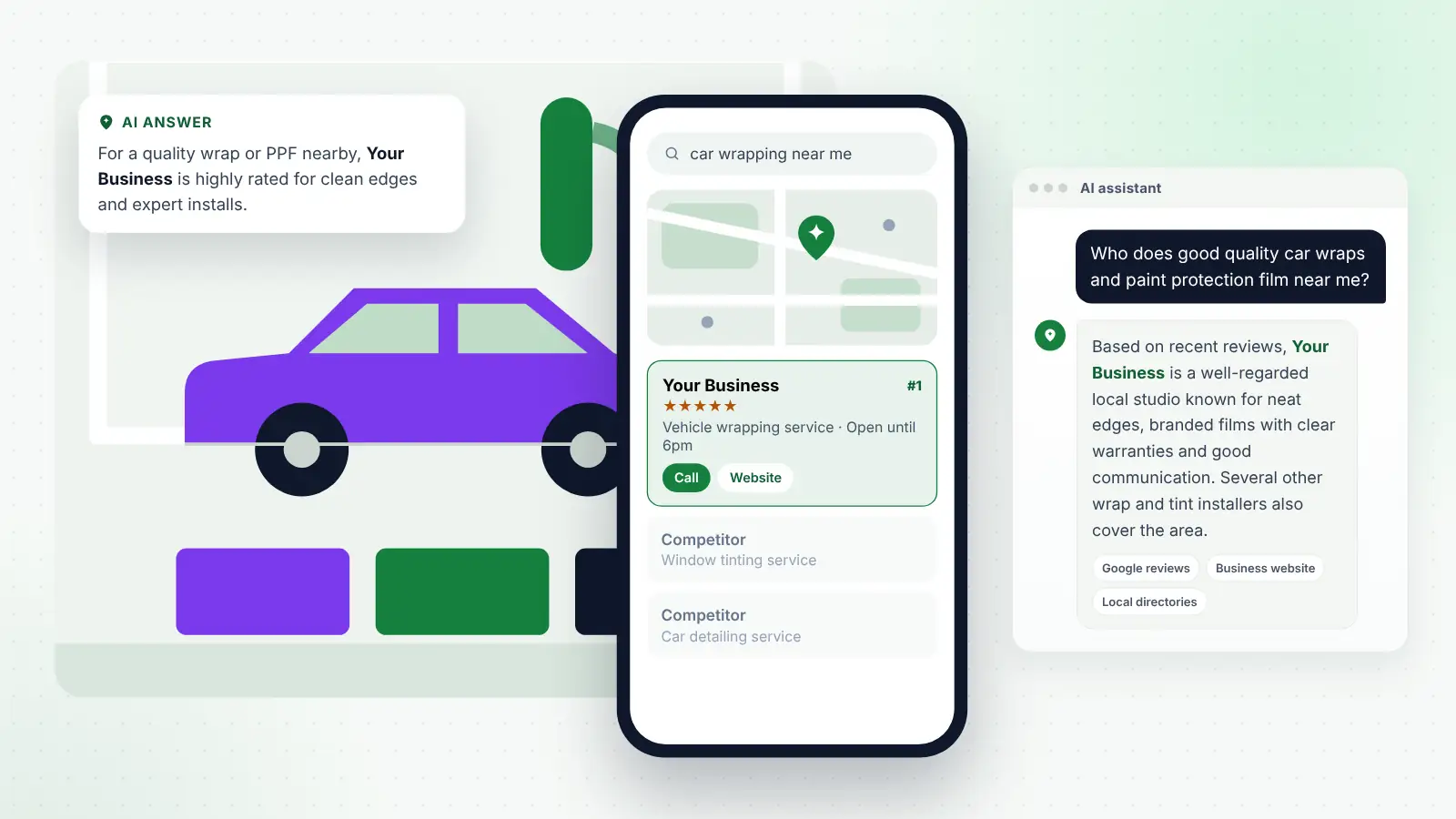
Most customers start with a search such as “car wrapping near me”, “window tinting Leeds”, “PPF installers near me” or “van livery Bristol”. They compare businesses on the map, check photos and reviews, and contact two or three.
For a wrap and tint studio, local SEO comes down to:
- A complete Google Business Profile. Choose the most accurate primary category, add secondary categories for tinting or graphics where relevant, list each service, set accurate opening hours and add a steady stream of real photos of your studio and finished cars.
- Steady, detailed reviews. Ask every happy customer for a review and encourage them to mention the car, the service and the finish, such as “full satin black wrap on my Golf” or “front-end PPF on a new Model 3”. Reply to every review politely.
- Consistent details everywhere. Your business name, address and phone number should match across your website, Google, Apple Maps, Bing Places, directories and any manufacturer installer finders.
- A website with a page for each service. Separate pages for colour change wraps, PPF, ceramic coatings, window tinting and commercial livery, each explaining the process, films, warranties, time required and aftercare.
- Local links and mentions. Car clubs, local car shows, business directories, partner dealers and local news coverage of interesting projects all help.
This takes consistent effort over months. If you would rather focus on installs, you can have specialists handle local SEO for car wrapping and window tinting studios while you concentrate on the work.
AI search and AEO for wrap and tint studios
More customers now ask AI assistants for recommendations and advice before they book. People ask ChatGPT, Gemini, Perplexity, Copilot and Google AI Overviews questions such as “who does good car wraps near me?”, “is 35% tint legal on front windows in the UK?”, “how long does PPF last?” or “do I need to tell DVLA if I wrap my car?”.
Assistants recommend studios whose details they can find and confirm in several places online. To give your studio the best chance of being recommended:
- Keep information consistent. The same name, address, services and opening hours everywhere make it easier for AI tools to identify your business with confidence.
- Describe services clearly. State exactly what you offer, the film brands you use, the finishes available and the areas you cover.
- Answer real questions. FAQ sections on tint law, DVLA and insurance, warranty terms, aftercare and how long jobs take give AI tools accurate, quotable answers.
- Earn detailed reviews. Reviews that mention specific services and cars help AI tools understand what you are known for.
- Get mentioned on reputable sites. Listings in manufacturer installer finders, coverage on local news sites and mentions by car clubs and partners add weight.
Accuracy matters most on tint questions, where an honest explanation of the limits makes you a more reliable source.
Keep customers and grow referrals
Give every customer written aftercare guidance on washing and how to raise a concern, and offer a free check-up a few weeks after a wrap or PPF install to catch any lifting early. Detailers without PPF or tinting, car dealers, body shops and car clubs are all good sources of referrals.
Frequently asked questions
Do I need a qualification to wrap or tint cars?
No formal qualification is legally required in the UK. Proper hands-on training is strongly advised, and certification from the film manufacturers you use can help you access their warranties and reassure customers.
What tint percentage is legal on front windows?
For most vehicles first used on or after 1 April 1985, the windscreen must let at least 75% of light through and the front side windows at least 70%. Because factory glass already reduces light, measure before fitting anything to the front.
Does a customer need to tell DVLA about a wrap?
If a wrap changes the main colour of the vehicle, the keeper should update the colour on the V5C. They should also tell their insurer, as insurers often treat a colour change wrap as a modification.
How long before a new wrap studio shows up in searches?
Improvements to your Google Business Profile and listings can help within weeks. Stronger map rankings and visibility in AI answers usually build over three to six months of consistent work.
Next steps
Start with proper training, the right insurance, a suitable unit and a small range of films you know well. Be honest about tint law, help customers with the DVLA and insurance points, and treat every job as a portfolio piece. Then make sure customers can find you through a complete Google Business Profile, steady reviews and clear service pages.