Stonework is built to outlast the people who commission it. A well-laid dry stone wall can stand for generations, a good lime repair lets an old house breathe for decades, and a carved fireplace becomes part of a home’s story. Customers sense this, which is why they take their time choosing a stonemason and why a poor choice, such as hard cement pointing or aggressive cleaning, can do damage that takes years to undo.
Most masonry businesses grow through word of mouth, architects and surveyors. That still matters. But owners of period homes, farms, churches and listed buildings now usually start with a search on their phone, a look at photos and reviews, or a question to an AI assistant. The masons who grow are the ones whose skill, materials knowledge and credentials are easy to see before the first site visit.
This guide is for established stonemasons, dry stone wallers and stone restoration firms who want more of the right work: from lime and consents to church projects, safety, tax, pricing and being found online.
Key points
- Customers choose a stonemason on trust, so show real photos of finished work, your materials knowledge and your credentials clearly.
- Explaining why lime usually suits older buildings, and why harsh cleaning can damage stone, sets you apart from cheaper general builders.
- Listed buildings, conservation areas and Church of England churches have their own permissions, and helping clients understand them early prevents costly delays.
- Credentials such as CSCS heritage skills cards, Stone Federation Great Britain membership and DSWA certification reassure owners and specifiers.
- Silica dust control, the Construction Industry Scheme and clear written quotes are part of running a professional, sustainable business.
- Local search and AI assistants increasingly shape who gets asked to quote, so consistent details, helpful content and genuine reviews matter.
In this guide
- What customers are really buying
- Credentials that build trust
- Lime, cement and doing right by older buildings
- Listed buildings, conservation areas and consent
- Church work: faculties and the DAC
- Pricing and quoting with confidence
- Health and safety: silica dust
- Money matters: CIS and getting paid
- Winning work through partners
- Local SEO for stone house owners
- AI search: what assistants tell your customers
- Frequently asked questions
- Final thoughts
What customers are really buying
Very few homeowners can judge a mortar mix or tell oolitic limestone from sandstone. What they notice, and what decides who gets the job, is simpler:
- Whether you understood the building. Owners of old houses want someone who asks about its age, stone and history before suggesting a fix.
- Whether the work will look right. Matching stone, joints and colour matter as much as structural soundness.
- Whether you handled permissions sensibly, rather than shrugging them off or overcomplicating them.
- Whether the site was safe and tidy, and whether you turned up when you said you would.
Architects and surveyors look for the same things, plus method statements, insurance and evidence of training.
Credentials that build trust
Stonemasonry is not licensed by law, which is exactly why recognised training and memberships matter.
CSCS cards and heritage skills
The Construction Skills Certification Scheme (CSCS) card is widely required on commercial and public sites. CSCS also offers heritage skills cards for traditional crafts, including stonemasonry, generally aimed at craftspeople with an advanced-level heritage qualification. If your team hold them, say so on your website and quotes: they are one of the clearest signals to a conservation architect.
Stone Federation Great Britain
Stone Federation Great Britain is the national trade association for the natural stone industry, with members across quarrying, processing, fixing, masonry and restoration. It publishes technical guidance, supports training through StoneTrain and runs the Natural Stone Awards.
The Dry Stone Walling Association
For wallers, the Dry Stone Walling Association (DSWA) runs a Craft Certification Scheme with practical tests at Levels 1, 2 and 3 and the Master Craftsman qualification. Holding Level 2 is the requirement to join the DSWA’s register of professional wallers, which many farmers, estates and landowners check. Levels 1 to 3 are also recognised Lantra qualifications.
Insurance and paperwork
Public liability insurance, employer’s liability insurance if you employ anyone, and clear risk assessments and method statements are basic expectations. Mention your cover on quotes.
Tip
Write a short “Our credentials” page listing your qualifications, cards, memberships and insurance, with a sentence explaining what each one means. Customers read it, architects check it, and AI assistants can quote it accurately.
Lime, cement and doing right by older buildings
One of the most useful things you can explain to customers is why the mortar matters. Most buildings constructed before the early twentieth century were built with lime mortars and are designed to manage moisture by letting it evaporate through joints. Hard, dense cement mortars and cement renders can trap moisture, so water escapes through the stone instead. Over time this can cause spalling, frost damage and erosion of the stone faces, which are far harder and more expensive to repair than joints.
The guiding principle in conservation guidance is that mortar should be softer and more permeable than the stone, so the joint is sacrificial and can be renewed.
| Question | Lime mortar | Cement mortar |
|---|---|---|
| Typical use | Historic and traditional solid-wall buildings | Modern cavity walls and new construction |
| Breathability | Allows moisture to evaporate through joints | Much less permeable |
| Flexibility | Accommodates slight movement | Rigid and prone to cracking around soft stone |
| Effect on old stone | Joint wears first and can be renewed | Can push damage into the stone |
| Working season | Needs protection from frost and fast drying | Less sensitive, but still weather-dependent |
Explaining this calmly helps customers understand why your quote may be higher than a builder’s.
Cleaning and repair without causing damage
Stone cleaning is where well-meant work most often goes wrong. Historic England’s guidance on caring for historic masonry consistently favours the gentlest method that will do the job, trial areas before full cleaning, and repairs that retain as much original material as possible. Abrasive blasting can strip a stone’s protective surface and blur carved detail, high-pressure water can drive moisture deep into a wall, and the wrong chemical cleaner can stain or weaken stone.
On your website, describe the methods you use, how you test before cleaning, and when you would advise leaving a weathered surface alone.
Listed buildings, conservation areas and consent
Much rewarding stonework is on listed buildings. Listed building consent is needed for works that affect a building’s character as a building of special architectural or historic interest. Councils advise that cleaning, significant repairs and changes of materials can all need consent, while like-for-like maintenance may not, and that each case is judged individually. Carrying out work that needed consent without it is a criminal offence, and both owners and contractors can be held responsible.
In practice, a few habits make listed work smoother:
- Ask early whether the building is listed or in a conservation area, and check the official list.
- Suggest the owner speaks to the council’s conservation officer before detailed pricing.
- Prepare a clear method statement covering materials, mortar mixes and cleaning methods.
- Keep photos before, during and after the work.
- Never say consent is not needed unless the council has confirmed it in writing.
The rules differ in Scotland, Wales and Northern Ireland, so if you work across borders, check each authority’s guidance.
Church work: faculties and the DAC
Churches are a significant source of skilled stonework. Church of England churches are generally covered by the ecclesiastical exemption, so instead of listed building consent, works are controlled through the faculty system.
A faculty is a formal permission granted by the diocese. Each diocese has a Diocesan Advisory Committee (DAC), which advises parishes on what is likely to be approved and what permissions are needed. Routine maintenance on List A may not need a faculty at all, some works on List B need the archdeacon’s written permission, and anything else usually needs a faculty. The Church of England’s own guidance is clear that parishes should talk to their DAC early and never start work before permission is in place.
For a mason, that means:
- Expect longer lead times, often months from first conversation to start on site.
- Work with the church architect, who usually specifies significant work.
- Provide clear documentation, such as method statements and sample panels.
- Be patient with volunteers, as churchwardens balance many demands.
Other denominations have their own arrangements.
Pricing and quoting with confidence
Customers rarely know what stonework costs, or why a specialist’s quote differs from a builder’s. Clear, itemised quoting helps you win on value.
| Job type | What affects the price | What helps the customer |
|---|---|---|
| Lime repointing | Area, joint condition, access, scaffolding, mortar matching | Explaining raking out depth and why lime is used |
| Dry stone walling | Length, height, stone supply, ground, how much is reusable | A price per metre range with clear assumptions |
| Stone repair | Matching stone, indents versus mortar repairs, carving | Photos of similar repairs and options explained |
| Stone cleaning | Method, trial areas, protection, consents | A note on trial patches and gentle methods |
| Fireplaces and features | Stone, design, carving, fitting, hearth requirements | Drawings, samples and a fixed design fee |
Prices vary by region, stone and access, so present any figures as guides. Follow each survey with a written quote setting out scope, materials, exclusions, payment stages and waste handling.
Tip
Include one or two lines in every quote explaining your material choices, such as “hydraulic lime mortar matched to the existing joints”. It shows expertise and makes like-for-like comparisons with cheaper quotes much easier.
Health and safety: silica dust
Cutting, dressing, grinding and polishing stone can release respirable crystalline silica, which can cause silicosis, chronic obstructive pulmonary disease and lung cancer. Silicosis can develop before symptoms appear and may keep worsening after exposure stops. The HSE has specific guidance for stoneworkers, and a well-run business treats it as non-negotiable.
The HSE’s guidance for stone work emphasises controlling dust at source first:
- Water suppression and on-tool extraction when cutting and grinding, with the equipment checked before use.
- Good housekeeping, cleaning with water or a suitable industrial vacuum rather than dry sweeping or compressed air.
- Respiratory protective equipment (RPE) where needed, with an assigned protection factor of at least 20 for many stone tasks.
- Face fit testing for tight-fitting masks, and wearers being clean shaven where the mask seals.
- Health surveillance for workers regularly exposed to silica dust.
Mentioning your dust controls in method statements reassures commercial clients.
Money matters: CIS and getting paid
If you work for builders or main contractors, you are likely to be covered by the Construction Industry Scheme (CIS). Under CIS, contractors deduct money from subcontractors’ payments and pass it to HMRC as advance payments towards tax and National Insurance. Registered subcontractors usually have 20% deducted, unregistered subcontractors 30%, and businesses that meet HMRC’s conditions can apply for gross payment status so nothing is deducted.
Work done directly for private homeowners generally falls outside CIS. Ask your accountant to review your position and keep CIS statements carefully.
Winning work through partners
Referrals remain one of the most reliable sources of good stonework. Partners worth building relationships with include:
- Conservation architects and building surveyors, who specify repairs.
- Roofers and scaffolders, who often spot failing chimney stacks and copings first.
- Landscape designers, who need walling, steps and paving.
- Estates, farms and land agents, who manage long runs of walling.
A tidy site with a sign, where the owner agrees, often leads to enquiries from neighbours with similar houses.
Local SEO for stone house owners
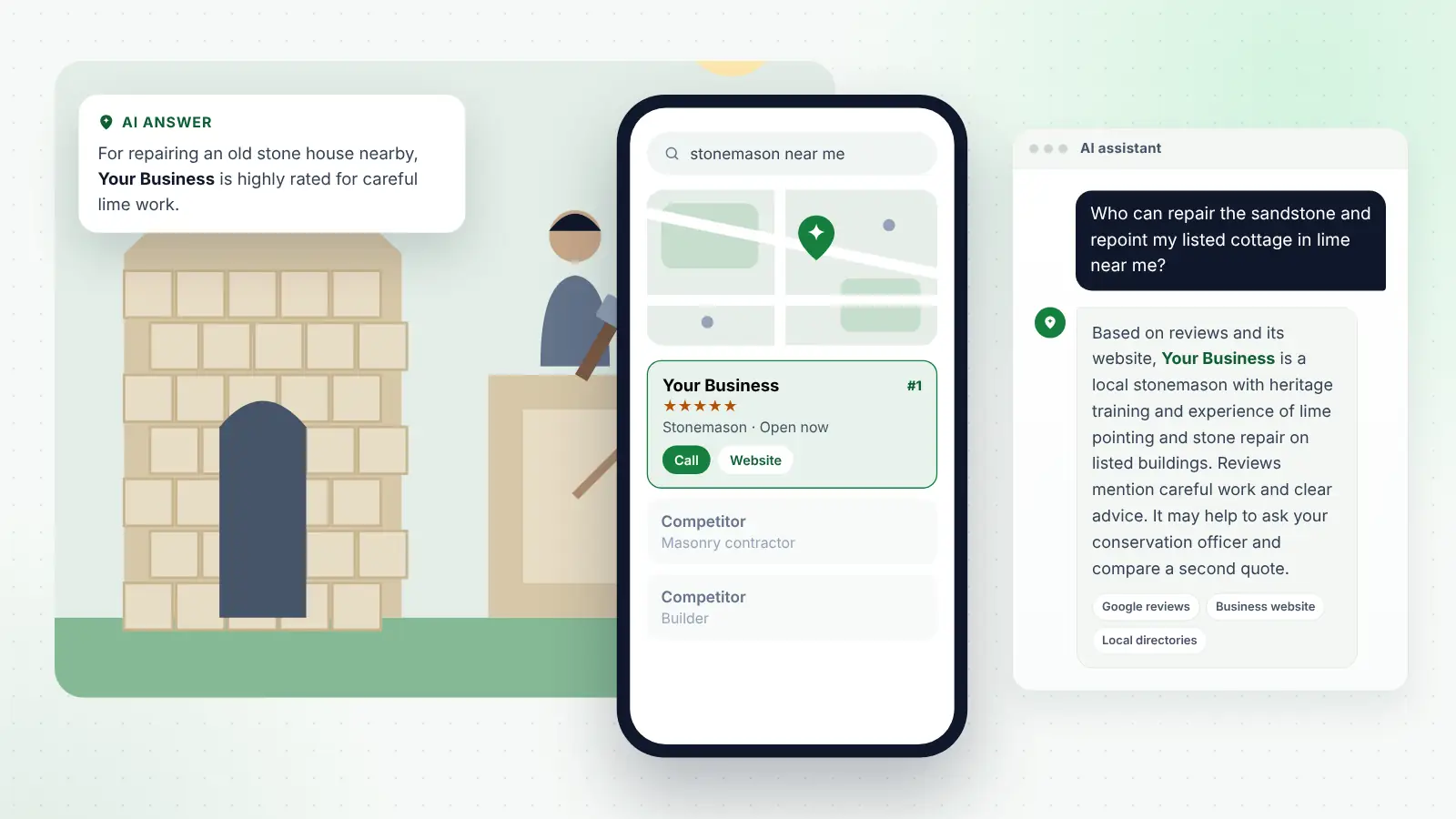
Stonework searches are local. People type “stonemason near me”, “dry stone waller [area]”, “lime pointing [town]”, “stone cleaning company” or “stone fireplace maker”, and they compare two or three businesses on the map before deciding who to contact.
Your masonry Google profile
Choose “Stonemason” or the closest available category as your primary category, and add relevant secondary categories that genuinely describe your work. Set your service area to the towns and villages you cover, list each service separately and add regular photos of finished walls, repairs, carving, fireplaces and your workshop or yard. Mention your memberships, heritage training and lime experience in your description.
Reviews and matching listings
Ask happy customers for a review once the work is complete, and encourage them to mention the type of job, the stone and the location. Keep your business name, address, phone number and website identical on Google, Apple Maps, Bing, Stone Federation and DSWA listings and other directories. Never write, buy or incentivise reviews: it breaches platform rules, and fake reviews are banned under UK consumer law.
Service and area pages
Give each main service its own page, such as lime pointing, stone repair, dry stone walling, stone cleaning, fireplaces and church work, and add pages for the main areas you serve. Pages that mention the local stone, such as Cotswold limestone, Yorkshire gritstone or Bath stone, can answer the exact questions owners search for.
Local links and mentions
Mentions on local history, civic society and community websites, local news coverage of notable restorations, and trade and heritage directory listings show search engines you are an established local business.
Local SEO builds gradually, usually over three to six months, and no one can promise a particular position. If you would rather spend your time on site and in the workshop, specialist local SEO for stonemasons and stone restoration firms can look after your profile, listings, content and links for you.
AI search: what assistants tell your customers
More people now ask AI assistants for help before they contact a tradesperson. Someone might ask ChatGPT “Should my stone cottage be repointed in lime or cement?”, ask Gemini “Who can rebuild a dry stone wall near me?”, ask Copilot “Do I need listed building consent to clean my stone house?” or ask Perplexity “What does a stone fireplace cost?”. Google’s AI Overviews also appear for many of these searches.
AI tools try to give careful answers, so they rely on clear, consistent information from several sources. For a stonemason, that typically means:
- Plain explanations of your methods, such as lime pointing and gentle cleaning.
- Consistent business details across your website, Google profile and trade listings.
- Clear credentials and genuine reviews describing the work and the care taken.
- FAQs answering real questions, such as when walling can be done.
- Mentions on reputable sites, such as heritage directories and local news.
This is often called answer engine optimisation, or AEO: be clear, consistent and accurate, and assistants can describe you correctly.
Tip
Ask an AI assistant “who are the stonemasons near [your town] who work with lime?” If your business is missing or described wrongly, review your Google profile, credentials page and service pages first.
Frequently asked questions
Do stonemasons need a licence?
There is no general legal licence. CSCS cards, heritage training, Stone Federation membership and DSWA certification are the usual ways to show competence.
Is listed building consent needed for repointing?
It depends on the building and the work. Like-for-like repointing in matching lime may not need consent, but changing materials, extensive repointing or cleaning can. Ask the owner to check with the council’s conservation officer before work starts.
How do faculties work for church stonework?
For Church of England churches, the parish usually applies to the diocese, guided by the DAC. Minor maintenance may fall under List A or List B, while larger repairs normally need a faculty. Allow plenty of time.
When is the best time of year for lime work?
Lime needs protection from frost and fast drying, so external lime work is usually planned between spring and early autumn.
How should I handle quotes that are much cheaper than mine?
Explain your materials, methods and what is included, and show similar finished work.
Final thoughts
The stonemasons who grow steadily understand the buildings they work on, explain their methods honestly, handle consents carefully and leave work that looks as if it has always been there.
The task now is to make that craft visible before the first site visit. Clear credentials, plain guidance on lime and permissions, honest quotes and genuine reviews help owners, specifiers and AI assistants find you and describe you accurately.