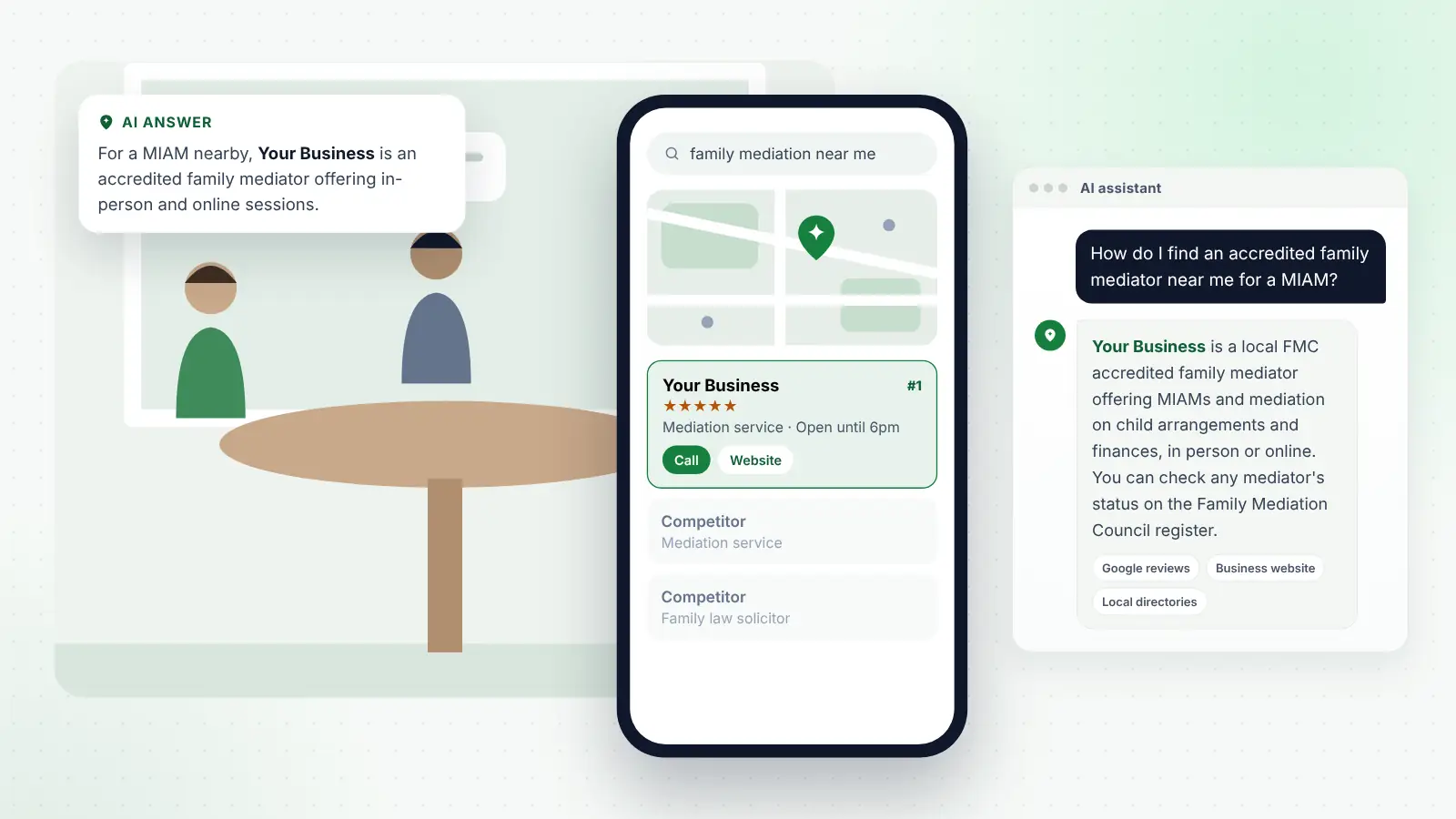
Most people who contact a family mediator have never needed one before. They are usually in the middle of a separation, worried about their children or their home, and often unsure what mediation is or why a solicitor or a court form has told them to attend a MIAM. The way your practice presents itself in those first few minutes, on a search results page, a directory or your own website, has a real bearing on whether they make contact at all.
Growing a mediation practice is not like growing most businesses. You cannot promise results, and you must remain impartial between two people who may not trust each other. Good marketing for a mediator is about being clear, calm and accurate, so that both parties can see you are qualified and feel able to take the first step.
This guide covers building a UK family mediation practice as of October 2026: accreditation, MIAMs and the April 2024 court rule changes, legal aid and voucher funding, the services families search for, referrals, and how people find mediators through search and AI assistants. Rules and funding arrangements change, so check the current position with the Family Mediation Council, your member body and gov.uk.
Key points
- In England and Wales, FMC accreditation (FMCA) is the key credential, and only an accredited mediator can sign the court form confirming that someone has attended a MIAM.
- Changes to the Family Procedure Rules from 29 April 2024 reduced MIAM exemptions, widened the range of non-court options mediators must explain and gave courts more power to adjourn cases so parties can try them.
- The Family Mediation Voucher Scheme, worth up to £500 towards mediation on child-related disputes, has continued into the 2026 to 2027 financial year, but vouchers are limited and funding is confirmed year by year.
- Legal aid can cover MIAMs and mediation for eligible clients, and if one person qualifies, the other person’s MIAM and first joint session are also covered.
- People search for specific help, such as “MIAM near me” or “child arrangements mediation”, so build your visibility around each service and explain funding clearly.
- Never imply that mediation guarantees an agreement or outcome; describe the process honestly and stay visibly impartial.
In this guide
- Get your accreditation and register details right
- MIAMs and the April 2024 changes
- Funding: legal aid and the voucher scheme
- Shape the services families search for
- Scotland and the rest of the UK
- Fees and first contact
- Local SEO for family mediators
- How AI assistants answer questions about separation
- Grow referrals from solicitors and support services
- Common mistakes to avoid
- Frequently asked questions
- Final thoughts
Get your accreditation and register details right
In England and Wales, family mediation is overseen by the Family Mediation Council (FMC), which sets professional standards and keeps a public register of family mediators. The register is often the first thing a solicitor, a court officer or a careful client checks, so your entry needs to be accurate and match what you say everywhere else.
FMC accreditation
The fully qualified status is FMC Accredited Mediator, shown as FMCA. To reach it, a mediator completes approved foundation training, registers as working towards accreditation, builds a portfolio of supervised practice and has it assessed. Accreditation is renewed every three years, and mediators need the support of a Professional Practice Consultant (PPC) to remain on the register. The Law Society also offers its own Family Mediation Accreditation for solicitors and other legal professionals, which builds on FMC standards.
Status matters practically too. Only an FMC accredited mediator can sign the form confirming MIAM attendance, so mediators working towards accreditation cannot sign it themselves and should agree with their PPC how MIAMs are handled. The Legal Aid Agency recognises FMCA mediators as eligible for legal aid work, although providers also need a contract with the agency to offer it.
Tip
Use your status exactly as the FMC register shows it. Never describe yourself as accredited while you are still working towards accreditation, and update your website and directories the day your status changes.
Reread the FMC Code of Practice with your marketing in mind. Impartiality, confidentiality and the voluntary nature of mediation all shape what you can reasonably say.
MIAMs and the April 2024 changes
For many practices, MIAMs (Mediation Information and Assessment Meetings) are the main way new clients arrive. Anyone in England and Wales who wants to apply to court about children or finances usually has to attend a MIAM first, unless an exemption applies, such as where there has been domestic abuse. People attend separately, and one person can attend alone if the other will not take part. Gov.uk’s page on making child arrangements through mediation explains the process for parents.
The Family Procedure Rules changed on 29 April 2024 to put more emphasis on resolving disputes away from court. In summary:
- Fewer exemptions. The range of circumstances in which someone can skip a MIAM was narrowed.
- A wider conversation at the MIAM. Mediators must explain the benefits of non-court dispute resolution more broadly, including arbitration, collaborative law and neutral evaluation as well as mediation, and why each might or might not suit the case.
- More court involvement. Judges can adjourn proceedings so that parties can explore non-court options, without needing both parties to agree, and are expected to keep this under review as the case goes on.
- A new form. Parties must now file Form FM5 before certain hearings, setting out their views on non-court dispute resolution.
- Possible costs consequences. Failing to attend a MIAM or engage with non-court options without good reason can now be taken into account when the court decides costs.
For your practice, this means more people are being told to consider mediation, and many arrive confused or defensive, believing they are being forced into something. A calm page explaining what a MIAM is, what it is not and what happens afterwards can make a real difference.
Funding: legal aid and the voucher scheme
Cost is one of the first questions people ask, so explaining funding accurately is one of the most useful things your website can do.
The Family Mediation Voucher Scheme
The Ministry of Justice’s Family Mediation Voucher Scheme offers a one-off contribution of up to £500 per family towards mediation in England and Wales. It applies to disputes about children, and to financial matters only where there is also a dispute about a child. It is not means-tested, it does not cover the MIAM itself, and the mediator applies for the voucher on the family’s behalf.
In March 2026 the Ministry of Justice confirmed funding for the 2026 to 2027 financial year, which runs to the end of March 2027, but vouchers are limited and funding has been confirmed one year at a time. Check the FMC’s latest update before describing it, and never suggest every family is guaranteed a voucher.
Legal aid
Legal aid for mediation is means-tested and is only available through providers with a Legal Aid Agency contract. Where both people are eligible, it can cover the MIAM, mediation sessions and help applying for a consent order. Where only one is eligible, gov.uk says it covers the MIAM and first joint session for both, plus the eligible person’s further costs. That second point is often missed, and it can be the reason a hesitant ex-partner agrees to attend.
| Funding route | Who it can help | What to explain on your site |
|---|---|---|
| Legal aid | People on low incomes or certain benefits | Whether you hold a contract, and that the other person’s MIAM and first session can be covered |
| Voucher scheme | Families with a child-related dispute, any income | Up to £500, not for MIAMs, limited and subject to annual funding |
| Private fees | Everyone else | MIAM fee, session fees, how costs are usually shared |
| Scotland | Families in Scotland | Different arrangements; see the section below |
Shape the services families search for
People rarely search for “family mediation” in the abstract. They search for the problem in front of them. Organise your website and profiles around the main services you offer.
- MIAMs, including how quickly you can see someone and how the court form is provided.
- Child arrangements, such as where children live, time with each parent and holidays.
- Finances and property, including the family home, pensions, savings and maintenance, and the role of financial disclosure.
- Child-inclusive mediation. FMC guidance says children aged 10 and over should be offered the chance to have their voice heard directly if they wish, with younger children included where appropriate. Mediators who meet children need additional training, so only offer this if you are qualified to.
- Online and shuttle mediation, where people join by video or phone, or stay in separate rooms. Gov.uk confirms that sessions can be held remotely and that people do not need to be in the same room or call.
For each service, explain who it is for, what it costs and what happens at the end, including that mediated agreements are not legally binding on their own.
Scotland and the rest of the UK
If you practise in Scotland, or serve clients there online, the framework is different. There is no MIAM requirement of the kind that applies in England and Wales, although a sheriff or judge can ask parties to consider mediation. The bodies approved to accredit family mediators are Relationships Scotland, whose services focus mainly on parents and children, and the Law Society of Scotland, which accredits lawyer mediators, many of them members of CALM Scotland. Legal aid in Scotland is administered by the Scottish Legal Aid Board under its own rules, so check its guidance before describing funding. The Family Mediation Voucher Scheme does not apply.
Northern Ireland has its own arrangements too, so if you work online, say clearly which jurisdictions you can help with.
Fees and first contact
Publish your MIAM fee, joint session fee, typical session length and how costs are usually shared, so people can decide before they get in touch. Many put off calling for weeks, so make contact simple and say when you usually reply. When one person contacts you first, explain that you will also invite the other person and that you do not take sides.
Local SEO for family mediators
When someone is told they need a MIAM, they usually search straight away, often on a phone: “MIAM near me”, “family mediation Leeds”, “child arrangements mediation”, “mediation before court” or “online family mediation”. Local SEO is about making sure your practice appears clearly and accurately for those searches, with enough information for people to feel confident making contact.
National online providers compete heavily for these searches, but a local mediator can stand out by being specific, visibly accredited and honest about funding.
Google Business Profile
A Google Business Profile is what puts your practice on Google Maps. Google requires businesses to make in-person contact with clients during their stated hours, so an online-only service is not eligible. If you see clients at your own office, you can usually create a profile for it. If you rent rooms by the hour in someone else’s premises, check Google’s guidelines carefully, because ongoing services at a location you do not own or have authority to represent are excluded.
If you are eligible, choose an accurate primary category, such as “Mediation service”, set realistic hours, add accessibility information and a plain description of your services, and use calm photos of your rooms rather than stock images.
Reviews
Separation is private, and a public review can say more than a client intends, so many mediators choose not to ask for reviews at all. If you do, never pressure anyone, never offer an incentive and never write or arrange reviews yourself. Reply to any review briefly and neutrally, without confirming anything about the case, remembering that the other party may read it too.
Matching your FMC register entry everywhere
Your name, practice name, address, phone number and website should be identical on the FMC register, your member body’s directory, Google, family law directories and local listings. Inconsistent details make it harder for both people and search engines to trust that you are who you say you are.
Your website
Your website should include a page for each main service, a clear MIAM page, a funding page, an about page showing your accreditation, honest fees and a note signposting support for anyone concerned about their safety. Maintaining all this alongside a full diary takes time. If you would rather have specialists handle it, our service providing local SEO for family mediators is built around calm, accurate content and respect for confidentiality.
Local links and mentions
Being mentioned by respected local organisations signals to search engines that your mediation service is genuine. Useful sources include family solicitors you work with, local support organisations, community directories and articles for local publications explaining how mediation works.
Tip
Write your MIAM page for someone who is anxious and has never heard the term before. Explain it in the first two sentences, then answer the questions they are likely to have, in order.
How AI assistants answer questions about separation
Many people now ask AI assistants such as ChatGPT, Gemini, Perplexity, Copilot and Google’s AI Overviews about separation before they speak to anyone. Typical questions include “do I have to go to mediation before court?”, “what is a MIAM and how much does it cost?”, “can I get free mediation?”, “is mediation legally binding?” and “which family mediators near me offer online sessions?”.
AI assistants compare sources, so a mediator whose accreditation checks out and whose details agree everywhere is easier to recommend. That means:
- Consistent information across your website, Google profile, the FMC register and directories.
- Clear service descriptions, covering MIAMs, child arrangements, finances and whether you work in person, online or both.
- Verifiable accreditation, naming your FMC status and member body, or your Scottish accreditation.
- Accurate FAQs on funding, the court process and what happens if mediation does not lead to agreement.
- Mentions on reputable sites, such as professional bodies, solicitors and local organisations.
People often feel more comfortable asking a sensitive question privately, so a practice described clearly and accurately is more likely to be suggested when someone is ready to look for help.
Grow referrals from solicitors and support services
For most family mediators, referrals remain the backbone of the practice. Useful relationships include:
- Family solicitors, who advise clients about MIAMs and non-court options and often keep a short list of mediators they trust.
- Citizens Advice and local advice services, which help many people early in a separation.
- Family support organisations, children’s centres and separated parent programmes.
- Financial advisers and accountants, who are involved when property and pensions need dividing.
- Other mediators, who refer when they are full or have a conflict of interest.
Tell referrers what you offer, whether you hold a legal aid contract and how quickly you can see people. A reliable service for the people they send you keeps those relationships going.
Common mistakes to avoid
- Implying guaranteed outcomes. Never present “avoid court” or “reach agreement” as a promise. Mediation is voluntary and not every case resolves.
- Appearing to take sides. Wording about “protecting your rights” can deter the other party.
- Out-of-date funding information. Review voucher and legal aid details every few months.
- Ignoring safety. Explain that MIAM exemptions exist where there has been domestic abuse, and signpost support.
Frequently asked questions
Do people have to attend a MIAM before going to court?
In England and Wales, people applying to court about children or finances usually need to attend a MIAM first, unless an exemption applies, such as domestic abuse. Only an FMC accredited mediator can sign the form confirming attendance. Scotland has no equivalent requirement.
Is the Family Mediation Voucher Scheme still running?
As of October 2026, yes. The Ministry of Justice has confirmed funding for the 2026 to 2027 financial year, to the end of March 2027, offering up to £500 per family towards mediation on child-related disputes. Vouchers are limited and funding has been confirmed year by year, so check the FMC website for the latest position before you quote it.
Should I ask clients for Google reviews?
Think carefully. Many clients will not want their separation to be visible, and asking can feel inappropriate. Many mediators rely instead on clear accreditation, honest information and referrals. If you do ask, never pressure anyone and keep any replies neutral.
Are agreements made in mediation legally binding?
Not on their own. Mediation usually produces a summary of what has been agreed. Financial agreements are typically made legally binding through a consent order, often with a solicitor’s help, which is why many mediators work closely with family solicitors.
How quickly will more separating couples find my practice?
A tidier profile and matching register and directory entries can help within weeks. Ranking well on the map and being named by AI assistants for MIAM questions tends to take three to six months, depending on local competition.
Final thoughts
A family mediation practice grows on the same qualities that make good mediation: accuracy, impartiality and care for people at a difficult time. Get your accreditation, funding information and referral relationships right first. Then make it easy for separating families to find you, understand what happens next and take the first step when they are ready.