A beauty salon can be a rewarding business to build. Treatments such as nails, lashes, brows and facials bring clients back every few weeks, loyal clients recommend you to friends, and a well-run salon can grow from one treatment room to a busy team. It is also a competitive sector, and the rules vary depending on exactly which treatments you offer.
Many therapists start by working from home, renting a room or going mobile, then open their own premises once they have a steady client list. Whichever route you take, the salons that do well tend to plan their treatment menu carefully, understand which licences and registrations apply, price for profit rather than to undercut, and make it easy for new clients to find and trust them.
This guide covers the practical steps for opening a beauty salon in the UK, including the areas where local councils set the rules and the changes coming for aesthetics treatments. Where something depends on your area, it says so, so you know when to check with your council.
Key points
- Your treatment menu decides which council licences, training and insurance you need, so plan it before you sign a lease.
- Skin piercing treatments such as semi-permanent make-up, electrolysis and piercing usually need council registration, and London boroughs license a wider range of treatments.
- The government is consulting on restricting high-risk cosmetic procedures to qualified healthcare professionals in England and plans a wider licensing scheme, so anyone offering aesthetics should follow its progress.
- Botox is a prescription-only medicine and cannot be advertised to the public, including on social media.
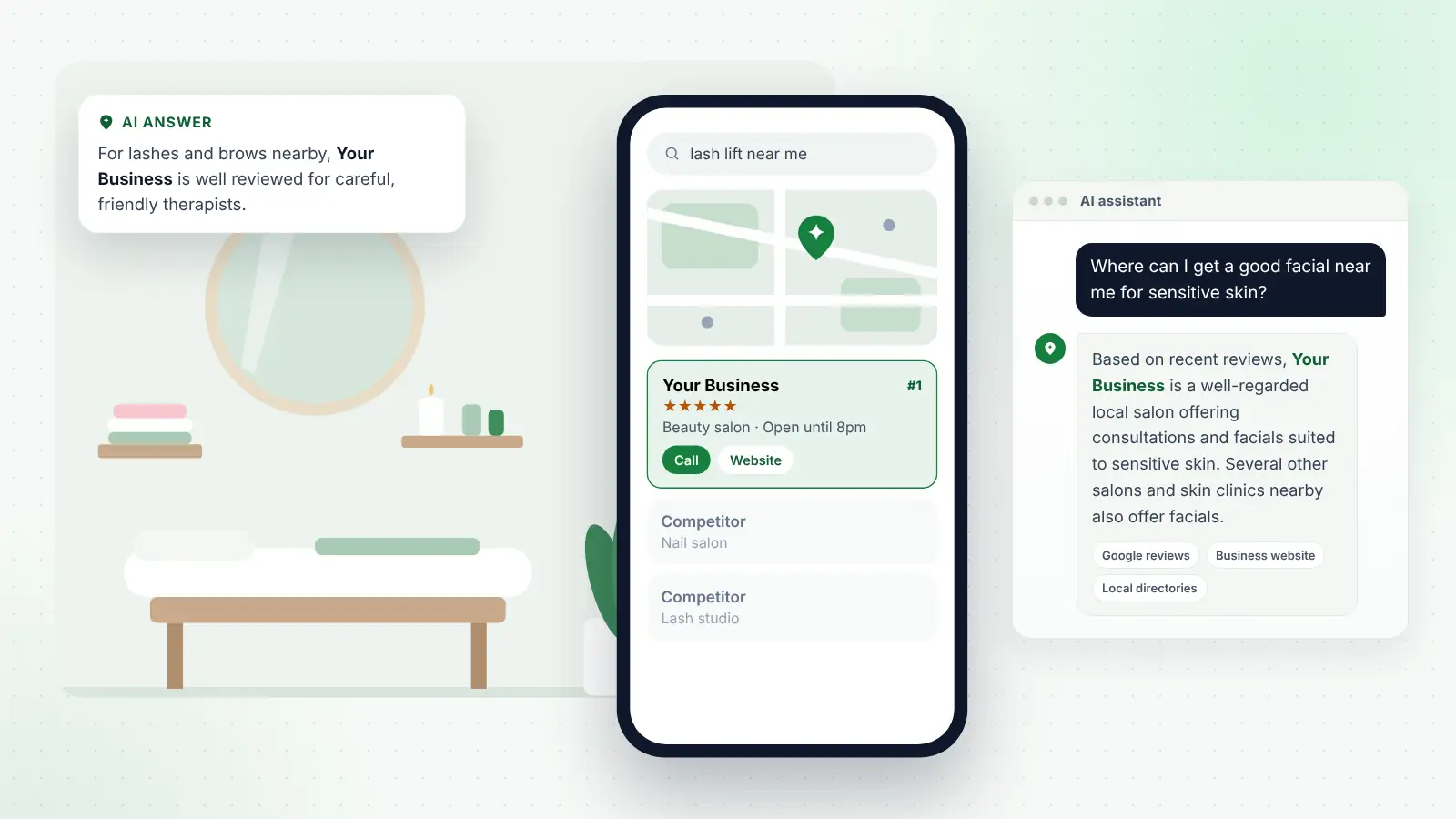
- Most new clients search by treatment, such as “lash lift near me”, so local SEO and AI search visibility should be built around your menu.
In this guide
- Choose your treatment menu and business model
- Training, qualifications and insurance
- Council licensing and registration
- Aesthetics and the coming licensing scheme
- Advertising treatments responsibly
- Plan your premises and budget
- Staffing, rental and pricing
- Local SEO: getting found for every treatment
- AI search: getting a new salon into chatbot answers
- Build loyalty and keep the diary full
- Frequently asked questions
- Final thoughts
Choose your treatment menu and business model
Start with what you are trained and genuinely good at, then think about what local clients want and how often they will come back. A salon built around maintenance treatments — nails, lash infills, brow tints, waxing — benefits from regular, predictable bookings. Higher-value treatments such as advanced facials or skin treatments bring a bigger spend per visit but need more expertise and trust.
Common models include:
- A full-service beauty salon offering a wide menu across nails, lashes, brows, waxing, facials and massage.
- A specialist studio focused on one area, such as nails, lashes and brows, or skin.
- A salon with an aesthetics element, where a qualified prescriber or healthcare professional provides injectable treatments alongside beauty services.
- A room rental or salon suite, which keeps overheads low while you build a client base.
- A mobile or home-based business, which can test demand before you take on premises.
Keep your opening menu focused. It is better to be known locally for excellent lashes and brows than to offer thirty treatments that nobody associates with you. You can add services as you grow and as your team’s skills expand.
Training, qualifications and insurance
There is no single legal licence to practise as a beauty therapist in the UK, but that does not mean anyone can safely offer any treatment. Recognised qualifications, such as NVQ or VRQ Level 2 and Level 3 in beauty therapy, along with product-specific and advanced training, are what insurers and clients look for. For some treatments, such as lash extensions or chemical peels, your insurer will want to see training certificates for each service.
Insurance
Insurance should be one of the first things you arrange. Most salons need:
- Public liability insurance in case a client or visitor is injured on your premises.
- Treatment or professional liability insurance covering the services you provide.
- Product liability insurance if you sell retail products.
- Employer’s liability insurance, which is a legal requirement in most cases once you employ staff.
- Buildings and contents cover, depending on your lease.
Check that every treatment on your menu is named on your policy, and tell your insurer before you add a new service. A treatment that is not covered leaves you exposed if something goes wrong.
Consultations and patch tests
Good consultation is part of safe practice. Use a consultation form for every new client, covering medical history, allergies, medication and skin conditions, and keep it up to date. For treatments such as lash and brow tints, lash extensions and some skin products, follow the manufacturer’s instructions on patch testing, record the date and result, and check what your insurer requires.
Tip
Store consultation forms and patch test records in your booking system rather than on paper. They are easier to keep up to date, and you can find them quickly if a client has a reaction.
Council licensing and registration
This is the area that causes the most confusion, because the rules depend both on the treatment and on where your salon is.
Skin piercing registration
Elsewhere in England, councils generally require businesses and practitioners offering skin piercing treatments to register with them. This typically covers tattooing, semi-permanent skin colouring (including microblading and permanent make-up), cosmetic piercing (including ear piercing), electrolysis and acupuncture. Registration usually involves an inspection of your premises, and you must follow the council’s hygiene byelaws. Some councils also cover treatments such as micro-needling under their local rules, so ask before you start. Wales has a national licensing scheme for special procedures such as tattooing, piercing, semi-permanent make-up, electrolysis and acupuncture, and Scotland has its own licensing rules, so check the requirements for your nation.
Special treatment licences in London
Most London boroughs operate a special treatment licensing scheme. Premises offering treatments such as massage, manicure, electrical treatments, laser and light treatments, saunas or other baths may need a special treatment licence, often renewed each year, alongside any skin piercing approvals. Some practitioners are exempt if they belong to approved professional bodies, but the details vary by borough.
Other council checks
- Planning. Check that your premises can be used as a beauty salon. Some councils treat certain beauty uses differently from general retail or services, so ask the planning department if the unit was previously used for something else.
- Business rates. Ask about the rateable value and whether small business rate relief applies.
- Signage. Larger or illuminated signs may need advertisement consent.
- Music. If you play music to clients, you will usually need TheMusicLicence from PPL PRS.
Aesthetics and the coming licensing scheme
If you plan to offer non-surgical cosmetic treatments — such as dermal fillers, anti-wrinkle injections, thread lifts or stronger chemical peels — be aware that regulation in England is changing. The Health and Care Act 2022 gave the government powers to introduce a licensing scheme for non-surgical cosmetic procedures. After consulting on proposals, the government announced in 2025 that it intends to introduce a scheme based on the level of risk. In October 2026 it opened a further consultation, running until 13 January 2027, on restricting high-risk cosmetic and wellbeing procedures, including certain injectable and laser treatments, to specified qualified healthcare professionals such as doctors, dentists and independent prescribing nurses, with the Care Quality Commission responsible for enforcement. At the time of writing, these restrictions and the wider licensing scheme for other procedures, which councils are expected to run, have not yet come into force, and detailed rules and dates are still to be confirmed.
Some rules already apply:
- Age limits. In England it is illegal to give botulinum toxin injections or fillers for cosmetic purposes to anyone under 18.
- Prescription-only medicines. Botulinum toxin products are prescription-only medicines. They must be prescribed by an appropriately qualified prescriber following a proper consultation with the client.
- Insurance and training. Insurers expect accredited training and, for injectables, often require a healthcare background or prescriber oversight.
If aesthetics is part of your plan, keep an eye on government announcements and trade body updates, build your processes around high standards now, and make your practitioners’ qualifications easy for clients to check. Scotland and Wales have their own approaches, so check the rules for your nation.
Advertising treatments responsibly
Advertising in the beauty sector is regulated by the CAP Code, which the Advertising Standards Authority (ASA) enforces. This applies to your website, social media posts, paid ads and even hashtags.
The most important rule for salons offering aesthetics is that prescription-only medicines, including Botox and other botulinum toxin products, cannot be advertised to the public. The ASA treats references to Botox on social media, including in hashtags, as likely advertising of a prescription-only medicine. You can usually promote a consultation for lines and wrinkles, but the product itself should not be promoted. The ASA’s guidance on advertising botulinum toxin products sets out what is and is not acceptable.
Other points to bear in mind:
- Do not exaggerate results. Claims about what a treatment achieves must be backed by evidence. Before-and-after photos must be genuine, must not be edited or filtered in a way that exaggerates the result, and should reflect typical results. The ASA advises avoiding them altogether for prescription-only treatments such as Botox.
- Avoid targeting under-18s. Ads for cosmetic interventions must not be directed at under-18s.
- Be socially responsible. Ads should not play on insecurities about appearance or pressure people into quick decisions, for example with time-limited offers on injectables.
- Get consent. Always have written permission before posting a client’s photos.
Plan your premises and budget
Look for premises that suit the treatments you offer: enough treatment rooms with privacy, good ventilation for nail work, hand-washing facilities, accessible toilets and storage for products. Consider footfall, parking and nearby competitors, but remember that many beauty treatments are booked in advance, so a quieter street with good parking can work well.
The figures below are rough guides only. Costs vary widely by area, size and condition of the premises.
| Cost | Typical range | Notes |
|---|---|---|
| Lease deposit and legal fees | Often several months’ rent | Have a solicitor review the lease |
| Fit-out (rooms, plumbing, lighting, ventilation) | Can range from a few thousand to tens of thousands of pounds | Ventilation matters for nail treatments |
| Couches, trolleys, nail stations, lamps | Varies by brand and quantity | Quality couches last many years |
| Opening stock and retail | A few hundred to a few thousand pounds | Start with products you know well |
| Council registration or licences | Varies by council and treatment | Some licences renew annually |
| Insurance | Annual premium | Depends on treatments and staff |
| Booking and payment system | Monthly subscription | Check deposit and reminder features |
Keep a contingency for several months of running costs. Fit-outs and council inspections can take longer than expected, and you may be paying rent before your first appointment.
Staffing, rental and pricing
You can employ therapists, pay commission, or rent rooms or stations to self-employed therapists. Each model has different costs and responsibilities. Room rental arrangements must genuinely reflect self-employment in practice — HMRC looks at factors such as who controls prices, hours and how the work is done — and HMRC publishes guidance on employment status, along with its Check Employment Status for Tax tool. Take advice from an accountant before setting up any arrangement.
When pricing, work out the true cost of each treatment: time, products, room costs and your hourly overheads. Many new salons underprice to compete and then struggle to raise prices later. Clear pricing on your website and Google profile also reduces time spent answering enquiries. Ask for deposits on longer or higher-value treatments, and show your cancellation policy at the point of booking.
Local SEO: getting found for every treatment
Beauty treatments are booked locally, usually on a phone and often at fairly short notice — nails before a holiday, a brow tidy before a wedding, a facial as a treat. What they type is the treatment itself rather than the word “salon”: “gel nails near me”, “lash lift [town]”, “brow lamination near me”, “hot wax Brazilian near me”, “facial for acne [area]”. Local SEO is about making sure your salon appears for those searches and looks like the right choice.
Google Maps results, with their star ratings and photos, usually appear before ordinary website listings. Being in that small group of salons people see first makes a real difference to how many enquiries you get.
Make your Google Business Profile work hard
Choose the most accurate primary category, such as “Beauty salon” or “Nail salon”, and add secondary categories only if they genuinely apply. List every treatment with a short description and price, link your online booking, keep opening hours accurate and post fresh photos of real results regularly. Clients want to see your work, your treatment rooms and your team.
Gather reviews after every treatment
Reviews influence where you appear and whether people book. Ask clients at the end of their treatment, when they are pleased with the result, and give them a simple link or QR code. Reviews that mention the treatment and therapist help you appear for those specific searches. Reply to all reviews calmly and professionally.
Keep listings consistent
Make sure your salon name, address, phone number and website are exactly the same on Google, Apple Maps, Bing, Facebook, Instagram, booking platforms and local directories. If you move or rebrand, update every listing.
Create a page for each treatment
Your website should have a clear page for each main treatment or treatment group, explaining what it involves, how long it takes, how long results last, aftercare, price and who it suits. Include genuine photos and answers to common questions. This gives clients confidence and gives search engines something specific to match.
Earn local links
Links from local sites — a town business directory, a wedding supplier list, a local magazine feature or a charity event you supported — show search engines that you are a real, established business in the area.
Local SEO builds over time, and results usually take three to six months to show clearly. If you would prefer to focus on your clients, specialist SEO for beauty salons and treatment studios can take care of your profile, listings, treatment content and links.
Tip
Write your treatment descriptions in the words clients use. If clients say “Russian lashes” or “brow lam”, use those phrases alongside the formal treatment name.
AI search: getting a new salon into chatbot answers
More people now ask AI assistants for recommendations before they book. Someone might ask ChatGPT “Where can I get natural-looking lash extensions near me?”, ask Gemini for “a salon in [town] that does Brazilian waxing for first-timers”, or ask Perplexity or Copilot which local salons are good for sensitive skin. Google’s AI Overviews also summarise options at the top of many searches.
These tools try to give a confident, useful answer, so they draw on information they can find and cross-check. For a beauty salon, that usually means:
- Consistent details across your Google profile, website, directories and booking platforms.
- Reviews that describe treatments, results and the experience in clients’ own words.
- Clear treatment descriptions, including who each treatment suits, what to expect and aftercare.
- FAQs that answer real questions, such as how long gel nails last, whether you patch test, or what to do before a wax.
- Mentions on reputable sites, such as local news, lifestyle blogs, wedding directories and industry awards.
Making your new salon easy for these tools to recommend is known as answer engine optimisation (AEO). The practical steps overlap with good local SEO, but there is extra value in being specific. A salon whose website clearly explains its approach to sensitive skin, with reviews mentioning it, is much easier for an AI assistant to recommend for that question than one with a generic “facials available” page. Keep claims measured and accurate, particularly for skin and aesthetics treatments, because AI tools also pick up on reliable, responsible information.
Build loyalty and keep the diary full
Repeat clients are the foundation of a profitable salon. Encourage rebooking before clients leave, especially for maintenance treatments such as infills and tints. Automated reminders reduce no-shows, and a clear cancellation policy protects your time.
Use quieter days for offers to existing clients rather than discounting popular slots. Courses of treatments, loyalty rewards and well-chosen retail products all increase the value of each client. Recommending the right aftercare also leads to better results and better reviews.
Track a few numbers monthly: new clients, rebooking rate, average spend, retail sales and where new clients found you. They will tell you which treatments and marketing efforts are working.
Frequently asked questions
Do I need a licence to open a beauty salon?
There is no single licence for beauty therapy, but some treatments need council registration or licensing. Skin piercing treatments such as semi-permanent make-up, electrolysis and ear piercing usually need registration, and in London many treatments, including massage and manicure, may need a special treatment licence. Contact your council before you open.
Can I offer Botox or fillers in my salon?
Botulinum toxin is a prescription-only medicine, so it must be prescribed by a qualified prescriber after a consultation, and it cannot be advertised to the public. Neither Botox nor fillers can be given for cosmetic reasons to under-18s in England. The government is consulting on restricting high-risk procedures to qualified healthcare professionals and plans a wider licensing scheme for non-surgical cosmetic procedures in England, so check the latest position before adding aesthetics.
How much does it cost to open a beauty salon?
It varies a great deal depending on location, size, fit-out and treatments. A small room or studio can be opened on a modest budget, while a multi-room salon with a full fit-out costs considerably more. Build a detailed budget and include a contingency for several months of running costs.
Should I start from home first?
Many therapists do, and it can be a sensible way to build a client list and test demand. Check your mortgage or tenancy terms, your insurance, business rates and whether your council needs to register or inspect home premises for the treatments you offer.
How long until a new salon is busy?
Most salons take several months to build a steady base of regular clients. Setting up your Google profile, collecting reviews and publishing clear treatment pages before you open can shorten that period.
Final thoughts
Opening a beauty salon combines skilled treatment work with careful business planning. Decide your treatment menu first, because it shapes your training, insurance, licensing and marketing. Keep consultation and hygiene standards high, advertise responsibly, and follow the changes coming for aesthetics if they are part of your plans.
Then make it easy for clients to find you for the treatments they want. A complete Google profile, steady reviews, clear treatment pages and consistent information across the web will help both search engines and AI assistants recommend your salon with confidence.