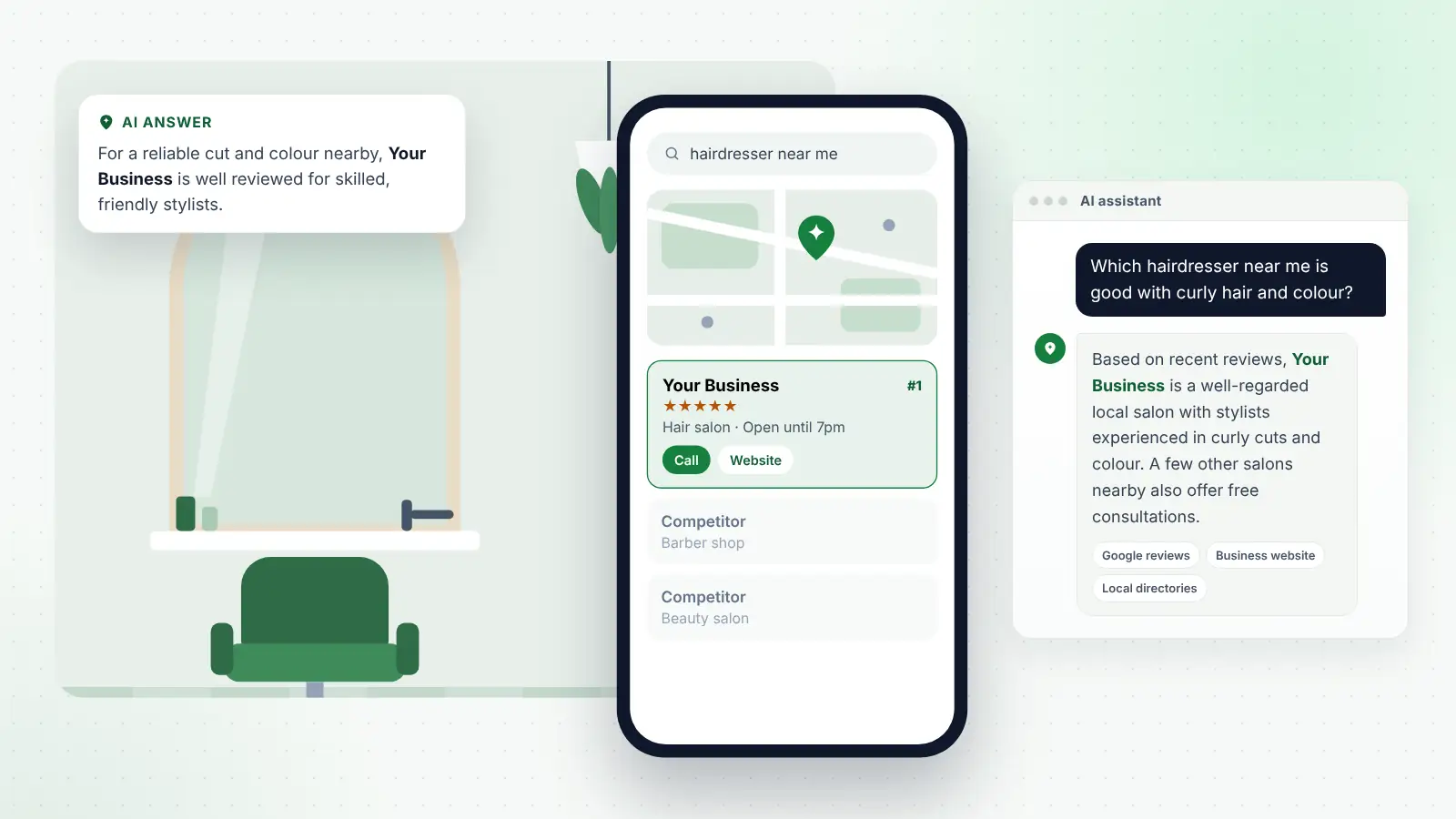
Opening your own hair salon or barbershop is one of the most common ambitions in the trade. Many stylists and barbers reach a point where they have a loyal following, a clear idea of how a salon should be run, and a feeling that they could do it better on their own terms. The skills that make you a good hairdresser are essential, but they are only part of what makes a salon succeed.
The salons that last tend to get the business basics right early: a sensible location, a realistic budget, a staffing model that works legally and financially, clear policies, and a steady supply of new clients to replace the ones who move away. That last part increasingly happens online, through Google Maps and, more recently, through AI assistants that people ask for recommendations.
This guide walks through each stage in plain terms, from deciding what kind of business you want to open to filling your column in the first few months. It is written for the UK, and it points out where rules vary so you know when to check locally.
Key points
- Hairdressing and barbering are not licensed professions in the UK, but qualifications, insurance and a voluntary state registration all build client trust.
- Your staffing model — employed, commission-based or chair rental — has real tax consequences, so it needs to reflect how people actually work.
- Allergy alert testing before colour services, safe chemical handling and a music licence are practical obligations many new owners overlook.
- Some extra services, such as massage, nails or laser, may need a licence or registration from your council, especially in London.
- Most new clients now find a salon through Google Maps, reviews and AI recommendations, so your online presence matters from day one.
In this guide
- Decide what kind of salon or barbershop you are opening
- Qualifications, registration and client safety
- Write a simple business plan and budget
- Find the right premises
- Choose your staffing model carefully
- Insurance, music and other practical obligations
- Set up bookings, pricing and policies
- Local SEO: getting found by clients nearby
- AI search: when clients ask a chatbot for a stylist or barber
- Open well and keep clients coming back
- Frequently asked questions
- Next steps
Decide what kind of salon or barbershop you are opening
Before you look at premises or price up chairs, be clear about the business you want to run. “A salon” can mean very different things, and each version has its own costs, client base and marketing.
Common models include:
- A traditional unisex or women’s salon offering cuts, colour, styling and treatments, usually by appointment.
- A barbershop focused on men’s cuts, fades and beard work, often mixing walk-ins with bookings.
- A specialist salon built around something you are known for — colour correction, curly and textured hair, extensions, bridal hair or grooming for older clients.
- A small studio or suite where you work alone or with one or two others, with lower overheads.
- A mobile or home-based business, which can be a sensible way to build a client list before taking on a lease.
Think about who your ideal clients are, what they will pay, how often they come back and how far they are willing to travel. A barbershop near a station may live on lunchtime walk-ins; a colour specialist may draw clients from across a town because of their portfolio. Being specific makes every later decision easier, including how you describe yourself online.
Qualifications, registration and client safety
Is a licence needed to cut hair?
There is no legal licence required to work as a hairdresser or barber in the UK. That surprises many people, but it means the responsibility for standards sits with you. Most professionals hold a recognised qualification, such as an NVQ or apprenticeship at Level 2 or Level 3 in hairdressing or barbering, and insurers and clients will generally expect one.
The Hair and Barber Council runs a state register for hairdressers and barbers under the Hairdressers (Registration) Act 1964. Registration is voluntary, but registered professionals can use the designations SRH (State Registered Hairdresser) or SRB (State Registered Barber). Some owners choose to register themselves and their team as a visible sign of training and standards.
Allergy alert testing
Hair colour allergies can be serious. Most permanent and many semi-permanent colour manufacturers instruct that an allergy alert test (often called a skin or patch test) is carried out before colour services — typically 48 hours beforehand — and repeated in line with the product’s instructions. Follow the manufacturer’s directions for every product you use, record each test, and check what your insurer requires. Trade bodies such as the NHBF publish practical testing protocols that are worth reading.
Chemicals and health and safety
Salons use chemicals such as bleach, colour, perm solutions and cleaning products. You need to assess the risks to staff and clients, provide gloves and ventilation where needed, and train your team to handle and store products safely. Dermatitis is a well-known risk in hairdressing, so glove use and good skin care matter for your staff as well as your clients. If you employ people, you also need employer’s liability insurance and a written health and safety policy once you have five or more employees.
Tip
Keep a simple digital record for every colour client: test date, product, result and their consent. If a reaction ever happens, clear records protect both the client and your business.
Write a simple business plan and budget
You do not need a fifty-page document, but you do need to know your numbers. A practical plan answers a few questions: how many chairs you will run, how many clients each chair needs per week, your average spend per visit, and how long it will take to break even.
Start with your fixed costs (rent, rates, utilities, insurance, software, loan repayments) and work out the monthly revenue you need just to cover them. Then look honestly at how quickly you can build a full column. Owners who bring an existing client base usually reach that point faster, but you should still plan for a few slow months.
The figures below are rough guides only. Costs vary a great deal by area, size and the condition of the premises.
| Cost | Typical range | Notes |
|---|---|---|
| Lease deposit and legal fees | Often several months’ rent | Get a solicitor to review the lease |
| Shop fit-out (plumbing, electrics, flooring, lighting) | Can range from a few thousand to tens of thousands of pounds | Backwash plumbing is often the biggest single job |
| Styling chairs, backwash units, mirrors | Varies widely by brand and quantity | Good used equipment is fine to start |
| Opening stock and retail products | A few hundred to a few thousand pounds | Start lean and reorder as you learn |
| Booking and payment system | Monthly subscription | Compare fees and how you own client data |
| Insurance | Annual premium | Depends on staff, services and premises |
| Signage, website and branding | Varies | Clear signage helps walk-ins find you |
Build a contingency of at least a few months’ running costs. Fit-outs often take longer than planned, and you will be paying rent before you take your first booking.
Find the right premises
Location matters more for a salon than for many businesses, because clients rarely travel far for a regular haircut. Look at footfall, parking, public transport, nearby competitors and who lives and works in the area. A quieter side street with good parking can work well for an appointment-based salon; a barbershop relying on walk-ins usually needs visibility.
Points to check before you sign:
- Planning use. Most salons fall within the commercial use class in England, but check with the local planning department if the unit was previously used for something very different, or if you plan major changes to the shopfront.
- Water, drainage and electrics. Backwash units need good water pressure and drainage. Ask a plumber and electrician to inspect before you commit.
- Business rates. Ask the council what the rateable value is and whether you might qualify for small business rate relief.
- Lease terms. Look at the length, break clauses, rent reviews and who is responsible for repairs.
- Signage. Illuminated or larger signs may need advertisement consent from the council.
Extra services and council licensing
If you only cut, colour and style hair, you will not normally need a council licence. However, many salons add other services, and some of these are regulated locally. In most London boroughs, premises offering “special treatments” such as massage, manicure, electrical treatments, laser and light treatments, or saunas need a special treatment licence from the council. Elsewhere in England, most councils require registration for skin piercing activities such as ear piercing, tattooing, semi-permanent make-up, electrolysis and acupuncture, while Wales and Scotland run their own licensing schemes for these treatments. Requirements vary, so check with your council before you add any service beyond hair.
Choose your staffing model carefully
How you work with stylists and barbers is one of the most important decisions you will make. The three common models are employment, commission-based arrangements, and chair or room rental.
| Model | How it works | Main considerations |
|---|---|---|
| Employment | You pay a wage, run PAYE and set the rota | Holiday pay, pension auto-enrolment and employment rights apply |
| Commission | Staff earn a share of what they take | Can still be employment for tax purposes if you control how they work |
| Chair rental | A self-employed stylist pays you to use a chair | Must genuinely be self-employed to be treated that way |
Chair rental can look attractive because you collect a fixed fee and avoid payroll, but the label on the agreement is not what decides someone’s status. HMRC looks at how the arrangement works in practice — for example, who sets prices and hours, who owns the client relationship, whether the person can send someone else in their place, and who provides the products and equipment. HMRC publishes guidance on employment status, along with its Check Employment Status for Tax tool, and it is worth working through both with an accountant before you take anyone on.
If a renter is genuinely self-employed, they should have their own insurance, their own booking system or clearly separated bookings, and freedom over their prices and hours. A clear written agreement covering rent, notice, shared costs and what happens to client details when someone leaves will save a lot of arguments later.
Insurance, music and other practical obligations
A few obligations catch new owners out because they are not specific to hairdressing.
- Insurance. You will normally want public liability and treatment liability cover, plus buildings or contents cover depending on your lease. Employer’s liability insurance is a legal requirement in most cases once you employ staff.
- Music. If you play music to clients — from a radio, a streaming service or a playlist — you will usually need TheMusicLicence from PPL PRS. Personal streaming subscriptions do not cover business use.
- Data protection. You will be holding client names, contact details and possibly notes about allergies or skin conditions. Keep records securely, be clear in your privacy notice about how you use them, and check whether you need to pay the data protection fee to the ICO.
- Waste. Salon waste, including chemical containers, needs to be disposed of properly. Ask your council or a commercial waste provider about the right arrangements.
- Accessibility. Think about step-free access, a chair that suits clients with limited mobility, and whether your toilet is accessible.
Set up bookings, pricing and policies
Your booking system shapes your clients’ experience and your cash flow. Look for online booking, automatic reminders, deposits for longer services, a way to record allergy tests and notes, and simple reporting so you can see rebooking rates. Check what happens to your client data if you ever switch providers.
When you set prices, avoid simply copying the salon down the road. Work out how long each service actually takes, what products it uses and what your hourly costs are, then price so each chair is profitable. Many salons tier prices by stylist experience, which gives newer team members a way to build a column.
Write a short, clear cancellation and late-arrival policy and show it at the point of booking. Deposits for colour, extensions and bridal work are common and reasonable. Clients rarely object when the policy is explained up front.
Local SEO: getting found by clients nearby
When someone moves to a new area, falls out with their current hairdresser or wants a specific service like balayage or a skin fade, they usually pick up their phone and search. They see a map with three or four salons, compare photos and star ratings, and make a decision in a minute or two. Local SEO is the work of making sure your salon is one of the businesses they see and feel confident about.
The searches are short and practical: “hairdresser near me”, “barbers open now”, “balayage specialist [town]”, “curly hair salon near me”, “kids haircut [area]”. Each one is an opportunity, and the salons that show up consistently are rarely there by chance.
Build a complete Google Business Profile
Your Google Business Profile is often the first thing a client sees, sometimes before your website. Choose the most accurate primary category (such as “Hair salon” or “Barber shop”), add your services with prices or price ranges, link your booking system, set accurate opening hours including holidays, and upload photos regularly. Real photos of your work, your team and the inside of the salon do far more than stock images. Google lets you add a future opening date to a new profile, so set it up shortly before you open rather than after.
Collect reviews steadily
Reviews influence both where you appear and whether people book. Ask every client, ideally while they are still in the chair admiring the result, and make it easy with a short link or QR code. Reviews that mention a specific service or stylist are especially useful. Reply to every review politely, including the occasional negative one, because future clients read your responses.
Match your salon details on every listing
Your salon name, address, phone number and website should be identical on Google, Apple Maps, Bing, booking platforms, social media and local directories. Inconsistent details confuse both clients and search engines. If you move or change your number, update every listing.
Give your website a page for each service
A simple website with clear pages for your main services — cuts, colour, barbering, bridal, extensions — gives Google and clients something specific to match against their search. Include prices or starting prices, what the appointment involves, how long it takes and photos of real results. A short page about the area you serve and how to find you also helps.
Earn a few local links
Links from local websites, such as a town business directory, a local events page, a wedding supplier list or a school fundraiser you sponsored, help show search engines that you are an established part of the community. A handful of genuine local links is worth more than a long list of irrelevant ones.
This is ongoing work rather than a one-off task, and results usually build over three to six months. If you would rather spend your time behind the chair, you can look at specialist SEO for hair salons and barbers to handle your profile, listings, content and links for you.
Tip
Post a few new photos of your work to your Google profile every week. Fresh, real images give searchers a reason to choose you and show that the salon is active.
AI search: when clients ask a chatbot for a stylist or barber
A growing number of people now ask AI assistants for recommendations rather than scrolling through search results. Instead of typing “hairdresser near me”, they might ask ChatGPT, Gemini, Perplexity or Copilot something like “Which salon near me is good for blonde balayage and won’t damage my hair?” or “Where can I get a good skin fade in [town] on a Saturday?”. Google also shows AI Overviews at the top of many searches, summarising options before the usual results.
These tools do not pick salons at random. They draw on information they can find and cross-check across the web, which tends to include:
- Consistent business details across Google, maps, directories and your own website.
- Reviews on Google and other platforms, including what clients say about specific services and stylists.
- Clear descriptions of your services, so the tool can match you to a specific request such as curly cuts, colour correction or children’s haircuts.
- Helpful FAQs on your website that answer the questions people actually ask, such as how long a colour appointment takes or whether you offer patch tests.
- Mentions on reputable local and industry sites, such as local news features, wedding directories or trade awards.
Getting a salon or barbershop into those answers is what people mean by answer engine optimisation (AEO). For a salon, the practical steps overlap heavily with good local SEO: describe each service clearly, use the words clients use, keep your details consistent, collect detailed reviews and publish genuine answers to common questions. A salon that clearly explains it specialises in textured hair, with reviews to back that up, is far easier for an AI tool to recommend for that request than one that simply says “all hair types welcome”.
Open well and keep clients coming back
The first few months set the tone. A soft opening for friends, family and existing clients lets you test your booking system, timings and team before you are busy. Make sure your Google profile, website and booking links are live before opening day, not after.
Once you are open, retention is where profit comes from. A client who rebooks every six weeks is worth far more over a year than a one-off visit. Encourage clients to book their next appointment before they leave, send reminders, and keep notes on preferences and formulas so every visit feels personal. Use quieter midweek slots for existing-client offers rather than discounting your busiest times.
Watch a few simple numbers each month: new clients, rebooking rate, average spend, retail sales and no-shows. They will tell you far more about the health of your salon than how busy a single Saturday feels.
Tip
Ask every new client how they found you and record it in your booking system. Within a few months you will know exactly which channels are worth your time and money.
Frequently asked questions
Do I need a qualification to open a salon?
There is no legal requirement to hold a qualification or licence to cut hair in the UK. In practice, most owners and stylists hold recognised qualifications, and insurers usually ask about training before providing cover. Clients also tend to look for evidence of experience and skill, so qualifications and voluntary state registration help.
Is chair rental a good way to start?
It can be, particularly if you want lower payroll costs or are sharing a space with experienced self-employed stylists. The key is that the arrangement must genuinely reflect self-employment in how it works day to day. Take advice from an accountant and use HMRC’s employment status guidance before you set it up.
How long does it take to fill a new salon?
It depends on whether you bring existing clients, your location and how visible you are. Many salons take several months to build a steady base. Starting your online presence, reviews and Google profile before opening shortens that period.
Should I use a booking marketplace?
Marketplaces can bring new clients, especially at the start, but they usually charge commission or fees on bookings. Many salons use them for discovery while encouraging repeat clients to book directly through their own website or Google profile. Read the terms carefully, especially around who owns the client data.
Do I need a licence to offer nails or massage as well?
Possibly. In London, many treatments such as massage and manicure need a special treatment licence from your borough council. Elsewhere, piercing, semi-permanent make-up and some other skin treatments usually need council registration or a licence, depending on which part of the UK you are in. Check with your local council before adding any service beyond hair.
Next steps
Opening a salon or barbershop is a big step, but it becomes manageable when you break it into stages: decide your model, plan your budget, choose premises carefully, set up your staffing properly and get the safety and licensing basics right. Then give clients an easy way to find you, see your work and book.
Start your Google Business Profile and collect your first reviews as early as you can. The work you put into being visible locally and recommended online will keep paying back long after the paint has dried on opening day.