Boat hire can be a very good business, but it comes with a short season, expensive assets, plenty of regulation and customers who are often nervous about doing something new. The operators who grow steadily are rarely the ones with the newest boats. They are the ones who get the licensing and safety right, explain clearly what customers are buying and make booking simple.
This guide is for UK narrowboat and canal holiday hire, day boat and self-drive hire on rivers and lakes, skippered boat trips and wildlife cruises, and marinas and boatyards offering berths, servicing and storage.
The rules differ by waterway and by type of boat, so treat this as a practical overview rather than legal advice, and always confirm details with your navigation authority, insurer and, where relevant, the Maritime and Coastguard Agency (MCA).
Key points
- Self-drive hire boats on most canals and rivers need a business licence or registration from the navigation authority, such as the Canal & River Trust or the Environment Agency, plus hire-specific safety certification.
- Skippered boats carrying more than 12 passengers are passenger ships and need MCA certification; smaller commercial boats follow codes of practice instead.
- A thorough, consistent handover and safety briefing protects your customers, your boats and your licence, and it is one of the things reviewers mention most.
- Clear deposits, damage terms and cancellation rules, set out before booking, prevent most disputes.
- The season is short, so plan shoulder-season breaks, winter trips, vouchers and marina services to keep income coming in.
- Your Google profile, reviews and website need to answer real customers’ questions, because local and AI search increasingly decide who gets booked.
In this guide
- Understand which rules apply to your boats
- Boat Safety Scheme and boat condition
- Handovers and safety briefings
- Insurance, deposits and cancellations
- Build an offer that suits your waterway
- Plan for seasonality
- Local SEO for boat hire and marinas
- AI search and boat hire
- Frequently asked questions
- Next steps
Understand which rules apply to your boats
Before thinking about marketing, be clear about which regulators cover your business. The answer depends on where you operate, whether customers drive themselves or you provide a skipper, and how many passengers you carry.
Self-drive hire on canals and rivers
On waterways managed by the Canal & River Trust, a commercial hire boat needs a business licence rather than a private one. The Trust distinguishes between self-drive holiday hire (boats with sleeping accommodation, hired for 12 hours or more) and self-drive day hire (boats without sleeping accommodation, hired for up to 12 hours). New operators submit an operating proposal first, and the Trust advises waiting for an in-principle decision before committing money. Its guidance on self-drive hire sets out what it expects, including:
- A hire boat safety certificate under the Boat Safety Scheme, or an exemption declaration for very simple boats with no gas, electrics or inboard engine.
- Third-party and public liability insurance of at least £2 million per claim from an FCA-authorised insurer.
- A written handover procedure covering navigation rules, locks and bridges, safe operation and on-board equipment, with a 24-hour emergency call-out service.
- Compliance with the Hire Boat Code developed by British Marine and AINA, which is written into the licence terms.
- A permanent base with fuel, water, waste disposal, customer parking and a safe boarding point.
The Environment Agency is the navigation authority for the non-tidal River Thames, the Anglian waterways and the Medway Navigation, and boats there must be registered. Its boat registration explanatory notes list extra requirements for business boats. Self-drive day and holiday hire boats, for example, need boat insurance, public liability insurance, BSS hire boat certification and compliance with the hire boat code of practice.
Other waterways, including the Broads, harbours and many lakes and privately owned rivers, have their own authorities and rules. If you cross from one authority’s water to another’s, you may need permission from both.
Skippered trips and passenger boats
If you or your staff skipper the boat and carry paying passengers, different rules apply. Government guidance on inland waterway vessel types defines passenger ships as ships that carry more than 12 passengers. Those vessels need to be surveyed and certificated by the MCA, and on inland waters the person in charge will usually need a Boatmaster Licence issued by the MCA.
Commercial boats carrying 12 or fewer passengers are not classed as passenger ships, but they still have to meet a recognised standard. On inland waters, that is usually the Inland Waters Small Passenger Boat Code. At sea, small commercial vessels must comply with merchant shipping regulations or one of the MCA’s codes of practice for small commercial vessels, a process often called “coding”. Some councils also license pleasure boats and boatmen in their area, particularly on the coast.
Marinas and boatyards
Marinas still deal with berthing agreements, fuel, waste, fire safety, environmental rules, planning and, where they connect to a navigation, the authority’s consent. Boatyards should make sure engineers working on gas and electrical systems hold the right qualifications.
Tip
Make a one-page list of every licence, certificate, code and policy that applies to your business, with renewal dates. Keep it where any senior member of staff can find it, and review it before each season.
Boat Safety Scheme and boat condition
The Boat Safety Scheme (BSS) is run jointly by the Canal & River Trust and the Environment Agency. Its examinations focus on reducing the risk of fire, explosion and carbon monoxide poisoning, covering fuel systems, gas installations, electrics and ventilation. Hire boats are examined against additional hire boat requirements, and the Canal & River Trust says every hire boat has needed a hire boat safety certificate since April 2018, regardless of age. Check that your examiner is qualified to carry out hire boat examinations before you book them.
A certificate is a minimum, not a maintenance plan. Well-reviewed operators tend to:
- Turn boats round with a written checklist: engine, bilges, gas, smoke and carbon monoxide alarms, fire extinguishers, lifejackets, ropes, toilets and bedding.
- Record defects and near misses, and fix recurring problems properly rather than patching them each week.
- Keep a spare boat, or at least spare parts and a mobile engineer, for peak weeks.
Handovers and safety briefings
For self-drive hire, the handover is where your business is won or lost. Many customers have never steered a boat or worked a lock. A rushed handover leads to damage and poor reviews; a good one leads to confident customers who come back.
A strong handover usually includes:
- A walk-through of the boat: engine checks, fuel, water, toilet, gas, heating and how to use the alarms and fire extinguisher.
- Clear rules of the water: keeping right, speed limits, passing moored boats, and where they can and cannot go.
- Safety points: lifejackets (particularly for children and non-swimmers), staying clear of the cill in locks, keeping hands and feet inside the boat, and what to do if someone falls in.
- A practical trial run, ideally through a lock or around a bend, with each person who will steer.
- Written information to keep on board: a route guide, lock and bridge instructions, mooring tips and your 24-hour emergency number.
Skippered trips need a briefing too: lifejackets, moving around safely, emergencies and rules for children and pets. Keep it short and consistent.
Tip
Film a short version of your handover and send it to customers a few days before they arrive. They arrive better prepared, handovers run more smoothly, and the video doubles as reassuring content for your website.
Insurance, deposits and cancellations
Insurance
Your policy needs to match exactly what you do: holiday hire, day hire, skippered trips, charters, marina operations or boatyard work. Navigation authorities set minimum public liability levels. You will need employers’ liability insurance if you have staff, and it is worth discussing hull cover, business interruption and loss of hire with a broker who understands marine businesses.
Deposits and damage
Most hire companies take a booking deposit, ask for the balance before departure and take a refundable security deposit or offer a damage waiver. Explain it plainly before booking:
| Charge | What to explain | Common problem |
|---|---|---|
| Booking deposit | Amount and whether it is refundable | Customers assume it is fully refundable |
| Balance | When it is due and how to pay | Missed payments close to peak weeks |
| Security deposit or damage waiver | What it covers and when it is returned | Disputes over normal wear and tear |
| Fuel | Included, charged by the hour or refilled on return | Surprise bills at the end of a hire |
| Extras | Pets, parking, bikes, linen, early arrival | Extras added at checkout feel unfair |
| Cancellation | Notice periods and refunds | Weather or illness cancellations |
The Digital Markets, Competition and Consumers Act 2024 means compulsory charges, such as booking fees, should be included in the headline price rather than added later. Optional extras are fine, as long as they are clearly optional.
Cancellations and bad weather
Under the Consumer Contracts Regulations, contracts for leisure services, accommodation and vehicle rental for a specific date or period are generally exempt from the usual 14-day right to cancel online and phone bookings. That makes your own terms important. Decide in advance what happens if a customer cancels, if water levels or a stoppage close a route, or if you cancel a trip because of high winds. Clear, fair terms, applied consistently, prevent most complaints.
Build an offer that suits your waterway
Most businesses combine several types of booking. A wider mix helps fill quieter days and makes better use of your boats, staff and base.
| Offer | Who it suits | Things to get right |
|---|---|---|
| Week and short-break holiday hire | Families, couples, groups of friends | Routes, berths, dog rules, start days |
| Day boat hire | Visitors, birthday groups, locals | Hourly rates, capacity, picnic and pub stops |
| Skippered trips and cruises | Holidaymakers, older visitors, schools | Timetable, accessibility, commentary |
| Wildlife and sea trips | Nature lovers, photographers | Realistic sightings, weather policy, what to wear |
| Private charters | Celebrations, corporate days | Catering, licensing, group sizes |
| Marina berths | Boat owners | Facilities, security, terms, waiting list |
| Servicing, repairs and storage | Owners at your marina and nearby | Clear guide prices, winter booking slots |
For wildlife cruises, be honest that sightings depend on season and conditions, and explain how you keep a respectful distance from wildlife.
Plan for seasonality
Most boat hire and trip businesses are busiest from Easter to early autumn, with school holidays selling out early, while marinas see a different rhythm of spring launches, summer visitors and autumn lift-outs. Ways to smooth the year:
- Sell shoulder-season short breaks and midweek hires to couples, walkers and retired customers.
- Offer winter trips where your waterway allows, such as festive cruises or wildlife trips at the right time of year.
- Sell gift vouchers before Christmas, Mother’s Day and Father’s Day.
- Promote winter storage, servicing, antifouling and refits to boat owners in late summer, before they book elsewhere.
- Take bookings for next season as soon as this one ends, and give returning customers first choice of dates.
Local SEO for boat hire and marinas
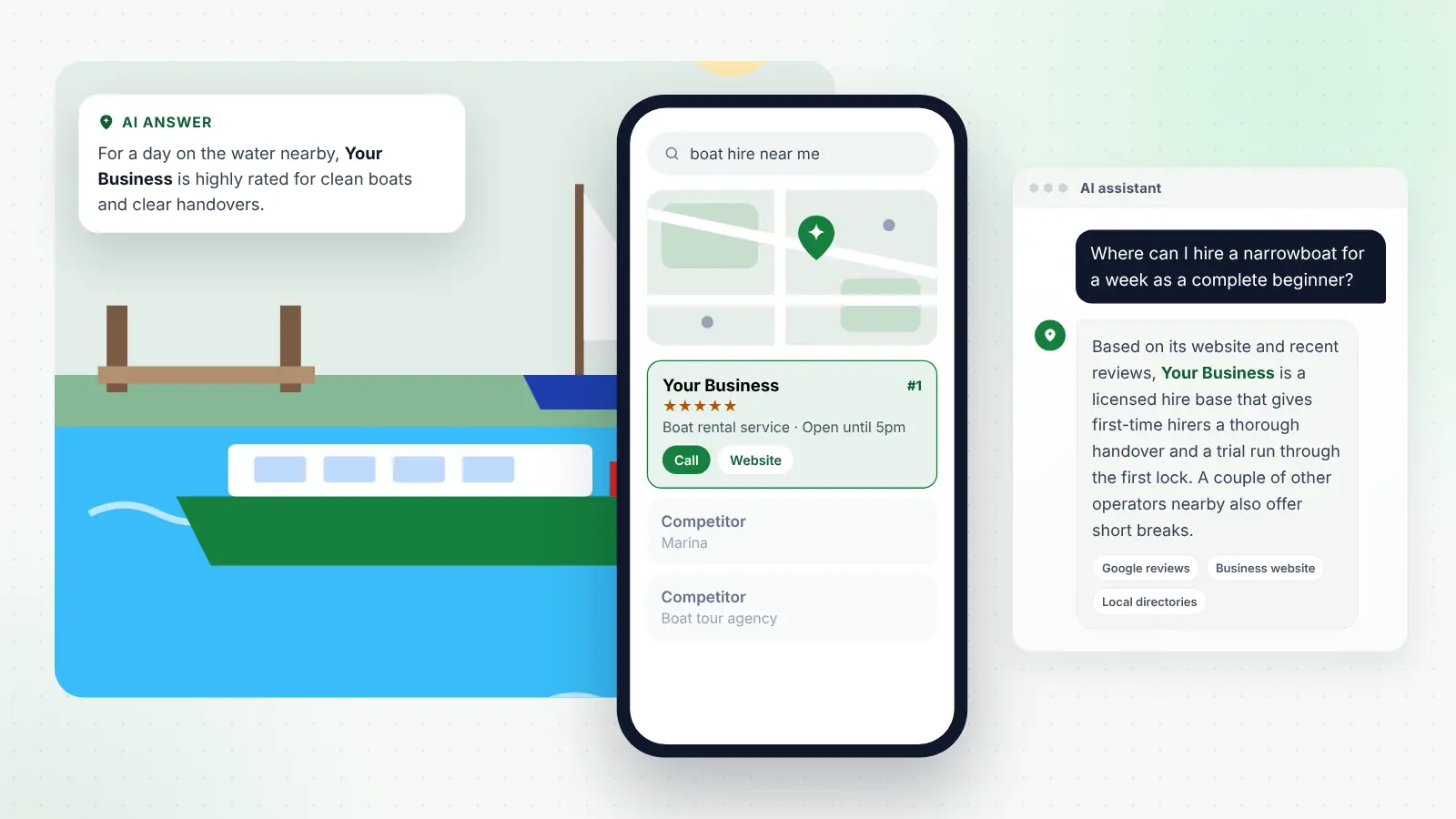
When someone searches “boat hire near me”, “boat trips near me” or “marinas near me”, Google shows a map with three businesses beneath it. Many trip and day boat bookings are made the same day or the day before, so appearing in that map in your area matters more than ranking nationally. Holiday hire is planned further ahead, but people still search by place: “narrowboat holidays Llangollen” or “canal boat hire near Oxford”.
Local SEO is the work that helps you appear for those searches. The main parts are:
- Google Business Profile. Choose accurate categories, such as boat rental service, boat tour agency, marina, boat repair shop or boat storage facility, and only the ones that genuinely apply. Set your season and opening hours correctly, including special hours for bank holidays. Add booking links, a clear description of what you offer, and plenty of real photos of boats, cabins, the marina and your team. Post updates about short-break offers, trip timetables and winter storage.
- Reviews. Ask customers for a review when they return the boat or step off a trip, while the day is fresh. Reviews that mention a clear handover, clean boats, helpful staff and a great route reassure first-timers. Answer each review courteously, including the ones about rain, reeds or a tricky lock.
- Consistent details. Your name, address, phone number and website should match exactly on your website, Google, Bing, Apple Maps, boating and tourism directories and your navigation authority or trade body listings.
- A clear website. Give each boat, trip and service its own page, with prices or guide prices, capacity, what is included, routes or departure points, accessibility and how to book. Describe the waterway and the places customers can reach.
- Local links and mentions. Tourist information sites, local pubs and attractions, holiday lets and campsites, walking and wildlife groups, local news and event listings can all link to you or mention you.
This takes steady work over several months, ideally before the booking season starts. Some operators manage it themselves, while others prefer specialists to handle SEO for boat hire companies and marinas so they can concentrate on the boats and the customers.
AI search and boat hire
More people now ask AI assistants such as ChatGPT, Gemini, Perplexity, Copilot and Google’s AI Overviews for recommendations rather than scrolling through results. They ask in full sentences, often with specific needs:
- “Where can I hire a narrowboat for a week as a complete beginner?”
- “Is there a day boat on the river near me that takes dogs?”
- “Which boat trips from the harbour are best for seeing seals?”
- “Are there marinas near me with berths for a 50-foot narrowboat?”
These tools try to give a short, confident answer, so they rely on information they can find and cross-check:
- The same name, base, phone number and season dates on your website, Google profile and boating directories.
- Clear descriptions of each boat, trip and service, including who it suits and what it costs.
- Reviews that mention specific things, such as beginners, dogs, accessibility or wildlife sightings.
- FAQs on your website that answer common questions directly: do I need experience, how long is the handover, can we bring the dog, what happens if it rains, is there parking.
- Mentions on reputable local, tourism and boating websites.
The practical work is the same as good local SEO: be specific and consistent. “Boats for all occasions” gives an AI assistant little to go on. If your website explains that your four-berth boats suit beginners, include a trial run through the first lock and accept two dogs, it can match you to the right question.
Frequently asked questions
Do I need a licence to hire out my own boat occasionally?
Usually, yes. The Canal & River Trust treats any privately owned boat offered for hire, even occasionally, as a hire boat, and hire boats need a business licence. Other navigation authorities have similar rules. Speak to the authority for your waterway and your insurer before taking any bookings.
When does a trip boat need MCA certification?
A boat carrying more than 12 passengers is classed as a passenger ship and needs MCA certification. Commercial boats carrying 12 or fewer passengers must still meet a recognised standard, such as the Inland Waters Small Passenger Boat Code or an MCA small commercial vessel code. Contact your local MCA Marine Office if you are unsure which applies.
How can we attract more first-time boaters?
Explain the handover in detail, show photos and videos of it, publish routes that suit beginners and collect reviews from first-timers. Many people assume boating is harder than it is, so reassurance is the most persuasive content you can offer.
How long does local SEO take to work for a boat hire business?
Sorting out your Google profile and boating listings can start to help within weeks. Stronger map rankings and visibility in AI answers usually build over three to six months, so it is worth starting in autumn or winter, ahead of the spring and summer booking rush.
Next steps
Start with the foundations: confirm your licences, certification and insurance are in order, and write down your handover and safety briefing so they happen the same way every time. Then make your prices, deposits and cancellation terms clear, and plan how you will fill the quieter months. Finally, make sure your Google profile, website and reviews tell new customers exactly what you offer, who it suits and why they can trust you on the water.