Heating oil is a business built on trust and logistics. Your customers are off-grid households, farms and rural businesses who cannot simply switch suppliers at the flick of a switch, but they can and do shop around every time the tank gets low. A few pence per litre, a slow reply to a quote or a missed delivery window is often enough to send them elsewhere.
The independent distributors who grow steadily tend to do the same things well. They make ordering easy, they are open about prices and minimum orders, they keep their drivers and tankers compliant, and they give customers good reasons to come back instead of comparing prices from scratch each time. Many also add LPG, agricultural fuels or kiln-dried logs.
This guide is for owners of UK heating oil, LPG and solid fuel businesses, from single-tanker family firms to multi-depot distributors. It covers the regulation and trade bodies that matter, the commercial decisions that affect loyalty, and how Google and AI assistants now shape who rural customers order from.
Key points
- Most growth comes from direct, repeat customers rather than one-off orders won through comparison sites or price-only buyers.
- UKIFDA membership and its code of practice, ADR-trained drivers and accurate metered deliveries are the foundations of trust.
- Following the 2026 CMA heating oil market study, the government has agreed in principle to a new regulatory regime for distributors, so clear quoting and fair cancellation terms matter more than ever.
- Transparent pricing, clear minimum order quantities and payment plans reduce lost quotes and help customers stay with you.
- Diversifying into LPG, agricultural fuels and Ready to Burn logs can fill delivery runs and spread seasonal demand.
- Local search and AI assistants increasingly decide which supplier rural customers contact first, especially during cold snaps.
In this guide
- Understand where your growth will come from
- Build trust with UKIFDA and a clear code of conduct
- Keep drivers, tankers and deliveries compliant
- Understand oil storage rules your customers ask about
- Price transparently and explain minimum orders
- Work with comparison sites and buying groups wisely
- Diversify into LPG, logs and solid fuel
- Prepare for changes in heating
- Local SEO for heating oil and fuel suppliers
- AI assistants and fuel orders
- Frequently asked questions
- Final thoughts
Understand where your growth will come from
Fuel distribution has thin margins per litre, so growth depends on volume, efficient routes and customers who stay. It helps to be clear about the different kinds of business you do.
| Customer type | How they usually order | Strengths | Watch out for |
|---|---|---|---|
| Domestic heating oil | Online, phone, comparison sites | Large market, predictable seasons | Price sensitivity, winter peaks |
| Agricultural and commercial | Accounts, regular calls | Larger drops, steady demand | Credit control, competitive tenders |
| Oil buying groups | Coordinator places a bulk order | Dense, efficient delivery runs | Lower margins per litre |
| LPG cylinders and bulk | Depot, stockists, contracts | Year-round demand, long contracts | Equipment and safety obligations |
| Logs and solid fuel | Online, phone, farm shops | Seasonal top-up to oil customers | Storage space, certification |
Track a few numbers every month: litres delivered per tanker per day, average drop size, the share of orders from repeat customers and the share coming through third parties.
Build trust with UKIFDA and a clear code of conduct
The UK and Ireland Fuel Distributors Association (UKIFDA) is the trade association for fuel distributors. Members agree to follow its code of practice, which sets expectations for how they deal with customers. For a buyer choosing between unfamiliar suppliers, it is a quick sign of a reputable business.
Trust has come under real pressure. During the sharp price rises in spring 2026, some households had orders cancelled and had to buy replacement oil at a higher price. The Competition and Markets Authority’s heating oil market study, published in July 2026, found the market generally competitive and that suppliers had not profited materially from the crisis, but it also concluded that heating oil households need stronger protections, and it recommended against a price cap.
In its response to the CMA heating oil market study, published in October 2026, the government agreed in principle to a proportionate regulatory regime for heating oil distributors, including a mandatory code of conduct, and said it would work with UKIFDA, Ofgem and the industry on reviewing existing codes in the meantime. No timetable has been set, but the direction is clear. Suppliers that already quote clearly, honour confirmed orders and explain their terms will be well placed.
What good practice looks like now
- Confirm every order in writing, with the price per litre, volume, delivery window and any charges.
- Explain plainly when and why a price could change or an order could be cancelled.
- Publish a simple complaints process and tell customers about any independent dispute resolution you use.
- Signpost payment plans and help for customers who are struggling, and record customers who need extra support.
Keep drivers, tankers and deliveries compliant
Customers rarely see your compliance work, but they notice when something goes wrong.
ADR for delivery drivers
Heating oil, diesel and LPG are dangerous goods, and drivers carrying them in tankers need an ADR driver training certificate covering the right modules, including carriage in tanks where it applies. The qualification lasts five years, after which drivers must complete refresher training and pass the exams again. Drivers who need access to fuel terminals also need a Petroleum Driver Passport. Keep a simple renewal calendar for every driver, as an expired card can take a tanker off the road at the worst possible time.
Accurate metering and delivery notes
Your tanker meters determine what the customer pays, so keep them maintained and calibrated, and give a clear delivery ticket every time. If no one is home, leave the ticket somewhere sensible and send a text or email confirmation. Accurate, well-documented deliveries prevent the disputes that turn into poor reviews.
Agricultural and commercial fuels
Farms and contractors often buy gas oil, diesel, lubricants and AdBlue. Since the 2022 changes, only certain uses remain entitled to rebated red diesel, with agriculture among them. Keep up to date with HMRC guidance and be confident explaining the rules to customers who are unsure.
Tip
Treat your drivers as your sales team. A driver who closes gates, checks the tank gauge, mentions a cracked tank base and leaves a tidy note does more for retention than any discount.
Understand oil storage rules your customers ask about
Customers often ask their supplier about tanks. You do not need to be an installer to explain the basics, but point people to the right professional.
Homes in England
New and replacement domestic oil tanks in England must meet building regulations. The GOV.UK guidance on storing oil at home recommends using an installer registered with a competent person scheme, such as OFTEC, who can self-certify the work. A bund that holds 110% of the tank’s capacity is needed in certain situations, including when the tank holds more than 2,500 litres, is close to water or a drain, or has vent pipes that cannot be seen during filling. Containers at a home holding more than 3,500 litres fall under the business rules instead.
Businesses in England
Businesses storing 201 litres or more of oil, including kerosene, diesel and HVO, must follow the business oil storage regulations, which set requirements for containers and secondary containment. Farms storing oil for agricultural heat and power follow separate rules, while oil heating a farmhouse follows the home rules. Scotland, Wales and Northern Ireland each have their own regulations, so check the rules where your customers are based.
When to refer customers on
OFTEC registers technicians for oil tank installation and boiler servicing. If you do not install tanks yourself, build relationships with local OFTEC-registered technicians and refer customers confidently.
Price transparently and explain minimum orders
Price is the first thing most customers check, and they increasingly expect to see it before they pick up the phone.
- Show a current price or instant quote. A live price per litre for common volumes, or a quote tool that works by postcode, removes friction.
- Explain what affects the price. Volume, delivery speed, location and wholesale movements all play a part. A short explanation builds confidence when prices change.
- Be clear about minimum orders. The government has noted that no minimum order volume is set in regulation, and that minimums depend on each tanker’s measuring equipment. The CMA recommended a review of how minimums are applied, so explain yours and the reason for it, and offer smaller deliveries where your equipment allows.
- Offer payment plans. Monthly payment schemes spread the cost of a fill and encourage customers to stay with one supplier.
Tip
Put your minimum order, delivery charges and typical lead time on the same page as your price. Customers who find these details easily are less likely to abandon a quote halfway through.
Work with comparison sites and buying groups wisely
Consumer price comparison sites are now a normal part of how many households buy heating oil. They bring orders, but those customers are often loyal to the cheapest price rather than to you.
Use comparison sites to fill capacity and reach new areas, and then work hard to turn those customers into direct ones. Deliver well, leave a friendly note with your own contact details and follow up before the next heating season.
Oil buying groups and syndicates, often run by community councils, parish councils or volunteers, place large combined orders for an area. Margins are lower, but the deliveries are efficient, and members who have a good experience frequently become direct customers or recommend you to neighbours. Make it easy for coordinators to work with you, with clear quotes, reliable dates and simple invoicing.
Diversify into LPG, logs and solid fuel
Many oil distributors add other fuels to make better use of their customer relationships and delivery days.
LPG cylinders and bulk tanks
LPG sales range from cylinders for homes, caravans and businesses to bulk tanks on supply contracts. Any installation work on LPG appliances or pipework must be done by a Gas Safe registered engineer qualified for LPG, so either employ engineers with the right competence or partner with local firms. Liquid Gas UK is the trade association for the LPG industry, and membership is worth showing if you are eligible.
Logs and kiln-dried wood
In England, the Air Quality (Domestic Solid Fuels Standards) (England) Regulations 2020 require wood sold in units under two cubic metres to be certified as Ready to Burn, meaning a moisture content of 20% or less. Woodsure runs the certification scheme. Larger volumes do not need the certification, but must come with advice on drying and storing the wood before use. Manufactured solid fuels must also meet the standards, and the sale of traditional house coal is no longer allowed in England.
Many off-grid homes also have a wood-burning stove, so logs, kindling and stove fuels sell well alongside oil.
Prepare for changes in heating
Customers increasingly ask whether oil heating has a future, and you need a clear, honest answer.
As of October 2026, the government has not set a date for phasing out new oil or LPG boilers in existing homes, and the Warm Homes Plan, published in January 2026, did not include one. Policy for off-grid homes could still change, so keep an eye on announcements. For new homes in England, the Future Homes Standard takes effect from March 2027 with a transition period, and its requirements, which in practice mean low-carbon heating such as heat pumps rather than boilers, are due to apply fully from 2028.
Meanwhile, the Boiler Upgrade Scheme in England and Wales offers a higher grant of £9,000, available from 21 July 2026 to 31 March 2027, for eligible properties replacing oil or LPG heating with an air or ground source heat pump. Over time, demand for kerosene from existing homes is likely to decline gradually rather than suddenly. Sensible responses include building the commercial and agricultural side of the business, offering HVO where there is demand, adding LPG and solid fuels, and keeping a close eye on policy updates.
Local SEO for heating oil and fuel suppliers
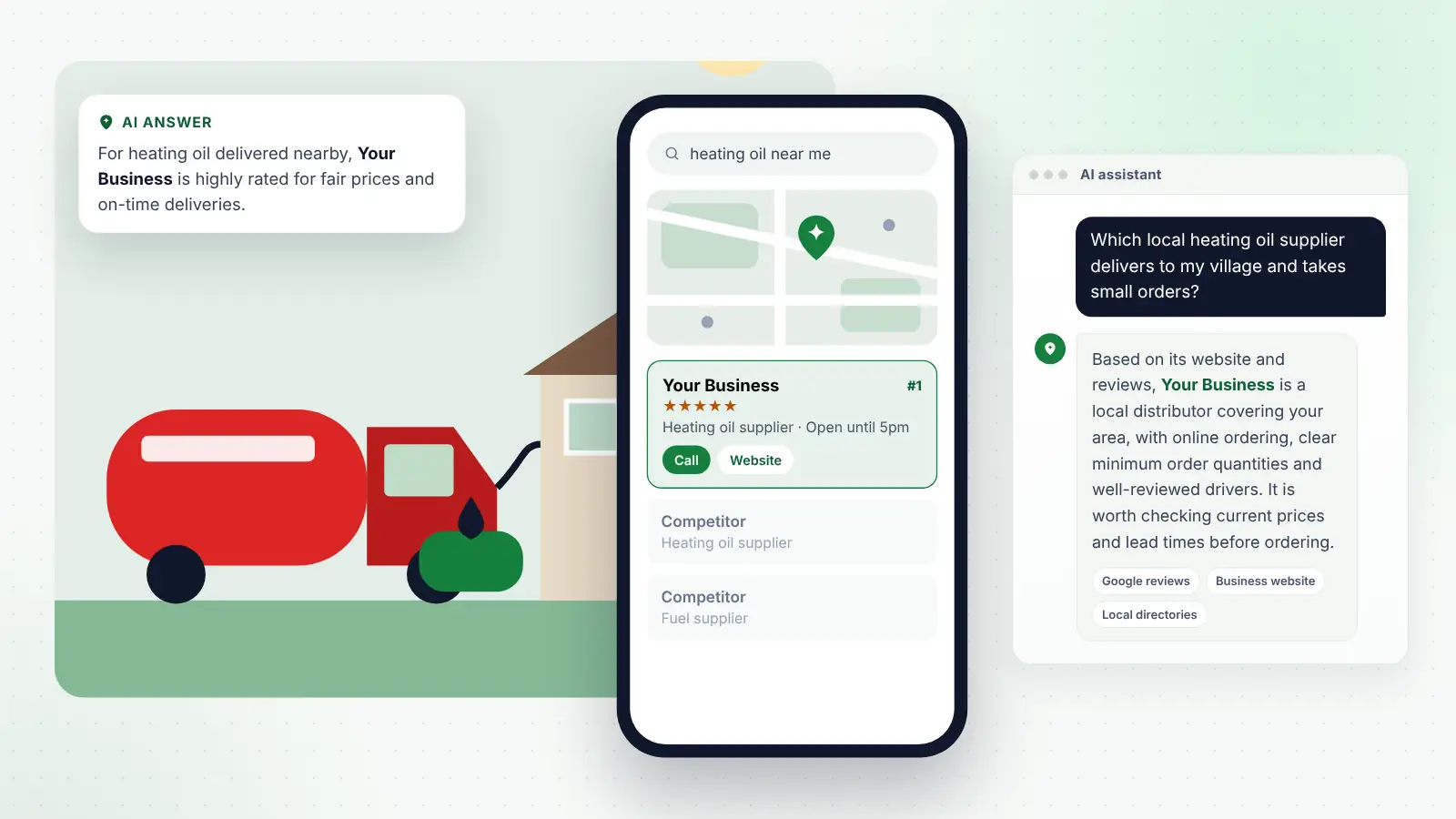
When a tank is running low or a cold spell is forecast, customers search for suppliers that deliver to them. Typical searches include “heating oil near me”, “kerosene delivery [town]”, “heating oil prices today”, “LPG bottles near me” and “kiln dried logs delivered”. The suppliers that appear first on the map and in search results are the ones that get those orders.
Google Business Profile
Your Google Business Profile is often the first thing customers see. Choose an accurate primary category, such as heating oil supplier, and add secondary categories for other fuels you sell. Set your service area to the postcodes you genuinely deliver to, add your depot hours and phone number, and upload real photos of your tankers, drivers and depot. Use posts for price updates and reminders to order early.
Reviews
Ask for reviews by text or email after delivery, when the experience is fresh. Reviews that mention punctual drivers, accurate deliveries, fair prices and helpful staff persuade best. Answer each one politely, even a complaint about a late drop.
Matching depot details everywhere
Your business name, address and phone number should match exactly across Google, Bing, Apple Maps, UK business directories, rural and farming directories, and trade association member finders.
A website built around areas and fuels
Create clear pages for each fuel you supply and for the main towns and villages you cover, with genuine local detail rather than copied text. Make your quote and ordering process work well on a phone, as many customers order from their mobile while standing next to the tank. If you would rather have specialists handle this, our local SEO for heating oil and fuel suppliers covers your profile, listings, content and links.
Local links
Links from parish newsletters, village websites, young farmers’ clubs, agricultural shows and rural community groups all help show search engines that you are a genuine part of the area. Sponsoring a local event or supporting a community oil club can earn worthwhile mentions.
AI assistants and fuel orders
More customers now ask AI tools such as ChatGPT, Gemini, Perplexity, Copilot and Google AI Overviews for recommendations. Typical questions include “who delivers heating oil to my village?”, “which oil supplier takes 300 litre orders?”, “where can I buy Ready to Burn logs near me?” and “is it cheaper to order heating oil in summer?”.
These tools build their answers from information they find across the web. They tend to favour businesses with consistent details everywhere, plenty of genuine reviews, clear descriptions of what they sell and where they deliver, and mentions on reputable local and industry websites.
To improve your chances of being recommended:
- Describe each fuel, your delivery areas, minimum orders and lead times in plain language on your website.
- Publish a frequently asked questions page covering ordering, payment plans, tank care and what to do in a spill.
- Keep your details identical across every directory and listing.
- Mention your UKIFDA membership, Ready to Burn certification and other credentials clearly.
Results usually build over three to six months, so start well before the heating season.
Frequently asked questions
Do I need to be a UKIFDA member to sell heating oil?
No, membership is not a legal requirement. However, it is a widely recognised trust signal, and the government intends to work with UKIFDA on codes of conduct while a wider regulatory regime is developed. Many customers look for it when choosing a supplier.
Should I accept orders from comparison sites?
They can be a useful way to fill tanker capacity and reach new areas. The key is to give those customers an excellent experience and your direct contact details, so their next order comes straight to you.
What is a sensible minimum order?
It depends on your tanker’s metering equipment, your routes and your costs. Whatever you choose, explain it clearly on your website and in quotes.
How can I reduce the winter rush?
Encourage customers to order in late spring and summer with reminders, payment plans and clear advice about winter lead times.
Is it worth selling logs alongside heating oil?
For many distributors it is, as off-grid homes often have a wood-burning stove. In England, wood sold in units under two cubic metres must be certified as Ready to Burn, so check the requirements before you start.
Final thoughts
The heating oil businesses that grow are the ones customers trust to turn up, deliver accurately and charge fairly. Clear pricing, honest terms, well-trained drivers and a sensible mix of fuels give you a strong base. Being easy to find on Google and in AI recommendations makes sure customers searching in your area discover you first. Start with the basics and track your repeat orders.