Very few people wake up planning to visit a notary. They arrive because someone overseas has asked for something they do not understand: a notarised power of attorney for a flat in Spain, an apostilled degree certificate for a job in the Gulf, a certified set of company documents for a bank account in Germany. They usually have a deadline, a list of instructions in confusing language and no idea what a notary does or what it should cost.
That makes a notarial practice unusual to market. Your clients are rarely repeat customers, they cannot easily judge your expertise and they often find you through a single search on a stressful afternoon. The practices that grow tend to be the ones that make a complicated process feel manageable, are open about fees and are easy to find when that search happens.
This guide covers growing a notary practice in the UK as things stand in October 2026: regulation and the trust signals that come from it, fee transparency, apostilles and legalisation, remote notarisation, identity checks, multilingual clients, referral partners, and how people now find notaries through Google and AI assistants.
Key points
- Notaries in England and Wales are regulated by the Faculty Office of the Archbishop of Canterbury, while in Scotland only practising solicitors can act as notaries, admitted through the Court of Session and registered by the Law Society of Scotland.
- The Faculty Office expects a notary’s website to set out the basis on which fees are calculated, and clients to receive written confirmation of the fee or estimate when they instruct you, so clear pricing pages are both a requirement and a selling point.
- Many documents need an FCDO apostille after notarisation, and some countries also require embassy legalisation, so explaining the full chain of steps and costs wins trust.
- Remote notarisation is only suitable where your regulator’s current guidance allows it and the receiving country will accept it.
- Most clients search by document or country rather than for “notary”, so build pages around the work people actually need.
- Referrals from solicitors, estate agents, accountants and translators remain valuable alongside local search and AI visibility.
In this guide
- Understand the regulation behind your trust signals
- Be open about fees
- Explain apostilles and legalisation clearly
- Decide how you will handle remote notarisation
- Make identity checks part of good service
- Serve multilingual and international clients
- Build referral relationships
- Local SEO for notaries
- How AI assistants recommend notaries
- Frequently asked questions
- Final thoughts
Understand the regulation behind your trust signals
Clients rarely know who regulates notaries, but they are reassured when you tell them plainly. Your regulatory status is the strongest trust signal you have, so it is worth understanding how it differs across the UK.
England and Wales
Notaries public in England and Wales are appointed and regulated by the Faculty Office of the Archbishop of Canterbury, acting for the Master of the Faculties. The Faculty Office sets the practice rules, maintains a public record of notaries and handles discipline. Notaries must hold professional indemnity insurance, and clients who are unhappy with the service can use the complaints process run through the Notaries Society (or, for scrivener notaries, the Worshipful Company of Scriveners) and, after that, the Legal Ombudsman.
Most notaries in England and Wales are general notaries, many of whom are also solicitors. A much smaller group are scrivener notaries, traditionally based in London, who have additional qualifications in foreign languages and foreign law. The two professional bodies are the Notaries Society, which most general notaries join, and the Society of Scrivener Notaries.
Scotland
Scotland works differently. Only solicitors with a current practising certificate can act as notaries public. A solicitor is admitted as a notary by petition to the Court of Session, and the Law Society of Scotland is responsible for admitting and registering notaries. The Law Society’s page on becoming a notary public in Scotland sets out the process. If you practise on both sides of the border, make it clear on your website which jurisdiction each of your notaries is admitted in.
What to show clients
- Your regulator, named in full, with a link to its public record of notaries where possible.
- Professional body membership, such as the Notaries Society or the Society of Scrivener Notaries.
- Your complaints procedure, including the route to the Legal Ombudsman.
- Your insurance, stated simply.
- Your experience, such as the countries and document types you handle most often.
Tip
Put a short “Who regulates us” panel in your website footer and on your contact page. Clients who are nervous about sending legal documents abroad look for exactly this kind of reassurance.
Be open about fees
Fees are the first thing most people ask about, and they are harder to explain for notaries than for most professions. The cost depends on the document, the country, the number of signatories, whether an apostille or embassy legalisation is needed and how quickly the client needs it.
The Faculty Office sets out what clients should be told. A notary’s website should explain the basis on which fees are calculated, the services offered and normal timescales, levels of insurance, how to complain and that the notary is “regulated through the Faculty Office of the Archbishop of Canterbury”. When a client instructs you, they should receive written confirmation of the fixed fee or the basis of charging with a proper estimate, the likely disbursements such as legalisation fees, VAT and when fees might increase. Rules are reviewed from time to time, so check the current requirements with the Faculty Office.
In practice, good fee information usually covers:
| Fee element | What to explain | Why it helps |
|---|---|---|
| Your notarial fee | Typical fees for common documents, or your hourly rate and minimum fee | Lets clients compare without ringing round |
| Apostille | That it is a separate FCDO fee, with a link to the official page | Avoids surprise when the total arrives |
| Embassy legalisation | That some countries charge their own fees and set their own timescales | Sets realistic expectations early |
| Courier and postage | Return costs, especially for urgent work | Prevents disputes at the end |
| Translations | When one is needed and who provides it | Shows you understand the full process |
| VAT | Whether figures include VAT | Keeps quotes honest and comparable |
Rather than copying government fees onto your site, link to the official source.
Explain apostilles and legalisation clearly
Confusion about apostilles generates many of your enquiries, and explaining the process well is one of the best ways to win work. Most clients do not know the difference between notarising a document, getting an apostille and having it legalised by an embassy.
The FCDO apostille service
The UK Legalisation Office, part of the Foreign, Commonwealth and Development Office (FCDO), confirms that a signature, stamp or seal on a UK document is genuine and attaches an apostille so the document can be used abroad. Some documents, such as many certificates issued by public registries, can be sent directly. Others, including powers of attorney, contracts and copies of passports or qualifications, must first be certified by a UK notary or solicitor. The official guide to getting a document legalised explains the current options, fees and timescales.
The FCDO also offers an e-apostille for PDF documents that a UK notary or solicitor has signed electronically. It is usually much faster than the paper service, but some recipients still insist on a paper apostille, and some document types cannot be e-apostilled, so check with the receiving party first. Faster paper-based options, such as next-day and restricted urgent services, are currently reserved for registered businesses.
Embassy legalisation
Countries that are party to the Hague Apostille Convention generally accept an apostille on its own. Others may require a further step at their embassy or consulate in the UK, which adds time and cost. Some Convention countries also have particular requirements for certain documents. The Notaries Society’s page on legalisation gives a useful overview you could point clients towards.
Turning this into content
A plain-English guide to “notarisation, apostilles and legalisation: what you need and in what order” is one of the most useful pages a notary can publish. Add short pages for the countries you deal with most, explaining typical requirements without promising acceptance, which is always for the receiving authority to decide.
Decide how you will handle remote notarisation
Many clients now ask whether they can be seen by video. The answer depends on where you practise, the document and where it will be used.
In England and Wales, any remote procedure must fit the Faculty Office’s rules and guidance for notaries, which is the first thing to check before offering or advertising remote services. Even where a remote appointment is possible, it needs robust identity checks, a proper record of the session and confidence that the receiving country will accept the procedure, and some acts are not suitable for remote handling at all.
In Scotland, the requirement for a notary to be physically present when a person signs or swears was removed by section 10A of the Requirements of Writing (Scotland) Act 1995, in force since 1 October 2022, and the Law Society of Scotland has published guidance on video notarial acts.
If you do offer remote appointments, explain clearly:
- Which documents and countries they are suitable for.
- How you will verify the client’s identity.
- What equipment and documents the client needs.
- That the receiving country must accept the procedure.
- When an in-person appointment is still needed.
Make identity checks part of good service
Identity checks are a core part of every notarial act, and some notarial work also falls within the UK’s anti-money laundering rules, particularly company and property matters. The Faculty Office is the anti-money laundering supervisor for notaries in England and Wales, and the government has confirmed plans to move professional-services AML supervision to the FCA over time, so keep an eye on the Faculty Office’s updates. Tell people in advance what to bring: original photo ID, proof of address, the documents to be notarised (unsigned, if you need to witness the signature) and, for company work, evidence of the signatory’s authority. A simple “what to bring” checklist on your website, repeated in your booking confirmation, saves wasted appointments and shows clients you take compliance seriously.
Tip
Send a short checklist with every booking confirmation. Clients who arrive with the right documents leave satisfied, and satisfied clients are the ones who leave reviews.
Serve multilingual and international clients
A large share of notarial work involves another language or legal system. Your clients may be overseas buyers, families dealing with an inheritance abroad, employees relocating or businesses opening a branch in another country.
- List the languages you work in on your website and Google profile, and only those you can genuinely work in.
- Explain how foreign-language documents are handled, including whether you need a translation and whether that must be certified or notarised.
- Build relationships with qualified translators, who can refer clients to you and handle translations you need.
- Name the countries you deal with often. Clients searching “notary for Italian power of attorney” want to know you have done it before.
- Consider translated summary pages for your main client communities, keeping them in step with the English version.
Build referral relationships
Referrals remain a steady source of work for most notaries. Useful partners include:
- Solicitors who do not offer notarial services, particularly conveyancing, probate and company law firms.
- Estate agents and overseas property specialists, whose clients often need powers of attorney.
- Accountants and company formation agents, who meet businesses expanding abroad.
- Translators and interpreters, who see clients at the start of an overseas process.
- Employers, recruiters, universities and international schools, whose staff and students need certified documents.
Make referring easy with a one-page guide partners can pass on, a direct contact and quick turnaround on quotes. Check your own professional rules before agreeing any referral arrangement, and never let a partner promise clients something you cannot guarantee.
Local SEO for notaries
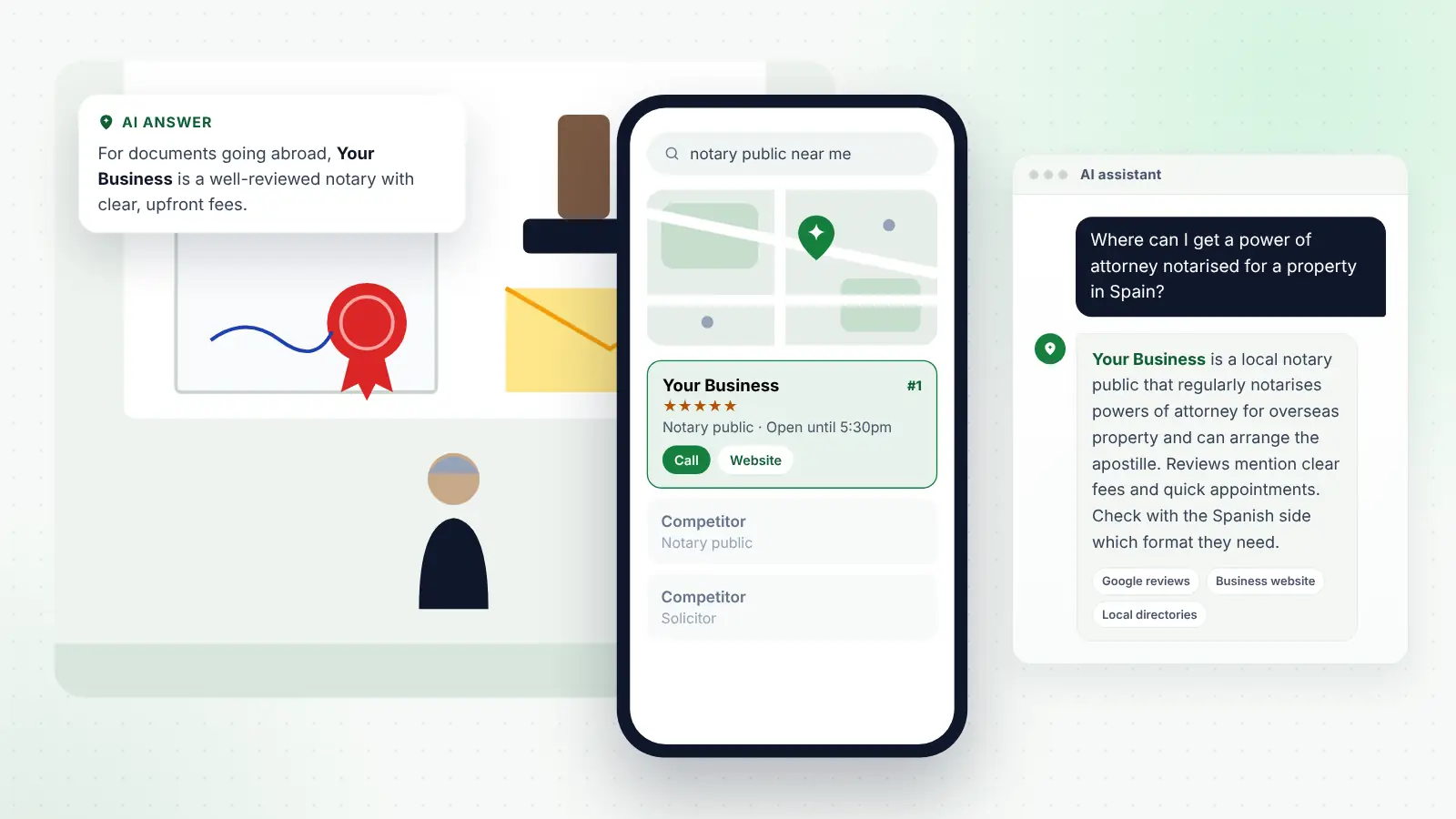
When people need a notary, most of them search on their phone: “notary public near me”, “notary Manchester”, “apostille notary near me” or “notarise power of attorney for Spain”. Local SEO is about appearing clearly and accurately for those searches, with enough information for people to trust you before they call.
Google Business Profile
Your Google Business Profile is what puts you on the map. Choose “Notary public” as your primary category if it reflects your main service, set accurate hours, add appointment and accessibility details, list your languages and write a plain description of the documents you handle. Google expects businesses on Maps to meet clients in person, so add your office address only if you genuinely see clients there. Real photos of your office and team build more trust than stock images of stamps.
Reviews
Reviews matter a great deal for a service most people use once. Ask clients when you hand over completed documents, and make it easy with a direct link. Reviews that mention the document, country or speed of service (“notarised my Spanish power of attorney quickly”) help both people and search engines understand what you do. Never offer incentives, and reply without disclosing any client details.
Consistent details
Your practice name, address, phone number and website should match across Google, the Faculty Office or Law Society records, the Notaries Society directory, legal directories and local listings. Inconsistencies make it harder for search engines to trust your listing.
Your website
Build a page for each main service, such as powers of attorney, company documents, certified copies and apostilles, plus your fee information, a “what to bring” page and guides for the countries you serve most. If you would rather have specialists take care of this while you concentrate on appointments, our service providing local SEO for notaries and notarial practices is built around accurate, carefully worded content.
Local links and mentions
Links and mentions from relevant sites help search engines trust you. Good sources include local business networks, partner solicitors and estate agents, chambers of commerce, translators you work with and helpful articles for local publications on buying property abroad.
How AI assistants recommend notaries
Many people now ask AI assistants such as ChatGPT, Gemini, Perplexity, Copilot and Google’s AI Overviews before they contact anyone. Typical questions include “what is an apostille and do I need one?”, “how do I get a power of attorney notarised for France?”, “can a solicitor notarise a document?”, “how long does an e-apostille take?” and “which notary near me speaks Polish?”.
These tools build answers from information they can find and cross-check. For notaries, that means:
- Consistent information across your website, Google profile, regulator records and directories.
- Clear service descriptions, naming the documents and countries you handle.
- Verifiable credentials, stating your regulator and society membership.
- Accurate FAQs on apostilles, legalisation, identity checks and fees, reviewed regularly.
- Languages spoken, listed plainly and consistently.
- Reviews and mentions on reputable legal, property and local websites.
AI assistants can repeat out-of-date information about fees and processing times, so clear, current content on your own site gives them a more reliable source to draw on.
Frequently asked questions
Do notaries have to publish their fees?
Notaries in England and Wales are expected by the Faculty Office to set out on their website the basis on which their fees are calculated, and to confirm the fee or a proper estimate in writing when instructed. Showing typical fees for common documents is the most helpful way to meet that expectation, and it reduces calls from people simply comparing prices.
Can a notary guarantee a document will be accepted abroad?
No. The receiving authority decides what it will accept. A notary can follow the instructions provided and the usual requirements for that country, but your website should be clear that clients need to confirm requirements with the receiving party.
Is remote notarisation worth advertising?
It can widen your reach, but only where your regulator’s current guidance allows it and the receiving country accepts it. Explain when it is suitable rather than presenting it as an option for every document.
How long does it take to build visibility online?
A refreshed profile and listings help within weeks; map positions and AI mentions take three to six months, depending on competition.
Should we compete with online apostille services?
Compete on clarity rather than price. Many clients prefer a local notary who can explain what they need, check their documents in person and handle the whole process, and your reviews and content can make that advantage clear.
Final thoughts
A notary practice grows on trust, clarity and being easy to find at the moment someone needs help. Make your regulation visible, explain your fees and the apostille process in plain English, prepare clients properly for their appointments and look after your referral partners. Then make sure your Google profile, website and listings tell the same clear story, so that people, and the AI tools they consult, can see why you are a sensible choice.