Private investigation is one of the few professional services in the UK where anyone can start trading with no licence, qualification or checks. That makes life harder for the careful, competent investigators and process servers who do things properly. Clients, solicitors and insurers look hard for signs that an agency is accountable before handing over a sensitive instruction.
It also creates a real advantage for businesses that show their credentials clearly. Most work comes from people who need help occasionally and search when they do: a landlord who needs papers served, a business checking a new partner, a solicitor tracing a beneficiary, an insurer that needs evidence on a claim. If your agency is easy to find, clearly professional and visibly lawful, you are well placed to win it.
This guide covers growing a private investigation or process serving business as things stand in October 2026: regulation, memberships, data protection, legal limits on surveillance, process serving, working with solicitors and how clients now find investigators through search and AI assistants. It is about marketing a lawful business, not legal advice, so check anything specific with your professional body or a solicitor.
Key points
- Private investigation is not licensed in the UK. SIA licensing was provided for in 2001 and announced in 2013 but never brought into force.
- Without a licence, voluntary trust signals carry the weight: ABI or IPI membership, ICO registration, insurance, qualifications and BS 102000.
- Knowingly or recklessly obtaining or disclosing personal data without the controller’s consent is an offence under the Data Protection Act 2018, and your marketing must never imply otherwise.
- Solicitors are often the most valuable long-term clients, and they are expected to check an investigator’s accountability before instructing.
- People search for specific services, such as “process server near me” or “trace a debtor”, so build visibility for each one.
- Local SEO and AI search results usually build over three to six months, and no honest provider can promise rankings.
In this guide
- Understand the regulatory position
- Build credibility with memberships, standards and insurance
- Treat data protection as part of your service
- Stay within the legal limits on surveillance and tracking
- Get process serving right
- Choose your services and clients
- Work with solicitors and other referrers
- Local SEO for private investigators
- Being recommended by AI assistants
- Pricing and handling enquiries
- Common mistakes to avoid
- Frequently asked questions
- Next steps
Understand the regulatory position
The Private Security Industry Act 2001 created the Security Industry Authority (SIA) and listed private investigation among the activities that could be licensed. In 2013 the government announced plans to license investigators, but they were never brought into force. As of October 2026, SIA licensing does not cover private investigation, so a private investigator does not need an SIA licence.
That has two practical consequences.
- Clients cannot rely on a licence to judge you. They look for other evidence of competence and accountability, and you need to make it easy to find.
- The law still applies in full. Data protection law, the criminal law on harassment and stalking, the law on intercepting communications, trespass and the rules of court all govern how you work.
If you also do SIA-licensable work, such as security guarding or close protection, you need the relevant licence for that activity, because licensing depends on what you do rather than your job title. Investigator licensing has not been introduced in Scotland or Northern Ireland either, but court procedures differ. In Scotland, formal service of court documents is largely carried out by sheriff officers and messengers-at-arms.
Build credibility with memberships, standards and insurance
In an unlicensed sector, your credentials do the job a licence would otherwise do, and they give solicitors and insurers something concrete to check.
The Association of British Investigators (ABI) is the most widely recognised body. Members are vetted before joining, including criminal record checks, verification of qualifications or experience, financial checks, ICO registration and professional indemnity insurance, and they are bound by a code with disciplinary sanctions. The ABI is the Law Society of England and Wales’s industry partner for investigation services and runs a directory solicitors are encouraged to use. The Institute of Professional Investigators (IPI) is a long-established professional institute and another credible signal, particularly for investigators who emphasise qualifications and professional development.
In November 2024 the Information Commissioner’s Office (ICO) announced the first approved UK GDPR code of conduct for the sector, the ABI UK GDPR Code of Conduct for Investigative and Litigation Support Services. The ICO’s announcement explains what it covers, including lawful bases for surveillance, background checks and tracing. BS 102000, the British Standard for investigative services, offers independent certification too.
| Trust signal | Why it matters | Where to show it |
|---|---|---|
| ABI or IPI membership | Independent vetting and accountability | Website header, Google profile, proposals |
| ICO registration | Shows you take data protection seriously | Website footer, privacy notice |
| Professional indemnity insurance | Solicitors often ask before instructing | About page, supplier forms |
| Qualifications | Evidence of training in law and methods | Team profiles |
| BS 102000 or GDPR code membership | Independent assurance on process and data | About page, tenders |
Tip
Only display logos and claims you are entitled to use, and keep them current. The ABI invites reports of anyone misusing its credentials, and a solicitor who spots an out-of-date claim is unlikely to instruct you.
Treat data protection as part of your service
Most businesses that process personal data must pay the data protection fee to the ICO, and for investigators it is a basic expectation. You can pay the data protection fee on gov.uk, and your entry appears on the ICO’s public register, which careful clients check. Make sure the name on it matches your trading name.
Under UK GDPR you need a lawful basis for each processing activity, and you need to be clear whether you act as controller, joint controller or processor for each client. Covert work usually relies on legitimate interests, which means carrying out and recording a balancing test, and higher-risk work such as surveillance calls for a data protection impact assessment.
Section 170 of the Data Protection Act 2018 makes it an offence to knowingly or recklessly obtain or disclose personal data, or procure its disclosure, without the consent of the controller, or to retain it without consent. Selling or offering to sell such data is also an offence. The defences are narrow.
For your marketing, this means never advertising or implying that you can obtain bank statements, phone records, medical records or anything else an organisation would not lawfully share with you. A clear statement on your website about what you will and will not do saves time and shows professional clients you understand the law.
Stay within the legal limits on surveillance and tracking
Surveillance for insurers, employers and solicitors is legitimate work when it is necessary, proportionate and lawful. The limits protect both the subject and your business.
- Harassment and stalking. The Protection from Harassment Act 1997 makes harassment and stalking offences, and watching or spying on someone is listed as an example of stalking behaviour. Surveillance needs a clear, legitimate purpose and should stop when that purpose is met.
- Tracking devices. Location data that identifies a person is personal data, and trackers also carry trespass and harassment risks. The ABI allows members to use them only in tightly limited circumstances and prohibits their use for private individuals on a partner’s or family member’s vehicle unless instructed through a solicitor. Many agencies decline tracking work altogether.
- Communications. Intercepting calls, messages or emails, or accessing someone’s accounts or devices without authority, is a criminal offence. Never offer it.
Bug sweeps sit on the other side of that line: you are helping a client check their own home, office or vehicle for devices someone else may have placed. That is lawful, in-demand work, and it is worth describing clearly, including what you will do if you find a device.
Tip
Matrimonial and relationship enquiries are often emotional. Ask why the client wants the information, and decline any instruction where the purpose is unclear or there are signs of control or abuse. Saying so on your website reassures the clients you do want.
Get process serving right
In England and Wales, service of civil court documents is governed by Part 6 of the Civil Procedure Rules (CPR). Personal service on an individual means leaving the document with that person, so accurate identification matters. Some documents, such as injunction orders and applications for committal, must be served personally, while others can be served by post or other permitted methods. Family proceedings follow the Family Procedure Rules.
You will usually provide a certificate of service, often on Form N215, or a witness statement setting out when, where and how service took place. These carry a statement of truth, so accuracy is essential. A careless certificate can delay or derail a case.
What clients value most in a process server:
- Fast acceptance and clear turnaround times.
- Honest updates, including failed attempts.
- Accurate paperwork delivered promptly.
- A calm, professional manner at the door.
- Fixed fees with clear terms for extra attempts, mileage and urgent work.
Choose your services and clients
Most agencies do better focusing on a few services and client types, each of which searches differently.
| Service | Typical clients | Example searches |
|---|---|---|
| Process serving | Solicitors, landlords, litigants in person | “process server near me” |
| Tracing | Solicitors, lenders, probate researchers | “trace a debtor” |
| Background checks | Businesses, investors, landlords | “background check on a business partner” |
| Claims surveillance | Insurers, loss adjusters, solicitors | “insurance fraud investigator” |
| Employee investigations | Employers, HR consultants | “employee sickness investigation” |
| Bug sweeps | Businesses, high-profile individuals | “bug sweep near me” |
Commercial and legal clients tend to provide repeat work and pay reliably. Private clients bring one-off, often urgent instructions that need more careful screening. A healthy mix usually leans towards the professional side.
Work with solicitors and other referrers
A solicitor’s firm that trusts you can send serving, tracing and evidence work for years. The Law Society’s guidance on instructing investigators and process servers tells solicitors to check professional accountability, ICO registration, data protection training and insurance, and to insist on clear, lawful methods. It is effectively the checklist your solicitor clients work from.
- Make due diligence easy. Keep a one-page supplier pack with memberships, ICO registration, insurance, data protection policy and complaints process.
- Put methods in writing. Provide a short written proposal for anything beyond routine serving.
- Report in usable form. Clear, factual reports and witness statements a court can rely on.
- Hit deadlines. Missed service deadlines end relationships quickly.
Other useful referrers include insurers and loss adjusters, HR consultants, insolvency practitioners, letting agents and other agencies needing cover in your area.
Local SEO for private investigators
When someone needs papers served in Leeds or a tracing job done in Bristol, they usually search with a place in mind. Google Maps and the local results show a handful of businesses, and those get the calls.
Google Business Profile
Choose an accurate primary category, such as private investigator or process server, and add services individually. If you work from home and do not see clients there, set a service area rather than showing an address. Mention your memberships in the description, keep hours accurate and use real photos of your team and office, never stock images of magnifying glasses.
Reviews
Many clients want discretion, so focus on those who can speak openly: solicitors, landlords, letting agents and business clients. Ask them to mention speed, communication and professionalism. When replying, never confirm or reveal anything about a case.
Consistent details
Your business name, address or service area, phone number and website should match exactly across your website, Google, Bing, Apple Maps, your ABI or IPI listing, the ICO register and UK directories.
Service and area pages
Give each main service its own page explaining what it involves, typical timescales, how fees work and the legal boundaries you work within. If you cover several towns, create genuinely useful area pages, for example covering local courts and turnaround times, rather than near-identical copies.
Local and industry links
Links from your professional body, chambers of commerce, local business groups and legal or property websites help search engines see you as an established business. Helpful guides, such as what landlords should know about serving notices, can earn mentions naturally. If you would rather have specialists handle this, our team provides local SEO for private investigators and process servers on rolling monthly plans.
Being recommended by AI assistants
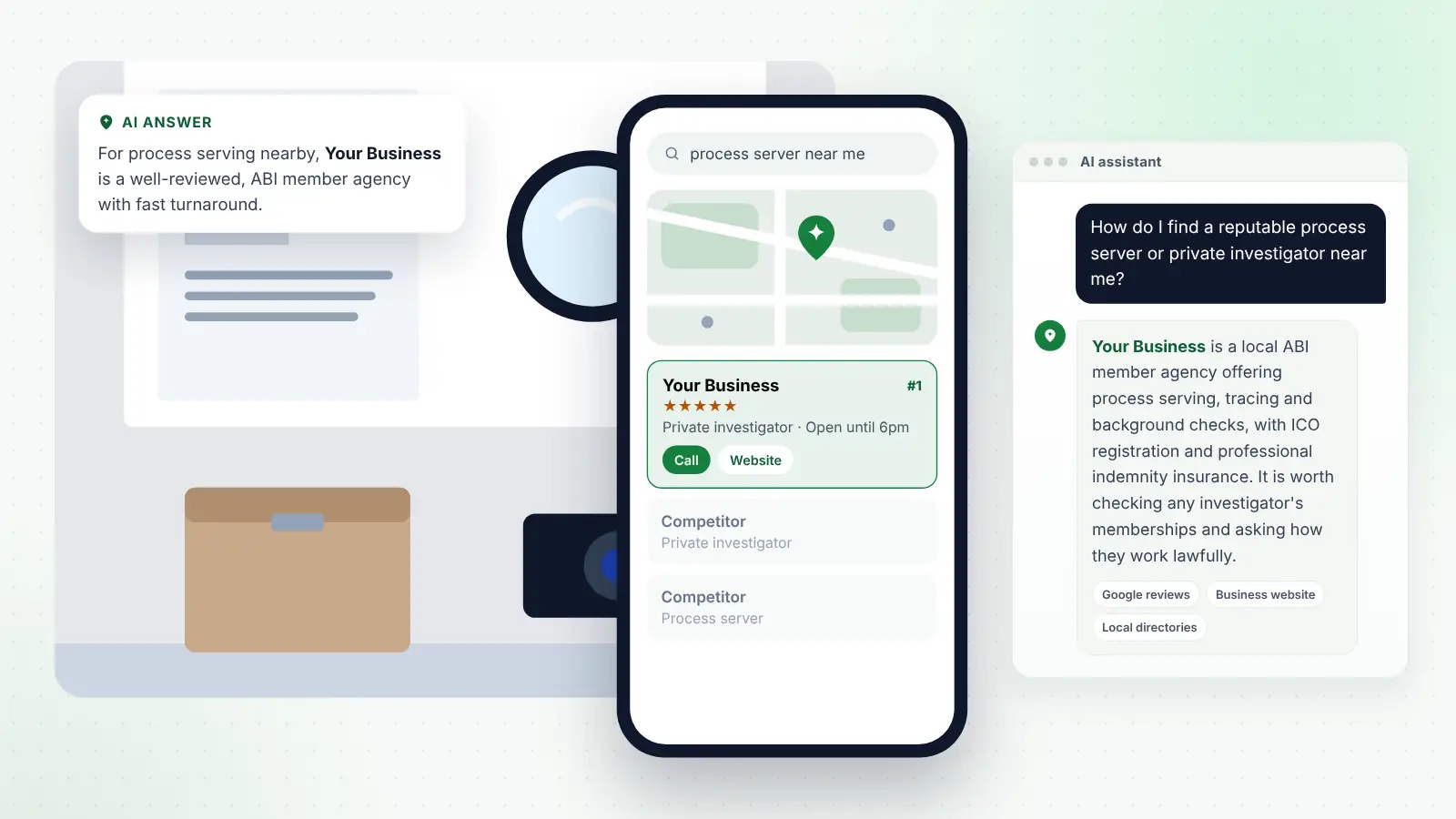
Clients increasingly put their questions to AI assistants. A landlord might ask ChatGPT “who can serve court papers near me”, a business owner might ask Gemini “how do I check out a potential business partner”, and a solicitor might ask Copilot or Perplexity “which tracing agents are ABI members in the North West”. Google’s AI Overviews answer questions like “do private investigators need a licence in the UK” directly on the results page.
Those assistants draw on what they can find and verify about an agency. For investigators, that means:
- Consistent business information across your website, directories, professional body and the ICO register.
- Reviews describing what you did well in plain language.
- Clear service descriptions explaining what you do, where and how.
- FAQ content answering real questions, such as how process serving works, how long tracing takes and what you cannot lawfully do.
- Mentions on reputable sites, such as professional directories, legal publications and local business websites.
AI tools repeat what they find, so a careless page implying you can access private records could be quoted back to a prospective client. Check periodically what the main assistants say about your business and correct outdated details at the source.
Pricing and handling enquiries
Fixed prices for process serving and basic tracing make it easy to instruct you, with clear terms for extra attempts, urgent service and travel. Surveillance and complex work is usually quoted individually, so explain how you price it, such as hourly rates, mileage and report preparation. Fees vary widely by region, so set yours from your own costs and market.
Screen every enquiry. A few questions about who the client is, what they want and why help you spot requests you cannot lawfully take on, and clients who may intend harm to the subject. Declining the wrong work politely is part of running a reputable agency.
Common mistakes to avoid
- Overclaiming. “We can find anyone” attracts the wrong enquiries and alarms professional clients.
- Out-of-date credentials. Lapsed memberships, insurance or ICO registration still shown on your site.
- Weak paperwork. Vague or late certificates of service lose solicitor clients fast.
Frequently asked questions
Do I need a licence to be a private investigator in the UK?
No. Licensing was provided for in law and announced in 2013 but never brought into force, so investigators do not need an SIA licence. Professional body membership is the best way to show you are accountable.
Should I join the ABI or the IPI?
Both are credible. The ABI is the body most solicitors recognise, thanks to its vetting and its partnership with the Law Society, and it runs the ICO-approved GDPR code for the sector. The IPI focuses on professional standing and education. Choose based on the clients you serve and the support you want.
Do I need to register with the ICO?
Almost certainly. Most businesses processing personal data must pay the data protection fee, and solicitors and insurers often check the ICO register before instructing an agency.
Can I advertise matrimonial investigations?
You can describe lawful help with family and relationship matters, carefully. Explain that you screen instructions, work within the law and decline work where there are safety concerns. Many investigators prefer to take this work through family solicitors.
How soon will an agency notice more instructions from search?
A cleaner profile and corrected directory entries can lift process-serving enquiries within weeks. Climbing the map and being named by AI tools for investigation work normally takes three to six months, depending on local competition.
Next steps
In an unlicensed sector, you have to show your trustworthiness clearly. Get your memberships, ICO registration, insurance and data protection policies in order, and write down what you will and will not do. Then build your presence where clients look: a complete Google profile, consistent listings, clear service pages and helpful answers to real questions. Done well, that brings more of the work you want and less of the work you would have to turn down.