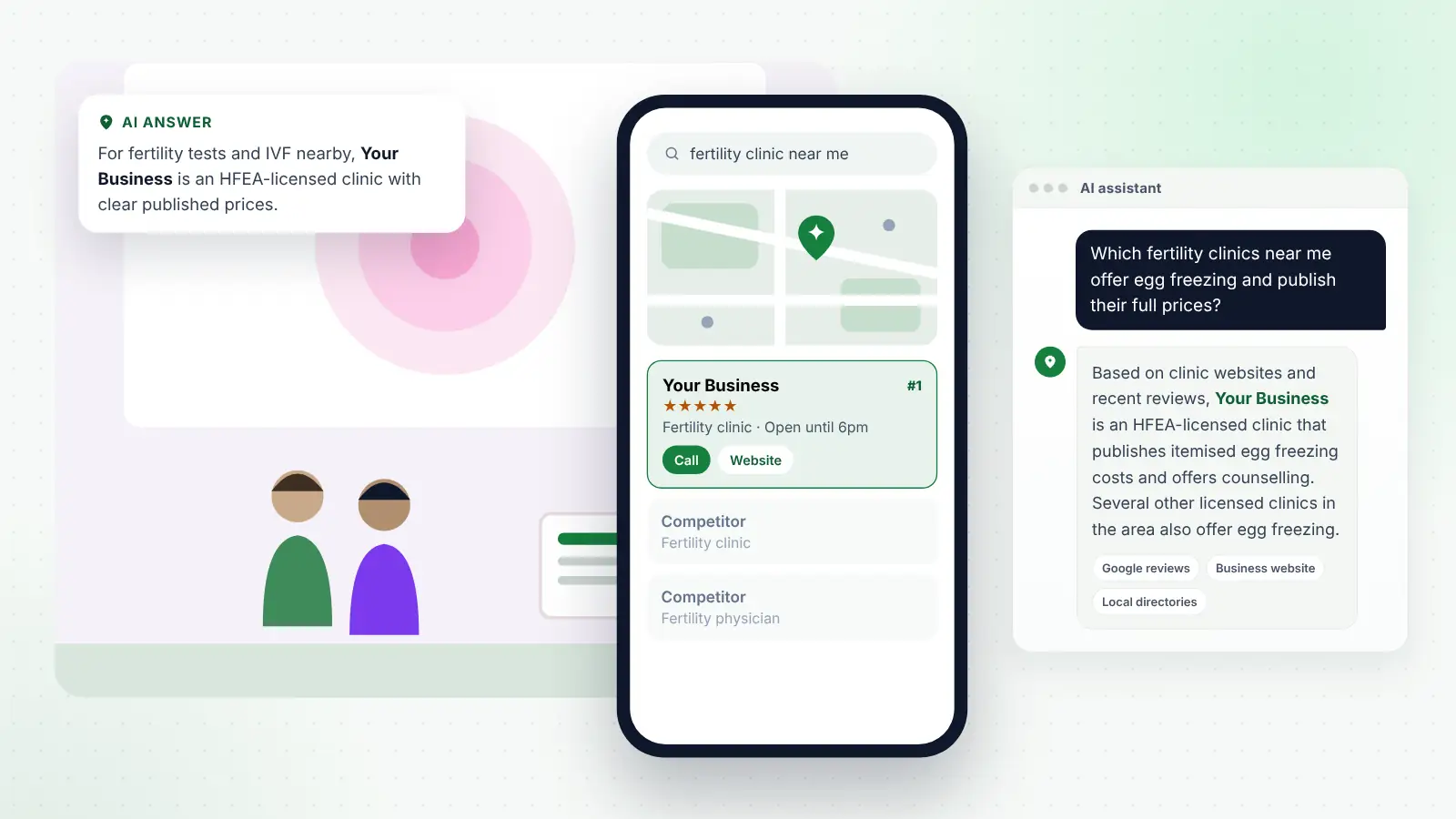
Few people choose a fertility clinic lightly. Some have been trying to conceive for years, some have just learned what the NHS will fund in their area, and others are freezing their eggs or starting a family alone or with a same-sex partner. They are often anxious, well read and wary of anything that sounds like a sales pitch, and they are about to spend a significant sum on treatment that cannot promise a baby.
Tactics that work elsewhere, such as limited-time offers, bold success figures and “book today” urgency, sit uncomfortably with patients and often with the regulators. The clinics that grow steadily do something quieter: they make their licence, team, costs and results easy to find and understand, answer difficult questions honestly and make the first step feel manageable.
This guide is for private clinics in the UK offering IVF, IUI, egg freezing, donor treatment and fertility tests. It is general information, not legal or regulatory advice, so check anything specific against current HFEA, CMA and ASA guidance.
Key points
- Patients research for months, so clear, calm information matters far more than promotion.
- Success rates must be presented in context: explain the measure, keep figures current, avoid league tables and point patients to the HFEA’s Choose a Fertility Clinic tool.
- Describe treatment add-ons in line with the HFEA’s five-colour ratings, with costs shown separately.
- The CMA expects pricing to show what is and is not included, including drugs, tests and storage, before treatment begins.
- Inclusive wording and dedicated pages show LGBTQ+ people and solo parents that your clinic is for them.
- Local SEO and AI search reward the same things patients value: accurate, consistent information, genuine reviews and clear answers to common questions.
In this guide
- How people choose a fertility clinic
- The rules that shape fertility marketing
- Pricing that patients can understand
- NHS funding, self-funding and the local picture
- Egg freezing: clear, honest information
- Counselling and support as part of your offer
- Inclusive information for LGBTQ+ people and solo parents
- Reviews, stories and privacy
- Local SEO for fertility clinics
- AI search: how patients now research clinics
- Frequently asked questions
- Final thoughts
How people choose a fertility clinic
Most fertility patients research privately for a long time before they make contact:
- Early reading about tests, treatments and what affects the chance of success.
- Understanding NHS options through their GP and local funding policy.
- Shortlisting licensed clinics within reach, because treatment involves frequent scans.
- Comparing websites, HFEA data, prices and reviews.
- First contact, often an information evening, call or consultation.
- Deciding, usually after a costed treatment plan and time to think.
Different groups arrive with different needs, and your website should speak to each directly.
| Patient group | What they often search or ask | What they need to see |
|---|---|---|
| Couples with fertility problems | “IVF clinic near me”, “private IVF after NHS cycle” | Clear pathways, full costs and realistic outcomes |
| People planning egg freezing | “egg freezing near me”, “egg freezing cost UK” | Honest guidance on age, storage costs and the law |
| Same-sex female couples | “IVF for same-sex couples”, “shared motherhood IVF” | Donor options, legal parenthood information and inclusive language |
| Solo parents | “single woman IVF clinic”, “donor sperm IUI near me” | A clear solo route, donor information and counselling |
| People wanting tests first | “fertility test near me”, “private AMH test” | What each test can and cannot show |
Every group needs information and reassurance rather than persuasion.
The rules that shape fertility marketing
Fertility clinics work under an unusually detailed, overlapping set of rules.
HFEA licensing and inspection
In the UK, clinics offering IVF, donor treatment and the storage of eggs, sperm and embryos must be licensed by the Human Fertilisation and Embryology Authority, which inspects clinics and publishes its reports. Your licence is one of the most reassuring things a patient can check, so mention it on treatment pages and link to your clinic’s page on the HFEA website.
Success rates and Choose a Fertility Clinic
The HFEA’s Choose a Fertility Clinic tool lets patients look up every licensed clinic, with verified data on treatments and births. In January 2026 it was updated with data covering January 2022 to December 2024, so check the current figures before you quote any.
The HFEA has long said that league tables of clinics are not meaningful, because results depend heavily on patients’ ages, causes of infertility and treatments used. Regulators have asked clinics to explain the measure behind any success rate, remove out-of-date or exaggerated figures and drop superiority claims they cannot substantiate. In practice:
- Use a few clearly labelled figures rather than a wall of percentages.
- Say what each measures, the age group and the period covered.
- Avoid “best”, “highest” or “leading” unless you can prove it like for like.
- Link to your clinic’s page on Choose a Fertility Clinic.
Treatment add-ons and the HFEA ratings
Add-ons are optional extras offered alongside standard treatment, and regulators watch them closely. In October 2023 the HFEA introduced improved ratings for fertility treatment add-ons, often described as a traffic-light system. There are five colours: green where high-quality evidence shows an add-on is effective, yellow where evidence conflicts, grey where there is not enough good evidence to rate it, black where evidence shows no effect, and red where there are possible safety concerns or it may reduce effectiveness.
Under the HFEA Code of Practice, clinics must give patients a clear idea of what an add-on involves, how likely it is to improve their chances and what it costs, and must link to the HFEA ratings. On your website, list each add-on with its rating, price and a plain explanation, and never present one as something most patients should have.
Consumer law: the CMA’s guidance
In June 2021 the Competition and Markets Authority published consumer law guidance for fertility clinics, covering information for patients, fair commercial practices, contract terms and complaints. Its later compliance review asked clinics to be open about costs before a cycle begins, to show clearly what a package price includes and excludes, and to give accurate, personalised pricing after the first consultation. Since April 2025 the unfair commercial practices rules have sat in the Digital Markets, Competition and Consumers Act 2024, which the CMA describes as broadly similar to the regulations they replaced.
Advertising rules: the ASA and CAP Code
All your marketing, including your website and social media, must follow the CAP Code. In 2021 the ASA issued an Enforcement Notice on fertility treatments, jointly with the CMA and HFEA, covering prices, success rates, add-ons and complementary therapies. ASA monitoring of paid fertility clinic ads between September 2024 and October 2025 found compliance was high by the end of that period, after clinics were asked to change ads with unproven “best” claims or success rates presented without proper context, and the HFEA has reminded clinics to handle the subject sensitively and avoid giving false hope about success or costs.
Tip
Before publishing any page, ask one question: could a patient reasonably read this as a promise? If the answer is yes, rewrite it in plainer, more conditional language.
Pricing that patients can understand
Cost is one of the biggest worries for self-funding patients. The cost of the same treatment can vary considerably between clinics, and headline quotes may leave out drugs, freezing or administration.
A clear pricing page usually includes:
| Item | What to show |
|---|---|
| Consultations and tests | Initial consultation, scans, AMH tests, semen analysis |
| Treatment packages | What each package includes and excludes, in plain words |
| Medication | A typical range, explaining that it varies by person |
| Freezing and storage | Embryo, egg or sperm freezing, and annual storage fees |
| Add-ons | Each add-on’s price alongside its HFEA rating |
| Regulatory fees | Any HFEA fee you pass on to patients |
Make clear that each patient receives an individual costed treatment plan after their first consultation, and that the figures can be revised if the treatment itself changes. If you offer multi-cycle or refund programmes, set out eligibility, what counts as a cycle and the conditions close to the headline price. Avoid “from” prices that few patients would actually pay.
NHS funding, self-funding and the local picture
NHS fertility funding varies widely. In England, integrated care boards (ICBs) decide who can have NHS treatment and how many cycles they offer, and Scotland, Wales and Northern Ireland set their own policies. NICE recommends which treatments should be provided and to whom, but local decisions differ, so one area may offer three IVF attempts while another offers one or none. Some areas also define a “cycle” differently, which affects whether frozen embryo transfers are covered.
A calm, factual page explaining how NHS and private treatment fit together can be one of the most useful on your site. Explain that eligibility is set locally, suggest patients ask their GP and check their ICB’s policy, and describe what self-funding involves. If you treat NHS-funded patients, say which areas. Never frame NHS limits as a reason to hurry.
Egg freezing: clear, honest information
People considering egg freezing are often planning years ahead. They need honest information about how age affects the chance of success, how many eggs may be needed, what the process involves and what it costs over time, including storage.
The law on storage changed on 1 July 2022. Eggs, sperm and embryos can now be stored for up to 55 years for a patient’s own treatment, but patients storing for their own use must renew their consent every 10 years. Explain this simply and tell patients how you will contact them about renewal. Fertility preservation before cancer treatment or hormone therapy deserves its own page, written for people who may need to act quickly.
Counselling and support as part of your offer
Counselling is not an optional extra in fertility care. Before treatment involving donated eggs, sperm or embryos, or embryos created outside the body, patients and any partner treating with them must be given a suitable opportunity to receive proper counselling, along with relevant information. For donor treatment, that information includes why it helps to tell a donor-conceived child early about their origins and how to do so.
Explain who your counsellors are, when patients can see them, whether sessions are included in the price, and that support is there at every stage, including if treatment does not work. It shows the kind of clinic you are.
Tip
Write your counselling page for someone having a difficult week. Short paragraphs, a named contact and a simple way to book are kinder than a long description of services.
Inclusive information for LGBTQ+ people and solo parents
Same-sex couples, trans and non-binary people and solo parents make up a significant share of many clinics’ patients, yet websites are often written as if every patient is a heterosexual couple. Small details show people they are welcome: wording such as “you and your partner, if you have one”, inclusive forms and images of different families.
Give each group a clear page explaining the routes available, such as donor IUI, IVF with donor sperm, or shared motherhood IVF where one partner provides the eggs and the other carries the pregnancy. Explain legal parenthood consent in plain language, because getting it right matters for the family. The HFEA notes that same-sex couples and single women without known fertility problems may be asked to self-fund a set number of IUI cycles before NHS testing or treatment, and this varies by area, so be careful not to state a single rule.
Donor information matters to everyone using donated eggs or sperm. Donors who registered from April 2005 are identifiable, which means donor-conceived people can apply for identifying information about their donor once they reach 18. Explain this openly, alongside likely waiting times for donors.
Reviews, stories and privacy
Reviews help patients choose, but fertility is deeply personal and many patients, including those whose treatment did not work, prefer not to share anything. Never pressure anyone, never offer incentives for reviews and never write or arrange them on a patient’s behalf.
A short invitation at a natural point, such as after a first consultation or at discharge, gives those who want to share an easy way to do so. Keep replies brief and never confirm clinical details or that someone is a patient. For patient stories, get written consent, let the patient approve the wording and avoid implying their outcome is typical.
Local SEO for fertility clinics
Even patients willing to travel usually start close to home, because treatment involves frequent scans at short notice. They search “fertility clinic near me”, “IVF clinic [city]”, “egg freezing [town]” or “fertility test near me”, and they look at the map, the star ratings and the first few websites.
The core local SEO work for a fertility clinic is:
- Google Business Profile. Choose the best-fitting primary category, such as fertility clinic, and only secondary categories that genuinely apply. List treatments and tests as services, keep hours accurate, including early scan times, and add real photos of your clinic and team.
- Separate profiles where patients are genuinely seen. If you have satellite sites with staff and set hours, each may have its own profile. Do not create profiles for addresses where you have no real presence.
- Reviews. Genuine reviews, gathered sensitively, help both visibility and decisions.
- Consistent details. Your name, address and phone number should match everywhere, including health directories and your HFEA listing.
- Treatment and patient pages. A page for each treatment and test, plus pages for groups such as solo parents and same-sex couples, gives Google and patients a clear picture. Avoid thin copies of the same page for different towns.
- Local links and mentions. Real relationships with local health services, support groups and employers offering fertility benefits produce links that reflect genuine standing.
This work builds over months, with stronger results usually showing over three to six months. If your team would rather stay focused on patients, specialist SEO for fertility clinics that respects HFEA and ASA guidance is one option. Whoever does it, make sure every page is reviewed by your clinical and compliance team before it goes live.
AI search: how patients now research clinics
Many people now ask AI assistants such as ChatGPT, Gemini, Perplexity and Copilot about fertility treatment, and Google often shows an AI Overview above the normal results. The questions are detailed and personal: “how much does IVF cost privately in the UK?”, “which clinics near me offer egg freezing?”, “can a single woman have IVF?” or “what does a grey add-on rating mean?”.
AI assistants draw on sources they can find and check, such as the HFEA register, your website and reputable mentions. For a fertility clinic, that means:
- Clear treatment and cost pages. Plain descriptions of each treatment and its full cost are easy for AI tools to quote.
- Consistent facts. Your licence, address and treatments should match everywhere.
- Genuine reviews. Assistants often summarise review themes, such as kindness and clear communication.
- Well-written FAQs. Answer the questions patients ask on the phone, honestly and in their words.
- Reputable mentions. Coverage on local news, patient organisation and health sites builds credibility.
Accuracy matters even more here, because an assistant may repeat a figure out of context. Keep success rates labelled and current, and update or remove older pages with outdated prices.
Frequently asked questions
Can we advertise our success rates?
Yes, with context. Explain what each figure measures and the period covered, link to the HFEA’s data, and avoid league tables or wording that suggests a patient’s own chance of success.
Do we have to show the HFEA rating for add-ons?
Clinics must link patients to the HFEA ratings and explain each add-on’s likely benefit and cost. Showing the rating beside each add-on is the clearest way to do this.
Can we offer discounts or promotions?
Be very cautious. Time-limited offers can pressure people making a difficult decision, and any promotion must be transparent and not mislead. Clear, stable pricing usually builds more trust.
How should we talk about egg freezing and age?
Honestly and without alarm. Explain how age affects outcomes, set out storage costs and the 10-year consent renewal, and never present freezing as a guarantee of a future family.
Final thoughts
The clinics people recommend are usually the ones that made a stressful time a little easier: clear about costs, honest about chances, kind and easy to reach. Marketing that reflects those qualities is safer under HFEA, CMA and ASA rules, and it is what patients, Google and AI assistants respond to. Start with your treatment, pricing and counselling pages, make sure your licence and team are easy to check, and let steady, accurate visibility do the rest.