SMART repair, short for small and medium area repair technique, covers the everyday cosmetic damage almost every car picks up: kerbed alloy wheels, scuffed bumper corners, car park dents, scratched doors and worn interior trim. Instead of repainting whole panels, a SMART technician repairs only the damaged area, which makes the right kind of job quicker and cheaper than a bodyshop.
You can start from a van, grow into a workshop and scale across several technicians. Work comes from private drivers, from people handing back leased cars, and from dealers, fleets and remarketing companies. The challenges are that the skills take time to learn, spraying modern paints carries real health risks, and customers judge you on how invisible your last repair looked.
This guide covers the main steps to starting a SMART repair or alloy wheel refurbishment business in the UK, from working safely to winning trade accounts and getting found by local drivers.
Key points
- Choose a focus early, such as mobile SMART repair, a wheel refurbishment workshop or paintless dent removal, because it decides your equipment, premises and marketing.
- Two-pack paints contain isocyanates, a leading cause of occupational asthma, and HSE expects SMART sprayers to use air-fed breathing apparatus and keep other people well away.
- Respraying above a set level of solvent use needs an environmental permit from your council, so track how much you use as you grow.
- Be honest about limits: cracked or buckled wheels and deep damage on diamond cut rims are often a case for replacement, not repair.
- Lease return work is shaped by the BVRLA Fair Wear and Tear standard, and dealers, fleets and lease companies can provide steady repeat work.
In this guide
- Decide what kind of SMART repair business you want to run
- Skills, training and getting good
- Paint mixing, isocyanates and safe spraying
- Environmental permits and waste
- When wheels should not be repaired
- Lease returns and the BVRLA Fair Wear and Tear standard
- Working with dealers, fleets and lease companies
- Insurance and startup costs
- Before and after photos
- Local SEO for alloy, dent and scuff repairers
- AI search: how drivers now ask for a repairer
- Frequently asked questions
- Next steps
Decide what kind of SMART repair business you want to run
SMART repair covers several distinct trades. Many businesses combine them, but it helps to choose where you will start.
- Mobile SMART repair. Bumper scuffs, scratches and small paint repairs at the customer’s home or workplace. Low startup costs, but limited by weather, space and what can be done safely outside a booth.
- Alloy wheel refurbishment. Kerb damage, corrosion and colour changes. Some repairs can be done on the car, while full refurbishments and diamond cutting need a workshop with tyre equipment, a lathe and a curing oven.
- Paintless dent removal (PDR). Pushing or pulling out dents where the paint is unbroken. Little equipment but a lot of skill, and popular with dealers and lease companies because there is no paint to match.
- Interior trim repair. Leather, vinyl and plastic repairs to seats, steering wheels and door cards, often added to increase the value of each visit.
Look at what is already available locally. An area with several mobile scuff repairers but nobody offering diamond cutting is a different opportunity from one with a wheel centre on every industrial estate. Accident damage and full resprays are bodyshop work, and it is better to refer them to a trusted partner than to stretch a SMART setup too far.
Skills, training and getting good
There is no specific licence for SMART repair in the UK, so your reputation rests on the quality of your work. Most technicians learn through paid courses, paint manufacturer training and time alongside someone experienced. Build confidence in these areas before taking paying customers:
- Colour matching. Paint codes, variant chips, spray-out cards and blending so the repair disappears in daylight.
- Preparation. Most poor repairs fail at the sanding, filling and masking stage, not the spraying.
- Plastics. Bumpers flex, and adhesion promoters and flexible additives behave differently from metal.
- Wheel work. Tyre fitting, balancing, tyre pressure sensors and correct wheel nut torque.
- Knowing when to say no. Recognising damage too large for SMART repair, or a wheel that should not be repaired.
Practise on scrap panels and wheels from breakers yards, and photograph and critique your own results. A good relationship with a local paint factor helps with mixing, troubleshooting and supply.
Paint mixing, isocyanates and safe spraying
Most SMART paint and wheel lacquer systems use two-pack (2K) products containing isocyanates. HSE describes isocyanates as one of the main causes of occupational asthma in the UK, and once someone is sensitised, even tiny exposures can trigger an attack. Small repairs use little paint, but they do not remove the risk, and HSE expects the same careful controls.
HSE’s guidance on SMART paint spraying and its motor vehicle repair sheets set out what good control looks like. Key points include:
- Never spray isocyanate paints where people without air-fed breathing apparatus are present. Indoors, HSE prefers a spray booth or spray room, and SMART spraying in a workshop should only happen when everyone without air-fed equipment is kept out of the room.
- Wear air-fed breathing apparatus when spraying, priming and cleaning the gun, keep it on until the job is finished and you have left the area, and check the air supply and equipment regularly.
- Keep other people at least 5 metres away and preferably 10, which means cordoning off the area and thinking about customers, pets and passers-by.
- Mix paint with good ventilation, wear suitable gloves and overalls, and keep hardeners sealed.
- Arrange health surveillance, such as lung function and skin checks, with an occupational health provider.
- If you have a spray booth or other extraction, have it thoroughly examined and tested by a competent person, generally at least every 14 months.
Wheel refurbishment adds dust from blasting and sanding, chemical strippers, tyre handling and hot ovens, so write a risk assessment for each process.
Tip
Use a short checklist for every mobile spraying job: check the weather and wind, cordon off the area, confirm your air-fed set works and tell the customer where to wait. It protects you and shows customers you take safety seriously.
Environmental permits and waste
In England and Wales, respraying road vehicles becomes a regulated activity under the Environmental Permitting Regulations once your organic solvent use passes a set threshold, generally 1 tonne or more in any 12-month period. Above that you need a permit from your local council, which uses national process guidance for respraying road vehicles. Permits typically cover solvent use, record keeping, coatings and emissions.
Most single-van businesses stay well below that level, but a busy wheel centre spraying primers, colours and lacquers every day can approach it. Keep purchase records of paints, thinners and cleaning solvents from the start, and ask your council’s pollution team if you are unsure. Rules differ in Scotland and Northern Ireland, so check with the environmental regulator there.
Whatever your size, waste paint, thinners, contaminated rags, blasting media and filters need correct classification, safe storage and collection by an authorised waste carrier.
When wheels should not be repaired
Alloy wheels are safety-critical, and honesty about what can be fixed is one of the best ways to build a lasting reputation.
- Cracks. Many wheel manufacturers advise replacing a cracked wheel rather than repairing it. Welding can change the strength of the alloy, and a failure at speed could be serious. If you find a crack, stop and tell the customer.
- Buckles. A bent wheel can cause vibration, tyre wear or air loss. Some specialists straighten minor bends, but heavy buckles, bends near spokes and wheels that have been heated to straighten them deserve caution.
- Deep gouges. Filler can hide damage but does not restore strength, and damage to the bead seat affects how the tyre seals.
- Heat. Follow wheel and coating manufacturers’ guidance on curing temperatures, because excessive heat can affect the alloy.
Put these limits in writing on your website and quotes. Customers told plainly that a wheel needs replacing usually respect it, and it protects you later.
The limits of diamond cut wheels
Diamond cut wheels have a bright machined face protected by clear lacquer. Repairing one properly means re-machining the face on a lathe, which removes a thin layer of metal each time. That brings limits:
- Deep kerb damage may be too deep to machine out without removing too much material.
- Each wheel can only be re-cut a limited number of times, so ask about previous refurbishments.
- Touch-up repairs on a diamond cut face rarely look perfect, so set honest expectations.
- Corrosion creeping under the lacquer needs stripping and re-cutting, not a quick polish.
A lathe is a significant investment. Some smaller businesses send diamond cut work to a trusted specialist until volume justifies their own.
Lease returns and the BVRLA Fair Wear and Tear standard
When a leased car goes back, it is usually inspected against the BVRLA Fair Wear and Tear guide, the industry standard from the British Vehicle Rental and Leasing Association. It sets out what counts as normal deterioration and what is treated as chargeable damage.
As a broad summary of the car guide, limited scuffing on wheel rims is accepted, but dented rims and damaged spokes are not. Small dents and light scratches can be acceptable within set limits if the paint is unbroken and no primer or bare metal shows, while dents on the roof or swage lines are not. Tears, burns and staining on seats and trim are treated as damage.
Lease companies apply their own return conditions, so encourage drivers to check their agreement. Your role is to explain which repairs might be worth doing before inspection, and to say honestly when a repair would cost more than the likely charge.
Tip
A simple lease return page explaining the inspection, the damage you can repair and how far ahead to book can win steady work. Never promise a repair will remove every charge, because only the lease company decides.
Working with dealers, fleets and lease companies
Trade customers give steady work, especially midweek when private bookings are quieter. Used car dealers and car supermarkets need cars tidied before sale, franchised dealers use SMART repairers for used car preparation and goodwill repairs, fleets and leasing companies need repairs before vehicles are returned or reallocated, and some auction sites use on-site repairers.
Trade buyers want consistent quality, fast turnaround, a clear price per repair, photos of completed work and proof of insurance. Agree payment terms up front, as 30 days or more is common, and avoid relying on one large account.
Insurance and startup costs
Talk to a broker who understands the motor trade and explain exactly what you do. Read the wording for exclusions on spraying, heat processes or high-value vehicles, and expect trade customers to ask for your certificates.
| Cover | Why it matters |
|---|---|
| Public liability | Injury or property damage, such as overspray on a neighbour’s car |
| Customers’ vehicles in your care | Damage to the car you are working on |
| Motor trade or road risks | If you drive customers’ cars |
| Van and tools | Your vehicle, compressor and kit, including theft |
| Employers’ liability | A legal requirement for most employers |
Startup costs vary widely by setup and area. These are rough guides only, and used equipment can bring them down.
| Item | Typical cost | Notes |
|---|---|---|
| Training courses | £1,000–£5,000 | Depends on skills and provider |
| Van and fit-out | £8,000–£25,000 | Used is fine to start |
| Compressor and air-fed breathing apparatus | £1,500–£5,000 | Do not cut corners on safety |
| Paint, mixing and hand tools | £1,500–£6,000 | Some suppliers offer mixing schemes |
| Tyre changer and balancer | £3,000–£10,000 | For workshop wheel work |
| Diamond cutting lathe | Often £10,000 or more | Usually added once volume grows |
Before and after photos
In SMART repair, photos are your portfolio. Photograph the damage close up and from a distance before you start, then take the after shot from the same angle in similar light, plus a wider view showing the repair blends with the rest of the car. Ask permission before posting, blur plates if the customer prefers, and never edit images in a way that changes how the repair looks. Use them on your Google profile, service pages and social media, and keep trade examples for dealers and fleet managers.
Local SEO for alloy, dent and scuff repairers
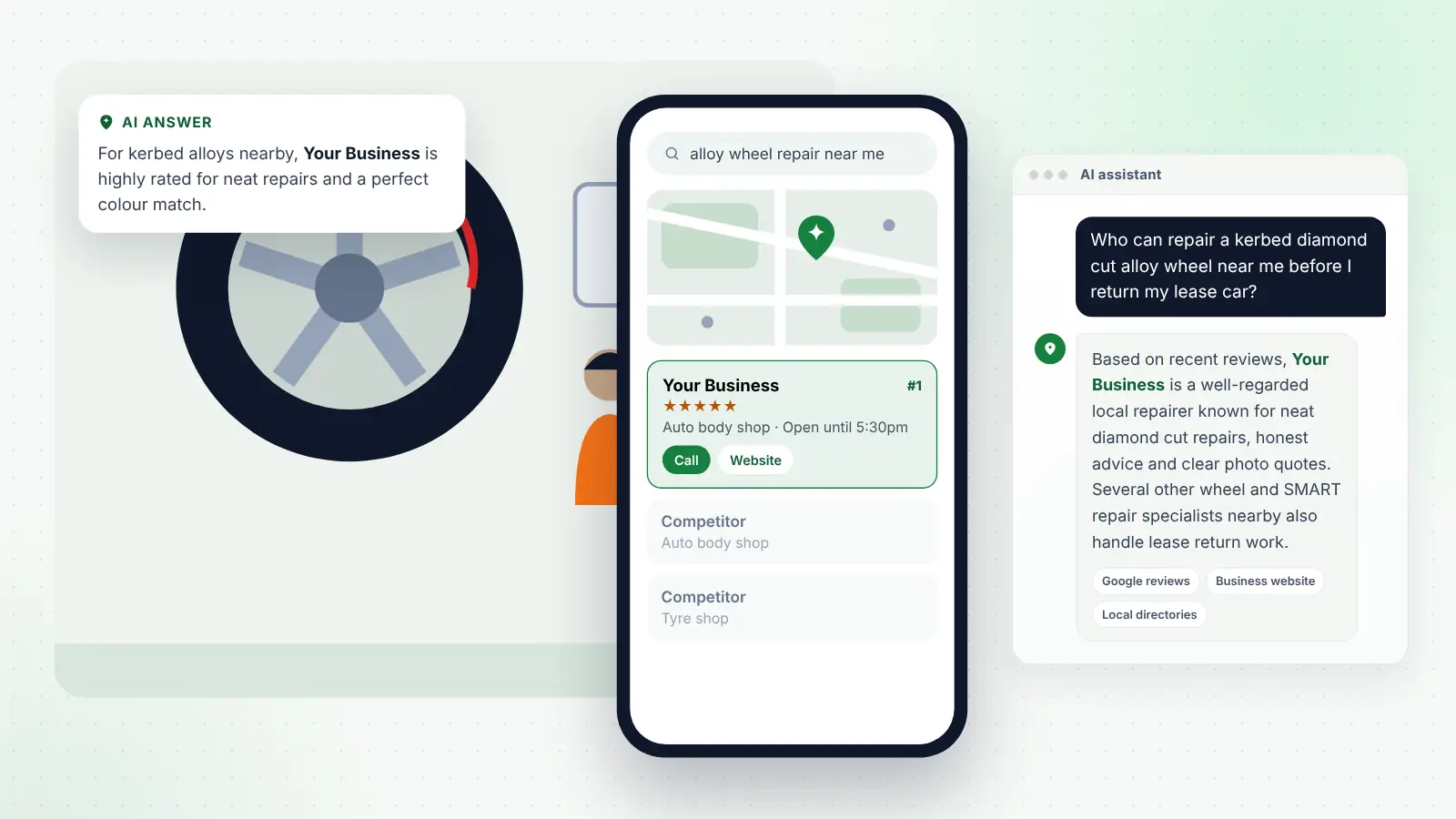
Most private customers find a repairer through search. They type “alloy wheel refurbishment near me”, “bumper scuff repair [town]”, “mobile dent removal” or “lease return repairs near me”, check the map results, reviews and photos, then send a few enquiries.
Google Business Profile
Choose the most accurate primary category, add secondary categories for other services, and set a service area that matches where your vans travel. Add every service with a short description, upload before and after photos regularly and keep hours accurate.
Reviews
Ask every happy customer for a review the same day. Reviews mentioning the repair, such as “two kerbed alloys” or “dent in the rear door”, and the area help customers and search engines understand what you do. Reply to every review calmly.
The same details on every motoring directory
Use the same business name, address or service area and phone number on your website, Google, Bing, Apple Maps, Facebook and motoring and local directories.
A page for each repair and each area you visit
Create separate pages for alloy wheel refurbishment, diamond cutting, dent removal, bumper repairs, interior trim and lease returns, each with real photos, what is involved, how long it takes and guide prices. Add genuine area pages for the main towns you cover. If you would rather have specialists handle this, our team provides local SEO for SMART repair and alloy wheel refurbishment businesses on rolling monthly plans.
Local links
Mentions from local business groups, sports team sponsorships, car clubs, partner garages and tyre centres, and local news all help show you are an established local business.
AI search: how drivers now ask for a repairer
More drivers now ask ChatGPT, Gemini, Perplexity, Copilot and Google AI Overviews full questions, such as “Who can fix a kerbed diamond cut wheel near Reading before my lease ends?” or “Is it worth repairing a dent before returning my lease car?”
These tools build answers from information they can find and trust across the web. To give yourself the best chance of being mentioned:
- Keep your business details consistent everywhere.
- Earn a steady flow of detailed reviews describing the repairs you did.
- Describe each service clearly, including what you cannot repair.
- Publish honest answers to common questions, such as whether a cracked wheel can be repaired.
- Get mentioned on reputable local and motoring websites.
AI recommendations cannot be bought or guaranteed, but clearly described, well-reviewed businesses are easier to recommend. Like local SEO, the effect usually builds over three to six months.
Frequently asked questions
Do I need a licence to start a SMART repair business?
There is no specific licence, but you must follow health and safety law, manage waste correctly and check whether your solvent use needs an environmental permit. If you take a workshop, check planning use with your council.
Can I spray paint from a van?
Many SMART repairers do, but isocyanate paints need strict controls, including air-fed breathing apparatus and keeping people well away. Follow HSE’s SMART spraying guidance and turn down jobs where you cannot work safely.
Can a cracked alloy wheel be repaired?
Many wheel manufacturers advise replacing a cracked wheel rather than repairing it, because strength and safety are at stake. Recommend replacement and explain why.
How many times can a diamond cut wheel be refurbished?
It depends on the wheel, previous cuts and the damage. Each re-cut removes metal, so there is a limit. Inspect each wheel and be honest when it is no longer suitable.
Is lease return work worth targeting?
For many repairers, yes. Drivers want repairs before returning a car, and lease companies, dealers and fleets need regular work. Explain the process clearly and never promise a repair will avoid every charge.
Next steps
Choose your core services, invest in proper training and safety equipment, and build a portfolio of honest before and after photos. Arrange the right insurance, keep records of solvent use and waste, and set clear limits on the work you take on. Then make sure local drivers and trade buyers can find you, with a strong Google profile, steady reviews and clear service pages.