A blocked ear feels like a small problem until you have one. Sounds go muffled, there may be ringing or pressure, and hearing aids can whistle or stop working properly. People want it sorted quickly, and in many parts of England they can no longer simply book the practice nurse. That has created steady demand for private ear wax removal from nurses, audiologists, hearing aid dispensers, pharmacists and dedicated ear care clinics.
An ear wax removal service needs less space and equipment than many health businesses, but it is still a clinical service. You need proper training, the right registration and insurance, sensible safety procedures and honest marketing. This guide covers the practical steps in the UK, focusing on England, where some rules differ from Scotland, Wales and Northern Ireland.
Key points
- NICE guideline NG98 recommends ear wax removal in primary care or community ear care services when wax is causing symptoms, and advises against manual syringing.
- NHS ear wax removal varies widely between areas in England, which is why many people now search for private clinics.
- There is no single national licence, but practitioners should be trained and assessed in each method they use and hold the right registration and insurance.
- In England, ear wax removal is a CQC regulated activity when a listed health care professional, such as a doctor or nurse, agrees treatment is needed and carries it out, so whether you must register depends on who treats patients.
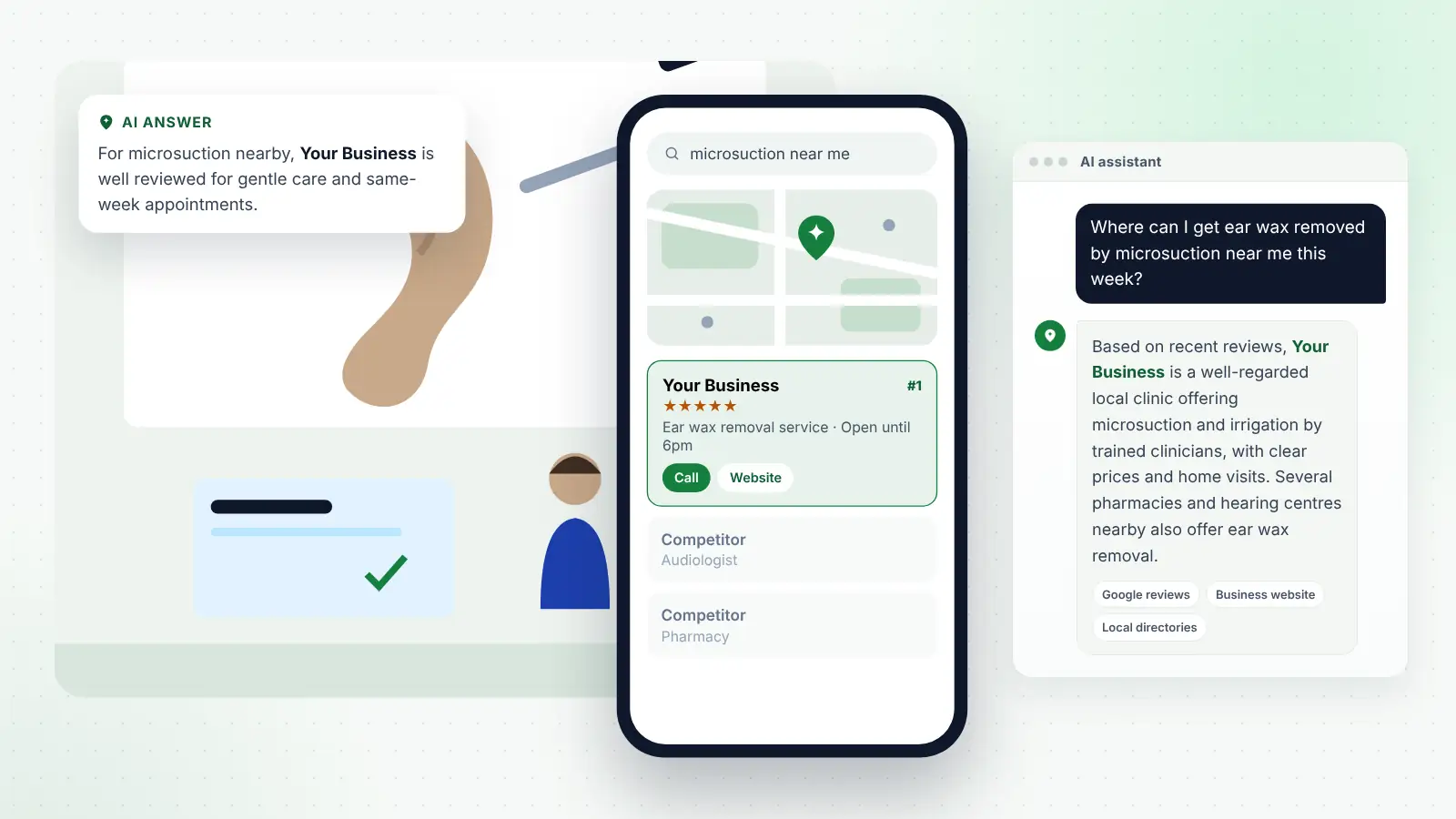
- Most patients search for a method and a timescale, such as “microsuction near me” or “ear wax removal today”, so build your visibility around those searches.
In this guide
- Understand the demand and the NHS picture
- Choose your clinic model
- Who can remove ear wax: training and registration
- CQC registration and insurance
- Know the red flags and when to refer
- Run home visits safely
- Equipment and rough start-up costs
- Price your services clearly
- Advertise responsibly
- Local SEO: helping patients find your clinic
- AI search: being recommended by AI assistants
- Build referrals and repeat patients
- Frequently asked questions
- Final thoughts
Understand the demand and the NHS picture
The National Institute for Health and Care Excellence (NICE) published its guideline on hearing loss in adults, NG98, in 2018. It recommends offering ear wax removal in primary care or community ear care services when wax contributes to hearing loss or other symptoms, or must be removed to examine the ear or take an ear impression. It suggests electronic irrigation, microsuction or another method such as manual removal with instruments, provided the clinician is trained and has the right equipment. It also says adults should not be offered manual syringing.
NHS provision has not kept pace with that guidance. Many GP practices no longer routinely remove ear wax, and some areas commission a community service while others do not. In January 2024, RNID reported that fewer than half of integrated care boards in England fully commissioned ear wax removal in line with guidance. Local arrangements change, so check what your own integrated care board currently provides.
That gap explains much of the growth in private ear care. It also means some patients arrive frustrated or assuming a blocked ear is all that is wrong. A good clinic is calm, clear about prices and confident about when to refer someone back to their GP.
Choose your clinic model
Many services combine more than one of these:
- Standalone clinic. A dedicated room with good lighting, a treatment chair and a sink. Strong visibility, but higher rent.
- Room in a pharmacy, hearing centre, opticians or GP surgery. Lower overheads, built-in footfall and referrals from the host.
- Home and care home visits. Valuable for older and less mobile patients, often booked by family members.
- An added service. Nurses, audiologists and pharmacists often add ear care to work they already do.
Common patient groups include hearing aid wearers, older people, people who use earbuds or ear plugs, swimmers and anyone told their GP practice no longer offers the service. Step-free access, parking and easy booking matter to all of them.
Who can remove ear wax: training and registration
There is no single protected profession for ear wax removal. Services are typically run by:
- Nurses registered with the Nursing and Midwifery Council (NMC).
- Hearing aid dispensers registered with the Health and Care Professions Council (HCPC), and audiologists, who may be HCPC registered or on the Academy for Healthcare Science (AHCS) accredited register.
- Pharmacists registered with the General Pharmaceutical Council (GPhC).
- Doctors, including GPs and ENT surgeons.
ENT UK’s clinical guidance on microsuction says it should only be performed by properly trained clinicians, that audiologists and nurses should complete an aural care course followed by supervised mentoring before working independently, and that clinicians should be registered with a regulator or accredited register. Non-healthcare staff should not perform microsuction.
Training routes
Training is offered by NHS-linked ENT and audiology teams, private ear care training providers and some equipment companies, including courses designed for pharmacy teams. Good courses usually include:
- Anatomy and assessment. Recognising a normal ear canal and eardrum, and common abnormalities.
- Method-specific skills. Separate training in irrigation, microsuction or instrument removal.
- Supervised practice. A set number of supervised procedures and a competency sign-off.
- Referral and complications. When to stop, when to refer and how to manage pain, bleeding or dizziness.
- Infection prevention and records. Decontamination, consent and clinical notes.
Endoscopic ear wax removal, using a video endoscope so patients can see their ear on screen, is increasingly popular but still needs specific training. Keep certificates and competency records for every method, and keep your skills current through continuing professional development.
Tip
List each method you are trained in, and who performs it, on your website and booking page. Patients searching for a specific method want to know you genuinely offer it, and clear information also helps you stay within your insurance cover.
CQC registration and insurance
In England, the Care Quality Commission (CQC) has published guidance on whether ear wax removal providers need to register. Whatever method is used, ear wax removal is the regulated activity “treatment of disease, disorder or injury” when a listed health care professional and the person agree an intervention is needed, and a listed health care professional carries it out. Carrying on a regulated activity without registration is an offence.
The CQC’s list of these professionals is specific. It includes doctors, nurses, paramedics and clinical scientists, among others, but not pharmacists or hearing aid dispensers, and many audiologists are not on it either. So a nurse-led or doctor-led service will usually need to register, while one run solely by a pharmacist or hearing aid dispenser may not. Check the CQC’s scope of registration guidance for your own team rather than assuming either way. If you do need to register, allow time: you need a registered provider, usually a registered manager, and policies on safeguarding, infection prevention, consent, complaints and incidents. If your situation is unusual, such as a service run inside someone else’s premises, contact the CQC before you start treating patients. Scotland, Wales and Northern Ireland have their own regulators for independent health care.
Your professional indemnity and public liability insurance should explicitly cover each method you use, every practitioner and any home or care home visits. Some insurers require evidence of specific training, so confirm cover in writing.
Know the red flags and when to refer
Safe ear wax removal is as much about knowing when not to proceed as it is about technique. Take a short history and examine the ear before every procedure. Common reasons to stop, avoid a particular method or refer to a GP or ENT service include:
- Ear pain, discharge or signs of infection.
- Bleeding, or a recent injury to the ear.
- A known or suspected perforated eardrum.
- Previous ear surgery, particularly mastoid surgery.
- Sudden hearing loss, or unexplained hearing loss in one ear.
- Dizziness, vertigo or new balance problems.
- New or one-sided tinnitus.
- A foreign body, or anything you do not recognise.
Some of these rule out irrigation in particular, while others need medical assessment whatever the method. Treat sudden hearing loss as urgent. Have a written referral pathway and record your findings and advice clearly. If a procedure becomes painful, stop; rebooking after a period of softening drops is better than pushing on.
Run home visits safely
Home and care home visits meet a real need but bring risks that clinic work does not:
- Equipment. Use portable equipment with good lighting, and transport clean and used items separately.
- Infection prevention. Apply clinic standards for decontamination and dispose of clinical waste correctly.
- Positioning. Seat frail patients safely and supported, especially anyone prone to fainting.
- Consent and capacity. A relative booking does not replace the patient’s own consent, and the Mental Capacity Act applies where capacity is in doubt.
- Lone working and safeguarding. Let someone know where you are, know how to raise a safeguarding concern and make sure staff have the right DBS checks.
For care homes, agree in advance how consent is obtained and how findings are shared with staff and GPs. Set clear travel boundaries and a visit fee that covers your time.
Equipment and rough start-up costs
Costs vary widely by area, premises and whether you buy new or used. These figures are rough guides only.
| Item | Typical cost | Notes |
|---|---|---|
| Microsuction unit | £1,000–£4,000 | Portable units suit home visits |
| Microscope, loupes or endoscope | £1,000–£8,000 | Endoscopes cost more |
| Electronic irrigator and otoscope | £300–£1,500 | Only if you offer irrigation |
| Training and competency sign-off | £300–£1,500 per method | Varies by provider |
| Chair, furniture and fit-out | £500–£10,000 | Much lower if sharing premises |
| Booking and records software | £20–£150 per month | Online booking and consent forms |
| Insurance and registration | £500–£2,500 per year | Indemnity, liability, CQC fees |
Budget for consumables such as specula, suction tips and tubing, plus equipment servicing and clinical waste collection.
Price your services clearly
Patients compare ear wax prices closely, often while their ear is blocked. Clear pricing builds trust and reduces calls that never become bookings.
- One ear and both ears. Set separate prices and explain when each applies.
- If wax does not clear. Say whether a follow-up is included and what you advise in the meantime.
- Little or no wax found. Decide what you charge and say so upfront.
- Home visits. State the fee and the areas it covers.
Avoid competing on price alone. Experienced clinicians, unhurried appointments and good aftercare matter more to many patients than the lowest headline figure.
Advertise responsibly
Health advertising in the UK is covered by the CAP Code, enforced by the Advertising Standards Authority (ASA). Section 12 covers medicines, medical devices and health treatments, and objective health claims must be backed by evidence. For ear wax removal:
- Avoid absolute safety claims. The ASA’s advice on “safe” claims explains that calling something completely safe needs proof, and every method carries some risk. Describe how you reduce risk instead.
- Be careful with “pain-free” and “guaranteed”. Most people find microsuction comfortable, but not everyone, and not every ear clears in one visit.
- Never discourage medical care. Your service does not replace seeing a GP for pain, infection or sudden hearing loss.
- Evidence comparisons. Claims that one method is better than another need support.
Your Google profile, social posts and reused reviews count as marketing too, so apply the same care everywhere.
Local SEO: helping patients find your clinic
Ear wax removal is a local and often urgent search, and many people book the same day. Typical searches include “microsuction near me”, “ear wax removal [town]”, “ear wax removal today”, “ear syringing near me”, “home visit ear wax removal”, “endoscopic ear wax removal” and “ear wax removal for elderly parent”.
The map results at the top of Google, with reviews, opening hours and booking links, are where most of those decisions are made.
Complete your Google Business Profile
Choose the primary category that best fits your service, and add others only where they genuinely apply. List each method separately with a clear description, and add opening hours, accessibility, parking, a booking link and real photos of your room and team. Set home visit service areas carefully, and if you run sessions inside a pharmacy or hearing centre, make the days clear.
Collect reviews ethically
Ask at a natural moment, such as when a patient says how much clearer things sound, and give them a simple link or card. Never offer incentives, and do not mention anything about the person’s health when replying.
Keep details consistent and build pages
Your name, address, phone number and website should match across Google, Apple Maps, Bing, health directories and partner pages. Offer email or text booking, because people with blocked ears often find calls difficult. Give each method its own plain-language page covering what happens, preparation, aftercare, price and when to see a GP instead, plus a team page showing registration and training, and pages for the main towns you cover.
Earn local and health links
Mentions from partner pharmacies and hearing centres, care homes, hearing loss charities, community groups and local news help search engines see that your clinic is established and trusted.
Local SEO builds gradually, usually over three to six months. If you would rather concentrate on patients, specialist local SEO for ear wax removal clinics can look after your profile, listings, service pages and links for you.
AI search: being recommended by AI assistants
More people now ask an AI assistant where to get help. Someone might ask ChatGPT “Where can I get ear wax removed by microsuction near me this week?”, ask Gemini for “home visit ear wax removal for my mum in [village]”, or ask Perplexity or Copilot “Is microsuction better than irrigation?”. Google’s AI Overviews also appear for many ear wax searches.
For health questions, AI tools lean on consistent, trustworthy information. For an ear wax clinic that means:
- Consistent details across your website, maps, directories and local listings.
- Reviews that mention the method used and how patients were treated.
- Clear service descriptions, so the tool can match you to “microsuction”, “endoscopic” or “home visits in [town]”.
- FAQs answering real questions: does microsuction hurt, do I need drops first, what if my wax does not clear.
- Evidence of registration, such as NMC, HCPC or GPhC status and, where it applies, CQC registration.
- Mentions on reputable sites, such as partner practices, charities and local news.
This is often called answer engine optimisation, or AEO. A clinic that states who treats patients, which methods it offers, where it works, what it charges and when it refers on is much easier for an AI assistant to recommend.
Build referrals and repeat patients
Pharmacies and opticians without ear care, GP receptionists who need somewhere to signpost patients, hearing aid audiologists, care homes and hearing loss groups can all become steady sources of referrals. Some people, particularly hearing aid wearers, produce wax regularly; explain aftercare and make rebooking easy without pushing appointments people do not need.
Tip
Track new patients by source each month. Knowing whether bookings come from search, a partner pharmacy or care homes shows you where to spend your time.
Frequently asked questions
Do I need to be a nurse or audiologist to remove ear wax?
There is no single protected profession, but clinical guidance expects practitioners to be trained, assessed and registered with a healthcare regulator or accredited register. Most services are run by nurses, audiologists, hearing aid dispensers, pharmacists or doctors.
Does an ear wax removal clinic need to register with the CQC?
In England, the CQC says ear wax removal is a regulated activity when a listed health care professional and the person agree treatment is needed and the professional carries it out, whatever the method. Listed professionals include doctors and nurses but not pharmacists or hearing aid dispensers, so the answer depends on who treats patients. Contact the CQC if you are unsure.
Can I still offer ear syringing?
NICE advises against manual syringing for adults. Electronic irrigation, microsuction and manual removal with instruments are the methods it suggests, provided the clinician is trained and equipped.
Is it worth offering home visits?
For many services, yes. They meet a real need and are often booked by family members. Price them to cover travel and follow the same safety standards as in clinic.
How long does it take to build a patient base?
Early bookings can come quickly where NHS provision is limited. Steady growth usually comes over several months as reviews, referrals and visibility build.
Final thoughts
An ear wax removal clinic meets a real local need, but it should be run as the clinical service it is. Train properly in each method, hold the right registration and insurance, settle your CQC position before you advertise, know your red flags and plan home visits with care. Then make sure people searching for microsuction or a home visit this week can find you, with a complete Google profile, steady reviews, clear service pages and consistent information that both search engines and AI assistants can trust.