Plant and tool hire is built on a simple idea: most people who need a mini digger, a breaker or a generator only need it for a few days, so they would rather rent one than buy it. The business case follows from that. Every machine you own should spend as many days as possible out earning, come back in good condition, and go out again safely after a proper check.
Doing that well is more demanding than it looks. You are buying and maintaining expensive equipment, taking on legal duties as a supplier of work equipment, writing hire terms that stand up for both trade and domestic customers, and often running delivery vehicles that bring their own licensing rules. You are also competing with national hire networks that appear prominently in search results, even in towns where they have no depot nearby.
This guide covers how to start a plant or tool hire business in the UK: choosing what to hire and to whom, the safety rules that apply to hire companies, hire terms, fuel, transport, insurance, costs and pricing, and how to make sure local trades and homeowners find you on Google and through AI assistants.
Key points
- Hire companies are treated as suppliers of work equipment, with duties to inspect, maintain and provide information on everything they hire out, plus LOLER thorough examinations for lifting and access equipment.
- Business customers are usually hired to on trade terms such as the CPA Model Conditions, while homeowners must be given terms that comply with the Consumer Rights Act 2015.
- Since April 2022, red diesel can only be used for a narrow list of purposes, so most construction plant must run on white diesel.
- Delivery vehicles and van-and-trailer combinations over 3.5 tonnes can bring operator licence and tachograph requirements.
- Most hires start with a local search, so a complete Google Business Profile, clear equipment pages and genuine reviews help you win bookings directly.
In this guide
- Choosing your hire business model
- Building your fleet
- Health and safety duties for hire companies
- Operator cards and training
- Hire terms for trade and domestic customers
- Red diesel and fuel
- Delivery vehicles, operator licences and tachographs
- Insurance
- Trade associations and accreditation
- Startup costs
- Pricing your hire
- Local SEO for plant and tool hire companies
- When trades ask an AI assistant where to hire a machine
- Common mistakes to avoid
- Frequently asked questions
- Final thoughts
Choosing your hire business model
Before you buy a single machine, decide what kind of hire business you want to run. It shapes your fleet, your premises, your staff and your customers.
- Tool hire shop — power tools, breakers, floor sanders, carpet cleaners, small access towers and garden equipment, mainly collected over the counter. Lower capital per item, lots of transactions and a strong mix of trade and DIY customers.
- Small plant hire — micro and mini diggers, dumpers, rollers, plate compactors and site equipment, usually delivered. Higher value per hire and mostly trade customers, plus homeowners doing landscaping or extension groundworks.
- Access equipment — scissor lifts, boom lifts, podiums and towers. Heavily regulated around inspection and training, and often hired to contractors and facilities managers.
- Power and site services — generators, lighting towers, welfare units, pumps and heaters. Steady demand from construction, events and emergency work.
- Operated hire — a machine supplied with a trained operator, charged by the day or hour. You take on more responsibility for how the work is done, and earn more for it.
Most new businesses start in one area and expand into others as customers ask for them. A tool hire shop might add mini diggers and dumpers; a small plant firm might add operated hire once it has reliable operators.
Tip
Before you commit to a fleet, ask local builders, landscapers and groundworkers what they hire most often and what they struggle to get. Machines that are hard to find locally at short notice usually hire out more reliably than the obvious choices everyone already stocks.
Building your fleet
Utilisation — the share of days a machine is actually out on hire — drives profit in this industry. A cheap machine that sits in the yard costs you money; a well-chosen one that is out most weeks pays for itself.
When choosing equipment, think about:
- Demand and access — micro diggers that fit through a side gate often suit domestic work, while larger mini diggers suit trades and groundworks.
- Transport — what you can tow or carry with the vehicles you have, and what licence your drivers need.
- Reliability and parts — well-known brands with good dealer support keep breakdowns short.
- Resale value — plant is often sold after a few years, so residual value matters.
- Security — tracking, immobilisers and marking schemes such as CESAR for construction machinery make theft less likely and recovery easier.
Many new firms buy good used machines with full service and inspection histories, or use finance and leasing to spread the cost. Whatever you choose, keep a clear record for every asset: purchase date, serial number, service history, inspections and hire history.
Health and safety duties for hire companies
PUWER and your duties as a supplier
The Health and Safety Executive (HSE) treats hire firms as suppliers of work equipment under section 6 of the Health and Safety at Work etc. Act 1974. That means you have broad duties for the safety of what you hire out, and duties under the Provision and Use of Work Equipment Regulations 1998 (PUWER) for equipment you control.
In practice, that includes:
- Pre-hire inspection and testing, so far as is reasonably practicable, to check for obvious safety defects.
- Planned maintenance so equipment stays safe between hires.
- Supplying user instructions and safety information with each item, and the Declaration of Conformity where relevant.
- Making sure equipment carries the correct conformity marking and labels.
According to HSE guidance, unless your hire agreement says otherwise, day-to-day and pre-use checks are the user’s responsibility, so explain clearly what the customer must check and how. The HSE’s equipment and machinery FAQs cover hire company duties in more detail.
LOLER thorough examinations
Lifting equipment — including access platforms, hoists, lifting accessories and excavators used for lifting — falls under the Lifting Operations and Lifting Equipment Regulations 1998 (LOLER). Unless an examination scheme drawn up by a competent person sets different intervals, HSE guidance says thorough examinations are due:
| Equipment | Examination interval |
|---|---|
| Lifting equipment used to lift people, such as scissor and boom lifts | Every 6 months |
| All lifting accessories, such as chains, slings and shackles | Every 6 months |
| Other lifting equipment | Every 12 months |
Examinations are often arranged by the hire company, but HSE is clear that the user still carries legal responsibility and should check there is a current report when the equipment arrives. Send a copy of the latest report with every lifting item, keep records you can produce in writing, and make sure the competent person carrying out examinations is not the same person who routinely maintains the machine. The HSE page on thorough examinations sets out what a report must contain.
If you allow excavators to be used for lifting, even occasionally, HSE guidance says they must be thoroughly examined as lifting equipment and fitted with additional safety devices such as check valves and an audible warning device. HSE also notes that excavators are often not the most suitable machine for lifting, so follow the manufacturer’s instructions and the industry guidance on lifting operations with excavators before offering it.
Other hazards to manage
Hand-arm vibration from breakers and drills, silica dust from cut-off saws, noise, and carbon monoxide from petrol and diesel engines used indoors all need clear guidance at the counter. Provide vibration and noise information, recommend suitable dust control and PPE, and never assume a homeowner knows the risks a tradesperson would.
Operator cards and training
There is no single licence required to drive a mini digger on private land, but most major construction sites will only allow operators who hold a recognised card. The two main schemes are CPCS (the Construction Plant Competence Scheme) and NPORS (the National Plant Operators Registration Scheme), both of which have cards recognised under the CSCS umbrella. Cards typically progress from a trained-operator card to a competent-operator card once the holder has gained experience and completed further assessment.
For your business, that means:
- Any operator you supply on operated hire should hold the right card for the machine and the site.
- Self-drive trade customers should be reminded that site rules, not the hire company, usually decide who can operate.
- Homeowners hiring a micro digger or dumper should get a proper handover, a demonstration and written instructions, and you should be prepared to refuse a hire if someone is clearly not able to use the machine safely.
- Your own yard and delivery staff need training on loading, securing and unloading plant.
For access equipment, IPAF training is widely expected for operators of mobile elevating work platforms, and many contractors will ask for evidence of it.
Hire terms for trade and domestic customers
Trade hire and the CPA Model Conditions
The Construction Plant-hire Association (CPA) publishes Model Conditions for the Hiring of Plant, most recently updated in 2021. They are widely used across the industry and are intended only for business-to-business hire. They deal with matters such as when the hirer becomes responsible for the plant, insurance of hired-in plant, breakdowns and the hirer’s obligations. The full documents are available to CPA members, and many hire firms use them or their own terms based on similar principles.
Homeowners and consumer law
When you hire to a homeowner for their own use, consumer law applies. Under the Consumer Rights Act 2015, hired goods must be of satisfactory quality, fit for any purpose the customer made known to you, and as described, and any service you provide (such as delivery or set-up) must be carried out with reasonable care and skill. Terms that create a significant imbalance against the consumer can be unfair and unenforceable, and important terms such as deposits, damage charges and late return fees must be transparent and prominent.
The CPA also publishes separate Consumer Conditions for hiring to the public. Whatever you use, do not simply hand trade terms to a homeowner. Take advice on your consumer terms, especially around cancellation, deposits and damage.
Tip
Write a one-page plain English summary for DIY customers covering what is included, what they must check before use, what happens if something breaks and when it must be returned. It reduces disputes and gives you something clear to point to.
Damage waivers, deposits and ID
Most hire firms take identification, proof of address and a deposit from new customers, and offer a damage waiver as an alternative to the customer arranging their own insurance. Be clear about what the waiver covers and excludes (theft and misuse are commonly excluded), and make sure staff explain it the same way every time.
Red diesel and fuel
Since 1 April 2022, rebated diesel (red diesel) can only be used for a limited list of purposes. Under HMRC’s rules, these include agriculture, horticulture, fish farming and forestry; rail vehicles; non-commercial heating and electricity generation; golf courses and community amateur sports clubs; certain marine use; and travelling fairs and circuses. Construction and general plant hire are not on the list, so most machines you hire to builders, groundworkers and homeowners must run on fully duty-paid white diesel.
The rules on who may use rebated fuel, and what happens when machines move between entitled and non-entitled users, are set out in HMRC’s Excise Notice 75 on using rebated fuels. If you hire to farmers or other entitled users as well as construction customers, read it carefully and keep clear records of how each machine is fuelled. State your refuelling policy in your hire terms, including whether machines go out full and what you charge for fuel used.
Delivery vehicles, operator licences and tachographs
Most plant hire involves delivering machines on a beavertail lorry, a plant trailer or a van-and-trailer combination. The transport side brings its own rules:
- Operator licence — GOV.UK guidance says you usually need a goods vehicle operator licence for a vehicle over 3.5 tonnes gross plated weight used in connection with a business, and usually for a vehicle and trailer combination with a combined maximum weight over 3.5 tonnes. Whether you need a restricted or standard national licence depends on how your operation is set up, so check with the Traffic Commissioner before applying.
- Tachographs — a van towing a trailer used commercially generally needs a tachograph when the combined maximum authorised mass is more than 3,500kg, and drivers’ hours rules then apply. Check whether any exemption genuinely fits your work before relying on it.
- Driving licences — since December 2021, drivers who passed their car test from 1 January 1997 can tow a trailer up to 3,500kg maximum authorised mass without a separate trailer test, but they still need extra entitlement, such as C1, to drive heavier vehicles like a 7.5 tonne lorry.
- Load security — machines must be properly chained, buckets lowered and attachments secured. Poorly secured plant is a serious road risk.
Operator licence applications can take several weeks, so start early if your plans include an HGV.
Insurance
Insurance is one of your most important costs and one of the most important conversations with customers. Speak to a broker who understands hire, and consider:
- Owned plant and equipment cover, including theft from your yard and while on hire.
- Public and products liability, which many trade customers and sites will ask to see.
- Employers’ liability, which the law requires as soon as you take on yard staff or drivers.
- Motor fleet and goods in transit for delivery vehicles and plant on the road.
- Hirer’s liability or operated plant cover if you supply operators.
Make sure your insurance, your hire terms and your damage waiver all say the same thing about who is responsible for what, and when.
Trade associations and accreditation
Joining an industry body helps with terms, training and credibility. The Hire Association Europe (HAE) represents plant, tool and equipment hire businesses of all sizes, and runs SafeHire, a certification scheme designed specifically for hire companies that can also help with SSIP approval. The CPA represents construction plant hire and publishes the Model Conditions used across the trade. Membership and accreditation are worth showing on your website, quotes and Google Business Profile, as contractors increasingly check them before opening an account.
Startup costs
Startup costs depend heavily on your model. Read these numbers as rough guides: they move with your region and with whether you buy machines new or second-hand at auction.
| Item | Typical cost | Notes |
|---|---|---|
| Small tools and power tools | A few thousand pounds upwards | A tool hire shop can start with a focused range |
| Micro and mini diggers | Several thousand to tens of thousands each | Used machines with full history are common to start |
| Dumpers, rollers and compaction | Varies widely | Often hired alongside diggers |
| Plant trailer or delivery vehicle | Varies widely | Check licence and tachograph implications first |
| Depot or yard | Varies by area | Security, access and planning matter |
| Inspections, servicing and testing | Ongoing | Budget for LOLER, PAT testing and servicing |
| Insurance | Varies widely | Get quotes before you finalise your fleet |
| Website, hire software and marketing | £1,000+ | Online availability and clear rates pay their way |
Build a realistic utilisation estimate for each machine and work out how many hire days it needs to cover its finance, servicing, insurance and depreciation before it makes a profit.
Pricing your hire
Most hire companies price by the day, weekend and week, with longer hires discounted. Your rates need to cover the cost of owning and maintaining the machine, the share of overheads, and the days it will inevitably sit idle.
A few principles help:
- Publish guide rates for your most popular equipment and be clear about whether they include VAT.
- List delivery and collection charges by area so customers are not surprised.
- Explain damage waivers, fuel, cleaning and consumables such as blades and bits.
- Offer trade accounts with agreed rates for regular customers.
- Review prices regularly against fuel, finance and parts costs.
Transparent pricing tends to win more bookings than asking every customer to ring for a quote.
Local SEO for plant and tool hire companies
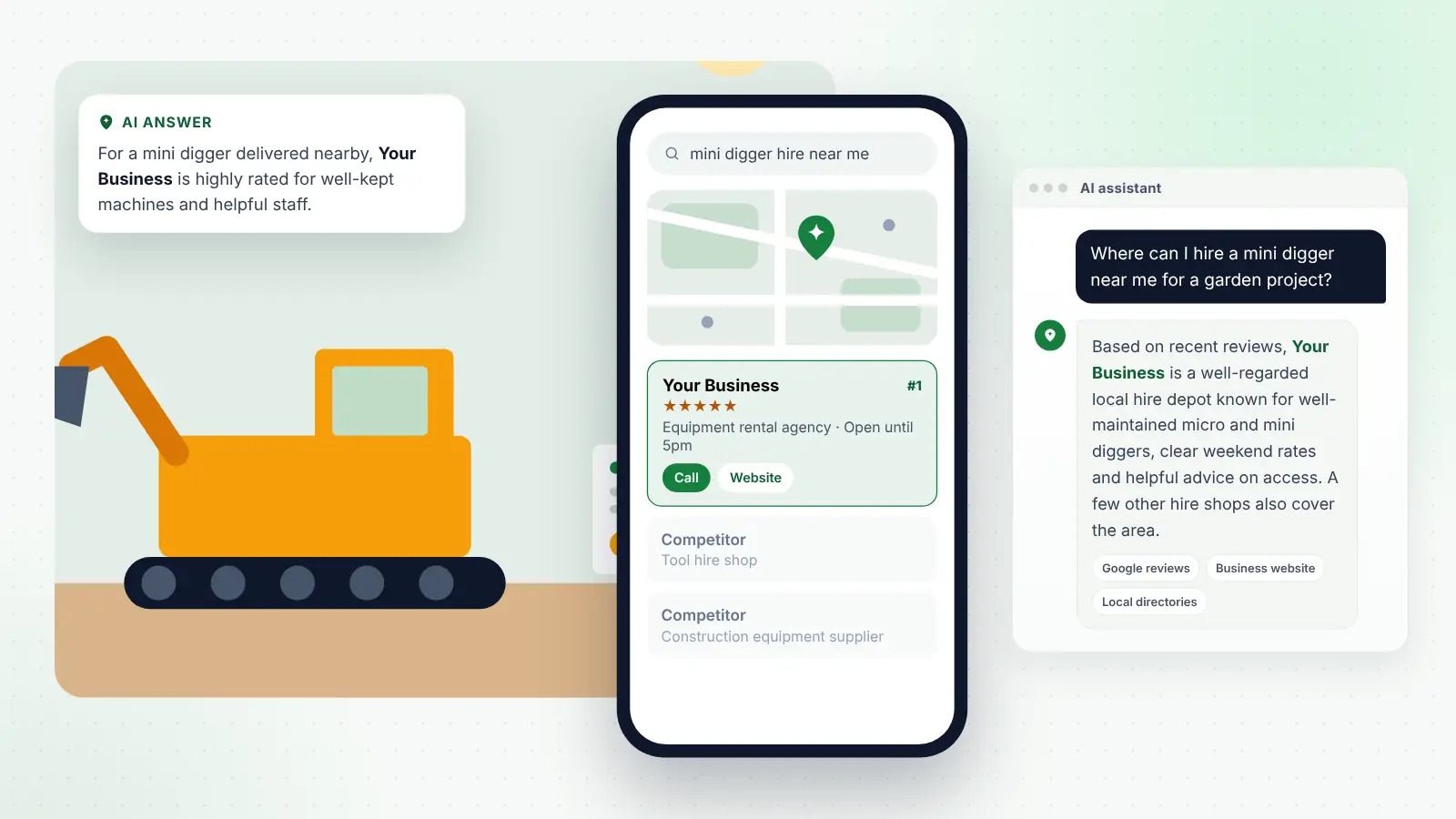
Most hires start with a search: “mini digger hire near me”, “tool hire” plus a town name, “scissor lift hire” or “generator hire for a weekend”. Customers look at the Google Maps results first, check distance, opening hours and reviews, and ring or book with the depot that looks most dependable. National chains compete hard for these searches, so a well-run local presence is one of the best ways to win work directly.
Google Business Profile
For many hirers, your depot’s Google Business Profile is the first impression they get. Make sure it includes:
- The most accurate primary category, such as equipment rental agency or tool rental service, with relevant secondary categories.
- Your real depot address and accurate opening hours, including early starts and Saturdays.
- Photos of your yard, counter, machines and delivery vehicles.
- Products or services for your main equipment categories, with short descriptions.
- Regular updates, such as new machines, seasonal reminders or delivery areas.
Reviews
Reviews strongly influence hire decisions. Ask every customer, ideally by text with a direct link after the machine is off-hire. Reviews that mention specifics — “the digger arrived at 7.30 as promised”, “they showed me exactly how to use the floor sander” — help customers and search engines understand your service. Respond courteously to each review, including the one complaining about a breaker that ran out of fuel.
Matching depot details on every directory
Keep your business name, address and phone number identical across your website, Google, Bing, Apple Maps, UK directories and trade association listings. If you have several depots, give each one its own consistent details.
Your website
A good hire website answers questions before customers have to ask. Include:
- A page for each machine or category with dimensions, weights, access width, typical uses and guide rates.
- Delivery area pages for the towns you genuinely serve.
- Clear explanations of ID, deposits, damage waivers, fuel and trade accounts.
- Your HAE or CPA membership, accreditations and how LOLER reports are provided.
- Online availability or booking, plus a visible phone number.
If you would rather focus on the yard and the fleet, specialist SEO for plant and tool hire companies can look after your profile, listings, content and links for you.
Local links
Links from local trades, associations and community sites tell search engines your depot is a genuine, established hire business. Good sources include local builders and landscapers you supply, trade association listings, community sponsorships, local events you power or equip, and local news coverage of genuine stories.
When trades ask an AI assistant where to hire a machine
Customers increasingly ask AI tools such as ChatGPT, Google Gemini, Perplexity, Microsoft Copilot and Google’s AI Overviews for help with projects. They might ask “what size digger do I need to dig footings for an extension?”, “do I need a licence to drive a dumper on my driveway?”, “what is the best way to hire a generator for a weekend event?” or “where can I hire a mini digger near me?”. The answers often include named businesses.
An assistant asked about digger hire nearby pulls its answer together from what has been published about local depots. They tend to favour businesses that have:
- Consistent information — the same name, address, phone number, hours and equipment categories everywhere.
- Strong, specific reviews — describing real hires, machines and delivery experiences.
- Clear equipment descriptions — sizes, weights, access widths and typical jobs written in plain English.
- Helpful FAQs — honest answers about fuel, licences, waivers, delivery and what to expect at handover.
- Mentions on reputable sites — trade associations, local news, suppliers and community organisations.
Much of this overlaps with good local SEO. Clear, accurate information that helps a homeowner choose the right machine also helps AI tools understand and recommend you.
Common mistakes to avoid
- Buying a fleet before checking demand — machines that rarely go out drain cash quickly.
- Skipping pre-hire checks — rushed turnarounds are when defects get missed.
- Using trade terms for homeowners — consumer law gives domestic customers different rights.
- Vague damage and fuel policies — unclear rules lead to disputes at off-hire.
- Ignoring transport rules — a heavy trailer combination can bring licence and tachograph requirements.
- Relying only on walk-in trade — a strong online presence brings new customers you would otherwise never meet.
Frequently asked questions
Do I need a licence to start a plant hire business?
There is no single licence to run a hire business, but you have duties as a supplier of work equipment, LOLER duties for lifting equipment, and you may need a goods vehicle operator licence for delivery vehicles or trailer combinations over 3.5 tonnes. Operated hire also means your operators need the right cards for the sites they work on.
Can I hire diggers to homeowners?
Yes, many hire companies do. Use consumer-compliant hire terms, give a proper handover and written instructions, and be prepared to recommend operated hire if a customer is not confident or the job is unsuitable.
Can my machines run on red diesel?
Generally not for construction work. Since April 2022, red diesel is restricted to specific uses such as agriculture, forestry and non-commercial heating. Check HMRC’s guidance if you hire to entitled users as well.
Should I join HAE or the CPA?
Membership is voluntary, but it gives you access to industry terms, guidance and training, and accreditation such as SafeHire can help when contractors check your credentials. Many hire firms find it worthwhile once they start opening trade accounts.
How quickly will hirers find our depot online?
A fuller depot profile and corrected listings can make a difference in weeks; higher map positions and AI mentions usually take three to six months, depending on how many chains and independents are nearby, so work done in winter is ready for the spring groundworks rush.
Final thoughts
A successful plant or tool hire business is built on well-chosen equipment, careful inspection and maintenance, clear terms and customers who trust that the machine will turn up working. Get your safety systems, hire terms, transport and insurance right from the start, and you build the reputation that keeps trade accounts loyal.
Once the yard is running smoothly, make sure local customers can find you. A complete Google Business Profile, clear equipment pages, honest rates and genuine reviews will help you win more hires directly — and help AI assistants recommend you when someone asks where to hire a machine nearby.