Lift maintenance is one of the steadiest kinds of income in building services. A lift that carries people has to be looked after for its whole working life, and most owners would rather keep a good lift company for years than go through the trouble of changing. The flip side is that contracts rarely come up for grabs, and when they do, the client is often unhappy and in a hurry.
Owners change lift company for predictable reasons: repeated breakdowns, slow responses to trapped-passenger calls, defects left open on a thorough examination report, or a renewal price that suddenly looks expensive. When that happens, a managing agent or facilities manager starts searching, asks colleagues and, increasingly, asks an AI assistant who else is out there.
This guide is for lift engineers and lift companies who want to win more of those contracts and keep the ones they have.
Key points
- Lifts used at work fall under LOLER and PUWER: maintenance keeps them safe, while a separate thorough examination by a competent person is normally due every six months for lifts carrying people.
- New lifts must meet the Lifts Regulations 2016, usually through designated standards such as BS EN 81-20 and BS EN 81-50, while BS EN 81-80 helps owners assess and improve the safety of existing lifts.
- In England, high-rise residential buildings need monthly checks of firefighting and evacuation lifts, which creates both duties for owners and work for lift companies.
- Fast, well-documented trapped-passenger and breakdown response is what clients remember, and what reviews describe.
- LEIA membership, clear contract terms and experience with multiple makes help you win work from other lift companies.
- Local search and AI assistants increasingly decide who gets the enquiry, so consistent details, reviews and clear service pages matter.
In this guide
- Know who you are selling to
- Your clients’ duties: LOLER and PUWER
- Standards that shape your work
- Accessibility and platform lifts
- High-rise buildings and firefighting lifts
- Breakdowns and trapped passengers
- Contracts clients renew
- Modernisation and refurbishment
- Lift credentials owners check before signing
- Local SEO for lift companies
- When managing agents ask AI to find a lift firm
- Frequently asked questions
- Next steps
Know who you are selling to
Lift work splits into several markets, and each buys differently:
- Managing agents and block managers: many buildings, and a need for reliable cover, clear reports and fewer resident complaints.
- Facilities managers and commercial landlords: offices, shops, hotels and hospitals, where downtime costs money.
- Housing associations and councils: larger portfolios, usually bought through tenders with detailed pre-qualification.
- Schools, care homes and healthcare premises: platform, evacuation and service lifts that people depend on.
- Homeowners, restaurants and shops: home lifts, dumbwaiters and goods lifts, where a personal service matters.
Most growing lift companies pick two or three markets they serve well, and let that shape their pricing, training and website.
Your clients’ duties: LOLER and PUWER
Thorough examinations under LOLER
The Lifting Operations and Lifting Equipment Regulations 1998 (LOLER) apply to lifting equipment used at work, which includes passenger and goods lifts in workplaces and buildings run as a business. HSE guidance on thorough examinations of lifting equipment explains that, unless a written examination scheme sets different intervals, equipment used to lift people should be thoroughly examined every six months, and other lifting equipment every twelve months.
The examination must be carried out by a competent person who is sufficiently independent and impartial. HSE says that person should not be the one who routinely maintains the equipment, because they would be judging their own work. If the competent person finds a serious defect, they must tell the dutyholder straight away and follow up with a written report, a copy of which goes to the enforcing authority.
Maintenance under PUWER
The Provision and Use of Work Equipment Regulations 1998 (PUWER) require work equipment to be maintained so it stays safe. For a lift, that is where your maintenance contract comes in: planned visits, adjustments, lubrication, replacement of worn parts and fault repairs.
Maintenance and thorough examination compared
Many owners confuse the two, so a simple explanation helps them see what they are paying you for.
| Aspect | Maintenance | Thorough examination |
|---|---|---|
| Main legal basis | PUWER | LOLER |
| Who usually does it | Your lift company, under contract | An independent competent person, often arranged through the insurer or an inspection body |
| How often | Set by the contract, manufacturer and usage | Normally six-monthly for lifts carrying people, or as a written scheme sets |
| What the client gets | Service records and repairs | A written report listing any defects and how urgent they are |
| What happens next | Faults fixed as part of the contract or quoted separately | Defects passed to the lift company to put right |
Tip
Offer to review every client’s latest thorough examination report with them and quote promptly for any defects. A report with open defects is often the moment a client decides whether to stay with their current lift company or move.
Standards that shape your work
New lifts and the Lifts Regulations 2016
New passenger and goods lifts placed on the market in Great Britain must meet the essential health and safety requirements of the Lifts Regulations 2016. Installers usually show conformity by following designated standards, the main ones being BS EN 81-20, which sets safety rules for the construction and installation of passenger and goods passenger lifts, and BS EN 81-50, which covers design rules, calculations, examinations and tests of lift components. Related parts of the BS EN 81 series cover subjects such as remote alarm systems, accessibility and firefighters’ lifts.
Lifts with a rated speed of no more than 0.15 metres per second, which includes many platform lifts and home lifts, are generally covered by the Supply of Machinery (Safety) Regulations 2008 instead, and so are stairlifts. Make sure your quotes and paperwork are clear about which regime applies and how the lift will be marked and documented at handover.
Existing lifts and BS EN 81-80
BS EN 81-80 gives a method for assessing the safety of existing passenger and goods passenger lifts against current thinking and prioritising improvements. It is not retrospective law, but a risk-based survey against it gives owners of older lifts a prioritised list to budget for, rather than a vague warning that the lift is “getting old”.
Guidance on examination and testing
The Safety Assessment Federation (SAFed), the body for independent engineering inspection organisations, publishes guidelines on the supplementary tests of in-service lifts, drawn up by an industry committee chaired by HSE that included lift companies, inspection bodies and lift owners. They take a judgement-based approach, with the competent person deciding which supplementary tests are needed and how often.
Accessibility and platform lifts
Under the Equality Act 2010, service providers and employers must make reasonable adjustments for disabled people, which can include changes to physical features of a building. A platform lift is often how a shop, surgery, school, church or office gives step-free access where a full passenger lift is not practical. For new buildings and many alterations in England, Approved Document M sets out guidance on access, including lifts.
The law does not say every building must have a lift, and what is reasonable depends on the organisation and the building, so be helpful rather than suggesting a client is breaking the law. Explain the options and the space, building work and maintenance each needs. Platform lifts used at work fall under LOLER and PUWER, so every installation is a chance to agree a maintenance contract at handover.
High-rise buildings and firefighting lifts
In England, the Fire Safety (England) Regulations 2022 introduced extra duties for responsible persons in high-rise residential buildings, defined as at least 18 metres high or at least seven storeys. Since 23 January 2023, they must carry out monthly checks of lifts for firefighters’ use, evacuation lifts and the mechanisms that let firefighters take control of lifts. If a fault with one of these lifts is not fixed within 24 hours, they must report it electronically to the local fire and rescue service. The government’s fact sheet on lifts and essential firefighting equipment sets out the detail.
Wider building safety reforms have also raised expectations about records, so managing agents increasingly want clear digital records of every visit, check and repair. Offering monthly firefighting lift checks, fast repairs and good records helps them meet their duties and shows you understand their buildings.
Breakdowns and trapped passengers
Nothing shapes a client’s view of you more than what happens when a lift stops. What clients look for:
- A clear response commitment for trapped passengers, separate from ordinary breakdowns, stated in the contract.
- A 24-hour call centre or on-call rota that answers quickly and keeps the caller updated.
- Engineers who can release passengers safely and talk calmly to them through the lift’s emergency alarm.
- A written follow-up explaining the cause, what was done and whether further work is recommended.
- Working emergency communication. Alarm lines on older analogue telephone lines need checking as the UK network moves to digital.
Record every call-out, response time and first-time fix. Those figures are your strongest evidence at renewal and when prospective clients compare you with their current provider.
Contracts clients renew
Most clients want clarity rather than the cheapest price. Many lift companies offer two or three levels of cover:
| Contract level | Typically includes | Suits |
|---|---|---|
| Basic or examination-support | Planned visits and preparing for thorough examinations, with call-outs and parts charged separately | Low-use lifts, owners with tight budgets |
| Standard | Planned visits, call-outs in working hours, minor parts | Most offices and residential blocks |
| Comprehensive | Planned visits, 24-hour call-outs and most parts, with agreed exclusions | Busy, critical or multi-lift buildings |
Whatever you offer, the details clients care about are the same: how many visits a year, response times by day and night, which parts are included, what the exclusions are and how notice and renewal work. Avoid long automatic renewal terms that clients only discover later.
Taking over lifts from other companies
Many owners assume only the original installer can maintain their lift. Explaining that you maintain multiple makes, and how you source parts, removes that barrier. Be honest about lifts with proprietary controllers or diagnostic tools you cannot access, and set out a clear handover plan covering records, keys, examination history and a condition survey in the first weeks.
Tip
Write a one-page “what changes when you switch to us” guide for prospective clients. It answers the questions that make managing agents hesitate, such as continuity of cover, records and parts.
Modernisation and refurbishment
As parts become obsolete, ageing lifts need modernising: a new controller, drive, door equipment, car interior or a whole new lift. It is often a client’s largest building project, and it usually goes to the lift company they trust.
To win modernisation work:
- Plan ahead with clients, giving them a realistic view of their lift’s remaining life and a rough budget years in advance.
- Use BS EN 81-80 surveys to explain safety improvements in order of priority.
- Explain disruption honestly, including how long the lift will be out of service and how residents or staff will be supported.
- Show completed projects with before and after photos.
Residential blocks often need to consult leaseholders before major works, so clear, early estimates help the project go ahead.
Lift credentials owners check before signing
Clients rely on a few signals to judge competence:
- LEIA membership, the trade association for the lift and escalator industry, which many clients and specifiers recognise.
- Engineer qualifications, apprenticeships and ongoing training.
- Health and safety accreditation, often required at pre-qualification for commercial and public-sector work.
- Insurance, including public liability and employers’ liability.
- Experience with specific makes and lift types, such as hydraulic lifts, machine-room-less lifts, platform lifts and dumbwaiters.
Show these on your website, Google profile and tenders, with a sentence explaining each.
Local SEO for lift companies
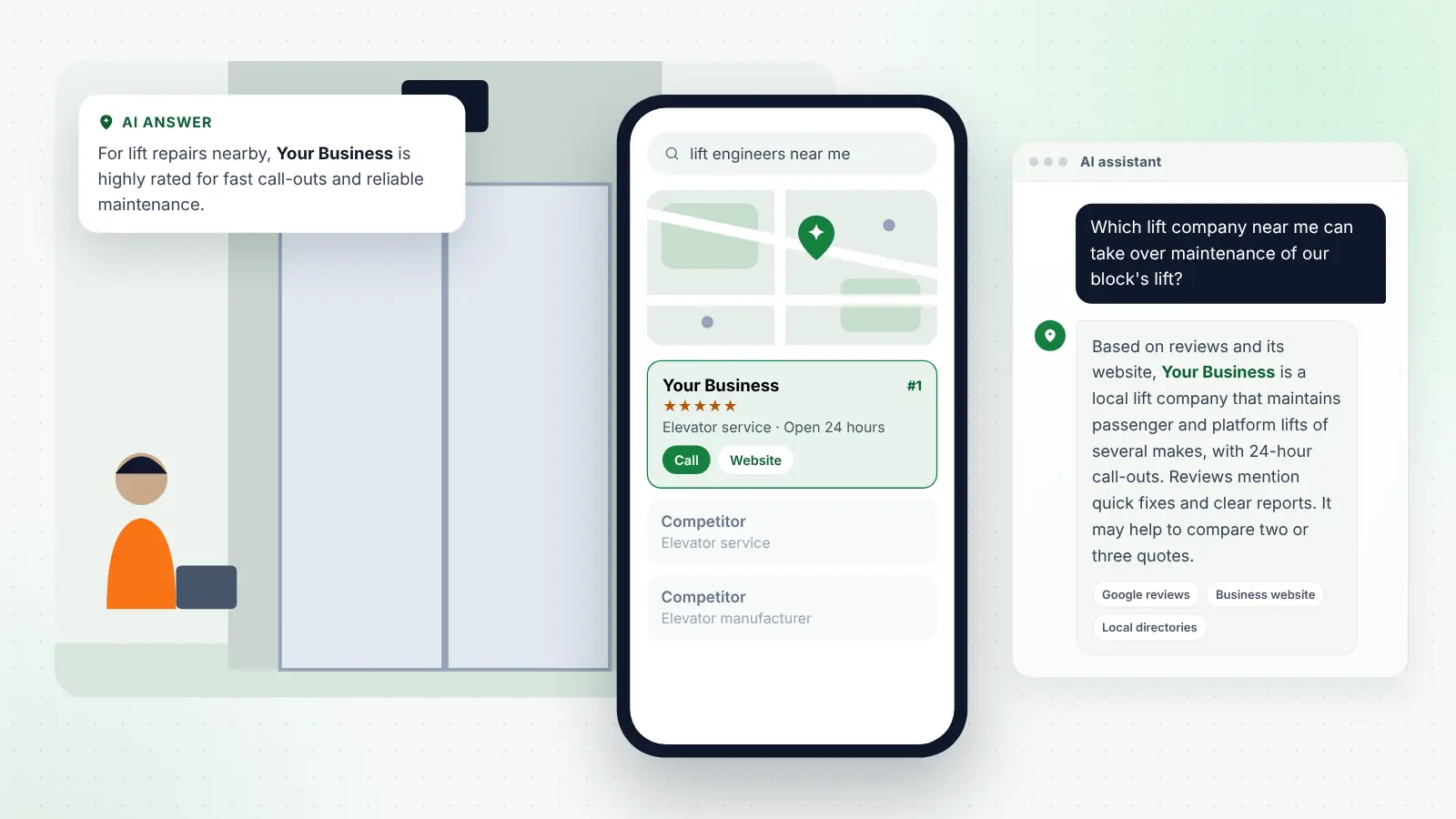
When someone searches “lift engineers near me”, Google usually shows a map with three local businesses above the ordinary results. For urgent breakdowns, the company at the top often gets the call.
The searches are specific. Managing agents type phrases like “lift maintenance companies London”, “lift service contract quotes” or “lift company for block of flats”. Homeowners search “home lift servicing near me” or “through floor lift repair”. Others look for “dumbwaiter repair” or “platform lift installers”. Every one of those deserves its own page or clearly headed section on your site.
The main elements of local SEO for a lift company are:
- Google Business Profile: choose the most accurate primary category, list every service, set your service area and opening hours (including 24-hour call-out cover if you provide it), and add photos of real work, engineers and vans.
- Reviews: ask clients after a successful repair, modernisation or first year of contract. Reviews that mention the type of work, such as “our platform lift” or “fast response to a trapped resident”, help both readers and search engines.
- Consistent details: keep your business name, address and phone number identical on your website, Google, Bing, Apple Maps, trade directories and facilities platforms.
- A website with service and area pages: separate pages for maintenance contracts, breakdowns and repairs, modernisation, platform lifts, home lifts and dumbwaiters, plus pages for the main towns and cities you genuinely cover.
- Local links: mentions from managing agents, builders, architects and partners you work with, local business groups, trade association member listings and local news coverage of notable projects.
If you would rather keep your engineers focused on lifts, specialist local SEO for lift engineers and lift companies can look after the profile, listings, content and links for you.
When managing agents ask AI to find a lift firm
Property managers increasingly put the question to an AI assistant instead of scanning a page of search results. A managing agent might ask ChatGPT, Gemini, Perplexity or Copilot “which lift company near me can take over maintenance of our block’s lift?”, and Google increasingly shows an AI Overview at the top of the results that summarises local options.
Assistants assemble their suggestions from lift company details they can find and verify. For a lift company, that usually means:
- Consistent information across the web, so your name, location, services and areas match everywhere.
- Reviews that describe response times, reliability and the experience of working with you.
- Clear service descriptions that state the lift types and makes you maintain, the areas you cover and your call-out arrangements.
- FAQs on your website that answer real questions, such as the difference between maintenance and a thorough examination, what a modernisation involves and how switching lift company works.
- Mentions on reputable sites, such as trade associations, partners, directories and local news.
Expect local SEO and AI visibility to improve steadily over roughly three to six months; no honest provider can promise a lift company a set position.
Tip
Ask your engineers which questions caretakers, residents and facilities staff ask most often on site, and answer each one on your website.
Frequently asked questions
Can a lift company carry out the LOLER thorough examination on lifts it maintains?
HSE says the competent person should be sufficiently independent and impartial, and should not be the person who routinely maintains the equipment. That is why many owners use their insurer’s engineer surveyors or an independent inspection body, with the lift company preparing the lift and fixing any defects found.
Do home lifts in private houses need LOLER examinations?
LOLER applies to lifting equipment used at work, so a lift a homeowner has for their own use is generally outside it. A lift in a home can be covered if it is provided or used as part of a work activity, for example by a care provider. Regular servicing in line with the manufacturer’s instructions is still important, so explain that clearly to homeowners.
Is it worth joining LEIA as a small lift company?
For many small companies it is, because LEIA membership is widely recognised by clients and specifiers and gives access to industry guidance and training. It tends to carry more weight in commercial and public-sector work than in domestic servicing.
How do I get more reviews from managing agents and facilities managers?
Ask directly after a well-handled breakdown or a smooth modernisation, with a short message and a direct link to your Google profile.
Next steps
Decide which markets you want more of, set out clear contract levels and response commitments, and explain owners’ duties in plain language on your website. Then check your Google Business Profile, add recent photos, ask satisfied clients for reviews and give each main service its own page.
Lift companies keep contracts by being reliable when it matters. The aim is to make sure prospective clients can see that reliability before their current provider lets them down again.