Shopfitting runs on fixed dates. A retailer has signed a lease, a salon owner has booked a launch, a restaurant has staff starting on a Monday. Clients choose the contractor they believe will hit that date without cutting corners, and they usually decide before they have looked closely at your price.
Many of those clients have never bought a fit-out before. An independent café owner searches online, asks other business owners and increasingly asks an AI assistant for names. Larger groups add prequalification and accreditations.
This guide covers compliance, consents, accreditations, joinery, programmes, case studies and how clients find shopfitters through Google and AI search. It is general information, not legal advice, and focuses on England.
Key points
- CDM 2015 applies to shop and hospitality fit-outs of every size, and on projects with more than one contractor the client must appoint a principal designer and principal contractor.
- Since October 2023, Part 2A of the Building Regulations has added dutyholder and competence duties for building work in England, alongside CDM.
- New shopfronts normally need planning permission, most illuminated signs need advertisement consent, and conservation areas and listed buildings bring extra controls.
- Landlord consent, shopping centre rules and out-of-hours working requirements often decide the programme, so raise them at the first meeting.
- Constructionline, an SSIP scheme such as CHAS or SafeContractor and trade body membership are the credentials buyers most often check.
- Real case studies with your own photographs, clear service pages and steady reviews help you appear on Google Maps and in AI recommendations.
In this guide
- Decide which projects you want more of
- CDM 2015 and the Building Safety Act
- Building regulations: fire safety and accessibility
- Shopfronts, signs and planning
- Landlord consent and centre rules
- The accreditations retailers and main contractors ask for
- Joinery: your own workshop or subcontract
- Tight programmes and out-of-hours working
- Case studies with photos
- Local SEO: how clients find a shopfitter
- AI search: how retailers ask assistants for a shopfitter
- Frequently asked questions
- Next steps
Decide which projects you want more of
Before you change your marketing, look back over the last two years and ask which projects paid well, ran smoothly and led to repeat work.
| Type of work | Typical client | What wins it | Watch out for |
|---|---|---|---|
| Independent retail fit-outs | Shop owners, boutiques | Design advice and a clear fixed price | Small budgets and late decisions |
| Salons and barbers | Owner-operators, franchisees | Plumbing, electrics and joinery in one package | Backwash drainage and tight opening dates |
| Restaurants, cafés and bars | Operators, hospitality groups | Hospitality experience and programme control | Extraction, kitchen services and licensing timing |
| Joinery, counters and display units | Retailers, designers, other fit-out firms | Workshop quality and lead times | Being treated as a commodity supplier |
| Multi-site roll-outs | Retail and hospitality chains | Consistency and capacity | Prequalification and payment terms |
Your website and Google profile work harder when they lead with the two or three sectors you most want. A restaurant owner wants to see restaurants; a barber wants to see barber shops.
CDM 2015 and the Building Safety Act
The Construction (Design and Management) Regulations 2015 apply to construction work whatever its size, including fit-outs inside existing shops and restaurants. Most shopfitting clients are commercial clients.
According to the HSE’s guidance for commercial clients, the client must make suitable arrangements for managing the project, appoint competent designers and contractors, allow enough time and resources and provide pre-construction information. On projects involving more than one contractor, the client must appoint a principal designer and a principal contractor. A construction phase plan is needed before work starts, and the principal designer prepares a health and safety file.
A project must be notified to HSE if the construction work is expected to last longer than 30 working days and involve more than 20 workers at any one time, or to exceed 500 individual worker days.
Since 1 October 2023, Part 2A of the Building Regulations 2010 has added a parallel set of duties for building work in England, introduced under the Building Safety Act 2022. Designers and contractors must have the skills, knowledge, experience and behaviours needed, and clients must take reasonable steps to check competence. Where there is more than one contractor, the client appoints a principal designer and principal contractor for building regulations purposes. These are separate from the CDM roles, although one company often holds both.
Your clients rarely know any of this. In proposals and on your website, say which roles you normally take, what your construction phase plan covers, how you check subcontractor competence and what you hand over at the end.
Tip
Write a one-page “How we manage your fit-out” sheet covering CDM roles, building control and handover. It answers a common prequalification question and reassures first-time clients that they are in safe hands.
Building regulations: fire safety and accessibility
Many fit-outs include building work: partitions that alter escape routes, changes to fire doors, new toilets, extraction and structural openings. Building control can be provided by the local authority or a registered building control approver. Shops, salons and restaurants are covered by the Regulatory Reform (Fire Safety) Order 2005, so if you use local authority building control the regulations require a full plans application rather than a building notice.
Fire safety
Common problems in shop and hospitality fit-outs include:
- Unsealed breaches in compartment walls and ceilings from new services.
- Counters and displays that narrow escape routes or block final exits.
- Decorative linings used without checking their fire performance.
- Emergency lighting and alarm coverage that no longer suit the new layout.
The responsible person for the premises, usually the occupier, must keep a fire risk assessment up to date, and a fit-out is exactly the kind of change that should trigger a review. Hand over clear records of fire-rated construction, fire stopping and life safety systems so they can do it properly.
Accessibility and Approved Document M
Approved Document M covers access to and use of buildings, and Volume 2 deals with buildings other than dwellings, including shops and restaurants. In broad terms, an alteration should not make a building less accessible than it was before, and new elements such as entrances, counters and toilets need to be designed with access in mind.
Separately, businesses serving the public must make reasonable adjustments for disabled customers under the Equality Act 2010, which can include physical features. A fit-out is the cheapest moment to get this right, so raise lowered counter sections, entrances, circulation space and accessible toilets at design stage.
Shopfronts, signs and planning
A new interior rarely needs planning permission, but the outside of the shop often does, and this is where first-time clients are most likely to be caught out.
- Shopfronts. Installing or materially altering a shopfront usually needs planning permission, because it changes the external appearance of the building. Many councils publish shopfront design guides and offer pre-application advice.
- Signs. Fascia and projecting signs are controlled by the advertisement regulations. Some signs have deemed consent within limits on size, position and illumination, but, as the Planning Portal’s guidance on advertisement consent explains, most illuminated signs need advertisement consent. Displaying an advertisement without consent where it is required can be a criminal offence.
- Conservation areas. Councils apply closer control to the size, design, materials and colour of shopfronts and signs, and the rules on illuminated signs are often stricter. Some areas have Article 4 directions that remove permitted development rights.
- Listed buildings. Listed building consent is needed for works that affect the character of a listed building, including signs attached to it, whether or not planning permission is also required.
- Change of use. Turning a shop into a café, bar or takeaway may need planning permission, so check before the client commits.
You do not need to be the client’s planning consultant, but flagging consent issues early and allowing decision times in the programme saves clients expensive delays.
Landlord consent and centre rules
Most retail and hospitality tenants need the landlord’s written consent before altering their unit, usually through a licence for alterations. In shopping centres and retail parks, you will also deal with the centre management team, who often have their own fit-out guides covering design approval, insurance, contractor inductions, permitted working hours, waste, deliveries and hot works permits.
Landlord approval can take weeks, and clients rarely start early enough. Raise it at the first meeting, prepare the drawings, method statements and insurance details the landlord’s surveyor expects, and build approval periods into the programme so the opening date is realistic.
The accreditations retailers and main contractors ask for
Independent owners rarely ask for accreditations, but retail chains, hospitality groups, shopping centre landlords and main contractors usually do.
| Credential | What it shows | Who asks for it |
|---|---|---|
| Constructionline | Verified supplier information at several levels | Main contractors, public bodies, larger retailers |
| SSIP schemes such as CHAS or SafeContractor | Health and safety competence | Retail and hospitality groups, facilities managers |
| ISO 9001 | Quality management | Larger clients and roll-out programmes |
| ISO 14001 | Environmental management | Brands with sustainability targets |
| ISO 45001 | Occupational health and safety management | Main contractors and frameworks |
| National Association of Shopfitters (NAS) | Membership of the shopfitting trade body | Designers, specifiers and clients |
The National Association of Shopfitters is the UK trade association for shopfitting contractors and their suppliers. Show each credential with its current level and renewal date, and keep details consistent across proposals and listings. Out-of-date logos do more harm than none.
Joinery: your own workshop or subcontract
Joinery is often what clients remember about a fit-out: the counter, the back bar, the display wall, the styling stations. Whether you make it yourself or buy it in affects your margins, your programme and how you market yourself.
| Own joinery workshop | Subcontracted joinery | |
|---|---|---|
| Quality control | Direct control over materials and finish | Depends on the supplier |
| Lead times | You set priorities | You compete with the supplier’s other customers |
| Cost | Premises, machinery, staff and dust extraction | Lower overheads, less margin on joinery |
| Marketing | Workshop photos and bespoke work set you apart | Focus on project management and installation |
| Risk | Quiet periods still carry fixed costs | Supplier delays can hit your programme |
If you run a workshop, show it: photographs of pieces being made and installed tell clients you control quality. Selling joinery to designers and other fit-out firms can keep it busy between projects. Wood dust is a hazardous substance, so HSE expects suitable extraction and controls.
If you subcontract, lead with design coordination, programme control and installation quality. Clients care more about the result and the date than where the counter was made.
Tight programmes and out-of-hours working
Shopfitting programmes are short and immovable. A restaurant may have a few weeks between getting the keys and opening, and a refit in a trading store may have to happen overnight or around opening hours.
Explain how you will manage that before clients ask:
- Show realistic programmes. Publish typical durations for common projects, with the factors that lengthen them.
- Explain out-of-hours working. Many centres restrict noisy work to nights. Describe how you plan night shifts, security and cleaning down for the morning.
- Respect neighbours. Councils can control construction noise, and residents above shops notice dust and deliveries.
- Order long-lead items early. Shopfront glazing, lighting and catering equipment can take longer than the build.
- Align with the client’s deadlines. Hospitality clients must register their food business with the council before opening, so match your handover to their timetable.
Tip
Add a short “typical programme” to each case study, such as “six weeks from keys to opening, including two weeks of night working”. It answers the question every client asks first and gives search engines and AI tools specific facts to use.
Case studies with photos
Finished shops carry the client’s brand, not yours, so many good shopfitters have almost no visible portfolio. Case studies fix that. A useful one answers what a client would ask in a meeting:
- What was the brief, and what kind of business was it?
- How big was the unit, and was it a shell, a refurbishment or a trading store?
- What was included, such as joinery, shopfront, M&E, flooring or signage?
- How long did it take, and was any of it done out of hours?
- What was difficult, such as a listed building, a centre approval process or a fixed launch date?
- How did the client find the result?
Use your own before and after photographs, and name or quote clients only with written consent. Always name the sector and town, because “barber shop fit-out in Leicester” is far more useful to search engines and future clients than “recent project”.
Local SEO: how clients find a shopfitter
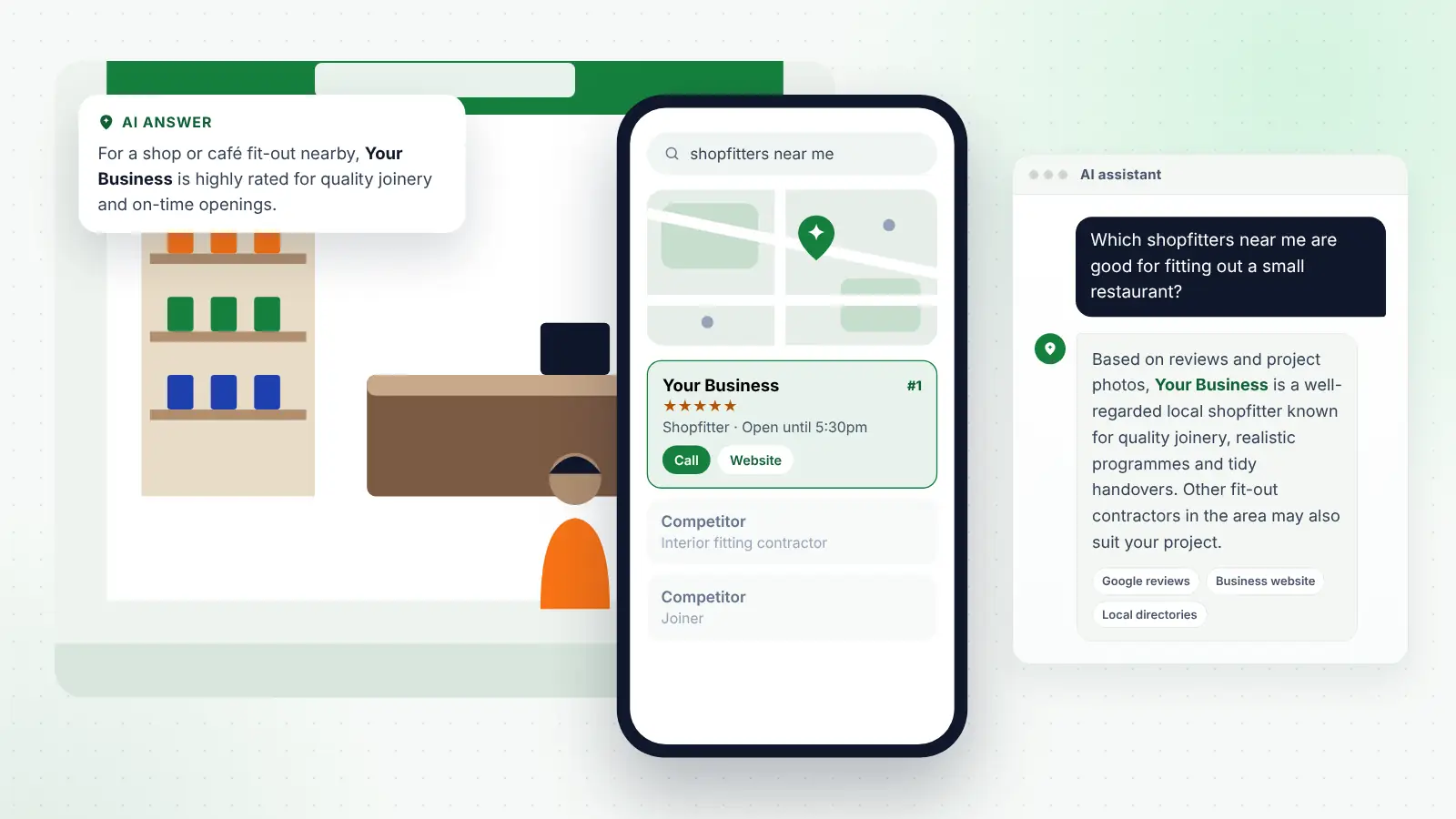
Many fit-out clients begin with a search. A new salon owner types “salon fitters near me”, a café operator searches “café fit out Bristol”, and a retailer looks for “shopfront installers” or “bespoke shop counters”. Designers and letting agents search too when a client asks them for names.
The shopfitters that appear in the map results for those searches tend to get several things right:
- A complete Google Business Profile. Choose an accurate primary category, list every service, set a genuine service area and add real photos of finished projects and your workshop.
- Steady, specific reviews. Ask clients soon after opening. Reviews that mention the sector, quality and opening on time persuade far more than “great job”. Reply to every review.
- Consistent details everywhere. Use the same business name, address and phone number on your website, Google profile, Constructionline and SSIP listings, trade body directory and UK business listings.
- A website with service and area pages. Create separate pages for retail, salons and barbers, restaurants and bars, showrooms, joinery and shopfronts, plus pages for the main towns or regions you cover, each with relevant case studies.
- Local and industry links. Mentions from your chamber of commerce, suppliers, designers and trade bodies help search engines trust your website.
If you would rather keep your time for estimating and delivery, some companies use specialists in local SEO for shopfitters and fit-out contractors to handle profiles, listings and content. Whoever does it, expect results to build over three to six months rather than overnight.
AI search: how retailers ask assistants for a shopfitter
More business owners now ask ChatGPT, Gemini, Perplexity, Copilot or Google’s AI Overviews for help before they search in the usual way. Typical questions include “Who are good shopfitters for a small café in Norwich?”, “How long does a salon fit-out take?”, “Do I need planning permission for a new shopfront?” and “What should a barber shop fit-out include?”
These tools rely on information they can cross-check across the web. To help them describe you accurately:
- Keep your company details, services and locations identical across every listing.
- Write clear service descriptions that say what you fit out, for which sectors and in which areas.
- Publish helpful FAQs on programmes, landlord consent, shopfront and signage consent, what affects cost and how out-of-hours work is managed.
- Build up reviews that mention the type of business and the town.
- Earn mentions on reputable local, retail, hospitality and trade websites, such as supplier case studies, trade body news or local business press.
None of this guarantees a mention, but the same information also helps a business owner decide whether to call you.
Frequently asked questions
Does CDM 2015 apply to a small shop or salon fit-out?
Yes. CDM 2015 applies to construction work of any size. On a commercial project with more than one contractor, the client must appoint a principal designer and principal contractor, and there must be a construction phase plan. Notification to HSE only applies above the duration and worker thresholds, but the other duties apply regardless.
Does a new shop sign need permission?
It depends on the sign. Some non-illuminated fascia and projecting signs have deemed consent within limits, but most illuminated signs need advertisement consent, and stricter controls apply in conservation areas and on listed buildings. Check with the local planning authority before the sign is ordered.
Which accreditations matter most for a smaller shopfitter?
An SSIP scheme such as CHAS or SafeContractor is often the first step, followed by Constructionline if you want to work for retail chains, main contractors or public bodies. Trade body membership helps with clients who cannot easily judge quality, and ISO certifications become important for larger roll-outs.
How long does it take to get more enquiries from search?
Profile and listing improvements can help within weeks, especially if your Google profile was incomplete. Climbing the map and being recommended by AI tools tends to take three to six months, depending on how many fit-out firms work your region.
Next steps
Decide which sectors you want, explain how you handle CDM, consents and programmes, and keep accreditations current. Then publish a few honest case studies, complete your Google Business Profile and ask recent clients for reviews. Stay in touch with designers, agents and past clients too. Small, steady improvements tend to bring better-fitting projects over time.