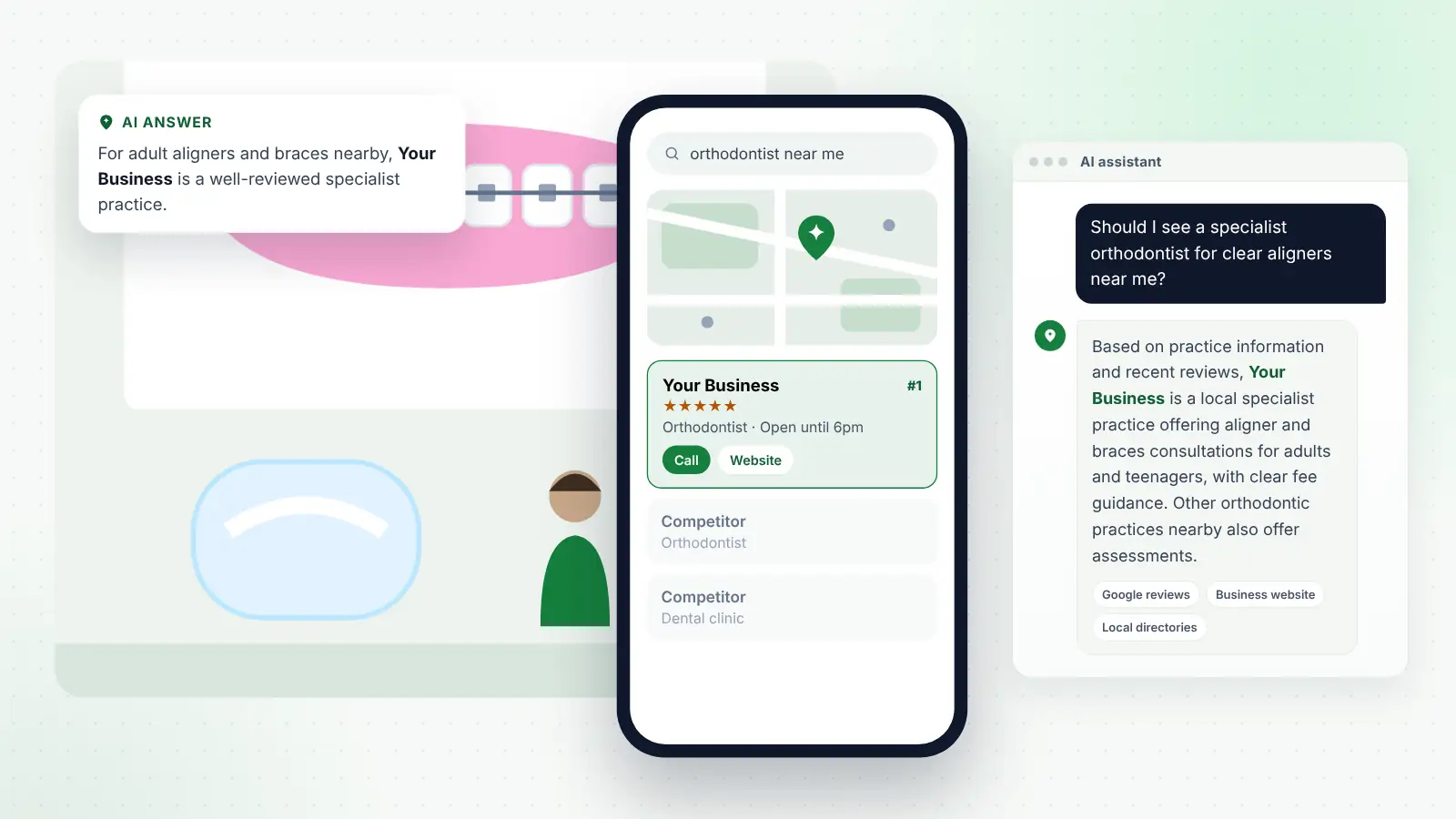
For many specialist orthodontic practices, the patient list used to look after itself. General dentists referred children, the NHS contract filled the chairs, and private adult work arrived steadily by word of mouth. That picture has changed. Adults now make up a large share of private demand, they start their research online rather than with their dentist, and the first names they see are often national aligner brands, general practices offering straightening and remote kits sold directly to consumers.
The specialist practice still has a strong case to make: years of additional training, experience with complex cases, a full range of appliances and a team that manages retention properly. The difficulty is that patients cannot see any of that from a search result. Unless your website, Google profile and reviews explain it clearly, a specialist practice can look much the same as any other provider, and often more expensive.
This guide is for owners and managers of specialist orthodontic practices, whether mainly NHS, mixed or wholly private. It covers who your patients are, the rules on titles and advertising, NHS eligibility, referrals, fees and finance, the enquiry journey, and how patients now find orthodontists through Google and AI assistants. It is general information rather than legal or regulatory advice, so check anything specific with the GDC, your indemnity provider or your own advisers.
Key points
- Adults and parents of children who are not eligible for NHS care research for weeks, so clear treatment information and prompt follow-up matter as much as visibility.
- GDC guidance says only dentists on its orthodontic specialist list should call themselves an orthodontist, which is a genuine trust signal worth explaining.
- Under-18s are assessed for NHS treatment using the Index of Orthodontic Treatment Need, and being clear about that helps parents understand their private options.
- Referring dentists remain a valuable source of patients, and a professional, easy referral process keeps them sending people to you.
- Offering monthly payments through a lender usually needs FCA authorisation, and all advertising must follow GDC guidance and the UK advertising codes.
- Patients increasingly ask Google Maps and AI assistants which orthodontist to choose, and both rely on consistent details, reviews and clear treatment pages.
In this guide
- Understand who your patients are now
- Make your specialist status clear and correct
- Explain aligners and fixed braces honestly
- Be clear about NHS eligibility for children
- Strengthen referrals from general dentists
- Present fees and finance properly
- Address remote and direct-to-consumer aligners calmly
- Follow up enquiries properly
- Local SEO for orthodontic practices
- AI search and how patients now ask for recommendations
- Frequently asked questions
- Next steps
Understand who your patients are now
A typical specialist practice serves several groups who search, worry and decide in very different ways. Lumping them together as “orthodontic enquiries” leads to generic pages and conversations.
| Patient group | What they usually search or ask | What they need before booking |
|---|---|---|
| Adults wanting straighter teeth | “clear aligners near me”, “adult braces [town]”, “Invisalign orthodontist” | Whether they are suitable, options, timescales, cost, visits needed and retainers |
| Adults whose teeth moved after earlier braces | “teeth moved after braces”, “orthodontic relapse treatment” | Reassurance that this is common, and an honest view of what can be done |
| Parents of children likely to be NHS eligible | “NHS orthodontist [town]”, “orthodontic waiting list” | How referral works, how long the wait might be and what assessment involves |
| Parents choosing private treatment | “private braces for teenager near me”, “how much are braces for kids” | Fees, finance, appliance choices and how school and sport fit around appointments |
| Patients wanting a second opinion | “orthodontist second opinion”, “is my treatment plan right” | A calm, impartial assessment and clear explanation |
The adult group deserves particular attention. Many adults still assume orthodontists only see children on referral from their dentist. Saying plainly on your website and Google profile that you see adults, and that they can book directly, removes a hidden barrier.
Make your specialist status clear and correct
Orthodontics is one of the GDC’s specialist lists. Any registered dentist can provide orthodontic treatment if they are competent to do so, but the GDC’s guidance on advertising says that dentists who are not on a specialist list must not use titles such as “orthodontist”. Those on the list can describe themselves as a specialist orthodontist. Dentists who are not on the list may say they have a special interest in orthodontics, are experienced in it, or that their practice is limited to it, but should not say they “specialise in” it.
For a specialist practice, this is one of your most important trust signals, and it is often buried. Patients do not know the rules, so a short explanation helps:
- Explain on a dedicated page what a specialist orthodontist is and that specialists are listed by the GDC.
- Show each clinician’s name, qualifications, the country where they qualified and their GDC registration number, which the guidance expects for anyone named as providing care.
- Introduce the wider team accurately, including orthodontic therapists and dental nurses, without giving anyone a title they do not hold.
- Include your complaints procedure and a link to the GDC, as the advertising guidance also expects for practice websites.
- Check that your Google profile, directory listings and social media bios use the same correct titles.
Tip
Avoid comparing your clinicians’ skills or qualifications with named competitors. Explain what specialist registration means and let patients draw their own conclusions.
Explain aligners and fixed braces honestly
Adults often arrive with a fixed idea of the treatment they want, usually clear aligners, because that is what they have seen advertised. A specialist practice is well placed to explain the full range of options and why one may suit a particular case better than another.
On your website, give each main treatment its own page covering:
- What it is and what kinds of problems it is commonly used for.
- How long treatment typically takes, phrased as a range and with the caveat that it depends on the case.
- How often patients need to visit and what happens at those appointments.
- What patients need to do themselves, such as wearing aligners for most of the day or looking after brackets.
- Retention afterwards, including the fact that teeth can move again without retainers.
- A fee range, with a clear statement that the exact cost follows a consultation.
Fixed braces, ceramic braces, lingual braces and aligners all have strengths and trade-offs. Writing about them fairly, rather than promoting whichever system carries the highest margin, is what builds trust with patients and the AI tools that summarise your content. Under the UK advertising codes, claims about what braces or aligners can achieve need robust evidence, and before-and-after images must be genuine and not misleading, so keep records that show they are.
Be clear about NHS eligibility for children
Many parents do not understand how NHS orthodontics works, and confusion leads to frustrated phone calls. In England, NHS orthodontic treatment is free for under-18s with a clear health need, assessed by an orthodontist using the Index of Orthodontic Treatment Need (IOTN), and is not usually available to adults except on a case-by-case basis. NHS Business Services Authority guidance says grade 4 and 5 cases can be treated on the NHS, while grade 3 cases are judged individually, with the appearance of the teeth also taken into account. Local referral guidance sets out the detail, and arrangements in Wales, Scotland and Northern Ireland are similar but separate, so check the current rules for your area.
A simple, accurate parent page can explain:
- That most children are referred by their general dentist, typically when adult teeth are coming through.
- That the assessment decides eligibility, so a referral does not guarantee NHS treatment.
- That waiting times vary by area and you will explain your current position honestly.
- What private treatment involves if a child does not qualify, or if the family prefers not to wait.
Present private treatment as a choice rather than a sales opportunity. Parents who feel pressured at an NHS assessment rarely come back, and they talk to other parents at the school gate.
Strengthen referrals from general dentists
Even with more adults booking directly, referring dentists remain a valuable source of both NHS and private patients. They want three things: confidence that their patients will be well looked after, an easy process, and their patients returned to them for routine care.
Practical ways to strengthen those relationships:
- Make the referral route simple and well publicised, with a clear page or form for referring practices.
- Acknowledge every referral promptly and send a clear letter after the consultation.
- Keep the referring dentist updated at key points, especially if you need them to treat decay or gum problems before orthodontics starts.
- Return patients to their own dentist and encourage regular check-ups throughout treatment.
- Offer occasional practical sessions, such as case discussions or guidance on when to refer.
Keep these relationships based on patient care. Payments or gifts linked to referrals raise obvious professional and ethical concerns, and are not a sound basis for a practice’s growth.
Present fees and finance properly
Private orthodontic treatment is a significant spend, and patients compare costs carefully. Publishing fee ranges for the main treatments, alongside what is included, helps patients decide before they call and saves your team time. A good fee page covers the consultation fee, the treatment range, retainers, replacement retainer costs and any review appointments after treatment.
Monthly payments help many families and adults go ahead, but how you offer them matters. The FCA’s guidance for vets and dentists explains that introducing patients to a third-party lender is credit broking, which needs authorisation, usually as a limited permission secondary credit broker. Offering your own payment plans can also be regulated, depending on how they are structured. Your finance promotions must make clear that you are a broker rather than the lender.
Tip
Before advertising “spread the cost” on your website or social media, check that your practice has the right FCA permission and that the wording has been approved through your finance provider.
Address remote and direct-to-consumer aligners calmly
Many adults compare specialist care with aligners ordered online after a scan or photos, sometimes with little or no face-to-face contact. At least one well-known international direct-to-consumer brand has stopped trading, which left some patients unsure who was responsible for their care.
The GDC’s statement on direct-to-consumer orthodontic treatment says there is no effective substitute for a physical, clinical examination when assessing suitability, and that patients must know the full name of the dental professional responsible for their treatment and be able to contact them.
You do not need to criticise competitors to make the point. Explain what your examination involves, why gum health and existing dental work matter, who supervises each case, what happens if a problem arises during treatment, and how retention is managed afterwards. Patients who understand those differences can make an informed choice, and a page on this topic often answers exactly the questions people put to AI assistants.
Follow up enquiries properly
Orthodontic decisions often take months. A patient may request information in January, book a consultation in March and start treatment in the summer. Practices lose many potential patients simply by not following up.
Review how enquiries move through your practice:
- How quickly does someone get a reply to a web form or social message, including at weekends?
- Does every consultation end with a written treatment plan and fee summary?
- Is there a planned follow-up for patients who have not decided, by phone or email, with their consent?
- Do you record why patients decide not to go ahead?
- Is someone responsible for the enquiry journey, such as a treatment coordinator?
Fixing the weakest stage usually brings more new patients than extra advertising, because more marketing simply sends more people into the same gaps.
Local SEO for orthodontic practices
Most patients choose an orthodontist they can reach easily, because treatment involves regular visits over many months. That makes local search central. When someone types “orthodontist near me” or “adult braces [town]”, Google shows a map pack of three practices, and those listings receive a large share of attention.
The foundations are the same as for any local business, applied to the details orthodontic patients care about:
- Google Business Profile. Choose “Orthodontist” as your primary category, list each treatment as a service, add accurate opening hours including late or Saturday sessions, upload real photos of your practice and team, and include a link to book a consultation. Say clearly that you see adults.
- Reviews. Ask satisfied patients and parents for reviews at natural points, such as when braces come off or retainers are fitted. Reviews must be genuine, and you should not offer incentives for them. Reply to all reviews politely without confirming anyone is a patient or sharing clinical details.
- Consistent details. Your practice name, address and phone number should match across your website, Google, Apple Maps, Bing, NHS listings and healthcare directories.
- Treatment and area pages. Separate pages for aligners, fixed braces, adult orthodontics, children’s treatment and retainers, plus pages for the main towns you serve, help Google match you to specific searches.
- Local links and mentions. Links from local schools’ event pages, community sites, sports clubs you support and health websites help establish your practice as a trusted part of the area.
If your clinical team lacks the time, our local SEO for orthodontists and specialist practices covers your profile, listings, treatment content and links, written with GDC guidance in mind.
AI search and how patients now ask for recommendations
Patients increasingly ask AI assistants for help before they search a practice name. Typical questions include “Do I need an orthodontist or a dentist for Invisalign?”, “Which orthodontist near me treats adults?”, “How much do braces cost for a teenager privately?” and “Is it safe to buy aligners online?”. ChatGPT, Gemini, Perplexity, Copilot and Google AI Overviews answer these with summaries and, often, named local practices.
Chatbots answering braces or aligner questions draw on practice details they can find and check. They tend to rely on:
- Consistent information across the web. If your practice details, treatments and team are described the same way on your website, Google profile and directories, AI tools can describe you confidently.
- Reviews. Reviews that mention specific things, such as clear explanations, adult treatment or a well-run aligner case, give AI tools concrete material to summarise.
- Clear service descriptions. Pages that explain what each treatment involves, who it suits and roughly what it costs are easy to quote accurately.
- FAQs. Plain answers to real patient questions, such as how long aligners take or what happens if a retainer is lost, match the way people phrase questions to AI.
- Mentions on reputable sites. Coverage in local news, membership of professional bodies and listings on healthcare directories all reinforce that your practice is genuine and established.
So many of these questions weigh up a specialist, a general dentist and a remote provider that a practice answering this honestly stands a better chance of being included.
Tip
Ask an AI assistant the questions your patients ask, such as “best orthodontist for adults in [town]”. If your practice is missing or described inaccurately, check that your website and listings state your treatments and specialist status clearly.
Frequently asked questions
Can a general dentist call themselves an orthodontist?
Any registered dentist can provide orthodontic treatment if they are competent, but GDC advertising guidance says titles such as “orthodontist” should only be used by dentists on the GDC’s orthodontic specialist list. Other dentists can describe a special interest or experience in orthodontics.
Do adults need a referral to see an orthodontist?
For private treatment, adults can usually book a consultation directly. They should still see their own dentist regularly, as decay or gum problems need treating first.
How do we explain NHS eligibility to parents without sounding negative?
Explain that NHS treatment for under-18s depends on an assessment of clinical need using the IOTN, that a referral does not guarantee treatment and that waiting times vary. Then describe private options as a choice, without pressure.
Should we mention specific aligner brands on our website?
You can say which systems you use, but focus on the clinical care around them: the examination, planning, supervision and retention. Patients and AI tools respond better to clear explanations than to brand names alone, and you should avoid any claims you cannot substantiate.
How long does it take for local SEO to bring in more consultations?
A tidier profile and listings can bring consultation requests within weeks; higher map positions and AI mentions usually take three to six months. Patients decide slowly, so steady visibility beats short campaigns.
Next steps
Start with the things patients see first. Check that your Google profile says you see adults, that your website explains specialist status and shows GDC numbers correctly, and that each treatment has its own clear page with a fee range. Then review how enquiries are followed up, make sure your finance wording is properly authorised, and give referring dentists a simple, reliable route to you.
None of this requires heavy advertising. It requires being clear, accurate and easy to choose, which is exactly what both patients and the tools they now use are looking for.