A mobile mechanic business is one of the most practical ways to work for yourself in the motor trade. You do not need to lease a workshop, your overheads are lower than a garage’s, and many drivers would rather have their car serviced on the drive than lose half a day dropping it off. Non-starts, flat batteries, worn brakes and warning lights all create urgent jobs where coming to the customer is exactly what they want.
It is also a business where the customer cannot see your premises before they book. They are trusting you to arrive on time, work safely on their property and charge what you said you would. Insurance, qualifications, sensible waste handling and clear pricing make that trust possible, and keep you on the right side of the rules.
This guide covers the main steps to starting a mobile mechanic or auto electrician business in the UK, from insurance and training to warranty servicing, waste oil, equipment, pricing and getting found in the areas you cover.
Key points
- A standard van policy does not cover customers’ cars, so you need motor trade cover and public liability; employers’ liability is a legal requirement once you employ staff.
- Recognised qualifications and IMI registration build trust, and electric and hybrid work needs high-voltage training matched to the job.
- UK competition rules generally let independents service cars during the manufacturer’s warranty, if you follow the schedule and use parts of matching quality.
- Waste oil, filters and batteries are hazardous waste that you are responsible for, and transporting your own waste usually means registering as a waste carrier.
- Repairing vehicles on a public road as a business can be an offence, so work on driveways and private land.
- Clear service areas, guide prices, reviews and a service-area Google profile help drivers and AI assistants recommend you.
In this guide
- Decide what kind of mobile business you want to run
- Get the paperwork right before the first job
- Get the right insurance
- Qualifications, IMI accreditation and EV training
- Servicing cars under the manufacturer’s warranty
- Taking used oil, filters and batteries away legally
- Working on customers’ driveways
- Diagnostic equipment and tools
- Pricing and service areas
- Local SEO: getting found in the areas you cover
- AI search: how drivers now ask for a mobile mechanic
- Frequently asked questions
- Next steps
Decide what kind of mobile business you want to run
Mobile work covers a wide range, and choosing a focus early shapes your equipment, training and marketing.
- Servicing and repairs. Services, brakes, suspension, batteries and general repairs at homes or workplaces. The core of most mobile businesses.
- Diagnostics and auto electrics. Warning lights, charging faults, battery drains, non-starts, sensors and wiring. Fewer mechanics do this well, so it can command a higher rate.
- Breakdown and non-start call-outs. Jump starts, batteries and roadside fixes. Well paid but less predictable.
- Fleet maintenance. Scheduled work for local firms running vans or company cars, carried out at their depot and booked ahead.
- Specialist work. Particular makes, classic cars, or electric and hybrid vehicles once you hold the right training.
Be honest about what you cannot do on a driveway. Clutches, gearboxes, major engine work and anything that needs a lift are often better done in a workshop. Many mobile mechanics build a relationship with a local garage so they can refer those jobs or rent ramp time. MOTs can only be carried out at an approved testing station, so you cannot offer them on the drive.
Get the paperwork right before the first job
Most mobile mechanics start as sole traders registered with HMRC for Self Assessment, and some later move to a limited company. Open a business bank account, use job software that keeps vehicle records and sends service reminders, and write clear terms covering quotes, deposits for parts, extra work and the warranty you give on parts and labour. You must register for VAT once taxable turnover passes the threshold, which is £90,000 as of October 2026; parts make up a large share of turnover, so keep an eye on it.
Get the right insurance
Insurance is where new mobile mechanics most often get caught out, because a standard commercial van policy covers your van, not the customer’s car.
Motor trade insurance
If you drive customers’ vehicles on the road, for example on a road test after brake work, you need motor trade road risks cover for vehicles in your care. Many insurers combine this with cover for your own van. Check the limits: some policies restrict vehicle values, driver ages or the types of work covered.
Public liability and other cover
Public liability insurance covers injury to others or damage to their property, such as oil on a block-paved drive or a car rolling into a garage door. It is not a legal requirement, but most customers and almost all fleet clients expect it. Also consider:
- Tools cover, including theft from the van overnight.
- Cover for customers’ vehicles in your care.
- Products and treatment risks, for faults arising from your workmanship or parts.
- Employers’ liability, a legal requirement in most cases once you employ anyone.
Prices vary widely by area, experience and cover, so get quotes through a broker who knows the motor trade.
Tip
Show your insurance on your website and quotes. Saying “fully insured for motor trade and public liability” answers a question many customers are too polite to ask.
Qualifications, IMI accreditation and EV training
There is no single licence you must hold to work as a mechanic in the UK, but qualifications matter to customers, insurers and fleet clients. Most mobile mechanics hold a Level 3 vehicle maintenance and repair qualification or equivalent experience. The Institute of the Motor Industry (IMI) runs the IMI Professional Register, which recognises technicians whose skills have been assessed, and offers accreditations in areas such as diagnostics and auto electrics.
Electric and hybrid vehicles
Electric and hybrid cars are an increasing share of what you will see on driveways, and their high-voltage systems can kill if handled incorrectly. IMI qualifications are commonly described in levels:
| Level | Broadly suitable for |
|---|---|
| Level 1 | Awareness for anyone working around electric vehicles |
| Level 2 | Routine maintenance near high-voltage systems, including safely de-energising them |
| Level 3 | Repair and replacement of high-voltage components with the system de-energised |
| Level 4 | Diagnosis, testing and repair of live high-voltage systems |
The IMI’s TechSafe recognition, part of its Professional Register, shows that a technician holds suitable qualifications and keeps up with continuing professional development for safety-critical work.
A driveway brings extra risks: weather, children, pets and no controlled work area. Decide which electric vehicle jobs you will take on site, carry insulated tools and protective equipment, and use barriers to keep the area clear.
Servicing cars under the manufacturer’s warranty
Many drivers believe they must use a franchised dealer while the car is under warranty. In general, that is not the case.
UK competition law includes the Motor Vehicle Block Exemption Order, which came into force on 1 June 2023 and runs until 31 May 2029. Together with guidance from the Competition and Markets Authority, it is designed to keep repair and maintenance open to independent repairers. In practice, a manufacturer should not make its warranty conditional on servicing within its own network, provided the work follows the manufacturer’s schedule and uses parts of matching quality.
To protect yourself and the customer:
- Follow the manufacturer’s service schedule for that vehicle, including model-specific items.
- Use fluids that meet the specification and parts of matching quality to the originals.
- Record part numbers, oil specifications and mileage on the invoice.
- Stamp the service book or update the digital service record where you have access.
- Explain that warranty repairs and recalls are usually done by a franchised dealer.
Saying this clearly on your website opens up newer cars many drivers assume you cannot touch.
Taking used oil, filters and batteries away legally
Mobile mechanics produce the same waste as a garage: used oil, filters, brake fluid, coolant, lead-acid batteries and oily rags. Much of it is classed as hazardous, and because your work produces it, it is your responsibility, not the customer’s. It should leave with you.
In England, the main duties are to:
- Classify each waste stream, from drained oil to old batteries, so you know which items count as hazardous.
- Store it safely in sealed, labelled, leak-proof containers in the van, with a spill kit to hand.
- Use authorised collectors, checking the carrier is registered and the destination site is permitted.
- Complete consignment notes when hazardous waste is collected, and keep your records. Digital waste tracking is being phased in, starting with the sites that receive waste, but consignment notes are still required.
Registering as a waste carrier
If carrying waste is a normal part of your business, you need to register as a waste carrier. Transporting waste you produce yourself, other than construction or demolition waste, generally falls into the free lower tier; carrying other people’s waste needs upper-tier registration. In England, regulations made in July 2026 replace waste carrier registration with a system of permits and registered exemptions. The main changes are due to start in July 2027, with existing registrations moving across in phases and lower-tier registrants generally given longer to switch, so check the Environment Agency’s latest guidance before you register or renew. Wales is keeping its current registration system for now.
Wales, Scotland and Northern Ireland have their own regulators and rules. Never pour anything into a drain: surface water drains often run straight to rivers.
Working on customers’ driveways
Stay off the public road. In England and Wales, under the Clean Neighbourhoods and Environment Act 2005, carrying out repairs or servicing on a vehicle on a road in the course of a business can be an offence, and councils can issue fixed penalty notices. The main exception is repairs following an accident or breakdown carried out within 72 hours. Work on driveways, private car parks and business premises, and check with the local council if you are unsure about a location.
Ask about permission. Tenants, flat owners and people on managed estates may need consent from a landlord or management company, and some business car parks have contractor rules. Ask at booking.
Protect the property. Use drip trays and ground sheets, especially on block paving and resin drives, and avoid early starts in residential streets.
Check the job is safe. A sloping drive, soft ground or a car tight against a wall may make a job unsafe. Rearranging is better than working on axle stands on gravel.
Diagnostic equipment and tools
Your van is your workshop, so equipment choices matter. A good multi-brand diagnostic tool is essential, and auto electricians will also want a quality multimeter, power probe and, ideally, an oscilloscope. Budget for annual software updates. Some newer vehicles use secure gateways that need a registered account before your tool can carry out certain functions, and manufacturers provide technical information portals for independent repairers, usually for a fee.
| Item | Rough guide | Notes |
|---|---|---|
| Used van with racking | Can range from several thousand to over £15,000 | Secure storage adds to the cost |
| Hand tools and lifting kit | Typically a few thousand pounds | Many mechanics already own much of this |
| Multi-brand diagnostic tool | From a few hundred to several thousand pounds | Plus annual software updates |
| Insurance | Varies widely | Motor trade, public liability and tools |
| Signwriting | Typically a few hundred pounds upwards | Your van is also your advert |
| Job and invoicing software | Often a monthly subscription | Look for service reminders |
Figures vary by area and supplier, so get quotes first.
Pricing and service areas
Pricing a mobile business is partly about the job and partly about the journey. Travel time is unpaid time, so define your area deliberately.
- Set a core service area, such as the towns or postcodes you can reach in around 20 to 30 minutes, and price standard work there without a travel charge.
- Add an outer zone with a travel charge or a minimum job value.
- Fix prices for common jobs, such as services, brake pads and discs, and batteries, and quote repairs as a labour rate plus parts.
- Charge for diagnostics as a fixed fee, and say clearly whether it comes off the repair.
- Plan routes by area, booking jobs on the same side of town on the same day.
Avoid competing on price alone: convenience and reliability are worth paying for.
Tip
Group your diary by area. Telling customers “I’m in your area on Tuesdays and Thursdays” fills gaps and cuts wasted miles.
Local SEO: getting found in the areas you cover
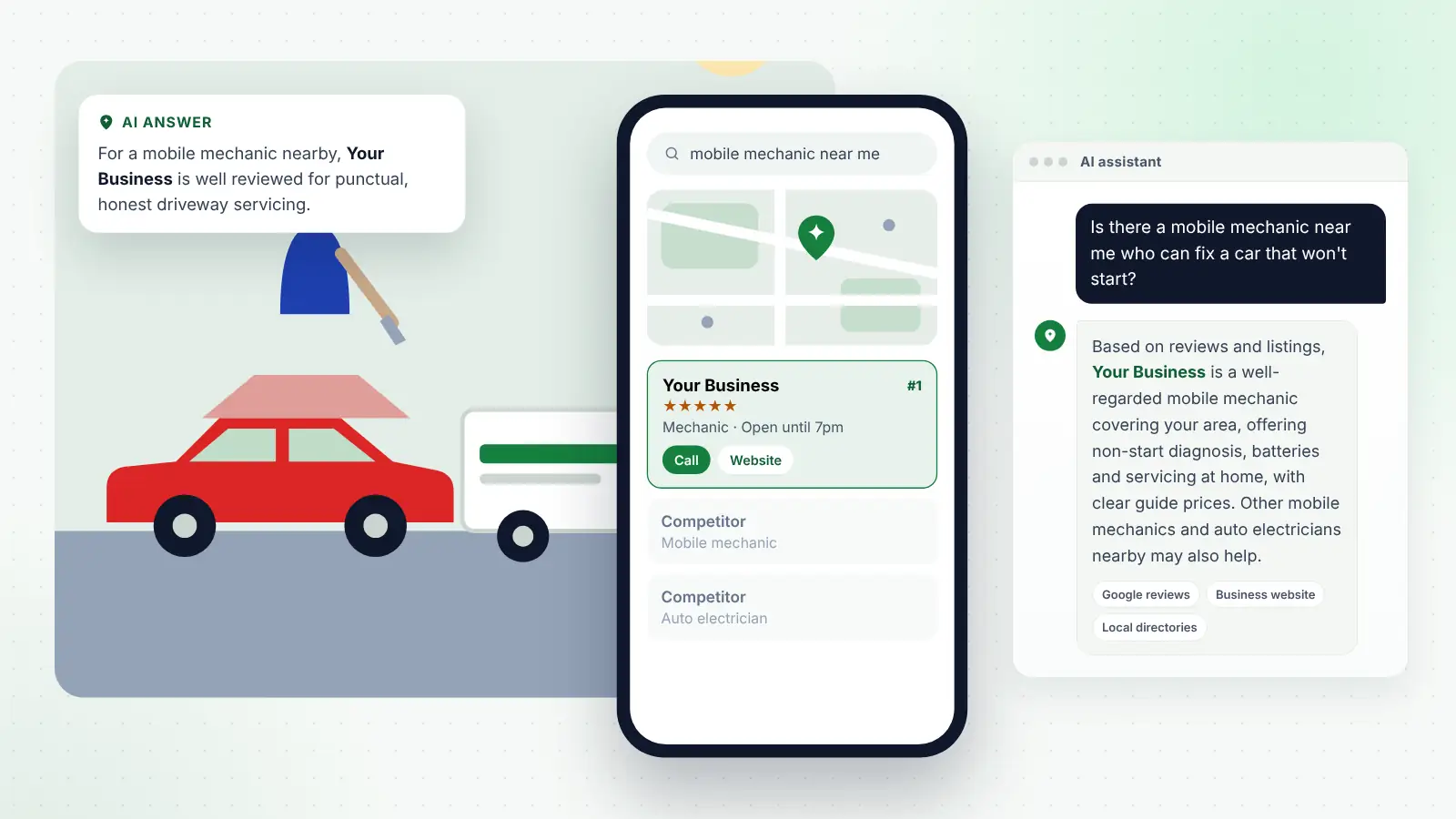
When drivers need a mobile mechanic, they usually search on their phone: “mobile mechanic near me”, “car service at home [town]”, “mobile mechanic car won’t start” or “auto electrician near me”. They tend to choose from the businesses shown on the map with good reviews, often within minutes.
Without a workshop on a main road, your online presence is your shop front.
Setting up a van-based Google Business Profile
Set up your profile as a service-area business, listing the towns you cover and hiding your home address if customers do not visit you. Then:
- Choose the most accurate primary category, with secondary categories such as auto electrician if they apply.
- List every service separately, including diagnostics, batteries, brakes, non-starts and fleet work.
- Add real photos of your van, tools and work in progress, with customers’ permission.
- Keep your hours accurate and return calls quickly.
Reviews, consistent details and website
Ask for a review once the job is done, with a direct link by text. Reviews that mention the job, the area and punctuality are especially useful. Reply to every review professionally.
Keep your business name, phone number and service area consistent across your website, Google profile, social media and directories. A simple website with a page for each main service and key area, with guide prices, qualifications and insurance, helps you appear for specific searches. Links from local business groups, community sponsorships and motoring sites add authority.
If you would rather spend your time on the tools, specialists can manage this for you; services such as local SEO for mobile mechanics and auto electricians cover profile set-up, listings and content. Either way, map visibility usually builds over three to six months.
AI search: how drivers now ask for a mobile mechanic
More drivers now ask AI assistants such as ChatGPT, Gemini, Perplexity, Microsoft Copilot and Google’s AI Overviews for help, and their questions are often specific and urgent:
- “Is there a mobile mechanic near me who can fix a car that won’t start?”
- “Can a mobile mechanic service my car while it’s under warranty?”
- “Who is a good auto electrician in Reading for a battery drain?”
Answer engine optimisation, or AEO, is about giving these tools reliable information they can confidently repeat. They tend to rely on:
- Consistent details about your services, areas and hours across the web.
- Reviews that mention specific jobs, vehicles and areas.
- Clear service descriptions, including what you can and cannot do on a driveway.
- FAQs on your website, such as whether you service hybrids, charge for diagnostics or cover a particular postcode.
- Mentions on reputable sites, such as local news, business groups and motoring directories.
If you want to be recommended for auto electrical faults, say so plainly, name the faults you diagnose and show the qualifications behind it.
Frequently asked questions
Do I need a licence to be a mobile mechanic?
There is no specific licence to work as a mechanic in the UK. You will need appropriate insurance, waste carrier registration if you transport your own waste as part of the business, and employers’ liability insurance if you employ staff. Recognised qualifications and IMI registration are strongly recommended.
Can a mobile mechanic do MOTs?
No. In England, Scotland and Wales, MOTs can only be carried out at a DVSA-authorised testing station. In Northern Ireland, MOTs are carried out at DVA test centres.
Will servicing a car under warranty cause problems for the customer?
Generally not, provided you follow the manufacturer’s schedule, use parts of matching quality and keep clear records. Warranty repairs and recalls are usually still handled by a franchised dealer.
Can I work on electric and hybrid cars?
Only with training and equipment suited to the level of work. IMI qualifications are graded by level, from awareness through to working on live high-voltage systems.
What should I do with waste oil?
Take it away with you in a sealed, leak-proof container and use an authorised collector, keeping your consignment notes and records. Never put it into a drain.
Next steps
Decide your focus and the area you want to cover, then put the essentials in place: motor trade and public liability insurance, waste carrier registration, a safe system for hazardous waste and any electric vehicle training you need. Equip the van with a reliable diagnostic tool and set clear guide prices.
Then build trust where customers will see it: a well set-up Google profile, steady reviews and consistent details across the web. Mobile mechanics who turn up on time, explain the work honestly and make booking easy tend to build a loyal customer base that keeps recommending them.