Most people who contact a translator are not shopping around for fun. They have a visa application due, a court hearing booked, a wedding abroad to arrange or a business contract waiting to be signed. They want to know three things quickly: will this translation be accepted, how fast can you do it, and what will it cost. The translators and agencies who answer those questions clearly, and are easy to find when someone searches, tend to win the work.
The market has also changed. National upload-and-pay platforms advertise heavily for certified translation searches, and machine translation has convinced some clients that translation should be instant and almost free. For a freelancer or small agency, competing on price alone is rarely wise. Competing on clarity, trust and specialism is.
This guide is for working language professionals who want more direct clients. It is general information, so always check specific requirements with the authority your client is dealing with.
Key points
- In England there is no state system of sworn translators, so clients need you to explain clearly what a certified translation is and what you provide.
- Home Office guidance asks for a translation that includes a statement of accuracy, the date, the translator’s or company’s name, signature and contact details, and in many cases their credentials.
- Membership of ITI or CIOL, ATC membership for agencies, NRPSI registration for public service interpreters and ISO 17100 certification are the trust signals worth showing.
- Being honest about machine translation and AI post-editing builds trust and protects your prices for work that needs a professional.
- Specialisms and specific language pairs are easier to market, and to be found for, than “we translate anything”.
- Local SEO and AI search help clients find you directly, and results usually build over three to six months.
In this guide
- Understand why clients choose a translator
- Explain certified translations clearly
- Show the credentials clients look for
- Be honest about machine translation and AI
- Protect confidentiality and handle data properly
- Build a specialism that clients can find
- Make quoting fast and pricing clear
- Win referrals from professional partners
- Local SEO for translators and interpreters
- When clients ask AI who can translate their documents
- Frequently asked questions
- Next steps
Understand why clients choose a translator
Before changing your marketing, it helps to separate your clients into groups, because each one searches and decides differently.
| Client type | Typical need | What they care about most |
|---|---|---|
| Individuals | Certified translations for visas, citizenship, marriage, driving licences or university applications | Acceptance by the authority, speed, a clear fixed price |
| Solicitors and immigration advisers | Court bundles, witness statements, evidence for immigration cases | Accuracy, confidentiality, deadlines, a reliable named contact |
| Local businesses | Contracts, product information, websites, staff documents | Specialist knowledge, consistency, ongoing support |
| Public services | Interpreting in health, police, courts and councils | Registration, professional conduct, availability |
Individuals search urgently and usually only once, so reviews, turnaround times and clear explanations matter most. Professional clients search more carefully and return often if you are reliable.
Explain certified translations clearly
The most useful thing you can do for prospective clients is explain, in plain English, what a certified translation is in the UK.
There are no sworn translators in England
In many civil law countries, such as France, Spain, Germany and Italy, sworn translators are appointed by the state and only they can produce an official translation. The UK works differently. As the Institute of Translation and Interpreting explains, there is no such thing as a sworn translator in the UK. Instead, a certified translation is one where the translator or translation company confirms in writing that it is a true and accurate translation of the original document.
This matters for your marketing. Avoid describing yourself as “sworn” or “officially approved” in the UK unless you genuinely hold an appointment from another country’s authorities, and if you do, explain which country and what that appointment means.
What a certification statement includes
The ITI, the Chartered Institute of Linguists (CIOL) and the Association of Translation Companies (ATC) jointly recommend that a certified translation is accompanied by a statement that it is a true and accurate translation of the original document, the date of translation, and the name and contact details of the translator or a representative of the translation company. Using a translator or company affiliated to a recognised professional body is also recommended.
What the Home Office asks for
For UK visa and immigration applications, Home Office guidance generally asks that any document not in English or Welsh comes with a full translation that can be independently verified. The translation is expected to include confirmation that it is an accurate translation of the original, the date, the full name and signature of the translator or an authorised official of the company, and their contact details. For many applications made inside the UK, the translator’s or company’s credentials are also expected. Requirements can differ by route and change over time, so link clients to the guidance for their visa type rather than restating it as fixed rules.
Notarised and apostilled translations
Some clients need a translation for use abroad, and the receiving authority may ask for it to be notarised or legalised. A notary public can witness the translator’s declaration, but a notary’s signature does not endorse the quality of the translation itself. An apostille from the Foreign, Commonwealth and Development Office confirms that a signature or seal on a UK public document is genuine. It does not verify the content. In practice, a translation usually needs a notarised declaration before it can be apostilled.
Tip
Add a line to every certified translation quote saying “please check with the organisation receiving your documents which type of translation they need”. It sets expectations and prevents most rejected-document disputes.
Show the credentials clients look for
Translation is not a legally regulated profession in the UK, which is exactly why credentials matter to clients.
- ITI membership. Qualified members of the Institute of Translation and Interpreting can use its certification seals on their work.
- CIOL membership or Chartered Linguist status. Widely recognised by public bodies and professional clients.
- ATC membership. For agencies, membership of the Association of Translation Companies signals that the business has been assessed against the association’s standards.
- NRPSI registration. Public service interpreters can register with the National Register of Public Service Interpreters, an independent voluntary regulator whose registrants follow a code of professional conduct.
- ISO 17100. Agencies certified to this standard for translation services have shown that they follow defined processes, including qualified translators and revision by a second linguist.
Display these on your website, quotes and Google Business Profile with a brief explanation of each. Only show memberships you currently hold, worded according to each body’s rules.
Be honest about machine translation and AI
Clients increasingly ask whether you use machine translation, and some arrive having already run their document through a free tool. Being open about this builds more trust than avoiding the question.
A sensible position for most practices is:
- Explain that machine translation can help with gist translation or large volumes of low-risk content.
- Be clear that certified, legal, medical and other high-stakes documents need a qualified human translator, because errors can have serious consequences.
- If you offer machine translation post-editing, describe it as a distinct service with its own price and quality level. ISO 18587 is the international standard for post-editing machine translation output, and while it distinguishes light from full post-editing, its requirements cover full post-editing.
- Make sure any tool you use is consistent with your confidentiality and data protection obligations.
Positioned this way, clients understand why a full human translation costs more.
Protect confidentiality and handle data properly
Almost every document you translate contains personal data: passports, birth certificates, medical records, court papers, financial statements. Under UK GDPR, you need a lawful basis for processing it, appropriate security and a clear retention policy, and some of it, such as health information, is special category data that needs extra care. Check whether you need to pay the data protection fee to the Information Commissioner’s Office.
Practical steps that also reassure clients:
- Offer a secure upload method rather than asking people to email scanned passports.
- Explain how long you keep documents and how you delete them.
- Have written agreements with any freelancers or agencies you subcontract to.
- Mention your approach to confidentiality on your website and in your Google profile description.
Build a specialism that clients can find
“We translate any language, any subject” is hard to believe and hard to rank for. Specialisms are easier to market and usually command better rates.
Ways to narrow your focus include:
- Language pairs. Being the go-to Polish, Romanian, Arabic, Urdu or Portuguese translator in your area, depending on your local communities and trade links.
- Document types. Immigration documents, academic transcripts, medical reports, court bundles or technical manuals.
- Sectors. Legal, healthcare, engineering, manufacturing, education, finance or marketing.
- Interpreting settings. Medical appointments, police and court work, business negotiations or conferences.
Give each specialism its own page explaining the documents you handle, turnaround times, pricing and which translators cover it. These pages give clients, search engines and AI tools something specific to match to their questions.
Tip
Keep a simple log of every enquiry for three months, noting the language pair, document type and how they found you. It quickly shows which specialisms are worth building pages and partnerships around.
Make quoting fast and pricing clear
Many translation enquiries are lost simply because the client could not get a quick answer. A few changes make a large difference:
- Publish guide prices for common certified documents, such as a one-page birth or marriage certificate, and say what they include.
- Explain how you price longer work, whether per word, per page or per hour for interpreting, and what affects the cost: language pair, subject, deadline and formatting.
- Be upfront about extras such as urgent turnaround, notarisation, apostille arrangements and postage of hard copies.
- Offer an online form where clients can upload documents securely and receive a quote, ideally the same working day.
Prices vary considerably by language, subject and area, so check what comparable professionals charge and position yourself on value rather than undercutting.
Win referrals from professional partners
Some of the most dependable translation work comes through people who are regularly asked for a recommendation.
| Partner | Why they refer | What they need from you |
|---|---|---|
| Immigration advisers and solicitors | Clients need translated evidence for applications | Correctly certified translations, reliable deadlines |
| Family and conveyancing solicitors | Documents from abroad for court or property matters | Accuracy, confidentiality, clear communication |
| Universities and colleges | International students and applicants need transcripts translated | Clear pricing and quick turnaround in term time |
| Accountants and business advisers | Clients trading abroad or with overseas paperwork | Specialist business and financial knowledge |
| Local businesses that export | Contracts, product information, websites | Consistency, terminology management, ongoing support |
Make it easy for partners with a single contact and a quick quoting process, and never imply that a translation guarantees the outcome of an application or case.
Local SEO for translators and interpreters
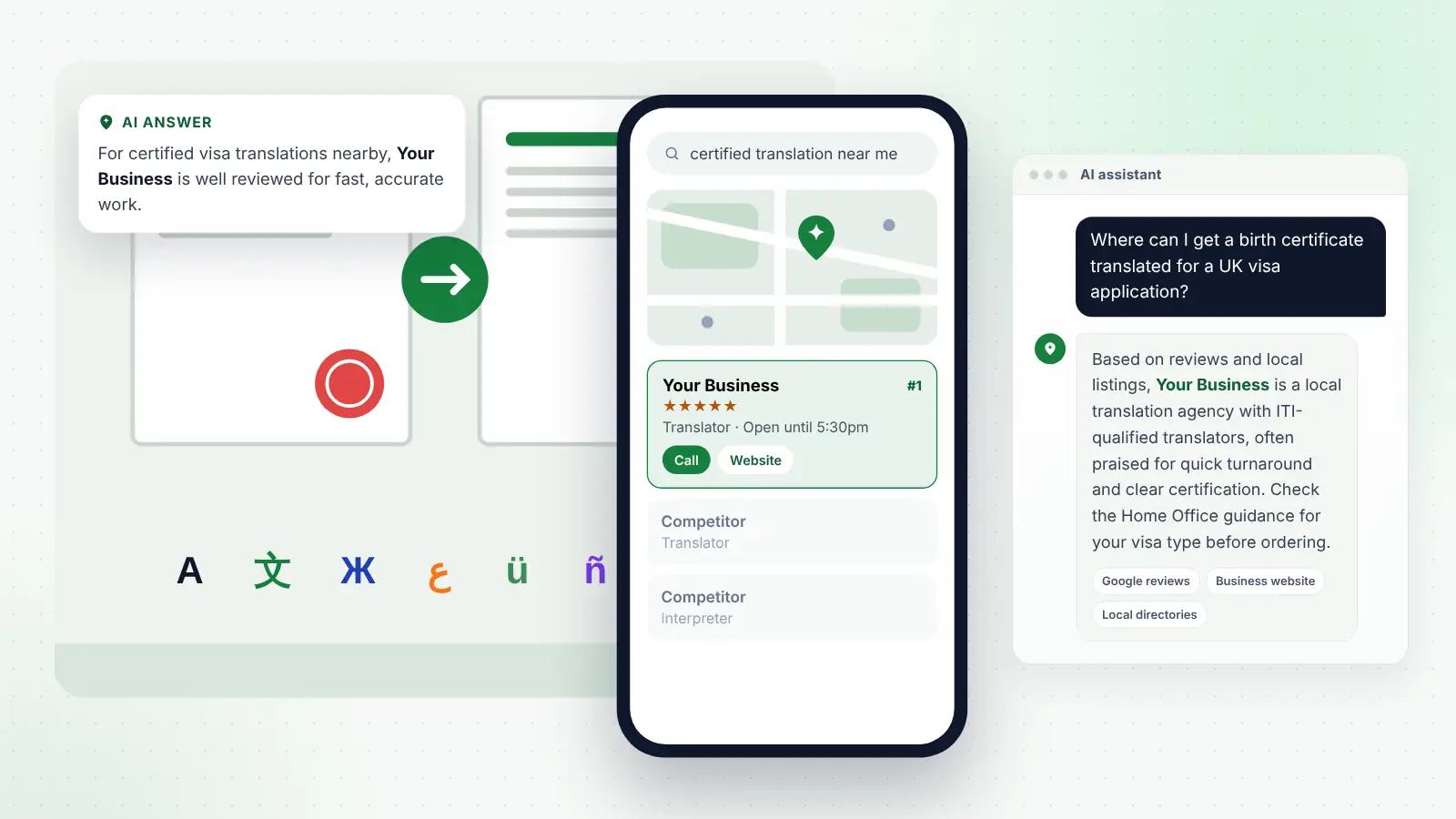
When someone needs a certified translation, they often search with an urgent, specific phrase: “certified translation near me”, “birth certificate translation for visa”, “Polish translator Leeds” or “Arabic interpreter for a hospital appointment”. Local search results, particularly the Google map listings, are often the first thing they see. Many clients prefer someone local they can visit with original documents.
Strong local visibility rests on a few foundations, and they work together.
Google Business Profile
Your Google Business Profile is often a client’s first impression. Choose the most accurate primary category, such as Translator, and add secondary categories that genuinely apply. Then:
- List each service separately: certified translation, legal translation, interpreting, notarised translation.
- Mention your languages and specialisms in the description, written for people, not keyword stuffed.
- Keep opening hours accurate, including whether clients can drop off documents in person.
- Add real photos of your office, your team and, with names and personal details hidden, examples of how certified translations are presented.
If you work from home and do not meet clients there, set your profile as a service-area business and hide your address.
Reviews
Ask satisfied clients for a review once their translation has been accepted or their interpreting session has gone well. Reviews that mention the document, language and turnaround reflect what future clients search for. Reply professionally and never mention any detail of a client’s case.
Matching details on registers and directories
Keep your business name, address, phone number and website identical everywhere: professional body directories, UK business listings, Apple Maps, Bing Places and local directories. Inconsistent details make search engines and AI tools less confident in your information.
A website with service and language pages
Your website should have a page for each main service and important language pair, plus a page explaining certified, notarised and apostilled translations. If you have offices in several towns, give each a genuine location page, and avoid thin pages for places you do not serve.
Local and industry links
Links from relevant, reputable websites build authority. Good sources include local business groups and chambers of commerce, university international offices, community organisations, partner solicitors and immigration advisers, and articles you contribute to industry or regional publications. If you would rather have specialists handle this work, our local SEO for translation and interpreting services covers your profile, listings, content and links.
When clients ask AI who can translate their documents
Before searching, plenty of clients now put their translation question to an AI assistant. They might ask ChatGPT, Gemini, Perplexity, Copilot or Google’s AI Overviews, “Where can I get a birth certificate translated for a UK visa?”, “What is the difference between a certified and a notarised translation?” or “Which translation agency near me is good for legal documents in Romanian?”
AI assistants compare what they find about you on your site, registers and directories before naming a translator. To give your language services a better chance of being named:
- Keep your information consistent. Your services, languages, location and credentials should match across your website, Google profile and directories.
- Describe your services clearly. Spell out which languages, document types and specialisms you cover, in plain English.
- Answer common questions. Add FAQs on certification, turnaround times, pricing, acceptance by authorities and confidentiality.
- Build reviews. AI tools often summarise what reviewers say, so reviews that mention accuracy and speed help.
- Earn mentions on reputable sites. Listings in professional body directories, local business organisations and partner websites all add credibility.
Many questions people ask AI tools are about what they actually need, so the business whose content explains those requirements clearly has a better chance of being recommended.
Tip
Every few months, ask two or three AI assistants the questions your clients ask, such as “who can translate a marriage certificate near me?”, and note whether you are mentioned and what information they use.
Frequently asked questions
Can any translator certify a translation in the UK?
There is no state appointment of sworn translators in England, so certification is a statement from the translator or company confirming the translation is true and accurate. In practice, authorities and clients expect a professional translator or company, ideally with membership of a recognised body such as ITI, CIOL or ATC, and some organisations set their own requirements.
Do I need NRPSI registration to interpret?
Registration with NRPSI is voluntary, but many public service clients look for it and it shows you follow a recognised code of professional conduct. If you work, or want to work, in public service settings such as health, police or courts, it is worth considering and showing clearly if you hold it.
How should I talk about machine translation?
Be honest about where you use it, where you never use it and what human revision involves. Offer post-editing as a separate service with its own price, and explain why certified, legal and medical work needs a qualified translator.
How long does local SEO take to work for a translation business?
Fixing your profile and directory entries can bring extra certified-document enquiries within a few weeks. Climbing the map and appearing in AI answers takes longer, often three to six months, depending on your language pairs, city and competition.
Next steps
Start with the basics: explain certification clearly, show your credentials, publish guide prices and make quoting fast. Then build the specialisms and partnerships you want more of, and ask happy clients for reviews. With an accurate Google profile, consistent listings and clear service pages, you give search engines and AI assistants good reasons to recommend you.