Google reviews get most of the attention, and for good reason: they sit right on your listing in Google Search and Maps. But they are not the only reviews your customers read. A homeowner choosing a builder may check Checkatrade or Which? Trusted Traders before calling. A diner may glance at Tripadvisor or OpenTable. A patient booking a private consultant may look them up on Doctify, and someone choosing a conveyancing solicitor may find the firm’s page on ReviewSolicitors before they find its website.
The problem is that there are far too many review platforms to keep up with, and many of them charge. Spreading effort across ten sites usually means a handful of reviews on each and none of them looking healthy. The better approach is to keep Google as your foundation, then choose two or three other platforms that your customers actually use, and do those well.
This guide explains how the main UK review platforms beyond Google work, who they suit and, where they charge, how their fee models work in general terms, as they stood in October 2026. It ends with a table of sensible choices by sector and a measured look at how review platforms feed into AI assistants.
Key points
- Google remains the review platform that matters most for nearly every local business; others should add to it, not replace it.
- Choose two or three extra platforms based on where your customers look, not where a salesperson says they should.
- Trade platforms differ a lot: some charge a membership fee, some charge per lead, and Which? Trusted Traders involves an assessment by a trading standards professional.
- Sector platforms such as Tripadvisor, OpenTable, Doctify and ReviewSolicitors carry weight with customers in those sectors because they are built for them.
- Apple Maps has its own simple ratings in the UK, based on thumbs up or down, so iPhone users can rate you even if you never ask.
- Reviews on reputable third-party sites can add to what AI assistants find about you, but nobody can say exactly how much weight they carry.
In this guide
- Why look beyond Google at all
- How to judge any review platform
- General platforms: Facebook, Trustpilot, Yell and Nextdoor
- Trade platforms and vetting schemes
- Hospitality: Tripadvisor and OpenTable
- Healthcare: Doctify and iWantGreatCare
- Legal and professional services
- Paid review collection tools: Feefo and Reviews.io
- Apple Maps ratings
- Choosing your two or three
- How review sites show up in Google Maps and local search
- How review platforms feed AI assistants
- Frequently asked questions
- Final thoughts
Why look beyond Google at all
There are three good reasons to care about other review sites, and one bad one.
The first is that customers in some sectors expect to see them. People hiring a tradesperson have been told for years to check a vetted directory, and many restaurant-goers habitually look at Tripadvisor. If your business is absent or has three reviews from 2019, that is noticed.
The second is search visibility. Directory and review-site pages often rank on the first page of Google for searches like “roofers in Chester” or “solicitors in Norwich”, and when someone searches your business name followed by “reviews”, third-party profiles frequently appear. A healthy profile there means a second positive result about you.
The third is corroboration. A business with a good rating on Google and a similar rating on an independent platform looks more trustworthy than one whose reviews all sit in one place, both to people and, quite possibly, to the systems that summarise businesses.
The bad reason is fear of missing out. Plenty of platforms will contact you with urgent-sounding messages about your “unclaimed profile”. Claiming a free profile is usually harmless; signing a paid contract because of that message rarely is.
How to judge any review platform
Before committing time or money, run each platform through five questions.
- Do my customers use it? Ask new customers how they found you and what they checked. Search for your service and town and see which review sites appear on page one.
- How are reviews verified? Some platforms only accept reviews from invited or confirmed customers; others allow anyone with an account. Verified platforms carry more weight with readers but take more effort.
- How does it charge? Free listing, monthly membership, pay per lead or a review-collection subscription. Each suits a different kind of business.
- Can I reply? Almost all platforms let you reply, but check, because Apple Maps ratings, for example, have no reply option.
- Will I maintain it? A platform you set up and abandon looks worse than one you never joined.
General platforms: Facebook, Trustpilot, Yell and Nextdoor
These suit many types of business and are worth considering whatever your sector.
Facebook recommendations
Facebook no longer uses the old star reviews on business Pages. Instead it asks people whether they recommend your business, with space to say why, and shows how many people recommend you alongside what they said. You can turn recommendations on or off for your Page, but switching them off removes useful social proof. They matter most for businesses with an active local Facebook following: cafés, salons, dog groomers, tradespeople who post finished work and anyone mentioned often in community groups.
Trustpilot
Trustpilot is best known for online and national brands, but local service businesses use it too. It has a free plan which, at the time of writing, includes up to 50 automated review invitations a month, replying to reviews and a basic widget for collecting reviews from your website, with paid plans adding more features. Trustpilot’s guidelines for businesses say you should invite customers in the same way whether their experience was good or bad rather than picking who to ask, keep invitations neutral and never offer incentives. It suits businesses that sell or book online, professional services such as solicitors and accountants, and firms that serve customers over a wide area.
Yell
Yell is a long-standing UK directory, now presenting itself as a marketplace for local services, where businesses can add a free listing and customers can leave star ratings and reviews. Check Yell’s own help pages for how reviews are checked, how to reply and what review request tools your account includes, as these features change. A free listing is worth claiming for most local businesses, particularly trades and older customer bases, even if you never pay for advertising.
Nextdoor
Nextdoor is a neighbourhood network where members confirm the area they live in. Businesses can claim a free Business Page, and neighbours can recommend them, either on the page or by tagging the business when someone asks for suggestions. Nextdoor provides a recommendation link you can share with customers. It works well for businesses serving a tight local area: cleaners, gardeners, handymen, tutors, childminders, dog walkers and independent shops.
Trade platforms and vetting schemes
For tradespeople, this is where the choice matters most, because the main platforms work in quite different ways and most of them charge. Always read the current terms before signing, as fees and plans change.
Checkatrade
Checkatrade is a well-known UK trade directory. Trades pay a monthly membership, with plans ranging from a basic listing that brings no sales leads to plans tied to a set volume of leads. Members go through checks before approval, and customers leave ratings and reviews on the trade’s profile. Checkatrade also offers a guarantee on some work booked through it, subject to its terms.
Rated People, now part of Checkatrade
Rated People used to work differently: homeowners posted a job and tradespeople on a paid plan bought the leads they wanted. That model has ended. In September 2026 Checkatrade Group bought selected assets of Rated People, including the brand, after the company that ran it went into liquidation. Reports indicate that Rated People trade memberships did not carry over and that jobs posted through the brand now go to Checkatrade members. If you had a Rated People account or reviews there, check directly with Checkatrade what is available to you before relying on that profile.
MyBuilder
MyBuilder is also a job-posting marketplace. Homeowners describe a job, interested trades express interest, and the trade pays a fee when the homeowner shortlists them. Customers leave feedback after the job, and that feedback becomes the trade’s reputation on the platform. It suits trades willing to compete for individual jobs, often earlier in a business’s life.
TrustATrader
TrustATrader positions itself as an alternative to lead-buying. Trades apply for membership, which it says is limited per area, and it states that members pay no commission and never pay per lead. Customers leave star ratings and reviews on the trader’s profile. Check the membership price and contract terms directly, as they are not published on its main joining page.
Which? Trusted Traders
Which? Trusted Traders is a vetting and endorsement scheme rather than a lead marketplace. According to Which?, applicants pay a one-off assessment fee and go through a credit check, possible customer reference checks and an interview of around 90 minutes with a trading standards professional, covering their processes, paperwork and complaints handling. Endorsed traders then pay an ongoing fee based on the size of the business, can display the logo, sign up to a code of conduct and are reassessed over time. Customers leave reviews on the trader’s profile, which are moderated, and negative reviews are not removed simply for being negative. The scheme’s trader FAQs set out the current eligibility rules.
Bark
Bark covers a much wider range of services than trades, including accountants, photographers, personal trainers, tutors and cleaners. Customers post a request, and professionals pay a fee to be introduced and receive the customer’s contact details. Professionals have a profile that can show reviews. Like other lead marketplaces, it can produce work, but the leads are shared and competitive.
Tip
Before paying for any trade platform, search for your main service and your town and note which platforms appear on page one, then ask the last ten customers whether they checked any of them. Pay for the platform your customers already use, not the one with the most persuasive sales call.
Hospitality: Tripadvisor and OpenTable
For restaurants, pubs, cafés, hotels, B&Bs and attractions, Tripadvisor is a platform many guests recognise. Listings are free to claim, and claiming lets you reply to reviews, update details and add photos. Tripadvisor has its own rules against fake and incentivised reviews, similar in spirit to Google’s. It is especially important for anything visitors to an area might look up: a seaside café, a country pub, a city-centre hotel.
OpenTable is a booking platform, but its reviews carry particular weight because, as OpenTable puts it, reviews come only from guests with a completed reservation. If you take bookings through OpenTable, those verified diner reviews build up automatically as part of the process, so the main job is replying and acting on recurring themes. If you use a different booking system, check whether it offers its own review collection.
Healthcare: Doctify and iWantGreatCare
Healthcare review platforms have stricter verification than general sites, which is part of their appeal to patients.
Doctify describes itself as a closed review platform: only providers who sign up, on a paid subscription, can be reviewed. Patients are invited after an appointment by email, text, tablet or QR code, reviews are verified by a text to the patient’s phone, and Doctify says providers cannot choose which compliant reviews are published. Its users include private consultants, clinics and hospitals.
iWantGreatCare is an independent patient feedback site covering a broad range of care, including doctors, dentists, GP practices, hospitals, pharmacies, physiotherapists, optometrists and care homes. It also provides patient experience monitoring to NHS and independent providers.
For a private dental practice, physiotherapy clinic or optician, Google remains the priority, with one healthcare-specific platform if your patients or referrers use it. Whatever you choose, the confidentiality rules of your regulator apply to every reply.
Legal and professional services
ReviewSolicitors is a specialist review site for UK law firms. It says it creates profiles for law firms across the UK, matched against the Solicitors Regulation Authority register for firms in England and Wales, so your firm probably already has a page whether or not you have claimed it. Firms can respond publicly to reviews, reviews cannot be deleted by the firm, and paid membership gives more control over the profile and tools to collect reviews, including integration with case management systems. Trustpilot is the other platform many firms use, particularly those handling conveyancing or other high-volume work online.
The SRA has encouraged firms to engage with online reviews, and its guidance makes clear that replies must never disclose confidential or privileged information. Accountants, financial advisers and other professional firms have no single dominant specialist platform; Google plus Trustpilot is usually a sensible pairing, sometimes with Bark for lead generation.
Paid review collection tools: Feefo and Reviews.io
Feefo and Reviews.io are not directories customers browse in the same way. They are subscription services that collect and display verified reviews for you. Feefo describes itself as invitation-only, sending feedback requests after a purchase or verified interaction, so every review links to a real customer. Reviews.io collects company and product reviews and offers integration with Google seller ratings, the stars that can appear in some Google ads.
They mainly suit businesses that sell online, run ads or handle a high volume of transactions, such as larger retailers, multi-site service firms and national brands. For a single-site salon or electrician, the cost is usually harder to justify than time spent on Google and one free platform.
Apple Maps ratings
Apple Maps does not use written reviews in the way Google does. In the UK, where the feature has been available for several years, people signed in with an Apple Account can rate a place with a thumbs up or thumbs down, sometimes across categories relevant to the type of business, and add photos. Apple notes that the feature is not available in every country, and that not every place shows the option. Apple also prompts some users to rate or add photos after a recent visit, using on-device suggestions.
Two practical points follow. You cannot reply to Apple ratings, so the only way to influence them is good service. And because place cards are also where ratings from some partner sites can appear, it is worth claiming your location through Apple Business and keeping your other profiles accurate. Apple’s support page on rating places in Maps explains how customers do it.
Choosing your two or three
| Sector | Start with | Add one or two of | Usually skip unless customers ask |
|---|---|---|---|
| Trades and home improvement | Checkatrade, Which? Trusted Traders or TrustATrader; Facebook | Paying for several lead platforms at once | |
| Builders and larger projects | Which? Trusted Traders or Checkatrade; Facebook for project photos | Pay-per-lead sites for small jobs | |
| Restaurants, cafés and pubs | Tripadvisor; OpenTable if you use it; Facebook | Trustpilot | |
| Hotels and B&Bs | Tripadvisor; Facebook | Trade or professional directories | |
| Private healthcare | Doctify or iWantGreatCare | General directories with open reviews | |
| Solicitors | ReviewSolicitors; Trustpilot | Facebook, unless you have an active local page | |
| Accountants and advisers | Trustpilot; Yell | Pay-per-lead sites if leads are poor | |
| Salons, barbers and beauty | Facebook; your booking app’s reviews | Trustpilot | |
| Hyper-local services | Nextdoor; Facebook | Paid review tools | |
| Online-heavy or multi-site businesses | Trustpilot, Feefo or Reviews.io | Small directories |
Treat this as a starting point. The right answer for your business depends on which sites your customers actually mention.
How review sites show up in Google Maps and local search
Your Google Business Profile reviews are what appear on the map pack itself, so they remain the priority for local visibility. Other review platforms contribute in less direct ways. Directory and review pages often rank for local searches in their own right, so a strong Checkatrade, Tripadvisor or ReviewSolicitors profile gives you a second chance to appear on page one. Each claimed profile is also a citation: another listing with your name, address and phone number, which supports the consistency Google looks for.
Consider someone searching “builders near me”. They see the map pack, check the top three Google ratings, then search one builder’s name and find a well-reviewed Which? Trusted Traders profile in the results. That confirmation can be what turns a shortlist into a phone call. The same pattern applies to a pub whose Tripadvisor page backs up its Google rating, or a solicitor whose ReviewSolicitors profile matches what clients say on Google.
Keep your details identical on every platform, and add new profiles only when you can maintain them. If you would prefer specialists to manage profiles, citations and reviews together, local SEO support that covers your listings and review profiles is one option.
How review platforms feed AI assistants
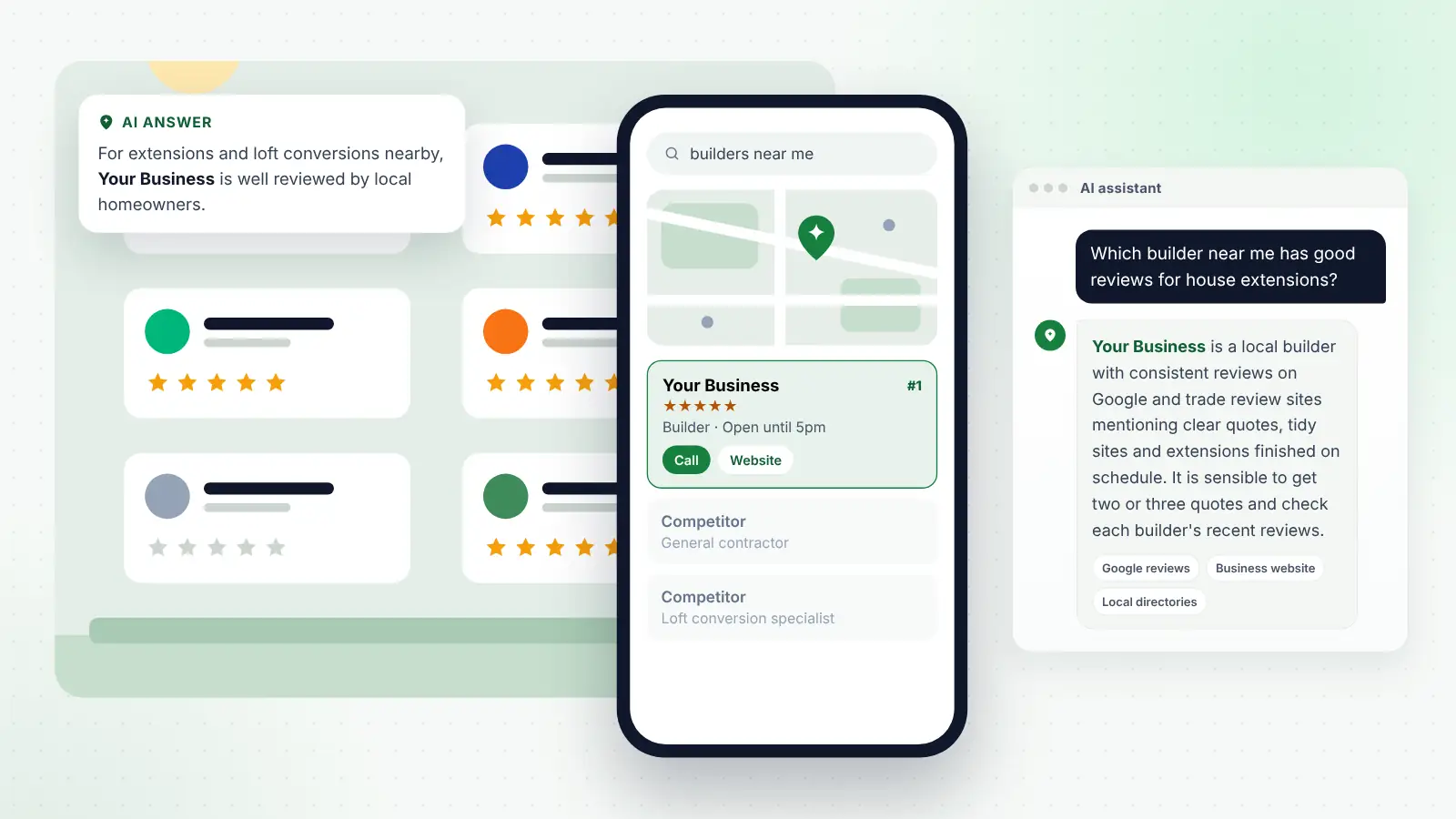
When people ask ChatGPT, Gemini, Copilot or Perplexity something like “Which builder near me has good reviews for house extensions?” or “Is there a good Italian restaurant in Harrogate for a family meal?”, the assistant tries to pull together what it can find about local businesses. Some of these tools search the web and cite sources, and review-site pages can be among the sources they use. Google has also been adding AI-generated summaries of reviews and place information in Maps and Search.
It is sensible to be measured about this. None of these companies publishes a list of the review sites it uses or how much weight it gives them, and the systems change frequently. What can reasonably be said is that consistent, detailed reviews across reputable platforms give an assistant more material to describe your business accurately, and that conflicting information, such as different phone numbers or very different ratings, gives it less reason to mention you with confidence.
So the advice is the same as for human readers: a strong Google profile, one or two respected platforms for your sector, genuine reviews collected consistently and calm replies. Be wary of anyone selling placements on obscure review sites as a route into AI answers.
Frequently asked questions
Do reviews on other sites help my Google ranking?
Not directly in the way your Google reviews do. They help indirectly: profiles on reputable sites act as citations, can rank for local searches themselves and give customers who search your name more positive results. Your Google reviews remain the most important for the map results.
Should I pay for Checkatrade or another trade platform?
It depends on whether your customers use it and whether you need the leads. Membership-based platforms suit trades who want a vetted badge and steady visibility; pay-per-lead platforms suit those willing to compete for individual jobs. Track the work each one produces for a few months before renewing.
Can I copy reviews from one platform to another?
No. Reviews belong to the platform where they were written, and you should not repost them elsewhere as if they were left there. You can display reviews on your own website with a clear source, but you must not present a selection of only positive reviews as representative.
How many review platforms should I be on?
For most local businesses, Google plus two or three others is enough. Claim free listings on the main directories so your details are correct, but focus active review collection on the platforms your customers actually read.
Can I ask the same customer to review me on two sites?
You can, but it is usually better to ask each customer to review you on one platform, and to rotate which you suggest. Asking for two reviews at once doubles the effort and tends to reduce how many people do either.
Final thoughts
Google reviews come first, but they are not the whole story. Work out which two or three other platforms your customers actually use, whether that is Checkatrade or Which? for a trade, Tripadvisor for a pub, Doctify for a clinic or ReviewSolicitors for a law firm, and give those the same care. Understand how each one charges before you sign, keep your details identical everywhere, reply to reviews on every platform you use and ignore pressure to join everything at once. A handful of well-kept profiles will do far more for your reputation, in search, on the map and in AI answers, than a scattering of neglected ones.