A letting agency is a different business from a sales agency, even though the two often share a shopfront. Sales income arrives in lumps when properties complete. Lettings income, once you have a managed portfolio, arrives every month. That recurring revenue is why many people who have worked in lettings or property management decide to set up on their own, and why a well-run lettings book is valued so highly when agencies change hands.
The trade-off is responsibility. You will hold other people’s money, manage homes that people live in, and carry a large share of your landlords’ legal obligations. The rules have also moved quickly. The Renters’ Rights Act 2025 changed how tenancies work in England from 1 May 2026, a national landlord register starts its regional rollout in December 2026, and further reforms on standards and redress are planned. For an agency that is organised and keeps up to date, that complexity is the reason landlords will pay you.
This guide is for anyone planning to start a letting or property management agency, whether that is tenant find, fully managed lettings, HMOs or block management. It covers service levels, regulation across the UK nations, systems, winning your first landlords, and how to be found when landlords search Google or ask an AI assistant. If you are also planning to offer sales, read our separate guide to starting an estate agency alongside this one. Everything here is general information as of October 2026, so check details with the relevant bodies and take professional advice where needed.
Key points
- Letting agents and property managers in England must belong to a government-approved redress scheme, and those who hold client money must join an approved client money protection scheme.
- The Tenant Fees Act 2019 bans most charges to tenants, so your income comes almost entirely from landlords.
- Since 1 May 2026, most private tenancies in England are periodic, section 21 has gone and rental bidding is banned, which changes how you let and manage.
- Wales requires agents to be licensed through Rent Smart Wales, and Scotland requires registration on the Scottish Letting Agent Register.
- Landlords choose an agent at a few key moments, so being visible on Google Maps and in AI recommendations at those moments matters.
In this guide
- Decide which lettings services you will offer
- Understand the regulation in England
- The Renters’ Rights Act and what it means for your agency
- Letting property outside England
- Build a compliance system landlords can rely on
- Set up your agency properly
- Price your services and win your first landlords
- Local SEO: how landlords find a letting agent
- AI search: how landlords now ask for recommendations
- Frequently asked questions
- Next steps
Decide which lettings services you will offer
Most agencies offer a ladder of service levels, and the mix you choose shapes your income, staffing and risk. Be clear about what you will and will not do before you write your terms of business.
| Service | What it usually includes | Income pattern | Main risks |
|---|---|---|---|
| Tenant find (let only) | Marketing, viewings, referencing, tenancy set-up | One-off fee per let | Lower lifetime value, tenancy set-up errors |
| Rent collection | Tenant find plus collecting rent and chasing arrears | Monthly percentage of rent | Client money handling, arrears disputes |
| Fully managed | Rent collection plus repairs, inspections and compliance | Higher monthly percentage | Maintenance liability, compliance failures |
| HMO management | Room lets, licensing support, more frequent inspections | Higher fees, more admin | Licence conditions, fire safety, tenant turnover |
| Block management | Service charges, contractors and communal areas for leasehold buildings | Annual management fee per unit | Service charge accounting, leaseholder disputes |
Fully managed lettings are where most of the recurring value sits, but they demand the most from your systems and people. Many new agencies start with tenant find and rent collection to build cash flow, then convert those landlords to full management as trust grows.
HMOs and block management are specialisms. HMO management involves licensing conditions, fire safety and a much higher volume of tenant contact. Block management sits in the leasehold world, with service charge accounting, budgets, major works consultation and residents’ associations. Both can be very good businesses, but take them on deliberately, with the right training and insurance, rather than as favours to existing clients.
Understand the regulation in England
There is no single licence for letting agents in England and no compulsory qualification. Instead, a set of separate legal requirements applies.
Redress and client money protection
Every letting agent and property manager in England must belong to a government-approved redress scheme, such as The Property Ombudsman or the Property Redress Scheme. If you hold client money, such as rent, deposits or funds for repairs, you must also belong to an approved client money protection (CMP) scheme. You must display your CMP certificate in your office and on your website and tell clients if your membership changes.
CMP schemes typically require you to hold client money in a designated client account, reconcile it regularly and carry professional indemnity insurance. Treat those requirements as the foundation of your accounting, not paperwork to sort out later.
Publicising your fees
Letting agents must publish their full fees, including VAT, on their website and in their office, along with details of their redress and client money protection schemes. Landlords should be able to see exactly what each service level costs before they contact you.
The Tenant Fees Act 2019
The Tenant Fees Act bans most payments that landlords and agents used to charge tenants, such as referencing, admin and check-out fees. Permitted payments include rent, a refundable holding deposit capped at one week’s rent, a tenancy deposit capped at five weeks’ rent where annual rent is under £50,000 (six weeks at or above that), utilities and council tax, and certain default fees such as replacing lost keys, which must be reasonable and evidenced. In practice, your income comes from landlords, and your fees need to reflect the real cost of the work.
Deposit protection
If you take a tenancy deposit for an assured tenancy in England (since 1 May 2026, the assured periodic tenancies that replaced assured shorthold tenancies), it must be protected in a government-approved tenancy deposit scheme within 30 days, and the tenant must be given the prescribed information within the same period. Failures can lead to penalties for the landlord, and landlords will look to their agent if the agent was responsible. Build deposit protection into your move-in checklist so it cannot be missed.
Anti-money laundering
Letting agency businesses that let property with a monthly rent at or above the equivalent of 10,000 euros fall within the Money Laundering Regulations and must register with HMRC for supervision. Many agencies never handle lets at that level, but if you operate in prime areas or manage corporate lets, check HMRC’s guidance on who needs to register for money laundering supervision before you trade.
The Renters’ Rights Act and what it means for your agency
The Renters’ Rights Act 2025 is the biggest change to private renting in England for a generation. The first stage took effect on 1 May 2026:
- No more section 21. Landlords can no longer end a tenancy without a reason. Possession now relies on reformed section 8 grounds, such as selling, moving in, serious rent arrears or antisocial behaviour.
- Periodic tenancies. Most new and existing assured tenancies are now rolling, with no fixed term. Tenants can end them with two months’ notice.
- Rent increases. Increases are limited to once a year, using the statutory process with two months’ notice, and tenants can challenge them.
- Letting practice. Rental bidding is banned, so you must not invite or accept offers above the advertised rent, and you cannot ask for more than one month’s rent in advance. You must not discriminate against tenants because they have children or receive benefits.
- Enforcement. Councils have stronger powers and higher civil penalties.
The second stage is the private rented sector database. Landlords will have to register themselves and their properties through a new service that opens on 15 December 2026, starting in the West Midlands and rolling out region by region through 2027, with three months to register once a region goes live. An annual fee per property has been announced. Agents can be authorised to provide information on a landlord’s behalf, but responsibility stays with the landlord. A new landlord ombudsman, which all private landlords will have to join, is expected to follow, with the government’s Renters’ Rights Act implementation roadmap pointing to 2028.
Further changes are planned for housing standards. A Decent Homes Standard for private rented homes is due to come in during the 2030s, and the government opened a consultation in October 2026 on applying Awaab’s Law, which sets time limits for dealing with hazards such as damp and mould, to the private rented sector. No date has been confirmed for private landlords, so watch for the outcome. The government has also said it intends to introduce wider regulation of property agents, though no timetable has been set.
For a new agency, these changes are an opportunity. Many self-managing landlords are unsure how to serve a valid section 8 notice, propose a rent increase or register on the database, and some will decide it is easier to hand the work to an agent who already knows.
Tip
Write a short, dated “what’s changed for landlords” page on your website and update it whenever a new stage of the reforms begins. It is useful to landlords, gives you a reason to contact past enquiries, and shows search engines and AI tools that you keep up to date.
Letting property outside England
If you plan to operate outside England, the rules are different, and in some ways stricter.
- Scotland. It has been a criminal offence since October 2018 to carry out letting agency work without being on the Scottish Letting Agent Register. To register, you must meet minimum training requirements and follow the statutory Letting Agent Code of Practice, which covers service standards, communication and the handling of client money. Most private tenancies in Scotland are private residential tenancies, which work differently from English tenancies.
- Wales. Agents who let or manage rental property in Wales must be licensed through Rent Smart Wales, which involves completing approved training, and landlords must register. Tenancies in Wales are occupation contracts under the Renting Homes (Wales) Act 2016, with their own notice periods and written statement rules.
- Northern Ireland. There is currently no mandatory licensing of letting agents, but tenancy and deposit rules still apply, and landlord registration is required.
Each nation also has its own approved tenancy deposit schemes and deadlines. If you plan to work across a border, build separate processes for each nation rather than adapting your English paperwork.
Build a compliance system landlords can rely on
When you fully manage a property, landlords rely on you to keep it legal. A missed certificate is one of the quickest ways to lose a landlord and a review. Your property management software should track every requirement with reminders well ahead of each deadline. In England, the core items include:
- Gas safety. An annual check by a Gas Safe registered engineer, with a copy given to tenants.
- Electrical safety. An electrical installation condition report at least every five years, with any required remedial work completed.
- Smoke and carbon monoxide alarms. Fitted where required and checked at the start of each tenancy.
- Energy performance. A valid EPC meeting the current minimum standard, with stricter targets planned, so check the latest position.
- Right to Rent. Checks on adult occupiers before the tenancy starts, in England.
- Deposit protection. Within 30 days, with prescribed information.
- Licensing. Mandatory HMO licences, and any additional or selective licensing schemes run by the local council.
- Database registration. From your region’s start date, making sure each landlord’s registration is complete.
Keep a clear record of who is responsible for each item. Your management agreement should say what you will handle, what the landlord must do and what happens if the landlord refuses to authorise essential work.
Set up your agency properly
Beyond regulation, a lettings business needs the right foundations from day one.
- Business structure and banking. Most agencies trade as limited companies. You will need a business account and a separate designated client account for client money.
- Insurance. Professional indemnity is usually a condition of CMP membership. Public liability and office cover are standard. Many agents also offer rent guarantee and landlord insurance through specialist providers.
- Software. Lettings software that handles marketing, referencing, tenancy documents, client accounting, maintenance and compliance reminders will save you far more time than it costs.
- Documents. Up-to-date management agreements and tenancy agreements that reflect the Renters’ Rights Act. Old fixed-term templates are a common and avoidable mistake.
- Contractors. A reliable panel of gas engineers, electricians, plumbers, locksmiths and handymen who answer the phone. Your reputation depends on them.
- Professional body. Membership of Propertymark or Safeagent is voluntary in England but widely recognised, and both offer training and CMP options.
- Data protection. You will handle tenants’ identity documents, references and financial details, so check whether you need to pay the ICO data protection fee and have clear policies.
Price your services and win your first landlords
Lettings fees are usually charged as a percentage of the monthly rent, with tenant find charged as a one-off fee and fully managed charged at a higher monthly rate. Rates vary widely by area, property type and competition, so research local agents’ published fees before you set yours. Competing purely on price is risky, because full management is labour-intensive and a cheap fee makes it hard to deliver a good service.
Your first landlords are most likely to come from:
- People you already know. Landlords you have looked after in previous roles, where your contracts allow you to approach them.
- Professional referrals. Mortgage brokers, accountants, conveyancing solicitors and sales-only estate agents meet landlords and investors constantly.
- Accidental landlords. People who have inherited a property, moved for work or cannot sell often need a lot of guidance and stay loyal when they get it.
- Self-managing landlords. Many are reconsidering after the 2026 reforms. A free rental valuation or compliance check is a natural first conversation.
- Buying a lettings book. Acquiring a smaller portfolio from a retiring agent can give you a base quickly. Check client account reconciliations, management agreements and compliance records before you commit.
Tenants matter too. Today’s tenant can be tomorrow’s landlord or buyer, and tenant experience shapes your reviews. Fast repair responses and fair deposit handling pay off.
Local SEO: how landlords find a letting agent
Landlords do not search for an agent often, but when they do, they search locally and compare carefully. Common searches include “letting agents near me”, “property management company [town]”, “fully managed lettings [area]”, “HMO management [city]”, “block management company near me”, “tenant find service” and “how much do letting agents charge”.
Local SEO helps your agency appear in Google’s map results and local listings at those moments. For a lettings business, the key elements are:
- Google Business Profile. Choose letting agent as your primary category, adding property management company if it fits. List each service level, add your hours, a rental valuation booking link, real photos of your team and office, and regular posts about recent lets and rule changes. Create a profile only for genuine staffed branches.
- Reviews from landlords and tenants. Ask landlords for reviews after a successful let or a well-handled repair, and ask tenants at move-in or a smooth check-out. Tenant reviews can be critical, so reply to every one calmly and factually. Don’t pay for reviews, post your own or tempt landlords with incentives for a good rating.
- Consistent details. Keep your agency name, address and phone number identical on your website, Google, Apple Maps, Bing, portals, redress and CMP scheme directories and professional body listings.
- Service and area pages. Write separate, genuinely useful pages for tenant find, rent collection, full management, HMOs and block management, plus pages for the areas you cover with local rental market observations.
- Local links and mentions. Landlord networking events, comments in local news on rental market changes, and links from local business groups and community organisations all build authority.
Some agencies do this in-house. Others bring in specialists in local SEO for letting agents and property managers, and Grow With SEO is one option. Either way, profile improvements can help quickly, while stronger map visibility usually builds over three to six months.
Tip
Publish your fees for every service level on one clear page and link to it from your Google profile. You are required to publicise fees anyway, and landlords who compare agents online are more likely to contact the one whose costs they understand.
AI search: how landlords now ask for recommendations
Landlords increasingly ask AI assistants for help before contacting an agent. They use ChatGPT, Gemini, Perplexity, Microsoft Copilot and Google’s AI Overviews, and their questions are often detailed:
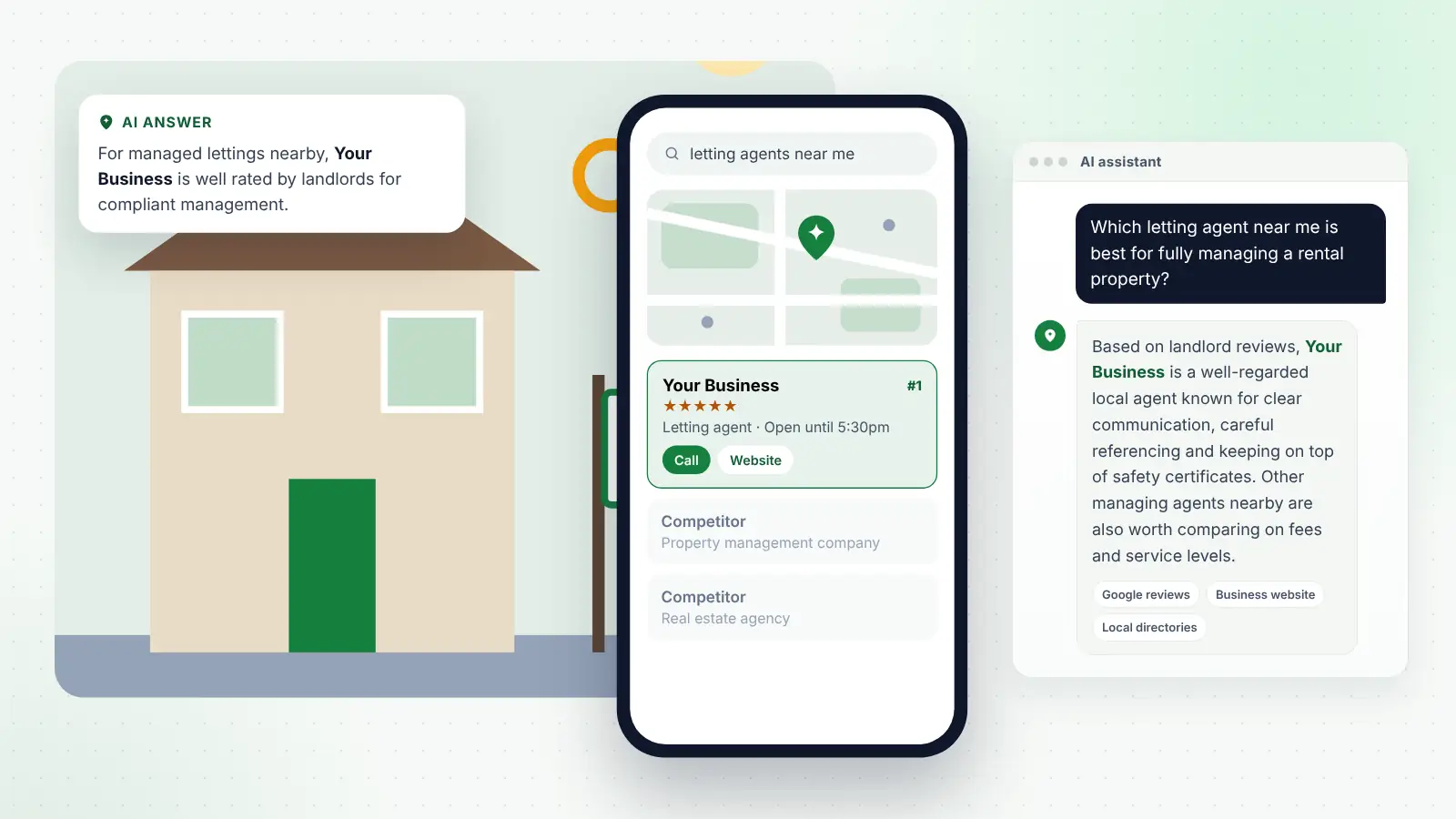
- “Which letting agent near me is best for fully managing a rental property?”
- “Who manages HMOs in [city] and understands the licensing rules?”
- “What do letting agents in [town] charge for full management?”
- “I’m moving abroad. Which local agent could look after my flat?”
- “Which letting agents in [area] can help me with the Renters’ Rights Act?”
When a landlord asks an AI assistant to suggest a local agent, the answer is pieced together from whatever it can find and verify about agencies online. Answer engine optimisation (AEO) is about making that information clear, consistent and credible. For a letting agency, that means:
- Consistent agency details across your website, Google profile, portals, scheme directories and professional bodies.
- Clear service descriptions that say exactly what each service level includes, which property types you manage and which areas you cover.
- Reviews that describe your strengths, such as careful referencing, quick repairs, low voids or clear monthly statements.
- Helpful FAQs on fees, what full management includes, how deposits work, and what the current rules mean for landlords, written in plain English and dated.
- Mentions on reputable sites, including local news, landlord associations, community websites and professional bodies.
Specialisms are especially valuable here. If you are an HMO specialist or a block manager, say so clearly and explain your experience. AI tools try to match a specific question to a specific provider, and a clear specialism gives them a reason to name you.
Frequently asked questions
Do I need a licence to start a letting agency?
In England there is no single licence and no compulsory qualification, but you must join a government-approved redress scheme, join a client money protection scheme if you hold client money, publicise your fees and follow the Tenant Fees Act and tenancy law. In Wales you need a Rent Smart Wales licence, and in Scotland you must be on the Scottish Letting Agent Register.
Can I start a letting agency from home?
Yes, many agents do, especially when starting with tenant find and rent collection. You still need redress and CMP membership, a designated client account and proper systems. Without a high street office, your Google profile, website and reviews do more of the work of building trust.
Is it better to start with tenant find or fully managed lettings?
Tenant find is simpler and brings in fees quickly, but each landlord is worth less over time. Fully managed lettings build recurring income but need strong systems and contractors. Many new agencies offer both and focus on converting tenant find landlords to full management once they have proved their service.
How has the Renters’ Rights Act changed the agent’s role?
In England, agents now set up periodic tenancies, use the statutory process for rent increases, cannot accept rental bids and must rely on section 8 grounds for possession. From December 2026, landlords also need to register on the new database by their region’s deadline. Landlords increasingly want an agent who can explain and manage all of this.
Should I take on HMOs or block management at the start?
Only if you have the experience. HMOs involve licensing, fire safety and frequent tenant contact, and block management involves service charge accounting and leasehold law. Both can be rewarding specialisms, but they are easier to add once your core lettings processes are working well.
Next steps
Starting a letting agency is a realistic goal for anyone with lettings experience, good organisation and the patience to get compliance right. Decide on your service levels, join a redress scheme and a client money protection scheme, set up a designated client account, update your documents for the Renters’ Rights Act and build a compliance system that never lets a certificate lapse.
Then make sure landlords can find you when they need help. A complete Google profile, consistent listings, clear published fees, genuine reviews from landlords and tenants and useful, dated content about the rules will help you appear when landlords search or ask an AI assistant which local agent to trust. Build those foundations before you need them, keep them accurate, and your portfolio has a steady way to grow.