More people in the UK are choosing to pay for some of their healthcare. Some want a GP appointment at a time that suits them, others want a full health check, a blood test without a long wait, travel vaccinations before a trip, or a dedicated consultation for menopause or men’s health. For doctors and nurses who want more control over how they practise, a private clinic can meet that demand and offer a rewarding way to work.
It is also one of the most tightly regulated small businesses you can start. Before you see a single patient, you will usually need to register the service with a regulator, make sure every clinician is properly registered and insured, set up safe clinical systems, and understand strict rules on what you can say in your marketing. The rules differ across England, Scotland, Wales and Northern Ireland, and they change from time to time.
This guide works through the main decisions in a sensible order: the kind of clinic you want to run, registration, your clinical team, premises and partners, money and fees, responsible advertising, and how patients now find a private clinic through Google and AI assistants. It is general information rather than legal, clinical or financial advice, so treat it as a starting point for conversations with your regulator, medical defence organisation, accountant and solicitor.
Key points
- Decide early which services you will offer, because they determine which regulated activities you register for and how you staff the clinic.
- In England, providers carrying on regulated activities must register with the CQC before they start; Scotland, Wales and Northern Ireland each have their own regulator and rules.
- Every doctor needs GMC registration and a licence to practise, plus appropriate indemnity, and your marketing must follow GMC guidance and the UK advertising codes.
- Prescription-only medicines, including weight-loss injections and most hormone treatments, cannot be advertised to the public, and the ASA is actively enforcing this.
- Patients increasingly choose a clinic by searching Google Maps and asking AI assistants, so accurate listings, clear fees and genuine reviews belong in your launch plan.
In this guide
- Decide what kind of clinic you want to run
- Registering with the right regulator
- Your clinical team and professional duties
- Premises, equipment and clinical partners
- Costs, fees and pricing transparency
- Advertising your clinic responsibly
- Local SEO: how patients find a private clinic near them
- Patients asking AI for a private doctor nearby
- Growing and keeping your patient base
- Frequently asked questions
- Next steps
Decide what kind of clinic you want to run
“Private clinic” covers a wide range of businesses. Being clear about yours shapes your registration, staffing, premises, fees and marketing. Common models include:
- Private GP service. Face-to-face appointments, often with longer consultations and same-day or next-day availability. Many also offer referral letters, private prescriptions and medical reports.
- Health check and blood test clinic. Screening packages, wellbeing assessments and individual blood tests, usually working with an external laboratory.
- Travel clinic. Vaccinations, malaria prevention advice and pre-travel consultations. Demand tends to rise before popular travel periods.
- Specialist clinics. Menopause, men’s health, sexual health or weight management services, led by clinicians with relevant training and experience.
- Minor procedures. Services such as removal of skin lesions, joint injections or ear wax removal, which need suitable rooms, equipment and protocols.
Many clinics combine several of these. A small private GP practice might add health checks and travel vaccinations, then specialist sessions once demand is proven. Starting with a focused set of services you can deliver well is usually safer than launching everything at once.
Also decide how much remote care you will provide. Video and telephone consultations are convenient, but remote prescribing carries extra responsibilities, and national online providers already compete heavily for those patients. Most local clinics do best by offering what an app cannot: a doctor patients can meet, an examination, and tests done on the spot.
Registering with the right regulator
Private healthcare providers are regulated as services, separately from the registration of individual clinicians. Which regulator you deal with depends on where you operate.
Registering with the CQC in England
In England, anyone carrying on a regulated activity under the Health and Social Care Act 2008 must register with the Care Quality Commission (CQC) before they start. For a private medical clinic, the activities that commonly apply are treatment of disease, disorder or injury, diagnostic and screening procedures, and surgical procedures. Some services, such as family planning, are separate regulated activities. Providing a regulated activity without registration is a criminal offence.
Registration usually involves a provider application, a registered manager application (unless you are an individual provider managing the service yourself), a statement of purpose describing your services, and evidence of your policies and premises. It can take several months, so start well before your planned opening date. Once the CQC has inspected and rated you, you must display your rating at the clinic and on your website.
Scotland: Healthcare Improvement Scotland
In Scotland, an independent clinic must register with Healthcare Improvement Scotland if a registered doctor, nurse, midwife or dental care professional provides services to the public outside the NHS. Registered pharmacists and pharmacy technicians were brought into the regime in 2024. Healthcare Improvement Scotland’s guidance on choosing a clinic explains how clinics are registered, inspected and graded.
Wales: Healthcare Inspectorate Wales
In Wales, independent hospitals, independent clinics and independent medical agencies may need to register with Healthcare Inspectorate Wales (HIW). The category depends on how and where the service is delivered, so use HIW’s guidance on registering an independent healthcare service and its enquiry process to confirm what applies to you.
Northern Ireland: RQIA
In Northern Ireland, private doctor services and independent clinics are registered and inspected by the Regulation and Quality Improvement Authority (RQIA), which publishes provider guidance for each type of service.
| Nation | Service regulator | What to check early |
|---|---|---|
| England | Care Quality Commission | Which regulated activities you need, registered manager, statement of purpose |
| Scotland | Healthcare Improvement Scotland | Whether your clinic meets the independent clinic definition |
| Wales | Healthcare Inspectorate Wales | Which category of independent service applies |
| Northern Ireland | RQIA | Which provider guidance applies to your service |
Tip
Write your statement of purpose or service description before you design your website. Your website, Google profile and registration should describe exactly the same services, and inconsistencies are easy to spot.
Your clinical team and professional duties
Every doctor working in the clinic must be registered with the General Medical Council (GMC) and hold a licence to practise. Doctors must also revalidate, which requires a connection to a designated body with a responsible officer. Doctors who work only in private practice need to arrange this deliberately, so confirm it for yourself and anyone you employ.
Nurses must be registered with the Nursing and Midwifery Council, and healthcare assistants and phlebotomists need training, supervision and clear protocols. Everyone providing clinical care needs appropriate indemnity or insurance for the work they do. Talk to your medical defence organisation early, because cover for private work, procedures and remote consultations can differ.
A typical small clinic team includes:
- A lead doctor, often also the medical director or registered manager.
- Sessional doctors to extend opening hours.
- A practice nurse for vaccinations, health checks and blood tests.
- A receptionist or patient coordinator who handles calls, bookings and payments well.
- Access to clinical governance support, whether internal or from an external adviser.
Check every clinician’s registration on the relevant public register before they start, and keep records of training, appraisal and recruitment checks.
Premises, equipment and clinical partners
Look for premises with good access, parking or public transport, a private and accessible consulting room, appropriate handwashing facilities, and space for a waiting area. If you plan to offer minor procedures, you will need a suitably equipped treatment room. Check planning use with the local council before signing a lease, and make sure the space will satisfy your regulator.
Several partners and systems sit behind a safe clinic:
- Laboratory. Choose a laboratory with appropriate accreditation, and agree how samples are collected, transported and reported. Decide who reviews results and how patients are told about them.
- Vaccines and medicines. Vaccines must be stored and monitored correctly in a suitable fridge, with a clear process if the temperature goes out of range.
- Yellow fever. Only designated centres can give the yellow fever vaccine. In England, Wales and Northern Ireland, designation is managed by the National Travel Health Network and Centre (NaTHNaC), and Scotland runs a separate programme. Designation requires training.
- Clinical waste and sharps. You will need a licensed waste contractor.
- Records and data. Patient records are special category data. Use a clinical system designed for private practice, register with the Information Commissioner’s Office if required, and agree how you share information with patients’ NHS GPs.
Costs, fees and pricing transparency
Start-up costs vary widely depending on premises, location and services. Rather than relying on general figures, build a plan with an accountant who understands healthcare. The main cost areas usually look like this:
| Cost area | What it typically includes | Notes |
|---|---|---|
| Premises | Rent, fit-out, accessibility, signage | Renting rooms by the session can keep early costs down |
| Equipment | Couch, diagnostic kit, vaccine fridge, emergency equipment | Procedure rooms need more |
| Systems | Clinical software, booking, payments, phones | Choose systems that integrate with each other |
| Registration and compliance | Regulator fees, policies, governance support | Budget for time as well as fees |
| Insurance | Indemnity, public liability, premises cover | Check cover for every service |
| Staff | Doctors, nurses, reception | Sessional staff can keep early costs flexible |
| Marketing | Website, Google profile, local listings | Start before opening |
Patients want clear prices. Publish fees for appointments, health checks, blood tests and vaccinations, and explain what is included: who interprets results, whether a follow-up is part of the price, and whether prescriptions, letters or extra tests cost more. Consumer protection law expects the total price to be clear upfront, and surprise charges lead to complaints and poor reviews.
You may also hear about the Private Healthcare Information Network (PHIN) and the Competition and Markets Authority’s private healthcare order. The order requires consultants who provide private care to supply fee information to PHIN, and requires operators of private healthcare facilities to submit data about the care they provide. GPs are not treated as consultants for these purposes, so a straightforward private GP service will often fall outside the consultant fee rules. If your clinic employs or hosts consultants, or provides procedures, check your position with PHIN.
Advertising your clinic responsibly
Medical marketing is closely controlled, and mistakes can lead to ASA rulings, regulatory attention or concerns about a doctor’s fitness to practise.
What you cannot say about prescription medicines
UK law does not allow prescription-only medicines to be advertised to the public. This applies to your website, Google profile, social media, paid ads and influencer content. In recent years the ASA has focused heavily on weight-loss medicines. Working with the MHRA and the General Pharmaceutical Council, it published an enforcement notice in September 2025, and its 2026 enforcement report on weight-loss medicine ads describes common breaches such as naming the medicine, using words like “jab” or “pen”, or showing branded injection pens.
The same principle applies to hormone replacement therapy, testosterone and other prescription-only treatments that menopause and men’s health clinics often provide. You can describe the consultation and the conditions you help with, but you should not promote a specific prescription-only medicine. Promotional pricing linked to these treatments is also an area the ASA is watching.
Health claims and professional standards
The UK advertising codes require health claims to be backed by evidence, and ads must not discourage people from seeking essential treatment or make diagnosis claims they cannot support. The GMC expects doctors to be honest and trustworthy in any information about their services, to keep it factual and verifiable, and not to exploit patients’ vulnerability or lack of medical knowledge. In practice, that means:
- Describe services accurately, and avoid words like “guaranteed”, “safest” or “best” unless you can prove them.
- Do not overstate what a health check or blood test can detect, and make clear that results need clinical interpretation.
- Be careful with testimonials, which must be genuine and must not imply results that are not typical.
- Never buy reviews, write your own or offer incentives for positive ones. Fake reviews are banned under consumer protection law.
- Keep patient confidentiality in everything, including replies to online reviews.
Tip
Ask your lead doctor to review every service page before it goes live. A short checklist of claims to avoid, shared with whoever writes your content, prevents most problems.
Local SEO: how patients find a private clinic near them
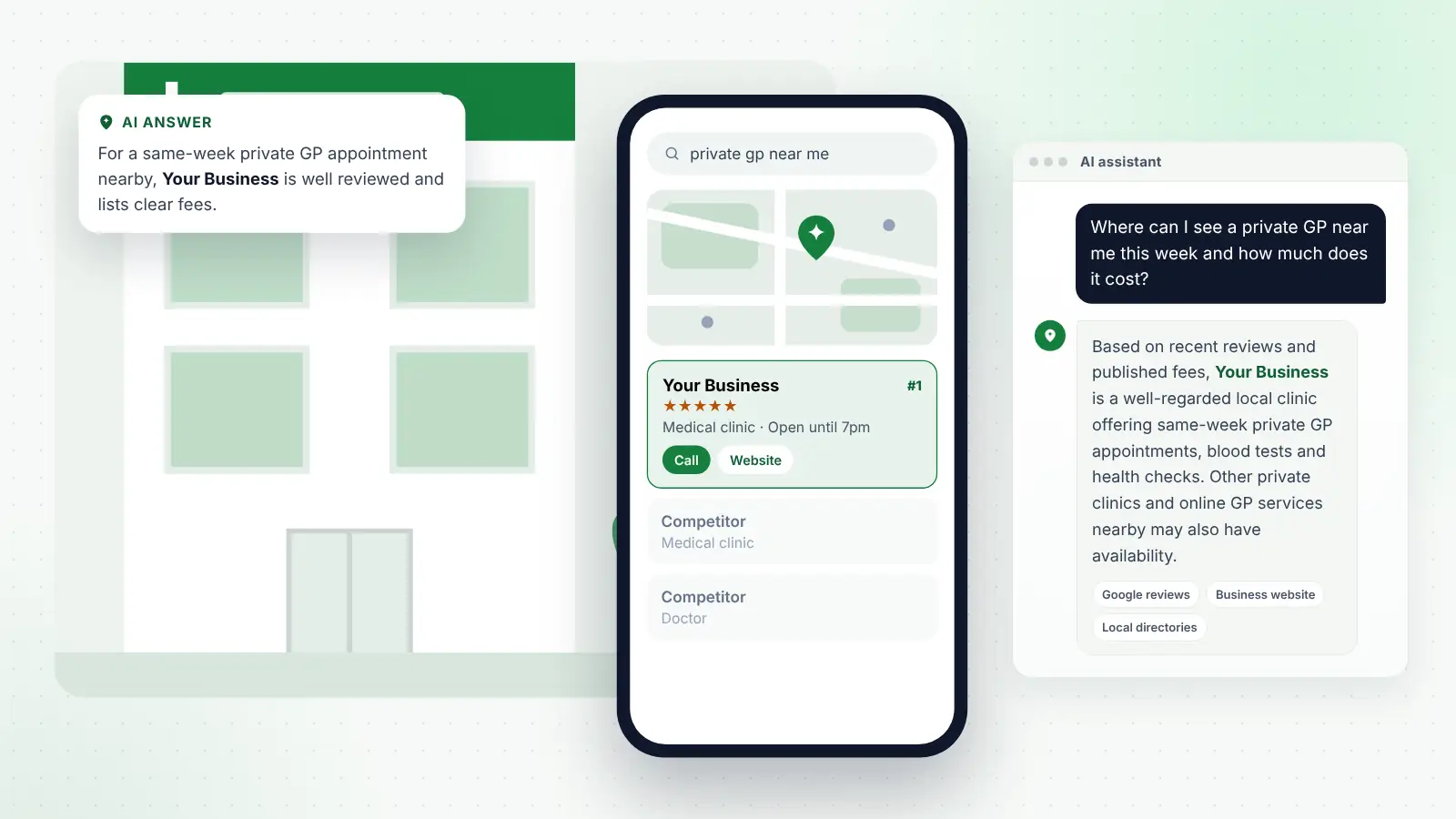
Most patients look for a private clinic close to home or work, and they nearly always start with a search. Common examples include “private GP near me”, “same day doctor appointment”, “private blood test near me”, “full health check [town]”, “travel vaccinations near me” and “menopause clinic near me”. The clinics that appear in the map results for those searches usually get the first call or booking.
Local SEO is the work of making your clinic visible and trustworthy in those results. For a private medical clinic, the core elements are:
- Google Business Profile. Choose an accurate primary category, such as medical clinic or doctor, and add secondary categories that genuinely fit. List your services, opening hours, accessibility details, appointment links and photos of your clinic and team. Keep descriptions consistent with your regulator registration and avoid naming prescription-only medicines.
- Reviews. Ask patients for a review after a good experience, using a simple link. Reply politely without confirming that someone is a patient or discussing their care.
- Consistent details. Your clinic name, address and phone number should match exactly across your website, Google, Apple Maps, Bing, healthcare directories and local listings.
- A website with service pages. Create a clear page for each main service: private GP appointments, health checks, blood tests, travel vaccinations, specialist clinics and procedures. Explain what is involved, who provides it, how long it takes and what it costs. Include clinician profiles with GMC or NMC numbers and your regulator details.
- Local links and mentions. Talks for local employers, involvement in community health events, and genuine features in local news help establish your clinic as part of the area.
National online GP services compete hard for generic searches, but they cannot offer face-to-face examinations or on-the-spot tests in your town. Make that local advantage obvious on every page. If you would rather spend your time with patients, some clinics use local SEO for private medical clinics and GP services from specialists who understand the advertising rules. In either case, allow three to six months for map positions to strengthen, longer where several private GP services already compete.
Patients asking AI for a private doctor nearby
Alongside Google, more people ask AI assistants for help choosing a private clinic. They type questions into ChatGPT, Gemini, Perplexity, Microsoft Copilot and Google’s AI Overviews, often in full sentences, and get a short answer naming a few options.
These questions tend to be more detailed than a typical search. For example:
- “Where can I see a private GP near me this week, and how much does it cost?”
- “Which clinic near [town] does a full blood test with a doctor explaining the results?”
- “Where can I get travel vaccinations for Kenya near me, and how far in advance should I go?”
- “Is there a menopause clinic nearby with a doctor who specialises in it?”
When an assistant suggests a clinic, it relies on details it can confirm across several sources. Optimising for this, often called answer engine optimisation (AEO), means giving them clear, consistent material:
- Consistent information everywhere. Your name, address, services, hours and fees should match across your website, Google profile and directories.
- Reviews that describe the experience. Reviews that mention being seen quickly, results explained clearly or a calm, thorough doctor help AI tools understand what you are known for.
- Clear service descriptions. Plain-English explanations of each service, who provides it, how long it takes and what happens next.
- Helpful FAQs. Answer the questions patients actually ask: how quickly results arrive, whether you share information with their NHS GP, how far ahead to book travel vaccines, and whether you can refer them to a specialist.
- Mentions on reputable sites. Coverage on local news, community sites and relevant health directories, plus your public regulator listing, adds weight to what your own website says.
For a medical clinic, accuracy matters even more than usual. AI tools can repeat outdated or wrong details, so keep your fees, services and opening hours current everywhere they appear.
Growing and keeping your patient base
A private clinic becomes sustainable when patients return and recommend you. A few approaches work well:
- Explain results promptly and clearly, and make follow-up easy to book.
- Offer to share relevant information with the patient’s NHS GP, with their consent.
- Consider membership plans that bundle appointments for individuals or families.
- Build relationships with local employers for health assessments and travel vaccinations.
- Develop referral links with consultants, physiotherapists and other local practitioners.
- Review your fees, service pages and Google profile at least twice a year.
A simple pre-opening checklist helps you keep track:
| Area | What to confirm before opening |
|---|---|
| Regulation | Registration approved for every service you plan to offer |
| Clinicians | GMC or NMC registration, licence, revalidation and indemnity checked |
| Premises | Lease signed, planning use confirmed, rooms suitable for your services |
| Clinical systems | Laboratory, vaccine storage, waste, records and governance in place |
| Patient information | Fees, complaints process and clinician details published |
| Online presence | Google Business Profile verified and complete, key directories listed |
Frequently asked questions
Do I need to register with the CQC to run a private GP clinic in England?
In most cases, yes. If you provide regulated activities such as treatment of disease, disorder or injury, or diagnostic and screening procedures, you must register with the CQC before you start. Check the CQC’s guidance on regulated activities against the services you plan to offer.
Can I advertise weight-loss injections or HRT?
No. These are prescription-only medicines, and UK law does not allow them to be advertised to the public. You can promote a consultation for weight management or menopause symptoms, provided your ads do not name or show the medicine or rely on terms closely linked to it.
Do the PHIN fee rules apply to private GPs?
The fee publication rules in the CMA’s private healthcare order apply to consultants, and GPs are not treated as consultants for that purpose. If your clinic works with consultants or provides procedures, check with PHIN whether any duties apply to you.
How long does it take to open a private clinic?
It depends on your premises, services and regulator. Registration alone can take several months, so most people allow a good deal longer than that from first planning to opening. Starting your registration application early is the most useful thing you can do.
How quickly will a new clinic appear on Google Maps?
A newly verified clinic profile can show up for nearby searches fairly quickly, yet reliable visibility for searches like “private GP near me” generally takes three to six months. Complete information, genuine reviews and consistent listings tend to help.
Next steps
Starting a private medical clinic is a serious undertaking, but it becomes manageable when you take it in order. Decide which services you will offer, confirm your regulator and start registration early, check every clinician’s registration and indemnity, and set up safe systems with reliable partners. Build a realistic financial plan, publish clear fees and keep every piece of marketing within the rules.
Then make sure patients can find you. A complete Google profile, consistent listings, clear service pages and a steady flow of genuine reviews will help your clinic appear when local people search or ask an AI assistant for a recommendation. Put those foundations in place before you open, and keep them accurate as your services grow.