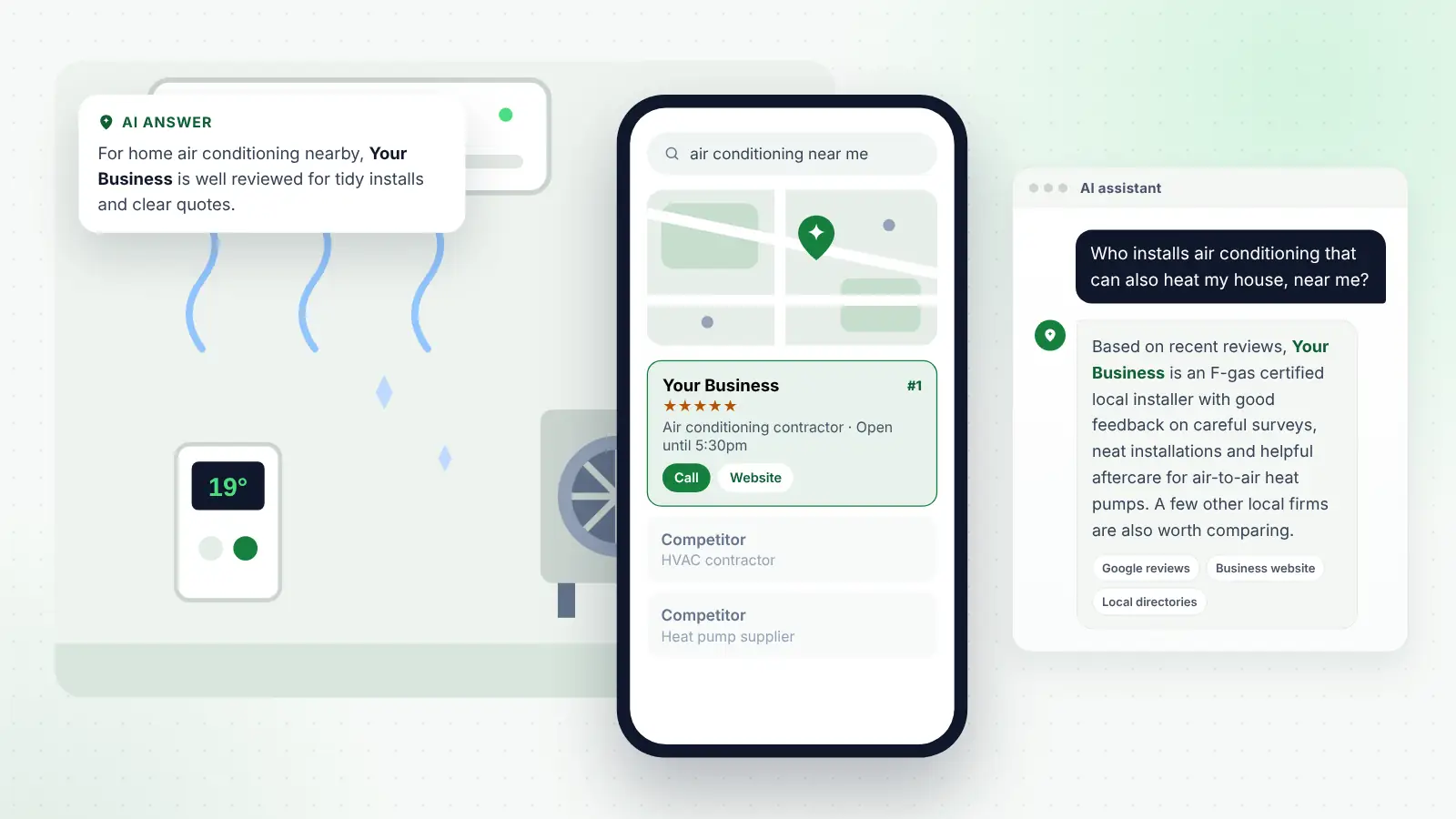
Air conditioning used to be something most British households only experienced on holiday or in the office. That is changing. Hotter summers, more people working from home, loft conversions that turn into ovens in July and a growing interest in heat pumps that can heat as well as cool have all made domestic air conditioning a realistic purchase for ordinary homes. On the commercial side, offices, shops, restaurants, surgeries and server rooms have relied on it for years and need it installed, serviced and repaired.
For a qualified refrigeration and air conditioning engineer, that combination of growing domestic demand and steady commercial maintenance makes it a good time to set up on your own. But it is a regulated trade. Refrigerants are controlled substances, electrical work in homes has its own rules, and grant schemes come with their own certification requirements.
This guide is for engineers thinking about going it alone, and for electrical or building businesses that want to add air conditioning properly. It covers the certification you need, the opportunity in air-to-air heat pumps, realistic startup costs, building income that lasts beyond the summer and making sure local customers can find you on Google and through AI search.
Key points
- In Great Britain, any business that installs, services or repairs air conditioning or heat pumps for other people needs F-gas company certification, and each technician handling refrigerant needs a personal F-gas qualification.
- Air-to-air heat pumps are now listed under the Boiler Upgrade Scheme in England and Wales with a £2,500 grant for homes, but only through MCS-certified installers.
- Most domestic installs need a new electrical circuit, which is notifiable work under building regulations in homes, so you need an electrical competent person scheme or a registered electrician partner.
- The HFC phase-down continues, with a further cut in available refrigerant scheduled for 1 January 2027, so plan for rising refrigerant costs and newer low-GWP systems.
- Servicing contracts, commercial maintenance and year-round visibility are what turn a busy summer into a stable business.
In this guide
- Decide what kind of air conditioning business you want to run
- F-gas certification: the legal foundation
- Electrical work and building regulations
- Air-to-air heat pumps, MCS and the Boiler Upgrade Scheme
- Setting up the business
- How much does it cost to start?
- Pricing, servicing plans and year-round income
- Local SEO for air conditioning installers
- AI search: how customers now find air conditioning installers
- Common mistakes new air conditioning businesses make
- Frequently asked questions
- Final thoughts
Decide what kind of air conditioning business you want to run
“Air conditioning” covers a wide range of work, and being clear about your focus shapes everything from the certification you need to the way you describe yourself online.
- Domestic air conditioning — wall-mounted split systems for bedrooms, home offices, conservatories and garden rooms. Often bought in a hurry during a hot spell.
- Air-to-air heat pumps — the same kind of equipment, sold and designed primarily as a heating system that also cools. A growing market as homeowners move away from gas and oil.
- Multi-split and ducted domestic systems — larger, higher-value projects for whole floors, extensions and new builds, usually planned months in advance.
- Commercial air conditioning — offices, retail, hospitality and healthcare. Bigger systems such as VRF, more paperwork and a tender or quote process rather than a quick home visit.
- Server room and process cooling — critical cooling where downtime is costly. Customers value fast response and resilience over price.
- Servicing, maintenance and repairs — planned maintenance contracts, breakdown call-outs and mandatory leak checks on larger systems.
Many new businesses start with domestic installs and servicing, then add light commercial work as they build a reputation. If you are leaving an employer, check your contract for restrictions before approaching any customers you looked after there.
F-gas certification: the legal foundation
Air conditioning systems and heat pumps contain fluorinated greenhouse gases (F-gases) as refrigerants. In Great Britain these are controlled under the GB version of the F-gas Regulation and the Fluorinated Greenhouse Gases Regulations 2015. Northern Ireland follows the EU F-gas rules instead, which are stricter in several areas, so check separately if you plan to work there.
Company certification
Any business, including a sole trader, that installs, repairs, maintains, services or decommissions stationary air conditioning, refrigeration or heat pump equipment for other people needs an F-gas company certificate. The government guidance on company F-gas certification lists the approved certification bodies for this work: Refcom, the F-Gas Register (run by Quidos) and Bureau Veritas. Certification involves showing that you employ suitably qualified technicians, have the right tools and equipment, and keep proper procedures and records.
Personal qualifications
Every technician who handles refrigerant needs a personal F-gas qualification for the type of work they do. City & Guilds 2079 is one of the best-known routes, and other awarding bodies offer equivalent qualifications. Qualifications are graded into categories, and Category I covers the full range of activities, including leak checking, recovery, installation and maintenance on any size of system. If you are new to the trade, a refrigeration and air conditioning apprenticeship or a recognised Level 2 or Level 3 qualification gives you the practical grounding that the F-gas qualification alone does not.
Records, leak checks and refrigerant handling
Equipment above certain size thresholds, measured in tonnes of CO2 equivalent rather than kilograms of refrigerant, must be leak-checked at set intervals, and larger systems need automatic leak detection. Many commercial systems fall into these bands, which is one reason maintenance contracts are so valuable. Keep accurate records of every installation, refrigerant addition and recovery from day one, and make sure recovered refrigerant goes through a proper reclaim route.
The changing refrigerant market
The GB phase-down of HFC refrigerants is continuing. Under the existing rules, the quota of HFCs that can be placed on the market falls again on 1 January 2027. The government consulted on reforming the GB phase-down, but in May 2026 it confirmed it will not legislate in 2026 to change the steps that take effect from 1 January 2027, and said it would set out next steps after considering the consultation responses. In practical terms, expect refrigerant prices to rise, manufacturers to keep moving to lower-GWP refrigerants such as R32 and propane-based R290, and customers to ask which refrigerant a system uses.
Tip
Put your F-gas company certificate number on your website, Google profile, quotes and invoices in exactly the same form. Customers check it, and AI assistants look for it when deciding which installers to recommend.
Electrical work and building regulations
Most domestic installations need a dedicated electrical supply for the outdoor unit. In England and Wales, adding a new circuit in a home is notifiable work under Part P of the Building Regulations. That means it must either be carried out by a business registered with an electrical competent person scheme, such as NICEIC or NAPIT, which can self-certify the work, or be notified to building control before it starts.
Many air conditioning engineers hold electrical qualifications and join a competent person scheme themselves. Others work with a trusted registered electrician who handles the supply and certification. Either approach works, but decide before you quote, because customers increasingly ask who will certify the electrical side, and an uncertified circuit can cause problems when they sell the house.
For commercial customers in England and Wales, larger air conditioning systems also need periodic energy assessments under the Energy Performance of Buildings Regulations, often called TM44 inspections. These are carried out by accredited assessors. You do not need to become one, but understanding the requirement helps you advise facilities managers and spot follow-on work.
Air-to-air heat pumps, MCS and the Boiler Upgrade Scheme
An air-to-air heat pump is, in hardware terms, very similar to a split air conditioning system. The difference is in how it is designed, sized and sold: as a primary heating system that delivers warm air to rooms, with cooling as a bonus. Unlike an air-to-water heat pump, it does not heat radiators or hot water, so homes usually need a separate solution for hot water.
What changed with the Boiler Upgrade Scheme
For years, air-to-air systems were excluded from government heat pump grants. That changed after the government announced in late 2025 that domestic air-to-air installations would be brought into the Boiler Upgrade Scheme, and the grant became available for applications from late April 2026. As of October 2026, the Ofgem Boiler Upgrade Scheme page lists a £2,500 grant for air-to-air heat pumps in residential properties in England and Wales. The grant is claimed by the installer, not the homeowner, and property and system conditions apply, so always check the current eligibility rules before promising a customer anything.
MCS certification and consumer codes
To offer Boiler Upgrade Scheme installations, your business must be MCS certified for heat pumps and meet the relevant MCS standards, which have been updated to cover air-to-air design and installation. You will also need membership of an approved consumer code, currently RECC or HIES. MCS certification involves an assessment of your processes, competence and installations, plus ongoing audits. It takes time and has a cost, but it opens the grant-funded market and is a strong trust signal even for customers who are not claiming a grant.
Planning and outdoor units
In England, the permitted development rules for air source heat pumps were relaxed from late May 2025. The old rule requiring units to be at least one metre from the boundary was removed, larger units became allowed on houses, and air-to-air heat pumps that provide heating as well as cooling were brought within the rules. Units must still meet the MCS noise standard, and there are limits on the number of units and stricter rules for flats, listed buildings and conservation areas. Cooling-only air conditioning is treated differently and may need planning permission, so check with the local council when you are unsure. Planning rules for heat pumps and AC units are set separately in Wales, Scotland and Northern Ireland, so do not assume the English relaxations apply there.
Tip
When you survey a home for air conditioning, ask how it is heated. Many customers have never heard of air-to-air heat pumps, and explaining that one system can cool in summer and heat in winter often changes the conversation and the value of the job.
Setting up the business
Structure, tax and VAT
Most installers start as a sole trader or a limited company. A limited company separates your personal finances from the business and can suit firms planning to employ engineers, while sole trading is simpler to run. Register with HMRC, keep clear records from the start and take advice from an accountant on VAT, as the threshold can be reached quickly with equipment-heavy jobs. Check the current VAT treatment of energy-saving materials such as heat pumps with your accountant, as relief rules depend on the installation.
Insurance
Public liability insurance is essential, and many commercial customers will ask for a minimum level before you set foot on site. Consider employer’s liability (a legal requirement once you employ staff), tools and van cover, professional indemnity if you design systems, and contract works cover for larger projects. Some manufacturer warranty schemes also expect certain insurance levels.
Suppliers and manufacturer accreditation
Open trade accounts with refrigeration and air conditioning wholesalers, and look at manufacturer installer programmes. Many major brands offer training, extended warranties for approved installers and listings on their installer finder pages, which can bring enquiries and give customers reassurance.
How much does it cost to start?
Costs vary widely depending on whether you already have tools, a van and qualifications. The table below is a rough guide only, and prices vary by supplier and area.
| Item | Typical cost | Notes |
|---|---|---|
| F-gas personal qualification | A few hundred pounds per person | More if you need refresher or practical training first |
| F-gas company certification | Hundreds of pounds a year | Varies by certification body and company size |
| Tools and equipment | £3,000–£8,000 | Vacuum pump, recovery machine, gauges, scales, leak detector, brazing kit |
| Van and racking | £8,000–£25,000 | Used is fine to start; finance or lease is common |
| Electrical scheme registration | Several hundred pounds a year | Only if you certify your own electrical work |
| MCS certification | Varies | Application, assessment and annual fees, plus consumer code membership |
| Insurance | £500–£2,000 a year | Depends on cover levels and turnover |
| Website, branding and listings | £500–£3,000 | Plus ongoing marketing |
Keep enough working capital to buy equipment for your first jobs before customers pay, especially for multi-split and commercial projects where unit costs are high.
Pricing, servicing plans and year-round income
The biggest challenge in air conditioning is seasonality. When a heatwave arrives, the phone rings constantly and you cannot keep up. When the weather cools, domestic enquiries can drop sharply. The businesses that do well build income that does not depend on the weather.
- Sell a maintenance plan with every installation. Annual servicing keeps systems efficient, helps protect manufacturer warranties and gives you a reason to stay in touch.
- Target commercial maintenance contracts. Offices, shops, restaurants and surgeries need planned maintenance and leak checks regardless of the season.
- Promote heating in autumn and winter. Air-to-air heat pumps let you market the same skills when cooling demand is low.
- Run a spring servicing campaign. Customers want their systems checked before summer, and it fills the diary before the rush.
- Work with builders and garden room companies. Extensions, loft conversions and garden offices are planned months ahead, regardless of the weather.
When you quote, explain what is included: the indoor and outdoor units, pipe runs, condensate drainage, electrical supply, commissioning and any making good. Customers comparing your quote with a cheap online fixed price often do not realise what is missing from it.
Local SEO for air conditioning installers
Most people buying air conditioning for the first time do not know an installer. They search Google for “air conditioning installers near me”, “home air conditioning cost” or “air conditioning repair” and look at the businesses on the map. Commercial buyers do the same, searching for “commercial air conditioning near me” or “office air conditioning service”. Being visible in those local results, especially before the summer rush, is one of the most valuable things you can do.
Setting up your air conditioning Google profile
Someone sweltering in a top-floor bedroom will often judge you on your Google profile before they ever see your website. Choose the most accurate primary category, such as air conditioning contractor, and add secondary categories that genuinely fit, such as HVAC contractor or heat pump supplier. List each service separately: domestic installation, air-to-air heat pumps, commercial systems, servicing and repairs. Set your service area to the towns you actually cover, add your opening hours and keep them accurate. Add photos of real installations regularly: neat pipe covers, well-placed outdoor units, tidy indoor heads. Customers worry about how the system will look, and good photos answer that.
Reviews that describe the system and the install
Reviews are one of the strongest signals for both customers and Google. Ask every customer, at the point they are happiest, usually just after commissioning. A quick text with a link straight to your review form, sent once the system is running, makes it easy for them. Reviews that mention the type of system, the town and what went well, such as quiet operation, a tidy install or clear advice, are more useful than “great job”. Answer each one with a short, courteous note, and pick up any comment about noise or unit placement constructively.
The same company details on every installer finder
Make sure your business name, address, phone number and website are identical across your website, Google profile, trade directories, manufacturer installer finders, your F-gas certification body’s listing and any MCS listing. Inconsistent details confuse search engines and customers.
Pages for each system type and the towns you cover
Your website should have a page for each main service, explaining what it involves, typical timescales, what affects the price and your certifications. Add pages for the main towns you cover, each with genuinely local information and examples of work there, not copies with the town name swapped. If you want specialists to handle this while you focus on installations, local SEO for air conditioning installers can cover your profile, listings, content and links.
Local links and mentions
Links and mentions from relevant local websites help show Google that you are a genuine local business. Good sources include local business groups, chambers of commerce, builders and electricians you partner with, community sponsorships and local news coverage of interesting projects.
AI search: how customers now find air conditioning installers
More customers now ask AI assistants for recommendations instead of, or as well as, searching Google. They might ask ChatGPT, Gemini, Perplexity or Copilot “Who installs air conditioning that can also heat my house near me?”, “Is an air-to-air heat pump worth it for a three-bedroom house?” or “Which company can service our office air conditioning in Leeds?”. Google AI Overviews answer similar questions at the top of search results.
These tools do not have a secret list of good installers. They draw on information that is published and consistent across the web: your website, your Google profile, reviews, directory listings, manufacturer installer pages and mentions on reputable local and industry sites. To make your company an easy one for an assistant to suggest when someone asks about cooling or air-to-air systems:
- Describe your services clearly on your website, including the systems and brands you install and whether you do air-to-air heat pumps, commercial work and servicing.
- State your certifications explicitly, including your F-gas company certificate, MCS certification if you have it and your electrical scheme.
- Answer common questions in plain English: how much does air conditioning cost, how noisy is it, can it heat as well as cool, does it need planning permission, how often should it be serviced.
- Keep details consistent across every listing so AI tools can be confident about who you are and where you work.
- Build steady, detailed reviews that mention the type of work and the area.
AI search matters particularly in this trade because many customers start with a question rather than a company name. Someone who wants to know whether an air-to-air heat pump suits their home will often ask an AI assistant first, and the businesses that have clearly explained the topic are more likely to be mentioned.
Common mistakes new air conditioning businesses make
- Under-quoting to beat online prices. Cheap fixed-price offers often exclude electrical work, long pipe runs or condensate pumps. Explain your inclusions rather than cutting your margin.
- Ignoring noise and placement. Neighbour complaints about a badly placed outdoor unit can undo a good install. Survey carefully and explain where the unit will go.
- Leaving the electrical side vague. Decide who certifies the circuit before you quote.
- Not selling servicing. Every installation without a maintenance plan is lost repeat income.
- Waiting for summer to market. Visibility takes months to build. Start well before the first hot spell.
- Overstating savings. Be honest about running costs and efficiency, especially when selling air-to-air as heating.
Tip
Keep a simple photo log for every job, before and after. It helps with warranty claims, MCS audits and your Google profile, and costs nothing but a few minutes on site.
Frequently asked questions
Do I need F-gas certification to install air conditioning?
Yes. In Great Britain, a business that installs or services air conditioning for others needs F-gas company certification, and anyone handling refrigerant needs a personal F-gas qualification. This applies to sole traders as well as larger firms.
Can I install air conditioning without being an electrician?
You can install the refrigeration side, but in homes in England and Wales a new circuit for the outdoor unit is notifiable electrical work. It needs to be done by someone registered with a competent person scheme, or notified to building control. Many installers partner with a registered electrician.
Are air-to-air heat pumps eligible for the Boiler Upgrade Scheme?
As of October 2026, Ofgem lists a £2,500 grant for air-to-air heat pumps in residential properties in England and Wales. The installation must be carried out by an MCS-certified installer and meet the scheme’s conditions, so check the current rules before quoting.
Does air conditioning need planning permission?
In England, air-to-air heat pumps that provide heating can fall under permitted development if they meet size, number and noise conditions. Cooling-only units, flats, listed buildings and conservation areas may need permission. Rules differ in Wales, Scotland and Northern Ireland, so check with the local council when unsure.
How do I get through the quiet months?
Build a base of servicing and commercial maintenance contracts, market air-to-air heat pumps as heating in autumn and winter, and work with builders and garden room companies whose projects are planned well in advance.
Final thoughts
Air conditioning is a growing, skilled trade with room for well-run local businesses. Get your F-gas certification in place, decide how you will handle electrical work and MCS, price honestly and sell servicing with every install. Then make sure customers can find you, on Google Maps and in AI answers, well before the next heatwave arrives. Build those foundations carefully and you will have a business that stays busy whatever the weather.