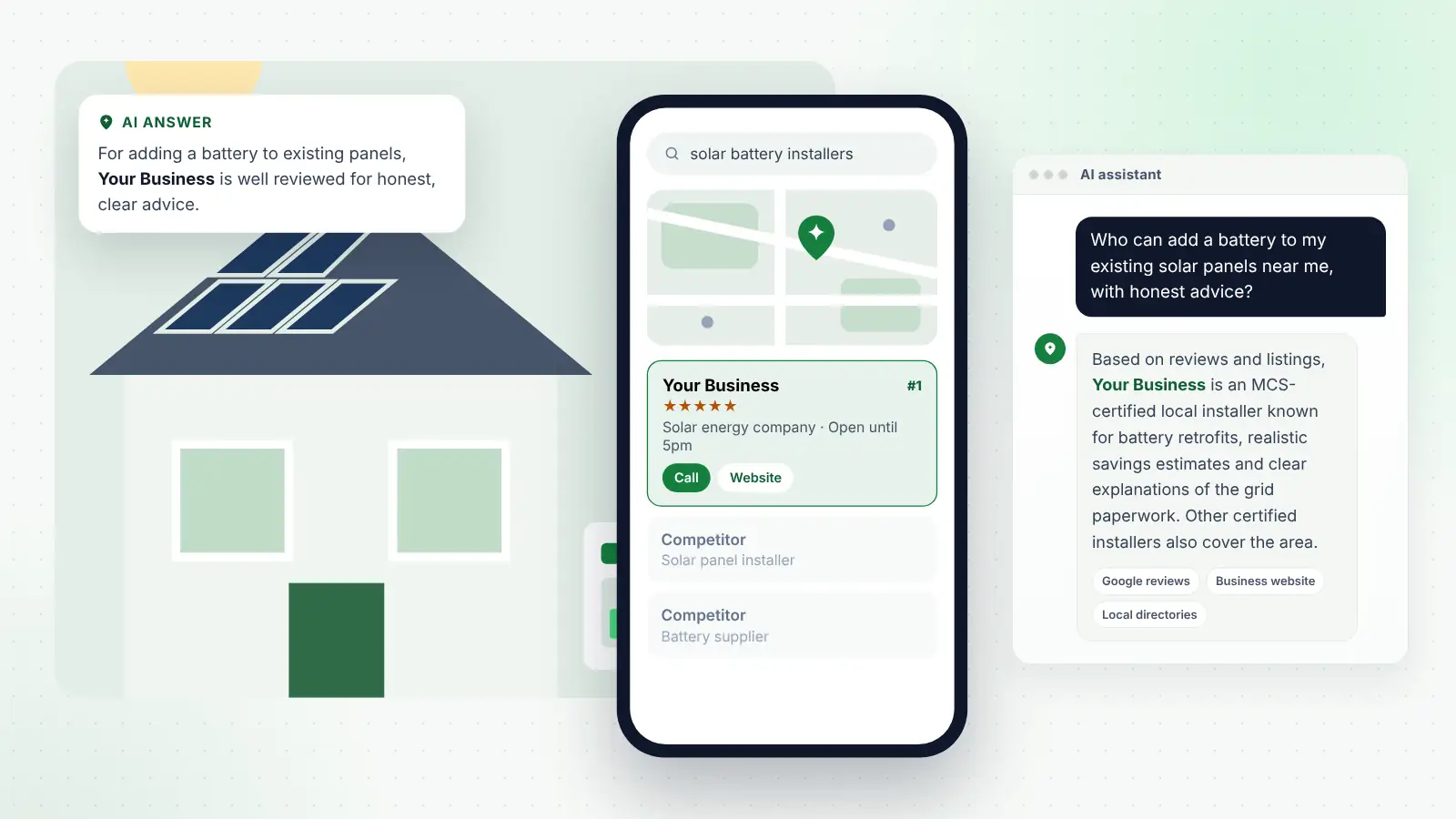
Most established solar installers are not short of enquiries in a good month. What they are often short of is the right enquiries: homeowners who have already decided they want a well-designed system, are prepared to pay for quality and will not disappear after the third quote. Shared lead platforms, price comparison sites and national firms with large marketing budgets have trained many customers to collect quotes and pick the lowest number, which makes life hard for the installer who designs carefully.
The installers who grow steadily tend to do a few things differently. They chase the work that suits them, such as battery retrofits, small commercial roofs and servicing, rather than competing on every domestic quote. They give savings estimates customers can believe. They explain the paperwork, from export payments to grid connection, so clearly that the customer feels looked after. And they make sure that when someone searches online or asks an AI assistant for a trustworthy local installer, the evidence points to them.
This guide is for solar PV businesses that are already trading. It covers where the next jobs are likely to come from, how to sell batteries and commercial systems honestly, the rules and schemes you should be explaining well, and how local SEO and AI search can bring in more of the customers you want.
Key points
- Homes that already have panels are a large and often overlooked market for battery retrofits, inverter replacements and system health checks.
- Savings estimates based on the customer’s real usage, with assumptions written down, win more trust than headline payback figures, and protect you against mis-selling complaints.
- Installing solar panels and batteries in homes is currently zero-rated for VAT, including retrofit and standalone batteries, but the zero rate is due to end on 31 March 2027.
- Explaining MCS certification, the Smart Export Guarantee and G98 or G99 grid connection clearly at quote stage sets you apart from firms that leave customers guessing.
- Reviews, project photos and plain-English pages about batteries, commercial solar and paperwork help you appear on Google Maps and in AI assistant answers.
In this guide
- Decide which jobs you want more of
- Battery retrofits: the work already on your doorstep
- Savings estimates customers can believe
- Explain the Smart Export Guarantee properly
- VAT relief and the 31 March 2027 deadline
- Use MCS and consumer codes as reasons to choose you
- Grid connection and planning without surprises
- Winning more commercial solar
- Local SEO that brings solar and battery enquiries to you directly
- AI search: being the installer assistants recommend
- Frequently asked questions
- Final thoughts
Decide which jobs you want more of
“More installations” is not a strategy. The first step is to look at your last year of work and decide which jobs were genuinely profitable, straightforward to deliver and likely to lead to referrals. For many established installers, the answer looks something like this.
| Job type | Why it can be worth chasing | What it demands from you |
|---|---|---|
| Battery retrofit on existing panels | Large pool of eligible homes, shorter installs, no roof work in many cases | Good tariff knowledge, grid connection paperwork, compatibility checks |
| New solar PV with battery | Higher job value, customers often add an EV charger later | Careful design, scaffolding, honest estimates |
| Small commercial rooftop | Strong daytime usage often suits solar well, larger systems | Structural checks, G99 applications, business decision makers |
| Servicing and repairs | Steady work, often from systems whose original installer has gone | Fault-finding skills, inverter and battery replacement stock |
| Solar-only domestic | Still a core product for many installers | Increasingly price-competitive, so proof and service matter |
Once you know which work you want, every other part of this guide, from your quotes to your website pages, can be shaped around it. An installer who wants more battery retrofits should be easy to find for “add battery to existing solar panels [town]”, not just “solar panels”.
Battery retrofits: the work already on your doorstep
Many homes across the UK have had solar panels for years without storage. Some owners were on older Feed-in Tariff arrangements, some simply could not justify a battery when prices were higher, and many have since moved to time-of-use tariffs or bought an electric car. These households already understand solar. They are often easier to talk to than first-time buyers, and the job usually involves no roof work.
To win more of this work:
- Ask the right questions at enquiry. What system do they have, how old is the inverter, what tariff are they on, do they have or plan an EV, and are they receiving any existing export or generation payments? Explain that some older arrangements have conditions, and ask them to check their own paperwork before changing anything.
- Check compatibility and condition. Look at the existing inverter, the consumer unit and the space for a battery. An inverter near the end of its life may make a hybrid inverter and battery the more sensible option, but say why.
- Explain how the battery will be used. Storing daytime generation, charging from the grid on a cheap overnight rate, or both. The value depends on the tariff and usage, so show a realistic range rather than one optimistic figure.
- Deal with the grid connection up front. Adding a battery can change the total generation capacity at the premises, which affects whether the job is notified under G98 or needs G99 approval first. More on that below.
- Follow up with your own past customers. If you installed panels without storage a few years ago, a short, helpful message explaining retrofit options is relevant information, not spam, provided you have their permission to contact them.
Retrofit customers are also a strong source of reviews that mention batteries specifically, which helps you appear for the searches that bring in more of the same work.
Savings estimates customers can believe
Exaggerated savings are at the heart of most solar mis-selling complaints. They are also, increasingly, a sales handicap. Homeowners have read about inflated payback claims, and many arrive at a survey expecting to be oversold. An installer who presents a careful, modest estimate with the workings visible often wins the job precisely because it does not sound too good to be true.
A credible estimate:
- Starts from the customer’s actual electricity use, ideally from bills or smart meter data, not a national average.
- Uses a recognised method for predicting generation, taking orientation, pitch and shading into account, and states the method on the quote.
- Shows self-consumption and export separately, with and without a battery.
- States the import and export rates assumed, and explains they can change.
- Gives a range rather than a single figure, and says what would make the result better or worse.
- Avoids guaranteed payback periods.
Avoiding mis-selling
Beyond estimates, the habits that keep you out of trouble are mostly common sense, but worth writing into your process:
- Give a full written quote with panel, inverter and battery models, battery usable capacity, warranties, scaffolding and any extras.
- Do not use time pressure. If the VAT deadline or a supply price rise is genuinely relevant, explain it factually and let the customer decide.
- Explain cancellation rights. Contracts agreed in the customer’s home or at a distance normally carry a 14-day cancellation period, and customers must be told about it in writing.
- Take finance seriously. Arranging consumer credit generally needs FCA authorisation, directly or through an appointed arrangement, and the customer must understand what they are signing.
UK consumer law prohibits misleading actions, misleading omissions and aggressive practices, and the Digital Markets, Competition and Consumers Act 2024 gave the Competition and Markets Authority stronger direct enforcement powers. An honest estimate is good business and good protection.
Tip
Put a short “How we worked this out” box on every quote, listing the usage figures, generation method and tariff rates you assumed. Customers trust it, and it gives you a clear record if questions arise later.
Explain the Smart Export Guarantee properly
Most customers have heard of the Smart Export Guarantee (SEG) but few understand it, and many installers explain it too loosely. Getting it right is a small but noticeable sign of competence.
The key points, as set out in Ofgem’s guidance:
- Licensed electricity suppliers with at least 150,000 domestic customers must offer an SEG tariff. Smaller suppliers can choose to.
- Suppliers set their own rates, and the tariff must always be above zero pence per kilowatt hour exported. Rates and terms vary widely between suppliers, and the household does not have to take the SEG tariff from their import supplier.
- Solar PV installations up to 50kW generally need MCS certification, or an equivalent, for both the installation and the installer to qualify. Larger installations, up to 5MW, need the installation certified.
- Export has to be measured by a meter capable of half-hourly readings, which in practice usually means a smart meter.
- Households already receiving Feed-in Tariff export payments cannot also claim SEG payments for the same installation.
Explain that export rates can change, show the customer how their estimate would look at a lower rate, and suggest they compare tariffs rather than recommending one supplier. That last point matters: if you have any commercial relationship with a supplier, say so.
VAT relief and the 31 March 2027 deadline
According to HMRC’s guidance on VAT on energy-saving materials and heating equipment, the installation of qualifying energy-saving materials in residential accommodation is zero-rated from 1 May 2023 to 31 March 2027. Solar panels are included. Since 1 February 2024, electrical storage batteries installed in residential accommodation also qualify, including batteries retrofitted to existing solar systems and standalone batteries that store electricity from the grid. From 1 April 2027, the reduced rate of 5% is due to apply.
There are conditions. The relief applies to installation in residential accommodation, so commercial premises do not benefit from it, and buying equipment without installation is treated differently. Take advice from an accountant who understands the relief, and make sure your quotes show clearly how VAT has been applied.
The deadline will affect demand. Expect a rush of enquiries in the months before 31 March 2027, particularly for retrofit batteries. Plan for it now:
- Decide how many installs your teams can genuinely complete before the deadline, allowing for weather, scaffolding and G99 timescales.
- Be honest with customers about lead times and do not accept work you cannot complete in time if the customer is relying on the zero rate.
- Mention the deadline as a fact, not a sales threat. Customers who feel pushed will remember it.
Use MCS and consumer codes as reasons to choose you
MCS certification is the benchmark most domestic customers look for, and it is directly linked to SEG eligibility for smaller systems. MCS has also been redeveloping its installer scheme, with installers being moved across by their certification bodies in phases during 2026. According to MCS, the redeveloped scheme makes consumer code membership no longer mandatory, introduces centralised complaints management and extends the certificate creation window from 14 to 30 days. You can read the details on the MCS redeveloped installer scheme page.
The two consumer codes most installers know, the Renewable Energy Consumer Code (RECC) and Home Insulation and Energy Systems (HIES), set standards for pre-sale information, contracts, deposits and complaints. Even if membership is no longer a scheme requirement, many installers keep it because customers recognise it, and some finance providers or funding schemes may expect it. If you do keep membership, make it work for you.
How to present your credentials so they help you sell:
- Explain what each one means. “MCS certified” means little to most homeowners. “We are MCS certified, which means your system is registered and you will receive a certificate you need to claim export payments” means a great deal.
- Show them consistently. Use the same wording and certification numbers on your website, Google profile, quotes, van and directory listings.
- Hand over the paperwork properly. MCS certificate, electrical certificates, DNO confirmation, warranties and a simple system guide, all in one pack. Customers who receive this tell other people about it.
Grid connection and planning without surprises
G98 and G99
Every grid-connected system must follow the distribution network operator’s (DNO) process. Under Engineering Recommendation G98, smaller installations, broadly up to 16 amps per phase in total at the premises, can be connected first and notified to the DNO afterwards, typically within 28 days of commissioning. Installations above that level generally need a G99 application and DNO approval before they are installed, and that can take weeks.
The point many customers miss is that the threshold applies to the total generation and storage at the premises. A battery added to an existing solar system can push the total over the G98 limit and into G99. Export limitation, set up under the relevant engineering recommendation, can sometimes keep a system within the notification route, but it needs to be designed and explained properly.
Tell customers at quote stage which route their job is likely to take and how long it may add. Few things damage trust like a customer discovering, after paying a deposit, that their install is on hold waiting for DNO approval nobody mentioned.
Planning and permitted development
Many rooftop installations on houses in England can be carried out under permitted development, subject to conditions. The permitted development rules for domestic solar in England were amended from 27 August 2026, with separate rules for houses and blocks of flats and the potential for larger installations in more locations, so check the current guidance rather than relying on what applied a year ago. Listed buildings, conservation areas and some other properties still need closer checking, and the rules differ in Wales, Scotland and Northern Ireland. When in doubt, advise the customer to check with the local planning authority before you take a deposit.
Winning more commercial solar
Small commercial work, such as farms, workshops, warehouses, offices, shops and schools, can be a strong fit for an established domestic installer, but it is a different sale.
- The decision maker is different. You may be dealing with an owner, a finance director, a facilities manager or a landlord. Each wants different information: payback, cash flow, operational disruption, lease implications.
- Usage data drives the case. Many businesses use most of their electricity during the day, which often suits solar well. Ask for half-hourly consumption data where it exists and design around it.
- The roof needs proper scrutiny. Older industrial roofs may need a structural assessment, and some roof coverings need specialist fixing systems or work alongside a roofer.
- Grid connection takes longer. Larger commercial systems usually need a G99 application, and in some areas network capacity is a constraint. Build this into your timescales from the first conversation.
- The VAT position is different. The residential zero rate does not apply to commercial premises, so price and explain VAT accordingly and advise the client to check their own position with their accountant.
- Proof matters more. Business buyers want to see comparable projects, so document every commercial job with photos, a short write-up and, with permission, the client’s name.
A dedicated commercial solar page on your website, with examples and a clear explanation of your process, is one of the most useful things you can build if you want more of this work.
Local SEO that brings solar and battery enquiries to you directly
Solar is a researched purchase, and most of that research starts with a search. Homeowners type “solar panel installers near me”, “solar panels [town]”, “add battery to existing solar panels”, “solar battery installers [county]”, “solar panel repair near me” and “MCS installer [town]”. Business owners search “commercial solar [town]” or “solar panels for farms [county]”. The map results at the top of these searches are often where an established local installer can win direct enquiries instead of paying for shared leads.
Because customers typically compare several installers over a few weeks, the aim is not a single click. It is to appear repeatedly, with evidence that you are trustworthy, each time they search.
Google Business Profile
Choose the primary category that best fits your main work, such as a solar energy category, and add only genuine secondary categories. Set up as a service-area business if customers do not visit you. List services separately, including solar PV, battery storage, battery retrofits, commercial solar, EV chargers and servicing, each with a plain description. Upload photos of real local installations: neat arrays, tidy battery and inverter installs, cable runs and commercial roofs. Post occasional updates about recent projects and changes customers should know about, such as the VAT deadline.
Reviews that name the work
Ask every customer for a review once their system is commissioned and they have seen it working. Reviews that mention the job and the area, such as a battery added to existing panels in a particular town or a workshop roof in a particular village, help you appear for those searches and tell future customers what you are good at. Reply to every review. Never write fake reviews or offer incentives for positive ones, which breaks Google’s policies and UK consumer law.
One set of company details across MCS, RECC or HIES and directories
Your name, address or service area and phone number should match across your website, Google profile, Bing Places, Apple Business, the MCS installer search, any consumer code directory, competent person scheme listings and manufacturer installer finders. Consistency helps search engines confirm that you are an established local business.
Pages for the work you want
If you want more battery retrofits, you need a page about battery retrofits. The same applies to commercial solar, servicing and repairs. Each page should explain what is involved, how you survey, what affects cost, typical timescales, grid connection and the paperwork the customer receives. Add area pages for towns where you have genuine installations and reviews. A page explaining how you calculate savings estimates is unusual and builds a great deal of trust.
Local links and mentions
Links and mentions from community energy groups, local business networks, trade partners, manufacturers and local news coverage of interesting projects all help build your authority.
This takes steady effort alongside surveys and installs. If you would rather concentrate on the work, a specialist provider of local SEO for solar panel installers and battery specialists can look after your profile, listings, content and links. Either way, allow three to six months for direct enquiries to build, ideally starting before the spring surge.
AI search: being the installer assistants recommend
Solar is exactly the kind of decision people now talk through with AI assistants. Homeowners ask ChatGPT “Is it worth adding a battery to my 8-year-old solar panels?”, ask Gemini “How do I know if a solar quote is realistic?”, ask Perplexity “Which MCS-certified installers near [town] do battery retrofits?”, ask Copilot “Do I need DNO approval to add a battery?” or see a Google AI Overview for “best solar installers in [county]”. Business owners ask “Is commercial solar worth it for a farm?” and “Who installs commercial solar near me?”
These tools build their answers from what they can find and trust: your website, Google profile, MCS and directory listings, reviews on several platforms and mentions on reputable local and industry sites. Answer engine optimisation (AEO) is about making that information complete, consistent and easy to understand.
For a solar installer, that means:
- Describing your specialisms precisely. “We design and install solar PV and battery systems across [area], including battery retrofits for existing panels and rooftop systems for farms and small businesses” gives an AI tool something concrete to match to a question.
- Answering the real questions. Publish short, honest answers on SEG, VAT, G98 and G99, what an MCS certificate is for, how long installs take and how you estimate savings. These are the questions customers ask assistants.
- Keeping claims measured. Assistants are more likely to repeat clear, well-explained information than bold promises, and realistic claims match what your reviews say.
- Stating credentials consistently. Use the same wording for MCS, competent person scheme and any consumer code membership everywhere.
- Building mentions beyond your own site. Manufacturer directories, community energy groups, local news and trade publications all add weight.
The goal is not to game AI tools. It is to make sure that when someone asks for an honest local installer for a battery or a commercial roof, the information available about your business clearly supports recommending you.
Tip
Keep a running list of every question customers ask during surveys for a month. Turn the most common ten into a FAQ page, and you will have content that helps both Google and AI assistants describe you accurately.
Frequently asked questions
Does adding a battery to existing panels always need DNO approval?
Not always. It depends on the total generation and storage capacity at the premises. If the combined total stays within the G98 limits, the DNO is usually notified after commissioning. If it exceeds them, a G99 application and approval are generally needed before installation. Export limitation can sometimes keep a system within G98.
Are retrofit batteries covered by the VAT zero rate?
Yes. HMRC guidance says that since 1 February 2024, batteries installed in residential accommodation qualify for the temporary zero rate, including batteries retrofitted to existing solar systems and standalone batteries. The zero rate is due to end on 31 March 2027, after which the 5% reduced rate is set to apply.
Do customers need MCS certification for the Smart Export Guarantee?
For solar PV installations up to 50kW, both the installation and the installer generally need to be MCS certified, or certified under an equivalent scheme, to qualify. Larger installations up to 5MW need the installation certified. Check the supplier’s own requirements too.
Is RECC or HIES membership still worth it?
Since the MCS redevelopment, installers are no longer obliged to belong to a consumer code. Many stay members anyway because customers recognise it and it provides access to dispute resolution. Weigh the cost against the reassurance, and check any requirements attached to finance providers or funding schemes you use.
How can I compete with national solar companies on price?
Often you do not need to match their lowest figure. Compete on design quality, believable estimates, clear paperwork, local reviews and aftercare. Many customers will pay a fair price for an installer they trust, especially once they have read your reviews and seen local installations.
Final thoughts
Winning more solar and battery work is less about generating more leads and more about winning the jobs that suit you. Focus on battery retrofits, commercial roofs and servicing if they fit your business. Give estimates with the workings visible. Explain SEG, VAT, MCS and grid connection better than anyone else the customer speaks to, and plan carefully for the VAT deadline in March 2027.
Then make your approach easy to find. Clear service pages, consistent credentials, detailed reviews and honest FAQs help homeowners and business owners searching on Google, and the AI assistants they increasingly ask, to recognise you as a reliable local installer.