Most established locksmiths have taken the call. A customer rings, sounding wary, and the first thing they ask is not “how soon can you get here” but “are you actually local, and how much will this cost?” Often they have just put the phone down on a number that turned out to be a national call centre, or they know someone who paid far more than expected for a simple lockout. They are not shopping for speed alone. They are shopping for someone they can trust with their front door.
That wariness is an opportunity for a genuine independent. You cannot outspend national directories on advertising, but you can do several things they find harder: give a straight price on the phone, turn up yourself, show verified credentials and build a local reputation that customers, letting agents and businesses can check.
This guide is for locksmiths who are already trading and want more of the right work. It covers how lead-generation directories operate and how to compete with them fairly, transparent call-out pricing, accreditation and vetting, ID checks before lockouts, insurance-approved locks, landlord and commercial accounts, and how Google and AI assistants now decide which locksmith gets the call.
Key points
- Many customers have learned to distrust locksmith search results, so being visibly local, named and accountable wins work on its own.
- Publish clear call-out pricing, including out-of-hours rates, and give a firm price or range on the phone before you set off.
- MLA approval, a DBS check and proper insurance only reassure people when you explain what they involve in plain terms.
- A consistent, polite ID-check process before every lockout protects the customer, protects you and is something genuine customers appreciate.
- Insurance-approved locks, landlord accounts and commercial work give you planned, repeat income alongside emergency calls.
- Google and AI assistants favour locksmiths whose details, prices, reviews and credentials are consistent wherever they appear.
In this guide
- How lead-generation directories work, and why it matters
- Transparent call-out pricing
- Credentials that customers can check
- ID checks before every lockout
- Insurance-approved locks: turning a call-out into an upgrade
- Landlord and letting agent work
- Commercial work
- Local SEO for locksmiths
- AI search: what assistants say when someone needs a locksmith
- Frequently asked questions
- Final thoughts
How lead-generation directories work, and why it matters
It is worth being precise about the competition, because customers often cannot tell the difference and you need to explain it calmly rather than simply criticise.
Many locksmith search results, paid adverts and listings are run by national lead-generation businesses rather than local locksmiths. A typical model works like this:
- The company advertises heavily, often with local-looking phone numbers, town names in its listings and low headline prices.
- A call centre takes the customer’s details and passes the job to a locksmith in its network, who may be nearby or may travel some distance.
- The locksmith pays the company a fee or commission for the job, and the final price is often set or adjusted on arrival.
Not every directory or national company behaves badly, and some subcontracted locksmiths are perfectly competent. The difficulty for the customer is that they do not know who will turn up, what the final bill will be, or who to contact if something goes wrong. The Master Locksmiths Association notes on its website that the industry is not regulated by government in the UK, which means anyone can trade, and it publishes a complaints route for customers who believe they have been scammed.
You do not need to attack competitors to benefit from this. You need to make the differences easy to see:
| What customers worry about | What a lead-generation listing often offers | What you can offer instead |
|---|---|---|
| Who will turn up | An unnamed locksmith from a network | Your name, photo and van on your website and profile |
| What it will cost | A low “from” price confirmed on arrival | A published call-out fee and a firm price or range on the phone |
| Where they are based | A local-looking number or virtual address | A real service area and a number you answer yourself |
| Whether they are vetted | Unclear | Stated MLA approval, DBS check and insurance |
| Who to complain to | A call centre | You, directly, plus your trade body if you are a member |
Tip
When a customer asks whether you are “a call centre”, answer simply: “No, you are speaking to the locksmith who will come out. My name is on the website and the invoice.” It is often enough to win the job.
Transparent call-out pricing
Price is the point where trust is won or lost. The customer’s biggest fear is a bill that bears no relation to what they were told on the phone.
What to publish
- Your call-out or attendance fee, and what it includes, such as attending and the first part of the work.
- Out-of-hours rates for evenings, nights, weekends and bank holidays, with the hours stated.
- “From” prices for common jobs, such as a standard lockout in working hours, a euro cylinder replacement or a UPVC mechanism repair.
- Parts pricing approach, for example a standard cylinder versus an anti-snap cylinder, with the difference explained.
- Payment methods you accept, so nobody is surprised by a cash-only request at midnight.
Since April 2025, under the Digital Markets, Competition and Consumers Act 2024, headline prices shown to consumers should include any unavoidable fees. If every job carries a compulsory call-out charge, do not advertise a lower “from” price that leaves it out.
What to say on the phone
- Ask what has happened, what type of door and lock it is and whether the key is lost, broken or locked inside.
- Ask for a photo of the lock if the customer can send one. It improves your estimate and shows you take care.
- Give the call-out fee, a likely price or price range for the work and your realistic arrival time.
- Explain what could change the price, such as needing to replace a damaged cylinder, and say you will confirm before doing anything extra.
- Confirm the price on arrival before you start, and give a written invoice with your business details.
Lockout calls are often urgent repairs that the customer asks you to attend immediately, and consumer law treats urgent repairs differently from ordinary off-premises contracts when it comes to cancellation. However, any extra goods or services you offer during the visit, such as a lock upgrade the customer had not asked about, can still carry cancellation rights. If you sell planned upgrades in the customer’s home, give proper cancellation information and get written confirmation if they want the work done straight away.
Credentials that customers can check
Logos on a van mean little unless the customer understands what sits behind them. Explain your credentials in one or two plain sentences each.
MLA approval
The Master Locksmiths Association runs a voluntary approved scheme. According to the MLA, its approved locksmiths are criminal record checked, have passed the MLA qualification and are visited by MLA inspectors on a regular basis. Customers can search the MLA’s “Find a Locksmith” directory to confirm a company is approved. If you are approved, say so in those terms: “We are MLA approved, which means we have been vetted, qualified and are regularly inspected.” If you are working towards approval, it is fine to say that too, but never display the logo until you are entitled to.
Check the MLA’s current membership categories and requirements directly, as they can change.
DBS checks
Self-employed people can apply for a basic DBS check in England and Wales, and Disclosure Scotland and AccessNI handle checks in Scotland and Northern Ireland. The MLA has said it can now carry out standard-level checks on its members. If you have staff, keep their checks current. Many housing providers and commercial clients ask for evidence before giving you work, so keep a copy of the certificate date ready to share.
Insurance
Hold public liability insurance and state your level of cover. If you employ anyone, employers’ liability insurance is usually a legal requirement, with limited exemptions such as some family businesses. Commercial clients and letting agents will often ask for a copy of your certificate, so keep a current PDF to send.
ID checks before every lockout
Opening a door for someone who does not have the right to enter is the risk every locksmith takes seriously. A consistent process protects the customer, the property owner and you, and it reassures genuine customers rather than putting them off.
A simple process
- Explain it on the phone. “Before I open the door, I will need to see something that shows you live there. Do you have anything with you?” This avoids awkwardness on arrival.
- Check on arrival before you start. Photo ID that shows the address is best. If it is inside, many locksmiths gain entry and then check ID, a utility bill or a tenancy agreement immediately, before leaving.
- Use corroboration where needed. A neighbour who knows the customer, a call to a letting agent or landlord, or post addressed to the customer can all help.
- Record what you checked. A short note on the job sheet of what was seen and when is usually enough.
- Refuse politely when it does not add up. If something feels wrong, decline the job or wait until the situation can be confirmed. It is better to lose one job than to be the locksmith who let someone in who should not have been there.
Tenants, landlords and lodgers
Tenants have the right to live in their home, but lock changes in rented property raise questions about who owns the locks and who should hold keys. If a tenant asks for a lock change, it is sensible to confirm whether the landlord or agent needs to be informed under the tenancy agreement. If a landlord asks you to change locks on an occupied property, be cautious: changing locks to exclude a tenant without following the proper legal process can be unlawful eviction, and you do not want to be part of that. When in doubt, ask for written confirmation and decline if the situation is unclear.
Handling personal data
Only keep what you need. Noting that you saw a driving licence showing the address is usually enough; photographing or storing copies of ID creates data protection obligations you may not want. If you do keep records, store them securely and for a set period.
Insurance-approved locks: turning a call-out into an upgrade
Many customers do not know what their home insurance policy requires until a locksmith asks. Raising it politely after a lockout or lock change is genuinely useful advice, and it often leads to further work.
- BS 3621 is the British Standard for thief-resistant locks, and many home insurance policies refer to it for final exit doors, often as a five-lever mortice lock on timber doors.
- Related standards cover locks with different escape arrangements, such as BS 8621, which allows the door to be opened from inside without a key. These matter where quick escape is important.
- UPVC and composite doors usually use multipoint locking with a euro cylinder, so customers often ask about anti-snap cylinders meeting TS 007 3-star or Sold Secure SS312 Diamond ratings.
The exact wording of insurance requirements varies between policies, so the most helpful advice is to ask the customer to check their policy schedule and then recommend a lock that meets it. Never tell a customer their insurance is invalid; explain what the standard is and let them confirm with their insurer.
Tip
Carry a short printed or digital sheet explaining BS 3621 and anti-snap cylinders in plain English. Leave it with every residential customer. It positions you as the expert and gives them a reason to call you, not a directory, for the upgrade.
Landlord and letting agent work
Emergency calls bring in revenue but they are unpredictable. Landlord and agency work brings planned, repeat jobs.
What agents and landlords need
- Lock changes between tenancies, booked around check-outs and check-ins.
- Fast response to tenant lockouts, with a clear procedure for confirming the tenant’s identity with the agent.
- Key management, such as keyed-alike systems or a register of which keys have been issued.
- Communal doors and HMO properties, where escape routes and fire safety matter. Locks on doors in escape routes should allow people to get out quickly, so check the property’s fire risk assessment and use appropriate keyless-egress hardware where required.
- Clear invoices with the property address, work done and photos, so the agent can pass costs on correctly.
How to win the account
Approach agents with a short, practical offer: your response times, your ID-check process for tenant lockouts, your pricing for standard lock changes and your insurance and DBS details. Offer a trial on a few properties. Agents value a locksmith who sends a photo and a short report after every job without being asked.
Commercial work
Commercial customers buy differently. They want reliability, documentation and continuity rather than the cheapest call-out.
- Master key systems let businesses control who can access which areas. Patented or restricted key sections make unauthorised copying harder, which is a strong selling point.
- Emergency exit and panic hardware on fire exits needs to meet the relevant standards, commonly BS EN 179 for emergency exit devices and BS EN 1125 for panic bars, and should be fitted with the building’s fire strategy in mind.
- Shop fronts and shutters often need same-day attention after a break-in, so a reliable emergency number matters.
- Access control and safes are specialist areas that add value once you are trained.
Offer commercial clients an account with agreed rates, a named contact, response times during and outside working hours, and a record of every key issued. Many will expect evidence of insurance, DBS checks and method statements before you start.
Local SEO for locksmiths
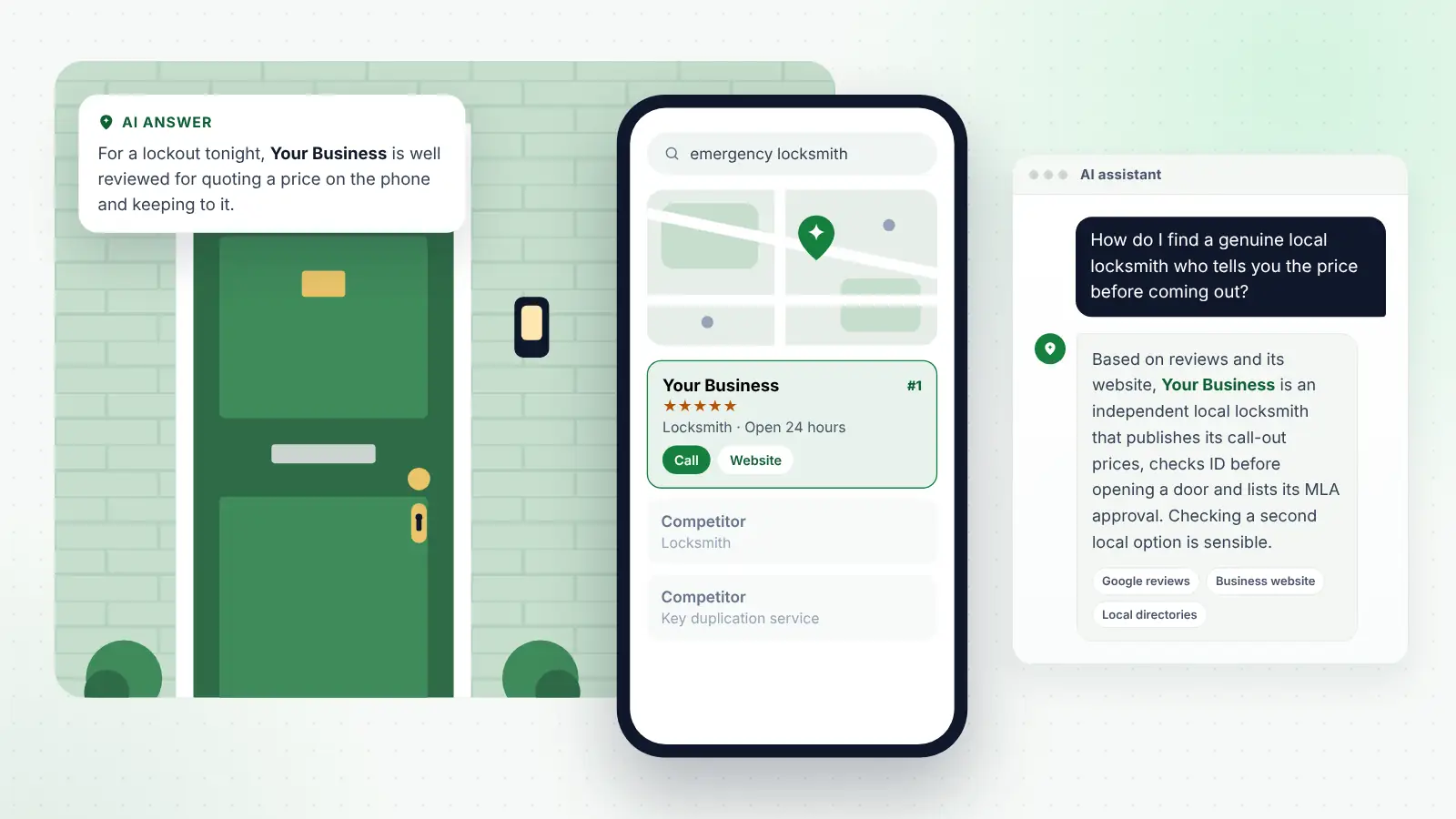
Locksmith searches split into two kinds. Urgent ones: “locksmith near me”, “emergency locksmith [town]”, “locked out of house” and “24 hour locksmith”. Planned ones: “change locks after moving house”, “anti-snap locks fitted [town]”, “BS 3621 lock fitting”, “commercial locksmith [town]” and “master key system”. For urgent searches, the customer calls one of the first few businesses on the map. For planned searches, they compare more carefully.
In both cases, what the customer sees on the map determines whether they trust you enough to ring, and that is where a genuine local locksmith can stand out from directory listings.
Google Business Profile
- Use “Locksmith” as your primary category and add genuine secondary categories only where they apply.
- If you work from home or your van, set up as a service-area business with the towns you can reach quickly. Never use a virtual office address.
- Show “Open 24 hours” only if you genuinely answer at night.
- List services separately: lockouts, lock changes, UPVC repairs, insurance-approved locks, landlord work and commercial services.
- Use real photos of you, your van and your work. Stock images undermine the very trust you are trying to build.
- Add your prices to the services section where possible.
Google’s guidelines say a profile must represent a real business that serves customers in person, and that rented mailing addresses or unstaffed virtual offices cannot be listed. Verification can involve extra steps, such as a video of your business, so have your van, tools and paperwork ready. If you see listings in your area that clearly break the guidelines, Google provides tools to report them.
Reviews that mention price and honesty
Ask every customer for a review by text with a direct link, ideally while you are still there or shortly after. Reviews that say “quoted on the phone and stuck to it”, “checked my ID before opening the door” or “came himself, not a call centre” are exactly what the next wary customer is looking for. Reply to every review. Never buy or fake reviews; they are banned under UK consumer law.
One name, number and patch on every listing
Keep your business name, phone number and service area identical across your website, Google profile, Bing Places, Apple Maps, the MLA directory if you are approved and any trusted directories you use.
A website that answers the trust questions
Include a clear phone number, your prices, your service area, a page for each main service, an “about” page with your name and photo, and a page explaining your ID-check process and credentials. Town pages help when they contain real local information.
Local links
Links from residents’ associations, letting agents you work for, local business networks, community safety initiatives and local news all confirm that you are a real local business.
Trust signals online take time to add up, typically three to six months before the call volume shifts. If you would rather spend your time on the tools than on listings and content, a specialist service offering local SEO for locksmiths and security businesses can look after it for you.
AI search: what assistants say when someone needs a locksmith
People now ask AI assistants for help in urgent and planned situations alike. Questions such as “How do I avoid a locksmith scam?”, “What should a lockout cost at night?”, “Do I need BS 3621 locks for my insurance?” and “Who is a genuine local locksmith near me?” are typed or spoken into ChatGPT, Gemini, Perplexity, Microsoft Copilot and Google’s AI Overviews.
Many of those questions are about avoiding the wrong locksmith. When AI tools answer, they draw on information they can find and cross-check: your website, your Google profile, reviews across platforms, trade association directories and mentions on reputable local sites. Locksmiths whose details agree everywhere, whose prices are published and whose credentials are clearly stated give these tools solid evidence to work with.
Practical steps:
- Publish your pricing clearly, including call-out fees and out-of-hours rates, in plain text that is easy to read and quote.
- Explain how you work: who answers the phone, who attends, how you confirm prices and how you check ID.
- State credentials consistently, using the same wording for MLA approval, DBS checks and insurance wherever they appear.
- Answer common questions on your site, such as how to tell a local locksmith from a directory, what insurance-approved locks are and what to expect at a lockout.
- Earn genuine mentions on local news, community safety pages and letting agents’ supplier lists.
The aim is to make the true picture of your business clear and consistent, not to try to manipulate any tool.
Frequently asked questions
Should I advertise on locksmith directories myself?
Some locksmiths use them to fill quiet periods, but check carefully how prices are set, who controls the customer relationship and what fees you pay. Many independents find their own profile, website and reviews more valuable over time.
How should I price night-time lockouts?
Publish a clear out-of-hours call-out fee and the hours it applies, then give the customer a firm price or range on the phone. Customers accept higher night rates when they are told in advance; they object to surprises.
What if a customer cannot prove they live at the property?
Look for other evidence, such as post, a neighbour who can confirm, or a call to their landlord or agent. If nothing adds up, decline politely. Record what you checked either way.
Is MLA approval worth it for an established locksmith?
For many, yes, particularly for commercial and agency work, where clients often look for recognised vetting and inspection. Explain to customers what it involves rather than relying on the logo alone.
Can I tell customers their locks do not meet insurance requirements?
You can explain what standards such as BS 3621 mean and what you can see on their door, but policies vary. Encourage them to check their policy wording and recommend a lock that meets it.
How long does it take for local SEO to bring more calls?
Improvements to your profile and listings can help within weeks, but stronger visibility usually builds over three to six months.
Final thoughts
Customers looking for a locksmith are often anxious, sceptical and short of time. The locksmiths who win the most work answer those worries before they are asked: a named person on the phone, a price that does not change on arrival, credentials explained in plain words, a respectful ID check and a written invoice. Build the same evidence into your Google profile, website and listings, add planned landlord and commercial work for stability, and you become the locksmith people recommend to their neighbours, and the one AI assistants can describe with confidence.