Most established groomers do not have a skills problem. They have a diary problem. December and the weeks before summer are booked months ahead, while late January and some autumn weeks have gaps that never quite fill. A regular cockapoo that should be in every six weeks drifts to every twelve and arrives matted, a new client books a Saturday and does not turn up, and a heavily coated dog priced like a short-coated one eats half an afternoon.
A full diary is not about cramming in more dogs. It is about the right dogs, at the right intervals, at prices that reflect the work, with enough of the year planned that busy seasons pay for themselves and quiet weeks are rare. That is mostly a matter of systems, rather than luck or extra marketing spend.
This guide is for groomers who are already trading, whether in a salon, from home or from a van. It covers rebooking cycles by coat type, puppy introductions, no-show policies, pricing by breed and coat condition, mobile and salon scheduling, seasonal peaks, photos and reviews, qualifications and the licensing position, and how local search and AI assistants send new clients your way.
Key points
- Rebooking each dog at the right interval for its coat before it leaves is the single most reliable way to keep a diary full.
- Puppy introduction visits create clients for life and make later full grooms safer and quicker.
- A clear, fairly applied no-show and late cancellation policy, with deposits for new clients, protects your time without driving regulars away.
- Pricing by size, coat type and condition, with published guide prices, stops difficult dogs quietly eating your profit.
- Grooming itself is not licensed in England as of October 2026, so qualifications, insurance and reviews are what owners use to judge you.
- An accurate Google profile, before-and-after photos and detailed reviews help both map searches and AI assistants recommend you.
In this guide
- Start with your diary maths
- Rebooking cycles by coat type
- Puppy introductions that become lifetime clients
- No-shows, late cancellations and deposits
- Pricing by breed, size and coat condition
- Mobile and salon: filling the diary in different ways
- Planning for seasonal peaks and quieter weeks
- Photos, reviews and proof of skill
- Qualifications, insurance and the licensing question
- Local SEO: getting found by owners who need a groomer now
- AI search: what assistants say when owners ask for a groomer
- Frequently asked questions
- Next steps
Start with your diary maths
Before chasing new clients, work out what a full week actually looks like for you. Many groomers feel busy without knowing whether they are at capacity or simply badly scheduled.
- List how long each type of groom really takes you, from arrival to collection, including drying and cleaning down. A small terrier tidy, a medium doodle full groom and a large double-coated de-shed are very different jobs.
- Count how many slots of each length you can realistically fit into a day without rushing or skipping breaks.
- Look back over the last three months and note how many slots went unfilled, how many were lost to no-shows or late cancellations, and how many over-ran.
- Work out your average income per hour rather than per dog. A cheap, quick bath and tidy may pay better per hour than a long full groom priced too low.
This tells you where the real gaps are. Some groomers discover they do not need more clients at all, just fewer lost slots and better prices on the dogs that take longest.
Rebooking cycles by coat type
The best source of future bookings is the dog already on your table. Clients who rebook at collection come back at the right interval; clients who say “I will ring you” often come back late, with a coat in worse condition, or not at all.
Recommend an interval based on the coat, not on what the owner thinks they want. The table below gives typical starting points. Every dog is different, and lifestyle, coat quality and the length of the trim all change the right answer.
| Coat type | Example breeds | Typical rebooking interval | What to explain to the owner |
|---|---|---|---|
| Continuously growing, curly or wavy | Poodles, cockapoos, cavapoos, bichons | Often every 4 to 6 weeks | Longer gaps lead to matting near the skin, which may mean a shorter clip |
| Long, silky | Shih tzus, Yorkshire terriers, Lhasa apsos | Often every 4 to 8 weeks | Home brushing between visits decides how long the coat can be kept |
| Wire, hand-stripped | Border terriers, schnauzers, some spaniels | Often every 8 to 12 weeks, sometimes rolling more often | Clipping changes the texture, so regular stripping keeps the coat correct |
| Double coat | Huskies, German shepherds, golden retrievers | Often every 8 to 12 weeks, more during heavy moults | De-shedding is maintenance, and shaving a double coat is not usually advised |
| Short, smooth | Labradors, Staffordshire bull terriers, beagles | Often every 8 to 12 weeks | A bath, de-shed and nail trim keeps shedding and nails under control |
Make rebooking the default at collection
- Have the next appointment suggested on screen before the owner arrives to collect.
- Offer two specific dates and times rather than asking “do you want to rebook?”
- Explain the reason in one sentence: “At six weeks we can keep this length. Leave it to ten and we will probably need to go shorter.”
- Send a confirmation straight away and an automatic reminder a day or two before.
- For regulars, offer a standing booking on a fixed cycle, such as every sixth Tuesday at 9am.
Tip
Note the interval each dog actually came back at. Once a month, contact any regular whose dog is more than two weeks past its recommended interval. A friendly message often fills a gap that week and saves a matted coat.
Puppy introductions that become lifetime clients
A puppy who has a good first experience with you is likely to be a client for many years, and an easier dog to groom along the way. Puppy owners are also some of the most active searchers and reviewers, so a strong puppy offer is one of the best ways to fill a diary with long-term regulars.
A structured introduction might look like this:
- First visit. A short session to meet you, explore the salon or van, hear the dryer at a distance, have feet handled and enjoy a gentle brush.
- Second visit. A bath, a gentle dry, a nail trim and a face and feet tidy if the puppy is comfortable.
- Third visit. A short, light trim, building towards a first full groom when the puppy is ready.
- Ongoing. Rebook on a short cycle at first so the puppy gets used to the routine while the coat is still easy to manage.
Keep sessions short, end on a good note and send the owner a photo and a short note on how the puppy did. Give simple home handling advice, such as touching paws and ears and brushing daily, because that makes later grooms quicker and safer.
Many owners look for a groomer as soon as they get a puppy, often after their vet or breeder mentions it. Building relationships with local vets, puppy trainers and reputable breeders means your name comes up at exactly the right moment.
No-shows, late cancellations and deposits
A single no-show can cost a groomer a large slice of a day’s takings, because the slot is usually too late to fill. A clear policy, applied consistently and kindly, protects your time without upsetting good clients.
Write the policy down
Your policy should be short and visible on your website, booking page and confirmation messages. Typically it covers:
- how much notice you need to cancel or move an appointment
- what happens if a client does not turn up or cancels late
- deposits for new clients, busy seasons or long appointments
- late arrivals and late collections
- what happens if a groom has to be stopped for the dog’s welfare
Charges for cancellations and no-shows need to be fair, clear and agreed before the booking. Under consumer law, terms that are hidden, unclear or disproportionate may not be enforceable, so keep fees reasonable and related to the loss you actually suffer. If you are unsure, Business Companion, the trading standards guidance site for businesses, and the CMA’s guidance on unfair contract terms are good starting points.
Apply it with judgement
- Take deposits from new clients and for high-demand dates such as December, but consider waiving them for long-standing regulars.
- Use automatic reminders by text or email, with an easy way to confirm or move the booking.
- Keep a short cancellation list of clients happy to come in at short notice, and message them when a slot opens.
- Treat genuine emergencies with understanding, while noting repeat patterns.
Tip
Send reminders two days before, not the night before. That leaves you enough time to fill a cancelled slot from your waiting list.
Pricing by breed, size and coat condition
Pricing is where many experienced groomers lose the most without noticing. A flat price by breed ignores the difference between a well-maintained coat booked every five weeks and the same breed arriving after four months without a brush.
Build a clear price structure
- Base price by breed or size and coat type, published as guide prices on your website.
- Condition charges, for matting, heavy undercoat, or coats that have been left too long, charged per time or as a set band.
- Handling charges for dogs that need extra time or a second pair of hands, explained calmly in advance.
- Add-ons, such as hand stripping, teeth cleaning, de-shedding treatments or nail grinding, each priced individually.
- Maintenance pricing, where dogs rebooked on the recommended cycle stay on the standard price, giving owners a reason to come back on time.
Talk about matting before it happens
Owners are often surprised when a matted dog has to be clipped short. Explain at booking and on your website that severe matting is usually kinder to shave out than to brush, and get agreement before you start. Photos of the coat on arrival help if there is any disagreement later.
Review your prices at least once a year against your costs, time per dog and what other established groomers nearby charge. Small, regular increases with notice are easier for clients to accept than a large jump after several years.
Mobile and salon: filling the diary in different ways
The principles are the same, but the scheduling challenge is different.
Salons and home-based setups
- Stagger drop-off times so you are not drying three dogs at once.
- Mix long and short grooms across the day to avoid over-runs.
- Use quiet morning or mid-week slots for nervous dogs, puppies and elderly dogs, and say so on your website.
- If you employ groomers or bathers, plan the diary around who is skilled at which coats.
Mobile groomers
- Group bookings by area so you are not crossing town between every appointment. Many mobile groomers work set areas on set days.
- Show on your website and Google profile which areas you cover on which days.
- Factor travel time, water and power into your pricing and slot lengths.
- Offer multi-dog household and neighbour discounts carefully, as they reduce travel between jobs.
Whether you use a salon or a van, waste water from grooming must not go into a surface water drain, which usually runs straight to a river or stream. Check with your water company how it expects grooming waste water to be disposed of, and whether you need its permission.
Planning for seasonal peaks and quieter weeks
Most groomers see predictable patterns. Demand usually rises before Christmas, before summer holidays and at the start of warm weather, when owners want lighter trims. Quieter periods often follow Christmas and the main summer holidays.
- Pre-book the peaks. Open December slots to regulars first, well in advance, and protect them for clients on a regular cycle.
- Protect your regulars during busy times. Clients who come every six weeks all year deserve priority over one-off Christmas bookings.
- Promote moulting season services. De-shedding packages in spring and autumn suit double-coated breeds and fill weekday gaps.
- Fill quiet weeks with maintenance work. Offer nail clinics, face, feet and tail tidies, or puppy introduction sessions.
- Plan time off around the pattern, so your own holidays fall in genuinely quiet weeks.
Avoid deep discounting to fill quiet weeks. It trains owners to wait for offers, and those slots are often taken by clients who would have booked anyway.
Photos, reviews and proof of skill
Owners choose a groomer largely on trust and on what they can see. Your best marketing is a steady stream of real photos and detailed reviews.
- Before-and-after photos of real dogs, with the owner’s permission, showing the coat types and styles you are known for.
- Photos of your setup: a clean salon or van, secure tables and calm dogs.
- Short captions describing the coat type, the trim and the interval the dog is on.
- Reviews after the best moments, such as a puppy’s first full groom, a transformation from a matted coat or a nervous dog’s calm visit.
Ask for reviews with a direct link sent in the collection message, and reply to each one. Reviews that mention specific breeds, handling or results are much more useful to owners than a simple star rating.
Qualifications, insurance and the licensing question
As of October 2026, there is no specific licence for dog grooming in England. Grooming is not one of the activities covered by the Animal Welfare (Licensing of Activities Involving Animals) (England) Regulations 2018, which cover activities such as dog boarding, home boarding, day care, dog breeding and selling animals as pets. If you add day care or boarding alongside grooming, that part of the business may need a council licence, so check with your local authority.
Elsewhere in the UK the position is under review. The Welsh Government has said it will consider pet grooming in a later phase of its plans for regulating animal activities, describing grooming as currently unregulated, and the Scottish Government consulted in 2023 on licensing several animal activities, including dog grooming. Neither had introduced a grooming licence at the time of writing, so check the latest position if you work there. Animal welfare law still applies to every groomer, including the duty of care under the Animal Welfare Act 2006 in England and Wales.
Because there is no licence, owners judge you by your training and insurance. Regulated grooming qualifications from City & Guilds and the iPET Network, canine first aid, and insurance that includes care, custody and control are all worth stating clearly on your website and profile. Add any short courses in breed styling, hand stripping or handling anxious dogs, since owners searching for those specific skills will look for them.
Local SEO: getting found by owners who need a groomer now
When owners need a groomer, they mostly search on their phone with phrases such as “dog groomer near me”, “cockapoo groomer [town]”, “mobile dog groomer near me”, “puppy groom [area]”, “dog groomer with availability this week” or “hand stripping near me”. The groomers in the map results usually get the first calls, and an established groomer who is not showing there is relying on word of mouth alone.
For a groomer focused on filling the diary, local SEO is mostly about making sure the right owners find you and can see quickly that you suit their dog.
Google Business Profile
- Choose “Pet groomer” or the most accurate primary category.
- Add each service separately: full groom, bath and tidy, puppy introduction, hand stripping, de-shedding, nail trims.
- Mobile and home-based groomers can set up as a service-area business, so the home address stays private and the areas covered are shown.
- Keep hours accurate, and use posts to share upcoming availability, seasonal packages and recent grooms.
- Upload new photos regularly, including before-and-after images and your setup.
Reviews
Make asking for reviews part of your collection routine. Detailed reviews that mention breeds, handling and results help owners and search engines understand what you specialise in. Reply to every review, including negative ones, calmly and briefly.
Consistent details
Your business name, phone number, address or service area and website should be identical on Google, Apple Maps, Bing, Facebook, your booking platform and directories. Inconsistent details make it harder for search engines to trust your listing.
A website that answers owners’ questions
Include guide prices by breed and coat type, your rebooking recommendations, your no-show and matting policies, your qualifications and insurance, your puppy introduction offer and the areas you cover. Mobile groomers benefit from a genuine page for each main area served, with real local detail.
Local links and mentions
Mentions from local vets, puppy trainers, dog walkers, pet shops, day care businesses and community websites help your visibility and send referrals directly.
This takes steady effort, and results usually build over three to six months. If you would rather spend your time grooming, specialist local SEO for dog groomers and mobile grooming businesses can look after the profile, listings and website for you.
AI search: what assistants say when owners ask for a groomer
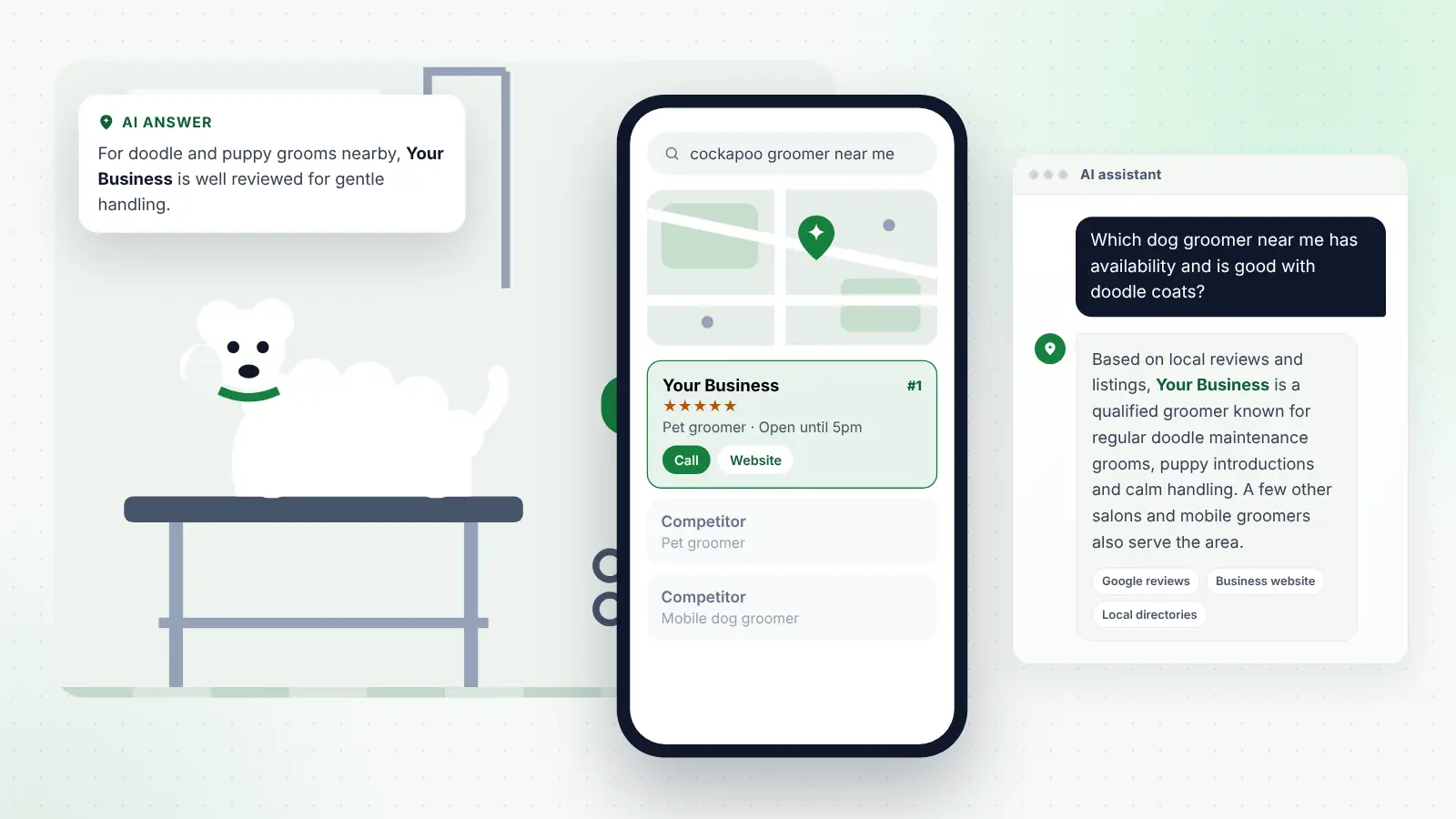
More owners now ask AI assistants such as ChatGPT, Gemini, Perplexity, Microsoft Copilot or Google’s AI Overviews for help finding a groomer. Their questions are usually very specific to their dog.
Typical questions include:
- “Which dog groomer near me is good with doodle coats?”
- “Is there a mobile dog groomer in [area] who does puppy introductions?”
- “Who does hand stripping for border terriers near [town]?”
- “Which groomer near me is good with nervous rescue dogs?”
- “How often should a cockapoo be groomed, and who near me can do it?”
These tools build answers from what they can find and cross-check about your business. Answer engine optimisation (AEO) means making that information clear and consistent:
- Consistent business information across your website, Google profile and directories, including areas covered and opening days.
- Clear service and breed descriptions, so an assistant can match “doodle coat” or “hand stripping” to your business.
- Detailed reviews that describe the dogs you groom and how you handle them.
- FAQs in owners’ words, such as how often a breed should be groomed, what happens with matted coats and how puppy introductions work.
- Mentions on reputable local and pet sites, which help confirm your business is real and well regarded.
Your rebooking guidance helps here too. A clear page explaining recommended intervals by coat type is the kind of useful, specific information that answers owners’ questions and gives assistants something concrete to cite. No one can guarantee a mention, but vague or missing information makes it much less likely.
Frequently asked questions
How often should I rebook my regular clients?
It depends on the coat, the trim and the owner’s home care. Curly and wavy coats often need grooming every four to six weeks, while short-coated breeds may only need a bath and de-shed every couple of months. Recommend an interval at each visit and rebook before the dog leaves.
Is it fair to charge for no-shows?
Yes, as long as the charge is clear, agreed in advance and reasonable for the loss you suffer. Put the policy on your website and in booking confirmations, and apply it consistently. Deposits for new clients and busy dates are a common, accepted approach.
Do I need a licence to groom dogs in England?
As of October 2026, no specific licence is required for grooming in England. If you add day care or boarding, that part of the business may need a licence from your local council. Wales and Scotland have both looked at future regulation, so keep an eye on announcements.
Should I offer puppy introduction sessions free?
Some groomers do, while others charge a small fee to reduce no-shows. Either way, keep sessions short and positive, and use them to build a relationship with the owner and the puppy.
How long does it take for local SEO to bring in more bookings?
It depends on your area and competition, but improvements usually build over three to six months. A complete Google profile, regular photos, steady reviews and clear service pages are the foundations.
Next steps
Start with your diary maths: how long each groom really takes, where slots are lost and what you earn per hour. Then set recommended rebooking intervals by coat type, make rebooking at collection the default, and write a short, fair no-show policy. Review your prices so that condition and handling are properly reflected, and plan your peaks and quiet weeks in advance.
Finally, make sure owners can find you and see why you suit their dog. Clear guide prices, your qualifications and insurance, real before-and-after photos and detailed reviews help owners, Google and AI assistants alike, and they keep your diary full with the right dogs at the right intervals.