Most established brokers can tell you exactly which months were good and which were thin, and the difference is rarely about the quality of their advice. It is about flow. When an estate agent partner is busy, when a batch of fixed rates comes to an end, or when a well-timed guide brings in first-time buyers, the diary fills. When those sources dry up at the same time, it empties, and the temptation is to reach for rate-led advertising that brings in price shoppers who leave for a fraction of a percent.
The brokers who grow steadily tend to do something less dramatic. They build a handful of reliable referral relationships, they look after the clients they already have so the remortgage comes back to them, and they publish useful, approved content that answers the questions people actually ask. They also treat compliance as part of their marketing rather than a hurdle, because in a regulated industry, clear and fair communication is itself a selling point.
This guide is for brokers who are already advising, whether directly authorised or an appointed representative of a network, and want more of the right clients. It covers referral partners, first-time buyer and remortgage campaigns, how the FCA’s financial promotion rules and the Consumer Duty shape your marketing, fee disclosure, reviews, content, and the local SEO and AI search work that brings new clients to you directly. It is general information rather than regulatory advice, so always check specifics with your compliance team or network.
Key points
- Steady growth usually comes from a few strong referral partners, retained clients and useful content, rather than rate-led advertising.
- Estate agents, conveyancers, builders, developers and accountants all refer for different reasons, so tailor what you offer each one.
- Your website, social posts, Google Business Profile posts and emails can all be financial promotions that must be fair, clear and not misleading under MCOB 3A, and approved before use.
- The Consumer Duty expects clear communication, fair value and good support, which also happens to be what clients praise in reviews.
- Remortgage and product transfer work is often the most reliable income in a brokerage, but only if you contact clients early.
- Local SEO and AI search let buyers and remortgagers reach you without an introducer, though the effect typically takes three to six months to build.
In this guide
- Find out where your clients actually come from
- Line up estate agents, developers and solicitors who refer regularly
- Run first-time buyer campaigns that build trust
- Make remortgage and product transfer work reliable
- Financial promotions: what the rules mean for everyday marketing
- Put the Consumer Duty at the centre of your client journey
- Fee disclosure that builds trust
- Reviews: ask well and reply carefully
- Pages that answer what borrowers actually ask
- Local SEO for mortgage brokers: being found by people nearby
- AI search: what an assistant says when asked for a broker
- Frequently asked questions
- Next steps
Find out where your clients actually come from
Before adding new activity, look at the last twelve months of completed cases and record the original source of each one. Typical categories are:
- Existing clients returning for a remortgage or product transfer.
- Recommendations from past clients, friends and family.
- Each referral partner, listed individually.
- Your website, Google Business Profile and other organic search.
- Social media.
- Paid advertising or bought leads.
Then add two more columns: the average income per case from each source, and how often cases from that source actually completed. Bought leads can look busy but complete poorly. A single conveyancer might send fewer cases than an estate agent but with almost every one completing. These patterns tell you where to spend your time.
Tip
Add a mandatory “how did you hear about us?” field to your fact-find and CRM. Without it, your marketing decisions are based on memory rather than evidence.
Line up estate agents, developers and solicitors who refer regularly
Referral relationships remain one of the most dependable sources of mortgage business. Each type of partner refers for different reasons, so the offer you make to each should be different.
| Partner | Why they refer | What they need from you | Watch out for |
|---|---|---|---|
| Independent estate agents | Faster, more secure sales; a better buyer experience | Quick appointments, decisions in principle, updates on progress | Agents with an in-house broker or existing tie-in |
| Conveyancers and solicitors | Fewer delayed completions; clients they can trust | Clean, well-packaged cases and prompt responses to queries | Never pressure them to recommend you to their clients |
| Builders and developers | Buyers who can actually proceed; help with reservations | Knowledge of new-build lending criteria and incentives | Lender limits on new builds and developer incentives |
| Renovation and extension builders | Clients who can fund the work they want | Further advance and remortgage-for-improvements advice | Never promise borrowing before a proper assessment |
| Accountants | Help for self-employed and company director clients | Understanding of how lenders treat different income types | Getting the right accounts and projections early |
Estate agents
Independent agents without an in-house adviser are often the most valuable partners, but they will only refer if you make their job easier. Offer same-day or next-day appointments for buyers they send, provide decisions in principle quickly and keep them informed about progress, within the limits of what your client has agreed you can share. Remember that estate agents must not discriminate against buyers who choose not to use services such as their recommended broker, so a good partnership never involves pressuring buyers.
Conveyancers and solicitors
Conveyancers see the cost of badly packaged mortgage cases first-hand: late offers, missing conditions and anxious clients. Partnerships tend to grow from reliability. Respond to their queries quickly, make sure offers are issued in good time and keep the client informed. Over time, they will recommend you when a client asks.
Builders and developers
Developers want buyers who can proceed, and renovation builders want clients who can fund the job. You can help by explaining lending criteria clearly, such as how lenders treat new-build properties, deposits and developer incentives, or how a further advance or remortgage might fund an extension. Be careful never to imply that borrowing is guaranteed.
Formalise and disclose
Put introducer arrangements in writing and follow your firm’s or network’s rules on disclosing any payments. Estate agents are expected to tell their clients about referral fees they receive, and the Consumer Duty expects you to make sure no arrangement influences the advice you give or leads to poor value for the client.
Run first-time buyer campaigns that build trust
First-time buyers are often anxious, short of information and early in their journey. They may be a year or more away from buying. That makes them ideal for a patient, education-led approach rather than a hard sell.
Ideas that work well for established brokers:
- A first-time buyer guide on your website explaining the stages, typical timescales and what lenders look at, kept up to date and approved.
- A “getting mortgage ready” checklist covering credit files, deposits, income evidence and common surprises.
- Small evening sessions, in person or online, sometimes with an estate agent or conveyancer partner, covering the buying process from start to finish.
- A clear first conversation. Explain how you are paid and what the client can expect before any detailed discussion, so there is no awkwardness later.
Keep government schemes and any figures in your content accurate and dated, because schemes, stamp duty thresholds and lender criteria change. Out-of-date information can be misleading, and it undermines trust as quickly as it was built.
Make remortgage and product transfer work reliable
For many brokerages, the most dependable income is from clients they have already helped. But lenders and other brokers contact borrowers ahead of their fixed rate ending too, so the broker who waits for the client to get in touch often loses them.
A simple retention process:
- Record the product end date for every case at completion, along with any early repayment charges.
- Make contact several months before the end date, with a short, approved message explaining that you will review their options.
- Review the whole picture, including changes in income, family circumstances and protection needs.
- Explain the options clearly, including staying with the current lender on a product transfer if that is the most suitable outcome.
- Record the outcome and set the next reminder.
The Consumer Duty is relevant here. It expects firms to avoid foreseeable harm, and a client drifting onto a lender’s standard variable rate because nobody contacted them is the kind of outcome it is concerned with. A well-run retention process supports good outcomes and protects your income at the same time.
Financial promotions: what the rules mean for everyday marketing
Almost everything you publish to attract clients can be a financial promotion: your website pages, Google Business Profile posts, social media, leaflets, emails and even short videos. Promotions relating to mortgages are covered by the FCA’s rules in MCOB 3A on financial promotions and communications with customers, alongside the wider requirement for communications to be fair, clear and not misleading.
In practical terms:
- Get approval first. If you are an appointed representative, your network will usually need to approve promotions before they are published. Directly authorised firms need their own approval process and records.
- Be balanced. Promotions should give a fair and prominent indication of the relevant risks and make clear that the loan is secured on the client’s home. Many firms use wording such as “Your home may be repossessed if you do not keep up repayments on your mortgage”, but your compliance team will confirm the exact wording and placement.
- Be careful with numbers. Mentioning rates or costs can trigger specific information requirements, such as a representative example. Many brokers avoid quoting rates in general marketing for this reason.
- Do not overpromise. Avoid “guaranteed approval”, “best rates” or promises about speed of offer.
- Treat social media like any other promotion. The FCA has published guidance on financial promotions on social media, and each post should be able to stand on its own with the necessary information.
- Show your status. Include your FCA status, or your principal firm’s, consistently across your website and profiles.
The FCA’s Mortgage Rule Review has already changed some rules and further proposals have been consulted on, so make sure your compliance team is working from the current version of the Handbook.
Put the Consumer Duty at the centre of your client journey
The Consumer Duty applies to products and services offered to retail customers and requires firms to act to deliver good outcomes. It is sometimes seen as paperwork, but for a growing brokerage it is also a useful description of what clients value. Its four outcomes map neatly onto the client experience:
- Products and services: recommending mortgages and protection that genuinely meet each client’s needs.
- Price and value: making sure the total cost of your service, including fees and commission, represents fair value.
- Consumer understanding: explaining options and documents in plain language, checking that clients understand.
- Consumer support: making it easy to ask questions, get updates and complain, with extra care for clients in vulnerable circumstances.
Clients rarely use these words, but their reviews often say the same things: “explained everything clearly”, “always available”, “kept us updated”. A brokerage that takes the Duty seriously tends to generate exactly the kind of feedback that wins the next client.
Fee disclosure that builds trust
Many clients do not know how brokers are paid, and some feel uneasy when a fee appears. Before you advise, the rules require you to explain the scope of your service and how you are paid, including any fee, when it becomes payable and whether you receive commission from lenders.
Make this a strength rather than a formality:
- Publish a clear fees page explaining how you charge, when fees are payable and what happens if the case does not proceed.
- Explain fees early in the first conversation, in plain terms that match your formal disclosure documents.
- Show what the fee pays for: sourcing, application management, liaising with agents and conveyancers, and ongoing reviews.
Clear fees reduce complaints, support your Consumer Duty fair value assessment and help AI tools and search engines describe your service accurately.
Reviews: ask well and reply carefully
Reviews influence both where you appear in local search and whether a prospective client calls. A steady flow of recent, specific reviews is worth more than a burst of old ones.
- Ask at natural moments, such as when the offer is issued or after completion, with a direct link.
- Ask for specifics. Invite clients to mention what the process was like, which helps the next client and gives search engines and AI tools more detail.
- Never incentivise or fabricate reviews. Fake reviews and concealed incentivised reviews are banned under UK consumer law.
- Protect confidentiality in replies. Thank reviewers without confirming any details of their mortgage or circumstances, even if they mention them first.
- Check your network’s rules, as some treat review replies and testimonials as promotions that need approval.
Pages that answer what borrowers actually ask
The best brokerage content starts with questions clients have already asked you. Keep a running list from your fact-finds and phone calls and turn the most common ones into approved website pages or articles, such as:
- “How much can I borrow if I am self-employed?”
- “What happens when my fixed rate ends?”
- “Do I need a broker for a product transfer?”
- “How do mortgage brokers get paid?”
- “Can I get a mortgage on a new-build flat?”
- “Will a small credit problem stop me getting a mortgage?”
Answer each one in plain English, explain what depends on individual circumstances and invite the reader to talk to you. This kind of factual content is usually easier to approve than rate-led advertising, stays useful for longer and is exactly what search engines and AI assistants look for.
Local SEO for mortgage brokers: being found by people nearby
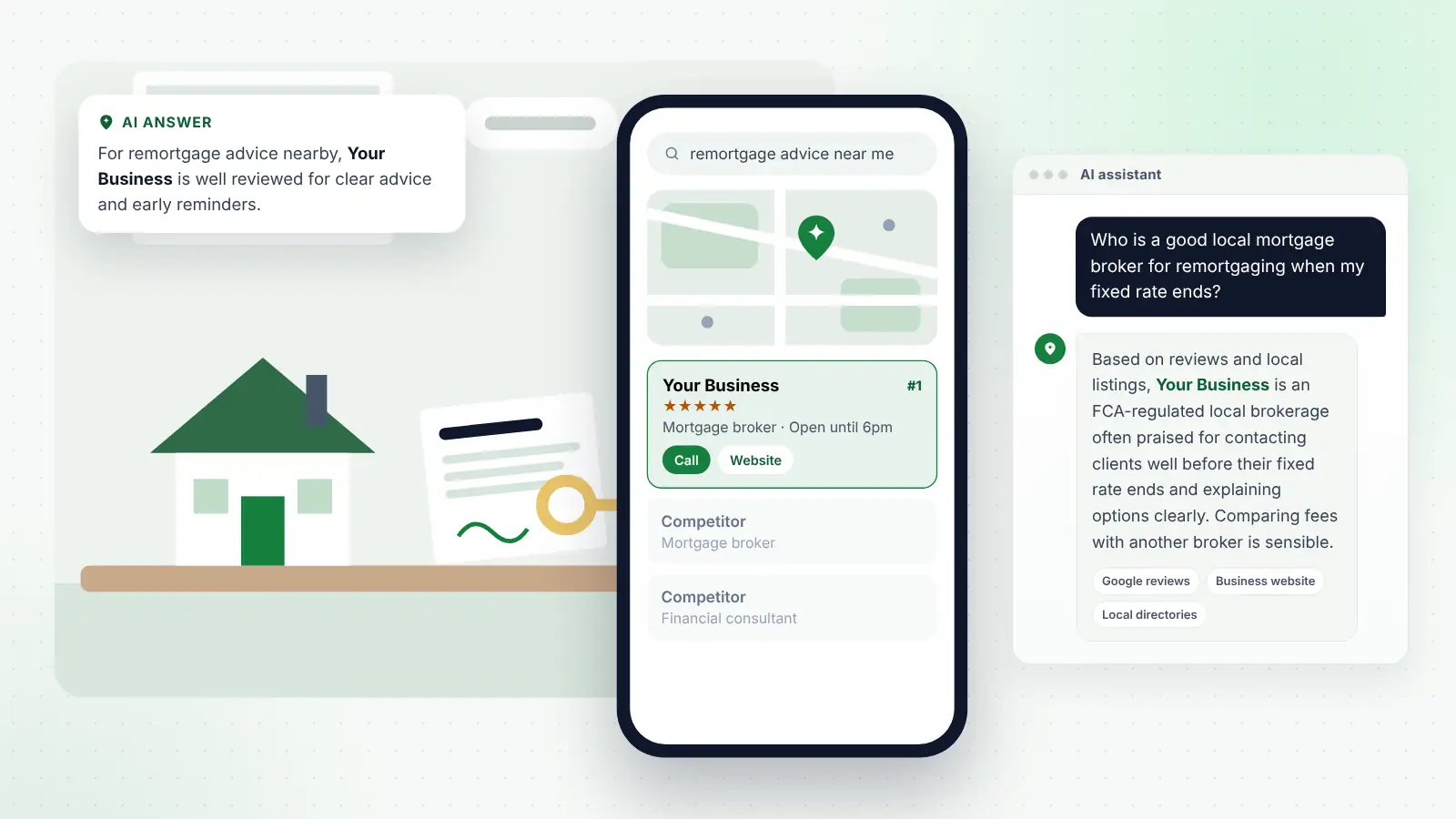
Many people still want a broker they can speak to, and often meet, in their own area. They search for “mortgage broker near me”, “first time buyer mortgage advisor [town]”, “remortgage advice near me”, “self employed mortgage broker [town]” and “independent mortgage advisor open Saturday”. These searches usually show a map with three local firms at the top.
To appear for these searches:
- Google Business Profile. Use “Mortgage broker” as your primary category, describe the client types you help, set accurate hours and add photos of your team. If clients do not visit your premises, set it up as a service-area business. Remember the profile description and every post are financial promotions, so run them past compliance first.
- Reviews. Recent, specific reviews help your ranking and reassure clients comparing brokers.
- Consistent details. Keep your firm name, address, phone number and FCA status consistent across your website, Google, Apple Maps, Bing, your network’s adviser finder and financial directories.
- Service and area pages. Create separate pages for first-time buyers, remortgages, home movers, self-employed clients, buy-to-let and protection, plus pages for the main towns you serve with genuinely local information.
- Local links. Your referral partners’ websites, local business groups, community sponsorships and local news comments all add authority.
If you would rather spend your time advising, specialist local SEO for mortgage brokers that fits around network approval can take on the profile, listings, content and links. In-house or outsourced, allow three to six months for that visibility to grow, with compliance sign-off built into the timetable.
AI search: what an assistant says when asked for a broker
More people now ask AI tools such as ChatGPT, Gemini, Perplexity, Microsoft Copilot and Google AI Overviews about mortgages before they speak to anyone. Their questions are often specific:
- “Who is a good local mortgage broker for remortgaging when my fixed rate ends?”
- “Do I need a mortgage broker as a first-time buyer?”
- “Which brokers in [town] help self-employed people?”
- “How much do mortgage brokers charge?”
An assistant describing your firm will repeat whatever it can confirm from several sources. For that description to be right, make sure:
- Your firm details are consistent across your website, Google profile, the FCA Register, your network’s listings and directories.
- Your services and client types are stated plainly, so an AI tool can tell that you help self-employed clients or landlords, for example.
- Your fees and process are explained on your website.
- Your reviews describe what you do well, such as clear explanations and early remortgage reminders.
- Your FAQ content answers real questions in plain language.
- You are mentioned on reputable sites, such as local news, partner websites and industry bodies.
Content that AI tools might summarise still needs to meet the financial promotion rules, so keep it approved, balanced and free of promises about rates or outcomes.
Tip
Ask an AI assistant “Which mortgage brokers in [your town] help first-time buyers?” every few months. If it misses you or gets details wrong, check that your website, Google profile and directory listings say the same thing clearly.
Frequently asked questions
What is the most reliable way to get more mortgage clients?
For most established brokers, it is a combination of strong retention for existing clients, a small number of reliable referral partners and steady local visibility online. Each supports the others: happy clients leave reviews, reviews help you appear in search, and partners are more confident referring a broker with a strong reputation.
Do Google Business Profile posts count as financial promotions?
They can, along with your profile description and other public marketing. Treat them like any other promotion and follow your firm’s or network’s approval process before publishing.
Should we pay estate agents for referrals?
Some brokers do have formal introducer arrangements. If you do, put them in writing, follow your firm’s or network’s rules on disclosure, and make sure the arrangement never influences your advice. Estate agents are expected to disclose referral fees to their own clients too.
How early should we contact clients about remortgaging?
Several months before their product ends is common, as many lenders allow a new product to be secured in advance. Follow your compliance team’s guidance on timing and wording, and make sure the review covers the client’s full circumstances, not just the rate.
Can we mention rates in our social media posts?
Promotions that include rates or costs must meet specific FCA requirements, which can include a representative example, and still need to be balanced and approved. Many brokers keep general social content focused on explaining the process and only mention rates in carefully approved promotions.
Next steps
Start with your own data: where your completed cases came from and which sources were worth the effort. Strengthen the two or three referral relationships that already work, set up a retention process for every product end date, and build a library of approved content that answers the questions your clients ask most.
Then make sure new clients can find you directly. An accurate Google Business Profile, recent and specific reviews, clear fees and consistent details across the web all help in local search and in AI assistants. Treat compliance as part of how you communicate clearly, and your marketing will support the kind of trust that keeps clients coming back.