A nail salon can be one of the most dependable businesses on a high street. Clients with gels, BIAB or acrylics return every three to four weeks for infills or a fresh set, many book their next appointment before they leave, and a good technician builds a loyal following quickly. The flip side is competition: most towns have several nail bars, and clients can compare photos, prices and reviews in seconds.
The salons that last are rarely the cheapest. They are the ones with consistently neat work, safe and clean practice, clear prices and a booking process that takes seconds. They also take the less visible parts seriously — ventilation, product handling and allergy risks — because those protect both clients and technicians over the long term.
This guide covers the practical steps for opening a nail salon in the UK, from training and licensing to the health and safety rules that apply to nail products, staffing models, pricing and how to get found by local clients on Google and in AI assistants. Some rules, such as special treatment licensing, change from one council to the next, and the guide flags those so you know when to ask locally.
Key points
- In most of England there is no specific licence to offer nail treatments, but most London boroughs require a special treatment licence for premises offering manicures and pedicures.
- Nail products are covered by COSHH, and HSE guidance expects good ventilation and extraction at the nail station, not just an open door.
- Allergies to acrylate chemicals in gels and acrylics are a well-documented risk, so careful application, correct curing and proper gloves matter for clients and technicians alike.
- Qualifications are not a legal requirement in most areas, but insurers and clients expect recognised training and product-specific certificates.
- Most clients search by service, such as “BIAB near me”, so build your Google profile, website and reviews around the services you want to sell.
In this guide
- Decide what kind of nail business you want to run
- Nail technician training and qualifications
- Licensing and council registration
- Health and safety: COSHH, ventilation and dust
- Acrylate allergies, consultations and patch testing
- Insurance
- Premises, equipment and startup costs
- Staffing: employment, commission or chair rental
- Pricing, rebooking and retention
- Local SEO: filling nail stations with nearby clients
- AI search: when clients ask an assistant where to get their nails done
- Frequently asked questions
- Final thoughts
Decide what kind of nail business you want to run
Start by deciding how you want to work and who you want to serve. The model you choose affects your premises, your staffing, your prices and the way you market the salon.
Common models include:
- A walk-in nail bar in a busy shopping area, with several stations, longer opening hours and a focus on speed and convenience.
- An appointment-led nail salon or studio, often with fewer stations, a calmer atmosphere and higher prices for more detailed work.
- A specialist nail art studio, known for hand-painted designs, 3D work and special-occasion sets.
- A home-based or room-rental technician, keeping overheads low while you build a client list.
- A mobile technician, visiting clients at home or working at events, weddings and parties.
Think about your service menu at the same time. BIAB (builder gel), gel polish, acrylic and gel extensions, nail art, manicures and pedicures all appeal to slightly different clients. A focused menu that you deliver brilliantly is better than a long list of services nobody associates with you. You can add more as your team grows.
Nail technician training and qualifications
In most of the UK there is no legal requirement to hold a particular qualification before you work as a nail technician. In practice, though, training is essential. Insurers usually want to see certificates for each service you offer, clients increasingly ask about training, and poor technique is one of the main causes of damaged nails and allergic reactions.
Recognised routes include Level 2 and Level 3 nail services qualifications from awarding bodies such as VTCT and City & Guilds, and NVQ qualifications in nail services. Many technicians add brand-specific training for the gel or acrylic systems they use, which also matters because manufacturers’ instructions on application and curing are designed around their own products.
When you hire, check certificates for each service, and consider a practical trade test so you can see a candidate’s prep, application and finishing for yourself. Keep copies of everyone’s training records, because your insurer may ask for them.
Tip
Use one product system per service where you can, with the lamp the manufacturer recommends. Mixing gels and lamps from different brands is a common cause of under-cured product, which raises the risk of reactions.
Licensing and council registration
Licensing for nail salons depends on where you are, so check with your local council before you sign a lease.
England outside London
Most councils in England do not require a specific licence for manicures, pedicures or nail enhancements. However, if you also offer treatments that pierce the skin — such as ear piercing, semi-permanent make-up, microblading or electrolysis — both the practitioner and the premises usually need to be registered with the council under the Local Government (Miscellaneous Provisions) Act 1982, and you must follow the council’s hygiene byelaws. Registration normally involves an inspection.
London
Most London boroughs operate a special treatment licensing scheme under the London Local Authorities Act 1991. In boroughs that use it, premises offering treatments such as manicures and pedicures, massage, electrolysis, laser treatments and tattooing typically need a special treatment licence, usually renewed every year. Some practitioners are exempt if they belong to approved professional bodies, and the details vary from borough to borough, so check your own council’s list of licensable treatments.
Scotland and Wales
Scotland and Wales have their own licensing schemes for skin piercing and tattooing. Wales has a national special procedures licensing scheme covering tattooing, semi-permanent make-up, body piercing, electrolysis and acupuncture, while Scottish councils license skin piercing and tattooing businesses. Standard nail services are not part of these schemes, but some councils have their own local rules, so ask before you open.
Other council checks
- Planning. Check that the premises can be used as a nail salon, particularly if the unit was previously used for something else.
- Business rates. Before signing for a shop unit, find out its rateable value and whether you can claim small business rate relief.
- Signage. A big or lit-up salon sign above the window may need advertisement consent from the council.
- Music. Playing a radio or playlist while clients sit at the desk usually means you need TheMusicLicence from PPL PRS.
- Waste. You will need a commercial waste arrangement for salon waste, including used chemical containers.
Health and safety: COSHH, ventilation and dust
Nail products contain chemicals that can be harmful if they are not handled properly. Acrylic liquids and powders, gels, primers, solvents and removers all fall under the Control of Substances Hazardous to Health Regulations 2002 (COSHH), which require employers to assess the risks and put controls in place. HSE’s guidance on COSHH for beauticians and nail bars highlights that acrylic fumes can cause headaches, dizziness and nausea, that dust from filing artificial nails can cause wheezing and asthma, and that some ingredients can cause skin allergies.
What good control looks like
- Carry out a COSHH assessment. List every product you use, read the safety data sheets and record how you will control exposure.
- Extract at source. HSE recommends good general ventilation plus extraction at the nail station, such as a downdraught table or an extractor hood. HSE also publishes a COSHH essentials sheet (SR13) on engineering controls for nail bars. Ask your council’s environmental health team what it expects, including whether extraction should vent outside rather than rely on recirculating filters.
- Choose safer products. Methyl methacrylate (MMA) liquid is widely discouraged in professional nail work, and many councils and industry bodies recommend ethyl methacrylate (EMA) based systems instead.
- Reduce exposure. Keep bottles capped, use dispensers with small openings, dispose of soaked wipes in a lidded bin and empty it regularly.
- Protect skin and eyes. Provide suitable gloves, eye protection where needed and good hand care, and do not allow eating or drinking at nail stations.
If you employ staff, you also need a general health and safety risk assessment, first aid arrangements and employer’s liability insurance. Even as a sole trader, a written COSHH assessment shows insurers and clients that you take safety seriously.
Acrylate allergies, consultations and patch testing
Allergic reactions to acrylate chemicals — including HEMA and other methacrylates used in gels, BIAB and acrylics — have become a recognised problem. The British Association of Dermatologists has repeatedly warned about allergies linked to artificial nails, noting that sensitisation is most likely when uncured product touches the skin, often because of poor technique, under-curing or using the wrong lamp. Once someone is sensitised, the allergy is usually long-lasting, and the same or similar chemicals are used in some dental fillings, bone cements and medical devices.
Technicians are at risk too, through daily skin contact. The dermatologists’ advice is that latex and vinyl gloves do not protect against these chemicals and that nitrile gloves, changed regularly, should be worn alongside a hands-off application technique.
Practical steps for your salon
- Take a consultation for every new client, covering previous reactions, skin conditions and medication, and update it at each visit.
- Keep product off the skin. Leave a small margin around the cuticle and side walls, and clean up any spills before curing.
- Cure correctly, using the lamp and curing times the manufacturer specifies.
- Recognise the signs. Itching, redness, swelling or blistering around the nails, fingertips or even the face can indicate a reaction.
- Act on reactions. If a client reports a reaction, stop applying acrylate products, remove them safely and advise them to speak to a pharmacist or their GP, who can refer them for specialist patch testing if needed. Record what happened.
Patch testing for acrylate allergy is a diagnostic test carried out by dermatology clinics, so rather than trying to test clients yourself, follow the manufacturer’s instructions for each product and check what your insurer expects. Patch testing is standard for some other beauty treatments, such as lash and brow tints, so if you offer those too, record the date and result of every test.
Tip
Add a short page to your website explaining how you prevent allergies and what to do if a client has a reaction. It reassures careful clients and gives AI assistants clear, responsible information about your salon.
Insurance
Insurance should be in place before your first client sits down. Most nail salons need:
- Public liability insurance, covering injury to clients or visitors.
- Treatment or professional liability insurance, covering the services you perform. Check that every service is listed, including BIAB, extensions and any nail art techniques.
- Product liability insurance if you sell retail products such as cuticle oils.
- Employer’s liability insurance, which the law requires in most cases as soon as you employ a nail technician or receptionist.
- Buildings, contents and business interruption cover, depending on your lease.
If technicians rent a station from you, make sure each one has their own treatment insurance, and keep copies of their certificates.
Premises, equipment and startup costs
Look for premises with enough space for comfortable stations, good ventilation options, hand-washing facilities, a toilet and storage for products. A ground-floor unit with good visibility suits a walk-in nail bar, while an appointment-led studio can work well on a quieter street with parking. Check with your landlord early about installing extraction and venting it outside.
The figures below are rough guides only. What you actually spend depends heavily on your town, the size of the unit and how much work it needs before the first nail station goes in.
| Cost | Typical range | Notes |
|---|---|---|
| Lease deposit and legal fees | Often several months’ rent | Have a solicitor review the lease |
| Fit-out, plumbing and lighting | A few thousand to tens of thousands of pounds | Good lighting helps both work and photos |
| Nail stations with extraction | Varies by brand and number of stations | Budget for extraction from the start |
| Pedicure chairs or spa units | Varies widely | Check cleaning requirements |
| Lamps, drills and tools | A few hundred pounds per station upwards | Use the lamp your product system specifies |
| Opening product stock | A few hundred to a few thousand pounds | Start with one or two systems |
| Licence or registration fees | Varies by council | London licences usually renew annually |
| Insurance | Annual premium | Depends on services and staff |
| Booking and payment system | Monthly subscription | Look for deposits and reminders |
Hold back enough to cover several months of rent, wages and product orders. Fit-outs, landlord consents and licence inspections often take longer than expected.
Staffing: employment, commission or chair rental
Nail salons use several staffing models, each with different costs and responsibilities.
| Model | How it works | Things to consider |
|---|---|---|
| Employed technicians | You pay a wage and set hours, prices and services | PAYE, holiday pay, pensions and the National Minimum Wage apply |
| Commission | Technicians earn a share of what they take | If they are employees, pay must still meet minimum wage rules |
| Chair or station rental | Self-employed technicians pay you to use a station | Must genuinely reflect self-employment in practice |
Chair rental can suit experienced technicians with their own clients, but it must be real self-employment. HMRC looks at factors such as who controls prices, hours and how the work is done, and its Check Employment Status for Tax tool can help. Take advice from an accountant before setting up rental arrangements.
Whichever model you use, you must check that every employee has the right to work in the UK before they start, and keep records of those checks.
Pricing, rebooking and retention
Work out the true cost of each service before you set prices: the time it takes, the product used, a share of rent, lighting, extraction, insurance and booking fees, and your own pay. Many new salons underprice to compete with nearby nail bars, then find it hard to raise prices later.
A few habits make a big difference to profitability:
- Price every variation clearly, including infills, removals, repairs, nail art and extra length.
- Take deposits for longer or higher-value appointments, and show your cancellation policy at the point of booking.
- Rebook before clients leave. Infills and maintenance appointments every few weeks are the foundation of a steady diary.
- Fill quiet weekdays with offers to existing clients rather than discounting popular weekend slots.
- Sell aftercare. Cuticle oil and hand cream improve results and add a little to each visit.
Track your rebooking rate, average spend, new clients and where each new client found you. Those few numbers will tell you more than any amount of guesswork.
Local SEO: filling nail stations with nearby clients
Nail appointments are booked locally, usually on a phone and often at short notice — a fresh set before a holiday, a repair after a broken nail, wedding nails for the weekend. Clients rarely search for “nail salon” alone. They search for “BIAB near me”, “acrylic nails [town]”, “gel nails open now”, “nail art near me” or “pedicure [area]”. Local SEO is about making sure your salon appears for those searches and looks like the obvious choice when it does.
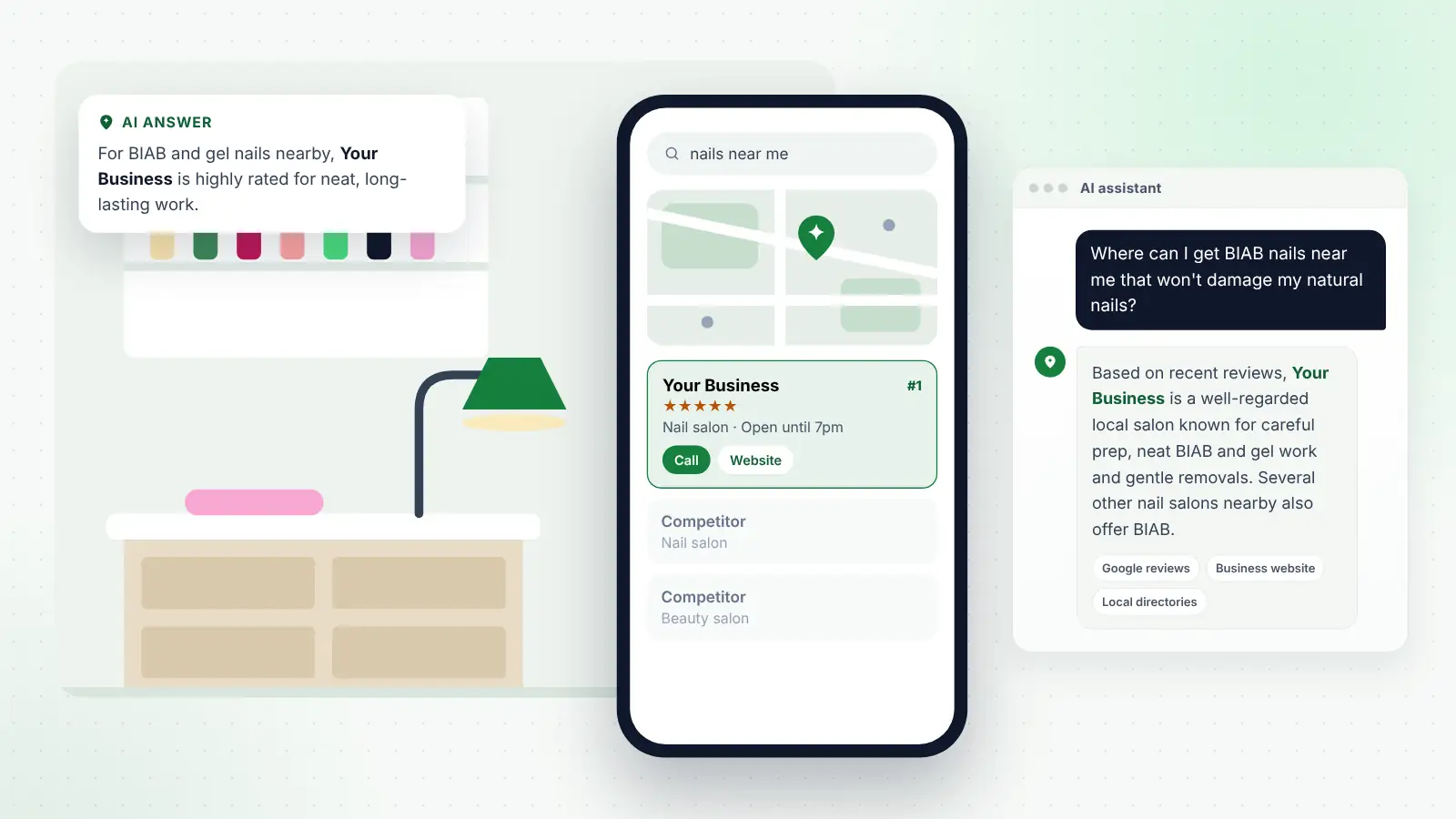
The Google Maps results, with their star ratings and photos, usually appear above ordinary website listings, and most clients choose from the first few salons they see.
Load your Google profile with real nail photos
Choose “Nail salon” as your primary category, and add secondary categories only if they genuinely apply. List every service with a short description and price, link your online booking and keep opening hours accurate, including holiday hours. Above all, post fresh photos of real work regularly. Clients want to see neat cuticle work, clean shapes and the styles you are best at.
Ask for a review while the polish is still drying
Reviews affect how high a new salon shows on the map and whether someone scrolling actually books. Ask clients at the end of their appointment, while they are admiring their nails, and give them a simple link or QR code at the station. Reviews that mention the service, the technician and how long the nails lasted help you appear for those specific searches. Reply to every review calmly and professionally, including the occasional critical one.
Match your details on Fresha, Treatwell and directories
Make sure your salon name, address, phone number and website are identical on Google, Apple Maps, Bing, Facebook, Instagram, booking platforms and local directories. Inconsistent details make it harder for search engines to trust that your information is correct.
Give each service its own page
Your website should have a clear page for each main service: what BIAB is and who it suits, how acrylic infills work, how long gel polish lasts, how removal works and what aftercare involves. Include prices, genuine photos and answers to common questions. This helps clients decide, and gives search engines something specific to match to each search.
Get mentioned by local bridal and beauty sites
Links from local websites — a wedding supplier directory, a local lifestyle blog, a town business directory or a charity event you supported — show search engines that you are a real, established business in the area.
A new nail salon’s visibility grows steadily rather than overnight, and a clear difference usually shows after three to six months. If you would rather spend your time at the nail desk, specialist local SEO for nail salons and nail technicians can look after your profile, listings, service content and links for you.
AI search: when clients ask an assistant where to get their nails done
More clients now ask AI assistants for recommendations before they book. Someone might ask ChatGPT “Where can I get BIAB near me that won’t damage my natural nails?”, ask Gemini for “a nail salon in [town] that does detailed nail art”, or ask Perplexity or Copilot which salons nearby are good for sensitive skin. For lots of these questions, Google also shows an AI Overview naming a few local salons.
These tools aim to give a confident, useful answer, so they draw on information they can find and cross-check across the web. For a nail salon, that usually means:
- Identical salon details on your Google profile, website, booking apps and beauty directories.
- Reviews that describe services, results and how long nails lasted, in clients’ own words.
- Clear service descriptions, including who each service suits, what to expect, removal and aftercare.
- FAQs that answer real questions, such as how long BIAB lasts, whether gels damage nails, or how you prevent allergic reactions.
- Mentions on reputable sites, such as local news, wedding directories, lifestyle blogs and industry awards.
People in marketing refer to this as AEO, or answer engine optimisation. The practical work overlaps with local SEO, but being specific matters even more. A salon whose website explains its approach to nail health, with reviews that mention gentle removals and long-lasting results, is much easier for an AI assistant to recommend for that question than one with a single “nails available” page. Keep claims measured and accurate — avoid promising that products are “allergy-free” or “completely safe” — because responsible, reliable information is what these tools and careful clients trust.
Frequently asked questions
Do I need a licence to open a nail salon?
In most of England there is no specific licence for nail treatments, although you will still need to meet health and safety, planning and business requirements. Most London boroughs require a special treatment licence for premises offering manicures and pedicures, and skin piercing treatments such as ear piercing need council registration or licensing in England, Scotland and Wales. Check with your local council before you open.
Do nail technicians need qualifications?
There is usually no legal requirement, but insurers expect recognised training for each service you offer, and clients increasingly ask about it. Level 2 or Level 3 nail services qualifications, plus product-specific training for the systems you use, are the usual starting point.
Can I rent out stations to self-employed technicians?
Yes, many salons do. The arrangement must genuinely reflect self-employment, with technicians controlling their own prices, hours and working methods, and each should have their own insurance. Take advice from an accountant and use HMRC’s employment status guidance.
What should I do if a client has a reaction to gel or acrylic?
Stop using the product on that client, remove it safely and advise them to see a pharmacist or GP, who can refer them for patch testing if needed. Record what happened, check that your application and curing process follows the manufacturer’s instructions, and let your insurer know if a claim is possible.
How long does it take for a new nail salon to get busy?
Building a loyal group of clients who rebook every three weeks usually takes a new salon several months. Setting up your Google profile, collecting reviews and publishing clear service pages before you open can shorten that period.
Final thoughts
Opening a nail salon combines skilled, detailed work with careful business planning. Check your council’s licensing rules, take ventilation and product safety seriously from day one, and make allergy prevention part of your routine rather than an afterthought. Price for profit, rebook every client before they leave, and choose a staffing model that suits the way you want to work.
Then make it easy for clients to find and trust you. A complete Google profile, a steady stream of reviews, clear service pages and consistent information across the web will help both search engines and AI assistants recommend your salon with confidence.