Car valeting is one of the more approachable businesses to start. You do not need a formal qualification, you can begin with a well-equipped van or even a car and trailer, and almost every street has cars that would benefit from a proper clean. At the other end of the scale, detailing work such as machine polishing, paint correction, ceramic coatings and paint protection film can command serious prices from owners who care about their cars.
The gap between those two ends is where most new businesses either find their footing or struggle. Hand car washes and cheap roadside operators set low price expectations, the weather can empty your diary overnight, and one careless mistake on a customer’s paintwork can cost more than a month’s profit. The businesses that last tend to be properly insured, careful about where their water goes, clear about what each package includes, and visible to local customers at the moment they search.
This guide covers the decisions and practical steps involved, from choosing between mobile and unit-based work to insurance, wash water rules, kit, pricing and building a steady stream of bookings online.
Key points
- Decide whether you will start mobile, in a unit, or both, and whether you are focusing on everyday valeting or higher-value detailing.
- Get insurance that covers damage to customers’ cars in your care, and motor trade road risks cover if you will drive or move them.
- Wash water containing detergent must not go into surface water drains, so plan for minimal-water methods, water collection or permitted foul sewer disposal.
- Price by named packages that reflect vehicle size and condition, and confirm paint correction and coating quotes after an inspection.
- A complete Google Business Profile with real before-and-after photos, steady reviews and clear service pages is what most customers see before they book.
In this guide
- Choose your model: mobile, unit-based or both
- Register and structure your valeting business
- Get the right insurance
- Understand the rules on wash water and run-off
- Choose your vehicle and equipment
- Build your skills before you charge for detailing
- Set valet and detailing prices that cover your time
- Local SEO: how customers find a valeter
- AI search: getting recommended by ChatGPT, Gemini and Google AI Overviews
- Win repeat work and fill quiet periods
- Frequently asked questions
- Next steps
Choose your model: mobile, unit-based or both
Mobile valeting
Most new valeters start mobile. You go to the customer’s home or workplace, which is convenient for them and keeps your overheads low. A well-organised mobile setup can handle maintenance washes, full valets, interior deep cleans and even machine polishing on dry days.
The trade-offs are weather, travel time and control. You are working outdoors, often on a driveway or street, without proper lighting, and you may be relying on your own water and power. Rain, frost and short winter days all limit what you can do, and travelling between jobs eats into the hours you can bill.
Unit-based detailing
A unit gives you shelter, lighting, a controlled environment and somewhere for customers to bring higher-value cars. Paint correction, ceramic coatings and paint protection film are much easier to do well indoors, because dust, damp and changing light all affect the finish and the curing of coatings.
A unit also adds rent, business rates, utilities and usually a longer lease commitment, so it tends to make sense once you have steady demand for detailing work. Before signing, check with the local council planning team whether vehicle cleaning is a permitted use for the unit, and ask the landlord and the water company about drainage.
Combining the two
Many established businesses run a mobile round for maintenance washes and valets while using a unit for correction and protection work. That mix gives you regular income from repeat customers and higher margins from detailing, but it needs careful scheduling so the van and the unit are both earning.
| Model | Best for | Strengths | Watch out for |
|---|---|---|---|
| Mobile only | Maintenance washes, full valets, interiors | Low overheads, convenient for customers | Weather, travel time, water and run-off |
| Unit only | Paint correction, coatings, PPF | Controlled conditions, higher-value work | Rent, rates, lease commitment |
| Mobile and unit | Growing businesses | Repeat income plus detailing margins | Scheduling, staffing two locations |
Register and structure your valeting business
Most valeters start as sole traders, which means registering for Self Assessment with HMRC and keeping records of income and expenses from the first job. Some choose a limited company from the outset, particularly if they plan to take on staff or expect to grow quickly. An accountant can help you weigh up the tax and admin differences for your situation.
Keep an eye on VAT. As soon as your taxable takings go over the £90,000 VAT registration threshold (the figure as of October 2026), you have to register and add VAT to your valets and coatings. Busy detailing businesses with high-value coating and PPF work can reach that level faster than you might expect, and it affects your pricing, so plan for it rather than finding out late.
A few other basics are worth sorting early:
- A separate business bank account so your records stay clean.
- Simple written terms covering cancellations, weather, access to water and power, and what happens if a car’s condition is worse than described.
- A booking system that takes deposits for longer jobs, sends reminders and records each car’s make, model and condition.
- A system for photographing every car before you start, including existing scratches, chips and wheel damage.
Tip
Photograph every car before you touch it, especially the paintwork and alloys. Clear, dated photos of existing damage are the simplest way to avoid disputes about marks that were already there.
Get the right insurance
Insurance for valeting is more specialised than many new starters realise, and a general public liability policy on its own is often not enough.
Public liability
Public liability insurance covers claims from members of the public for injury or damage to their property connected with your work, for example someone tripping over a hose or pressure washer lance on a pavement. It is not a legal requirement, but most customers, landlords and commercial clients expect it.
Damage to customers’ vehicles
This is the cover that matters most. Standard public liability policies commonly exclude damage to the vehicle you are actually working on, which is exactly the risk you face when machine polishing, using chemicals on trim or cleaning delicate interiors. Look for cover that specifically includes accidental damage to customers’ vehicles in your care, custody or control, and check the limit is high enough for the most valuable cars you are likely to handle.
Motor trade road risks
If you will drive customers’ cars at all, even moving one off a driveway to a better spot, collecting and delivering cars to your unit, or taking them through a car wash, your personal car insurance is unlikely to cover you. Motor trade road risks insurance is designed for driving vehicles you do not own in the course of your business. Speak to a specialist motor trade or valeting broker about how far you will drive customers’ cars and how many you will have at your premises at once.
Other covers to consider
- Employers’ liability insurance, which the law requires as soon as you take on a helper or employee, usually with at least £5 million of cover.
- Tools and equipment cover for polishers, pressure washers, extractors and stock, including when the van is parked overnight.
- Business use on your own van insurance, and declaring any modifications such as fitted water tanks or racking.
- Premises or contents cover if you take on a unit.
Read the policy wording, not just the summary, and ask your broker directly whether machine polishing, ceramic coating and PPF installation are covered, because some policies treat them differently from standard valeting.
Understand the rules on wash water and run-off
This is the area new valeters most often get wrong. Water from washing a car carries detergent, road grime, oil, brake dust and other contaminants. Surface water drains, the ones in streets and many driveways, usually run straight to local streams and rivers without treatment, so that dirty water must not go into them.
The government’s pollution prevention guidance for businesses, which covers England, lists vehicle washing as an activity that produces contaminated water, and says only clean water should go into a surface water drain. Contaminated water, which the guidance calls trade effluent, can go into the foul sewer only with permission from your water company; otherwise it should be kept for reuse, treated or removed by a registered waste carrier. It also notes that oil separators do not work properly when the water contains detergent from car washing.
What that means for a mobile valeter
- Use as little water as possible. Rinseless, waterless and low-water methods are increasingly common for maintenance washes and reduce run-off significantly.
- Avoid letting wash water run across a driveway into a gully or street drain. Water capture mats and a wet vacuum let you collect run-off and take it away.
- Do not empty buckets down a street drain. Dispose of dirty water only where you have permission to do so.
- Dilute products to the correct working strength and avoid strong traffic film removers and degreasers on jobs where you cannot control run-off.
- Wash very dirty vehicles, engine bays and commercial vehicles where there are proper facilities, rather than on a customer’s drive.
What that means for a unit
If you wash cars at a unit, you will usually need either a drainage arrangement that sends wash water to the foul sewer with your water company’s trade effluent consent, or a water recycling or collection system. Charges for trade effluent depend on volume and what is in it, and the consent may include conditions on the products you use. Ask the water company early, ideally before you sign a lease, because retrofitting drainage can be expensive.
Rules and enforcement differ slightly between England, Scotland, Wales and Northern Ireland, so check with the environmental regulator for your area if you are unsure.
Tip
Being able to explain how you deal with run-off is a genuine selling point. Commercial clients, business parks and managing agents may ask about it before letting a valeter work on their site.
Choose your vehicle and equipment
The van or trailer
A small or medium panel van is the most common choice for a mobile valeter. Things to think about:
- Payload. Water is heavy: roughly a kilogram per litre. A large water tank, pressure washer, generator, hose reels and stock can quickly approach a small van’s payload limit, so check the vehicle’s maximum authorised mass and weigh the loaded van if in doubt.
- Water and power. Decide whether you will carry your own water and power or use the customer’s. Carrying your own makes you independent but adds weight, cost and noise from a generator; using the customer’s is simpler but needs agreeing in advance.
- Racking and security. Secure racking keeps chemicals upright and kit organised, and good locks and insurance protect expensive equipment.
- Signage. A clean, clearly branded van parked outside a job is advertising on every street you work in.
Some valeters start with a car and trailer. Since December 2021, most car licence holders in Great Britain can tow a trailer up to 3,500kg maximum authorised mass without taking an extra test, though the total weight still has to stay within your vehicle’s towing limits.
Core kit
| Item | Typical cost | Notes |
|---|---|---|
| Pressure washer | £300–£1,200 | Petrol or electric, depending on your water and power setup |
| Water tank and pump | £200–£800 | Size it to your payload, not just your ambitions |
| Wet vacuum and carpet extractor | £200–£900 | Essential for interiors and capturing water |
| Dual action polisher | £150–£450 | The standard machine for enhancement and correction |
| Pads, towels and brushes | £200–£500 | Replace regularly; cheap towels cause marring |
| Chemicals and coatings | £300–£800 to start | Buy in larger sizes once you know what works |
| Lighting and paint depth gauge | £100–£500 | Needed for correction work and inspections |
These are rough guides only and prices vary widely between brands and suppliers.
Build your skills before you charge for detailing
Basic valeting can be learned quickly with practice, but machine polishing and paint correction carry a real risk of damage if done badly. Burning through clear coat on an edge or crease can turn a profitable job into an expensive respray.
Practical ways to build skills:
- Practise on your own cars, friends’ cars and scrap panels before charging anyone.
- Take a hands-on course in machine polishing and paint correction from an established training provider.
- If you want to install ceramic coatings or PPF, look at manufacturer training and approved installer programmes. Some products and warranties are only available through trained installers.
- Learn to use a paint depth gauge and to explain to customers what can and cannot be corrected.
Be honest about limits. Deep scratches through to primer, stone chips and failed lacquer usually need a bodyshop, and telling a customer that upfront builds far more trust than overpromising.
Set valet and detailing prices that cover your time
Pricing is where many valeters undersell themselves. A full valet can easily take three or four hours once you include setup and travel, and correction work can take one or more full days.
Use named packages
Named packages make it easier for customers to choose and easier for you to quote quickly. A typical ladder might be:
- Maintenance wash for regular customers, often every two or four weeks.
- Mini valet covering a safe exterior wash and a light interior tidy.
- Full valet including a thorough interior clean, upholstery or leather care and exterior protection.
- Enhancement polish to restore gloss and remove light swirls.
- Paint correction and coatings, quoted individually after an inspection.
Scale prices by vehicle size, and include a condition supplement for heavy pet hair, sand, mould or very soiled interiors. Price by the job, not by the hour, but know your own hourly rate so you can check every package covers your time, travel, products and wear on kit.
Build in deposits and weather terms
For any job longer than a couple of hours, and certainly for detailing, take a deposit when the customer books. Make your weather policy clear: whether you rebook automatically if it rains, and whether some services can only be done under cover.
Local SEO: how customers find a valeter
Most valeting enquiries start with a local search. Someone selling a car searches for car valeting near me, a new parent wants a car interior deep clean, a dog owner searches for pet hair removal from a car, and an owner who has just bought a car looks up ceramic coating near me or paint protection film cost. They look at the map results first, then photos and reviews, and contact two or three businesses that cover their area and look trustworthy.
That makes Google Maps visibility one of the most valuable things you can invest in. A valeter who appears in the top three on the map for their town tends to get more enquiries than one hidden lower down, even if the work is similar.
Build a Google profile that shows off your finishes
- Choose an accurate primary category, such as car detailing service, and add relevant secondary categories.
- If you are mobile, set yourself up as a service-area business, hide your home address and list the towns and postcodes you cover.
- Add every service you offer with a short description and, where possible, a guide price.
- Upload real before-and-after photos and short videos of your own work regularly. Generic stock images do nothing for trust.
- Keep opening hours accurate and add a booking link.
- Post updates for seasonal offers, maintenance plans or new services.
Earn steady, detailed reviews
Reviews are often the deciding factor for valeting, because customers are trusting you with something they care about. Ask every customer, ideally by message with a direct link soon after the job. Reviews that mention the car, the service and the result, for example a full interior valet on a family SUV or a ceramic coating on a new car, help both customers and search engines understand what you are good at. Reply to every review, including the occasional critical one, calmly and helpfully.
Use the same details on every motoring directory
Make sure your business name, phone number, website and service area match across your Google profile, website, Facebook and Instagram pages, and UK directories. Inconsistent details make it harder for Google to be confident about your business.
Build a website with service and area pages
Social media is good for showing work, but a website gives you something you control. Include a page for each main service, such as mobile valeting, interior cleaning, paint correction and ceramic coatings, with what is included, how long it takes, aftercare advice and guide prices. If you cover several towns, a genuinely useful page for each area you serve, with examples of local work, can help you appear in those places.
Get mentioned by car clubs and local sites
Links and mentions from relevant local websites help show Google you are an established business. Sponsoring a local sports team, working with car clubs, getting listed by local business groups and partnering with independent garages, dealers or bodyshops can all lead to genuine mentions. If you would rather have specialists handle the profile, content and links for you, our local SEO for car valeting and detailing businesses is built around exactly this kind of work.
Tip
Ask customers if you can photograph their car when you hand it back, with the number plate blurred or out of shot. A steady stream of fresh, real photos helps both customers and search engines see what you do.
AI search: getting recommended by ChatGPT, Gemini and Google AI Overviews
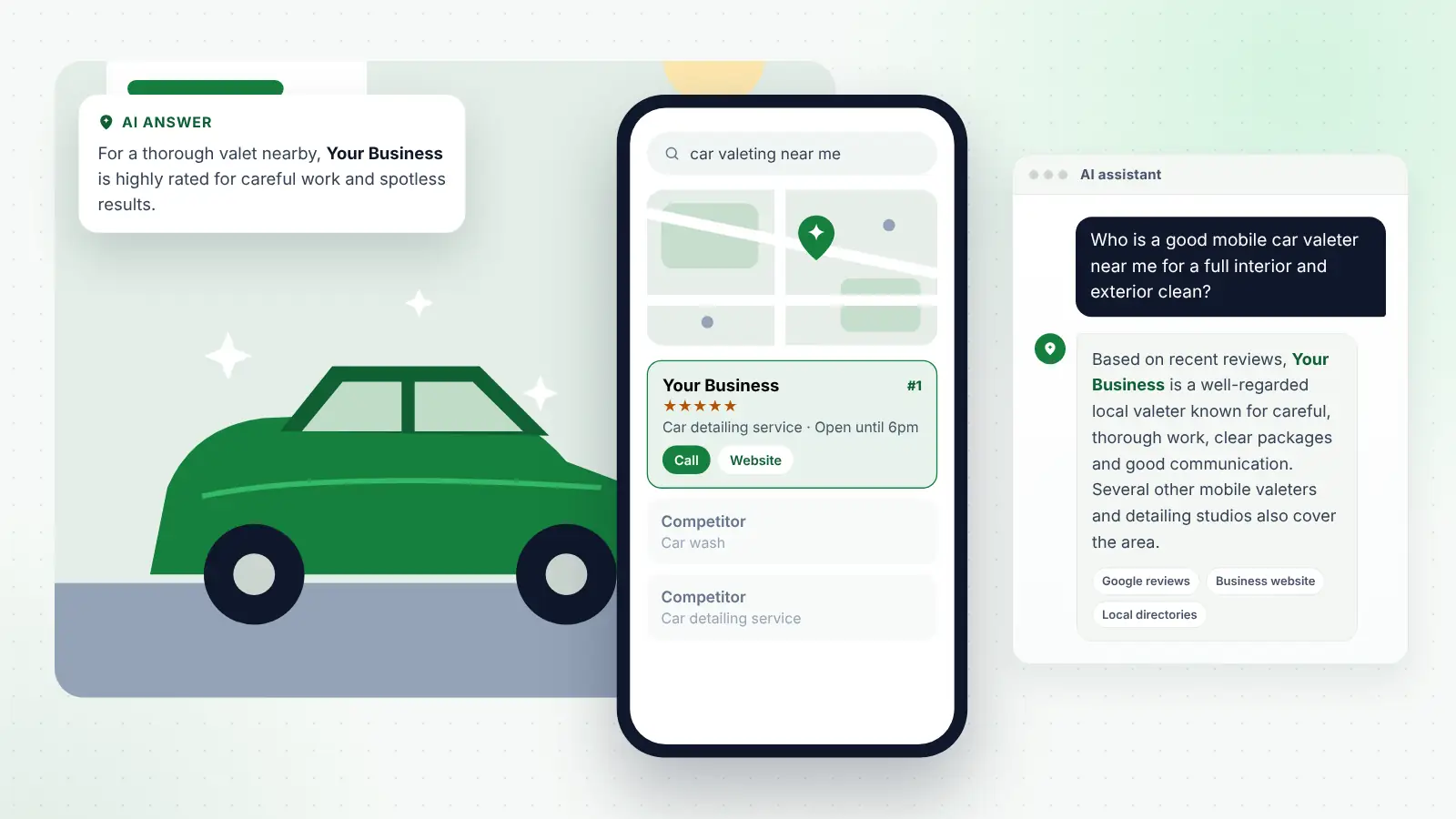
More and more drivers now ask an AI assistant who to trust with their car instead of scrolling through a page of results. They type questions into ChatGPT, Gemini, Perplexity, Microsoft Copilot or see answers in Google AI Overviews, such as:
- Who is a good mobile car valeter near me?
- What is the difference between a ceramic coating and wax, and who does coatings locally?
- How much does paint correction cost, and is it worth it on a five-year-old car?
- Can someone come to my office car park and valet my car while I work?
These tools do not have a secret list of preferred businesses. They draw on information that is available across the web and try to give an answer they can support. For a valeting or detailing business, the things that tend to matter are:
- Consistent information. Your name, area, services and contact details matching across your website, Google profile, directories and social media.
- Reviews. Plenty of genuine reviews that describe the work, on Google and other trusted platforms.
- Clear service descriptions. Plain explanations of what each package includes, who it suits and roughly what it costs, which makes it easy for an AI tool to match you to a question.
- Helpful FAQs. Answers to the questions customers actually ask, such as how long a coating lasts with proper care, what aftercare is needed, and whether you need access to water and power.
- Mentions on reputable sites. Being referenced by local news, business groups, car clubs and partner garages helps show you are a real, established business.
The practical work is largely the same as good local SEO: be clear, be consistent, collect reviews and explain your services properly. The difference is that AI tools tend to favour businesses whose information is easy to understand and corroborate across several sources, so a detailed, accurate website and a well-maintained profile matter even more.
Win repeat work and fill quiet periods
Valeting is seasonal. Spring and summer are usually busy, while winter brings rain, short days and cancellations. A few ways to smooth that out:
- Maintenance plans. Regular customers on a two or four-weekly wash bring predictable income and keep coated cars looking their best.
- Trade work. Independent garages, used car dealers, bodyshops and lease return companies often need cars cleaned and prepared, and the work is less dependent on the weather.
- Business and fleet contracts. Offices, business parks and companies with vans or pool cars can provide regular midweek work.
- Winter services. Interior deep cleans, odour treatments, underbody and wheel arch cleans after salty roads, and coatings booked into a unit all work in colder months.
- Gift vouchers. Valet and detailing vouchers sell well before Christmas and Father’s Day.
Book the next visit before you leave each job, and send a reminder a few days before it is due.
Frequently asked questions
Do I need a qualification to start a car valeting business?
No formal qualification is required to start valeting in the UK. However, training in machine polishing, paint correction and coating application is strongly recommended before you offer those services, and some coating and PPF products are only available through trained or approved installers.
Can I wash cars on a customer’s driveway?
You can work on a driveway, but you are responsible for where the wash water goes. Water containing detergent and grime must not run into surface water drains. Low-water or rinseless methods, water capture mats and collecting run-off for proper disposal all help you work responsibly.
What insurance does a mobile valeter need?
At a minimum, public liability insurance and cover for accidental damage to customers’ vehicles in your care, which is often excluded from standard policies. If you drive customers’ cars, you will also need motor trade road risks cover, and employers’ liability insurance becomes a legal requirement once you employ staff.
How much can I charge for a full valet?
Prices vary considerably by area, vehicle size and condition. Rather than copying a competitor, work out your own hourly costs including travel, products and equipment, then build packages that cover them with a margin. Higher-value services such as paint correction and coatings should always be quoted after inspecting the car.
Should I start mobile or take on a unit?
Most new businesses start mobile because it keeps costs low while you build a customer base and reviews. A unit tends to make sense once you have steady demand for detailing work that benefits from controlled conditions, and once you have checked planning use and drainage with the council and water company.
Next steps
Starting a car valeting or detailing business is less about the latest products and more about getting the fundamentals right: insurance that genuinely covers customers’ cars, a responsible approach to wash water, kit that suits your van and your services, and pricing that pays for your time. Get those in place, take a careful, professional approach to every car, and photograph your work as you go.
From there, steady visibility on Google Maps and in AI recommendations, backed by real reviews and clear information about what you do, is what turns good work into a full diary. Results build over months rather than weeks, so the earlier you start, the better placed you will be when the busy season arrives.