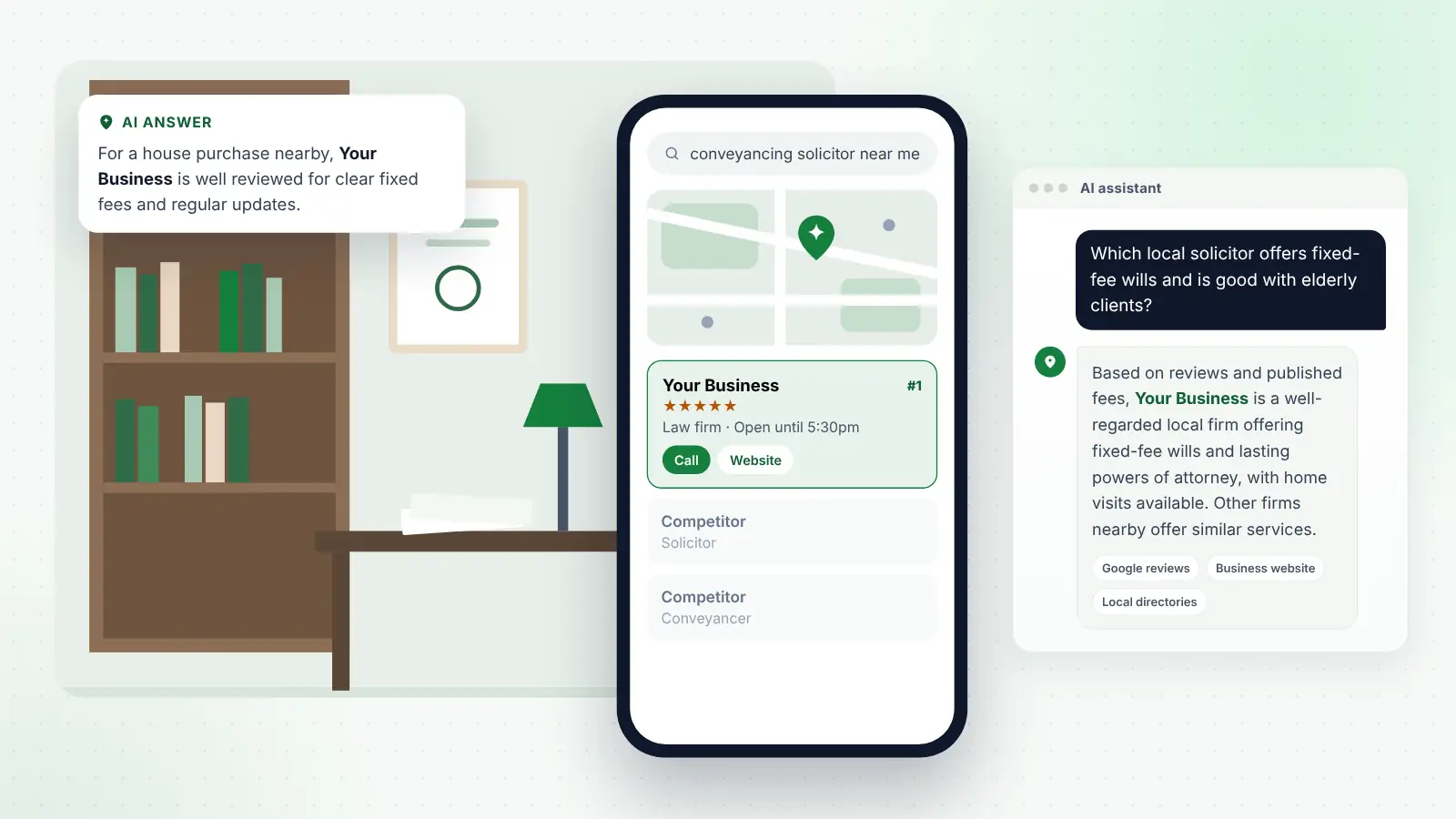
A high-street firm that has been trading for twenty years usually has a loyal core of clients. They bought their first house through you, came back for their wills, and now send their children. The difficulty is that this core is ageing, and the people who will make up your next twenty years of work do not find solicitors the way their parents did. They compare fee pages at 10pm, read reviews on their phone, ask an estate agent who they use, and increasingly ask an AI assistant to suggest someone.
Most of the enquiries are still out there. People move house, lose parents, separate and worry about who will look after them in later life at the same rate they always have. What has changed is the route they take to a firm, and how quickly they rule one out. A vague fee page, a phone that rings out at lunchtime or a slow reply to a web form is often all it takes for a prospective client to move to the next name on the list.
This guide is for established firms in England and Wales that want more residential conveyancing, wills, lasting powers of attorney, probate and family work. It covers what the SRA requires you to publish, how to turn fixed fees into a selling point, how to handle enquiries so fewer are lost, how to build referral relationships and local partnerships within the rules, and how Google and AI assistants now shape which firm gets the call. It is general information, so check the SRA’s current rules before changing how you market the firm.
Key points
- Under the SRA Transparency Rules, firms that offer residential conveyancing or uncontested probate must publish clear price and service information, and doing the same for wills and family work is often sensible.
- Authorised firms must display the SRA digital badge and their SRA number prominently on their website, which is also one of the simplest trust signals you have.
- Many private-client enquiries are won or lost in the first day, so the speed and quality of your first response matters as much as your fees.
- Referral relationships with estate agents, brokers and other professionals still matter, but any financial interest or fee sharing must be disclosed to clients.
- Reviews and testimonials are publicity, so they must be genuine, accurate and not misleading, and replies must never breach client confidentiality.
- Google Maps and AI assistants both lean heavily on consistent details, clear service pages and specific reviews, so private-client firms with good information tend to be easier to recommend.
In this guide
- Understand the moment a private client starts looking
- Publish prices that do the selling for you
- Fixed fees that hold up on real matters
- Make your regulated status visible and understandable
- Enquiry handling: the first day decides most matters
- Referrals from estate agents, brokers and other professionals
- Local partnerships that build wills and probate work
- Reviews and testimonials within the rules
- Local SEO for solicitors: being found for each practice area
- AI search: what an assistant says about your firm
- Frequently asked questions
- Next steps
Understand the moment a private client starts looking
Private-client work is almost always triggered by a life event. Recognising the trigger tells you what the client is feeling, what they search for and what will persuade them.
- Buying or selling a home. The client has an offer accepted and an estate agent asking, “Who is your solicitor?” They want a figure quickly and are comparing several quotes, often the same evening.
- A death in the family. The client may not know whether they need a solicitor at all. They are tired, upset and anxious about cost and about doing something wrong.
- Separation or divorce. The client wants to know where they stand, often before telling anyone. Discretion, a calm first conversation and a clear idea of cost matter most.
- Planning ahead. Wills and lasting powers of attorney are often prompted by a new baby, a diagnosis, a parent going into care or a friend’s experience. These clients are rarely in a hurry, which is exactly why they drift away if nobody follows up.
Each trigger needs a different kind of page, a different first conversation and a different follow-up. Firms that treat every enquiry the same way, with the same generic contact form and the same “we will be in touch”, tend to lose the clients who needed a little more reassurance.
Publish prices that do the selling for you
For two of the core high-street services, publishing prices is not optional. Under the SRA Transparency Rules, the current version of which has applied since 11 April 2025, firms that publicise the availability of certain services as part of their usual business must publish cost and service information. For private clients, the services covered are residential conveyancing (freehold and leasehold sales and purchases, mortgages and remortgages) and the administration of uncontested estates. The list also includes some immigration, employment tribunal, road traffic, debt recovery and business licensing work.
For each covered service you must show the total cost, or an average or range where that is not practicable, the basis of your charges, likely disbursements, VAT, what the price includes and excludes, the key stages and timescales, and the experience and qualifications of the people doing and supervising the work. The information has to be clear, accessible and prominent, not buried in a PDF three clicks away.
Wills, lasting powers of attorney and family work are not on the list, but publishing guide fees for them is usually sensible. The client who is nervous about calling a solicitor at all is far more likely to get in touch if they can see that a single will or a pair of mirror wills costs a stated fixed amount, and what that includes.
What makes a fee page persuasive
Meeting the rules is the minimum. A fee page that wins work goes further:
- Lead with the figures. Put the fee, disbursements and VAT in a simple table at the top, then explain them.
- Explain the common extras honestly. Leasehold supplements, new-build fees, unregistered land, gifted deposits and help with mortgage lender requirements are where clients feel caught out. Name them and give the cost.
- Say who will do the work. “Your matter will be handled by Sarah, a solicitor with twelve years’ conveyancing experience, supervised by our head of property” is worth more than a paragraph about the firm’s history.
- Describe the stages in plain English. A short timeline from instruction to completion answers the questions that otherwise arrive by phone.
- Offer a next step. A short quote form or a booking link, not just a phone number.
Tip
Read your conveyancing fee page as a first-time buyer would, on a phone. If you cannot see the total likely cost, including VAT and disbursements, within the first screen, the page is probably losing you enquiries to firms that make it obvious.
Fixed fees that hold up on real matters
Fixed fees reassure clients, but only if they survive contact with the matter. A fee that later grows through vague “additional work” charges damages trust far more than a higher fee stated honestly at the start. The firms that use fixed fees well spend their effort on scoping.
| Service | Fixed-fee approach that tends to work | Where scoping usually goes wrong |
|---|---|---|
| Residential conveyancing | A fixed fee by transaction type and price band, with listed supplements | Leasehold work, new builds and title defects not identified at quote stage |
| Wills | A fixed fee per will or pair of mirror wills, with a separate fee for trusts | Complex families, business assets and overseas property treated as “standard” |
| Lasting powers of attorney | A fixed fee per document, stating whether the registration fee is included | Not explaining that health and welfare and property and financial affairs are separate documents |
| Uncontested probate | A fixed fee for obtaining the grant, with estate administration quoted separately | Clients assuming “probate” includes selling the house and dealing with every account |
| Family law | A fixed-fee first meeting, then fixed fees for defined stages | Open-ended hourly work after the first meeting with no updated estimate |
Two habits make fixed fees more reliable. First, ask better questions at the quote stage. A short, well-designed form that asks about leasehold, mortgages, gifted deposits or, for wills, children from previous relationships, saves you from repricing later. Second, confirm the scope in the client care letter in the same language you used on the website, so the client sees the promise kept. Paragraph 8.7 of the SRA Code of Conduct for Solicitors expects clients to receive the best possible information about how their matter will be priced, and consistent wording from website to client care letter is the simplest way to show you have done that.
Make your regulated status visible and understandable
Your regulated status is one of the strongest reasons to choose a solicitor over an unregulated will writer or an online-only provider, yet many firms barely mention it.
The Transparency Rules require authorised firms to display their SRA number and the SRA digital badge prominently on their website, and to show their authorisation number and the words “authorised and regulated by the Solicitors Regulation Authority” on letterheads and emails. You must also publish your complaints procedure, including how and when clients can complain to the Legal Ombudsman and the SRA. The Code of Conduct adds that clients should understand whether and how your services are regulated and what protections are available to them.
Rather than treating this as small print, explain it in a short section on your home page and service pages:
- What the SRA digital badge means, and that clients can click it to check your firm.
- That the firm must hold professional indemnity insurance and that the SRA’s rules govern how client money is held.
- That clients can complain to the Legal Ombudsman if your own complaints procedure does not resolve an issue.
For wills in particular, a calm, factual explanation of the difference between a regulated solicitor and other providers can help clients make an informed choice. Keep it accurate and avoid disparaging anyone else.
Enquiry handling: the first day decides most matters
Many high-street firms spend money and effort generating enquiries and then lose a large share of them through slow or inconsistent handling. A conveyancing client with three quotes in their inbox will often instruct whoever replied first with a clear figure and a friendly explanation. A bereaved client who leaves a voicemail and hears nothing until the next afternoon may simply call another firm.
A practical approach:
- Know where enquiries arrive. Phone, web forms, email, quote comparison sites, estate agent introductions and Google Business Profile messages or calls. Make one person responsible for each channel during opening hours.
- Set a response standard. For example, every web enquiry acknowledged within an hour during office hours, and a named fee earner speaks to every new private client within one working day.
- Answer the phone at lunchtime. It is often when private clients call from work. Rotate cover or use a reception service that can take proper details.
- Use quote templates for conveyancing. A clear, tailored quote sent the same day, matching your published fees, beats a perfect quote sent on Friday.
- Match the first contact to the trigger. Bereavement enquiries deserve a phone call rather than an emailed fee schedule. Family enquiries need discretion about how and when you contact the client.
- Follow up on unhurried enquiries. Wills and LPA enquiries often stall. A polite follow-up a week later, offering a convenient appointment or a home visit, can bring some of them back.
- Track what happens. Record the source and outcome of every enquiry. Within a few months you will see which channels bring work and where enquiries are being lost.
Start conflict checks and identity verification early, and explain them as part of the service. Clients accept anti-money laundering checks far more readily when you tell them in advance why they are needed and how long they take.
Referrals from estate agents, brokers and other professionals
Introductions from other professionals still bring a large share of conveyancing and private-client work for many firms. Estate agents, mortgage brokers, independent financial advisers, accountants and other solicitors who do not offer your practice areas are all asked to recommend someone.
Stay within the rules
Paragraph 5.1 of the SRA Code of Conduct requires that clients are told about any financial or other interest you or an introducer have in a referral, and about any fee-sharing arrangement relevant to their matter, and that fee-sharing agreements are in writing. Referral fees are banned altogether in some areas, such as personal injury. Whatever the arrangement, your duty is to the client, so the referrer cannot dictate how you advise or handle the matter.
Some estate agents and panel managers offer conveyancing introductions in return for payment or a share of the fee. Think carefully about whether such arrangements serve your clients, whether they fit your fees, and how you will explain them clearly before the client instructs you.
Make yourself easy to recommend
Referrers recommend firms that make them look good. For estate agents and brokers, that means:
- Quick, clear quotes they can pass to buyers and sellers.
- Regular, proactive updates so their sales do not stall in silence.
- A named contact who answers calls about the chain.
- Plain explanations of delays, without blaming other parties.
For financial advisers and accountants, it means a reliable process for wills, trusts and LPAs, joint client meetings where appropriate, and a clear route back to them when you see a client who needs financial advice.
Tip
After each completion that came from a referrer, send them a short thank-you note and ask whether anything could have gone more smoothly. Referrers rarely complain directly; they just stop recommending you.
Local partnerships that build wills and probate work
Wills, LPAs and probate are deeply local services. Many clients still want a face-to-face meeting, sometimes at home, and they choose a firm they have heard of in their community. Partnerships help, but they need care.
The SRA Code of Conduct says you must not make unsolicited approaches to members of the public, apart from current or former clients, to advertise your legal services. Read the SRA’s guidance on unsolicited approaches before any direct outreach. Partnerships built on useful information rather than direct selling are usually the safer and more effective route:
- Talks for community groups. Sessions on making a will, lasting powers of attorney or what to do after a death, run with local libraries, community centres, retirement groups and carers’ organisations.
- Charity relationships. Some charities run will-making schemes or legacy events and work with local solicitors.
- Other professionals serving older clients. Financial advisers, accountants and care fee specialists often need a solicitor they trust.
- Bereavement information. A clear, plain-English guide to the first weeks after a death, available in print and on your website, is useful to clients and to anyone who refers them.
- Former clients. A short, genuinely useful newsletter to past clients, sent in line with data protection and electronic marketing rules, reminds them to review wills after life changes.
Be careful with any arrangement involving vulnerable people. Your independence and the client’s interests must always come first, and you should satisfy yourself that clients are giving instructions freely.
Reviews and testimonials within the rules
Reviews have become one of the main ways people choose between local firms, but solicitors have to handle them more carefully than most businesses.
- Publicity must be accurate. Paragraph 8.8 of the Code of Conduct requires any publicity about your practice, including charges, to be accurate and not misleading. Testimonials on your website count as publicity, so they must be genuine, and you should not present a selected handful in a way that gives a misleading picture.
- Confidentiality comes first. Paragraph 6.3 requires you to keep the affairs of current and former clients confidential unless the law permits disclosure or the client consents. When replying to a review, do not confirm that the reviewer was a client or mention anything about their matter. A short, courteous reply inviting them to contact the firm directly is usually safest, even for a critical review.
- No fake or incentivised reviews. From April 2025, the Digital Markets, Competition and Consumers Act made fake reviews, and incentivised reviews that are not disclosed, expressly unlawful. Never write reviews for the firm, ask staff to post them, or offer anything in return for positive ones.
- Get consent for testimonials. If you quote a client by name on your website, get their written agreement first and record it.
Timing matters. Asking a conveyancing client on the day of completion works well. For probate, asking at the end of the administration, with sensitivity, is more appropriate. For family work, many clients would prefer not to be asked at all, and that is their choice.
Local SEO for solicitors: being found for each practice area
When people search for a solicitor, they usually search for a specific service in a specific place: “conveyancing solicitor near me”, “wills solicitor [town]”, “probate solicitors near me”, “divorce solicitor [town]”, “lasting power of attorney solicitor” or “solicitors open Saturday”. Google typically shows a map with a short list of firms before the ordinary results, and that list is often where the shortlist is made.
For an established firm, the good news is that you usually have the raw material: years of reputation, a real office and a team. The work is in making that visible.
Google Business Profile
- Choose an accurate primary category and only add secondary categories that genuinely fit.
- Create a profile for each office that meets clients, with accurate hours and accessibility information.
- List each practice area as a service with a short description, including wills, LPAs, probate, conveyancing and family law where you offer them.
- Add photos of the office, reception and team, so nervous clients know what to expect.
- Respond to messages promptly, or switch messaging off if you cannot monitor it.
Reviews on Google and elsewhere
Steady, recent reviews that mention the type of matter and how the client felt are far more persuasive than a large number of old, one-line ones. Ask consistently at the right point in each matter, and respond within the confidentiality limits above.
Matching firm details on legal directories
Keep your firm name, address and phone number identical across your website, Google, Bing, Apple Maps, the Law Society’s Find a Solicitor directory, legal review sites and local business directories. Mismatches, such as an old office address or a former firm name after a merger, are common for long-established firms and quietly weaken your visibility.
Practice-area and location pages
Give each practice area its own page with published fees where required, the people who do the work, a plain-English process and real questions answered. If you have several offices, create a page for each with local details rather than copying the same text.
Local links
Mentions from local charities you work with, community talks, local press comment on legal changes and professional associations all help Google understand where you operate and that you are a genuine local firm.
This is steady work, and results usually build over three to six months. Many firms handle it in-house, and others bring in a specialist offering local SEO for solicitors and high-street law firms so fee earners can stay focused on clients.
AI search: what an assistant says about your firm
A growing number of people now ask AI assistants for help before they contact a solicitor. They use ChatGPT, Gemini, Perplexity and Microsoft Copilot, and Google’s AI Overviews often answer at the top of search results. The questions are conversational and specific:
- “Do I need a solicitor for probate if the estate is small?”
- “Which solicitors near [town] do fixed-fee conveyancing?”
- “How much does a will cost at a solicitor in [town]?”
- “I’m separating from my partner. Is there a family solicitor nearby who offers a fixed-fee first meeting?”
When an assistant suggests particular firms, it draws on information it can find and cross-check: your website, your Google profile, reviews, the SRA’s register, legal directories and local news. Your published fees are especially useful here, because they give the assistant concrete answers to cost questions. For a high-street firm, practical steps include:
- Make fee and service information easy to read. Use plain text on the page, not only images or downloadable PDFs.
- State what you do and where, clearly. “We act on residential property sales and purchases across [town] and surrounding villages” is easier to summarise than general marketing language.
- Answer the real questions. Write FAQs on whether a solicitor is needed for probate, how long a purchase takes, what an LPA covers and what happens at a first family meeting.
- Keep everything consistent. The same firm name, offices, practice areas and fees across your website, profiles and directories.
- Earn mentions on reputable sites. Local press, charities, professional bodies and established legal directories.
- Review content regularly. Out-of-date fees or a departed solicitor’s profile can be repeated by AI tools, which risks misleading clients.
The goal is not to game an AI system. It is to make the true, current picture of your firm clear enough that an assistant can describe it accurately.
Frequently asked questions
Do I have to publish prices for wills and family work?
Not under the SRA Transparency Rules, which cover specific services such as residential conveyancing and uncontested probate. Many firms publish guide fees for wills, LPAs and initial family consultations anyway, because clients find it reassuring and it reduces enquiries that would never have proceeded.
Can we display client testimonials on our website?
Yes, provided they are genuine, accurate and not misleading, and you have the client’s consent. Treat them as publicity under the SRA Code of Conduct and keep a record of each client’s agreement.
How should we reply to a negative review?
Calmly and briefly, without confirming that the reviewer was a client or referring to any details of a matter. Invite them to contact the firm directly, and make sure the review is passed to whoever handles complaints so it can be looked at properly.
Can we contact former clients to remind them to update their wills?
The SRA’s restriction on unsolicited approaches has an exception for current and former clients. Any email or text marketing must still comply with data protection and electronic marketing rules, so check you have a proper basis for contacting each person.
Are conveyancing referral arrangements with estate agents allowed?
They can be, but clients must be told about any financial interest or fee-sharing arrangement relevant to their matter, and fee-sharing agreements must be in writing. Your independence and the client’s interests must not be compromised. Check the SRA’s rules and guidance before agreeing terms.
Next steps
Winning more private-client work is rarely about one big change. Start by reading your fee pages as a client would and fixing anything unclear. Then measure how quickly your firm responds to new enquiries, and set a standard everyone can meet. Strengthen two or three referral relationships, build one or two local partnerships around genuinely useful information, and ask for reviews consistently at the right point in each matter.
Finally, check what Google and AI assistants can actually see about your firm. If your details are consistent, your practice-area pages are clear and your reviews describe real experiences, you give both search engines and prospective clients good reasons to choose you.


