Plumbing is one of the few trades where demand never really goes away. Pipes leak, boilers fail, taps drip and bathrooms get replaced whatever the economy is doing. That steady demand is why so many employed plumbers and heating engineers eventually think about going it alone — more control over the diary, the type of work and, in time, the income.
Running a plumbing business is a different job from being a good plumber, though. You become responsible for registrations, insurance, tax, pricing, chasing invoices and, crucially, making sure the phone rings. Plenty of skilled tradespeople struggle in their first year not because of their workmanship but because they underestimated the business side.
This guide walks through the practical steps of starting a plumbing business in the UK: the registrations you genuinely need, how to structure the business, what it costs to get going, how to price, and how to get found by local customers on Google and in AI assistants. It is written for people setting up on their own or with one or two others, not for large contractors.
Key points
- Anyone carrying out gas work must be on the Gas Safe Register, both as a business and as an individual engineer, with valid ACS assessments for each appliance type.
- Water regulations, unvented hot water (G3) competence and building regulations notification all affect what plumbing work you can sign off yourself.
- Decide early whether you will trade as a sole trader or limited company, and register with HMRC on time.
- Startup costs depend mostly on your van, tools and training; many plumbers start lean and add equipment as work grows.
- Local SEO and AI search visibility matter more in plumbing than most trades because so many jobs are urgent and go to the first credible business a customer finds.
In this guide
- Is starting a plumbing business right for you?
- Qualifications, registrations and the rules that apply
- Setting up the business properly
- How much does it cost to start a plumbing business?
- Pricing your work and writing quotes
- Finding your first customers
- Local SEO for plumbers: getting found on Google Maps
- AI search: how customers ask assistants for a plumber
- Growing beyond the first year
- Common mistakes new plumbing businesses make
- Frequently asked questions
- Next steps
Is starting a plumbing business right for you?
Before spending money on a van and livery, be honest about what kind of business you want. Plumbing covers a wide range of work, and the day-to-day reality of each is quite different:
- Emergency and reactive plumbing — leaks, blockages, burst pipes, no hot water. Unpredictable hours, urgent customers, good margins on call-outs, but tiring if you are the only one answering the phone.
- Heating and boilers — servicing, repairs and installations. Requires Gas Safe registration, but offers repeat work and higher-value jobs.
- Bathroom and kitchen installations — planned projects that are booked weeks ahead. Better for diary planning, but you need to manage tiling, electrics and other trades.
- Landlord and letting agent work — a steady stream of smaller jobs and annual gas safety checks, with slower payment terms.
Most successful small firms start with a mix and narrow their focus once they see which work they enjoy and which is most profitable. It also helps to have a few months of personal expenses saved before you leave employment, because cash flow in the first quarter is rarely smooth.
Qualifications, registrations and the rules that apply
There is no single “plumbing licence” in the UK. Instead, different types of work are controlled by different regulations and schemes. Getting this right protects your customers, keeps you legal and is increasingly something customers check before they book.
Training and qualifications
Most plumbers qualify through an apprenticeship or a recognised Level 2 and Level 3 plumbing and heating qualification, combined with on-site experience. Short courses that promise to make you a fully qualified plumber in a few weeks rarely give you the competence or the evidence that schemes and insurers expect, so be cautious if you are retraining.
Gas Safe registration
If you will work on gas appliances or pipework, registration with the Gas Safe Register is a legal requirement. Both the business and each engineer working for it must be registered, and the register covers Great Britain, Northern Ireland, the Isle of Man, Jersey and Guernsey. The Registered gas engineer entry on the government’s regulated professions register sets out the basics.
To register, engineers need to pass ACS (Accredited Certification Scheme) assessments for the specific work they do — a core gas safety assessment plus appliance categories such as boilers, cookers or fires. You can only work on the appliance types listed on your registration, so think about which categories you need before booking assessments. Your registration card shows these, and customers are entitled to ask to see it.
When you install a new gas boiler, the work must also be notified under building regulations. Gas Safe registered businesses usually do this through the register, and the customer then receives a compliance certificate. If you plan to take on landlord work, remember that landlords need an annual gas safety check on their appliances, which only a Gas Safe registered engineer can carry out.
Water regulations and approved contractor schemes
All plumbing connected to the mains water supply must meet the Water Supply (Water Fittings) Regulations 1999 in England and Wales (with equivalent rules in Scotland and Northern Ireland). Some installations must be notified to the water company before work starts.
Joining an approved contractor scheme, such as those listed on WaterSafe, has practical benefits. Approved contractors can issue a certificate confirming work meets the regulations, and for many types of job they do not need to give the water company advance notice, which avoids delays. Membership typically involves evidence of training, insurance, a complaints procedure and periodic checks of your work.
Unvented hot water systems (G3)
Unvented hot water cylinders store water at mains pressure and can be dangerous if installed incorrectly. In England and Wales, building regulations Part G (requirement G3) require that they are installed only by a competent person, which in practice means holding a recognised unvented hot water qualification. The installation must also be signed off, either through a competent person scheme or by notifying local building control. If you plan to fit system boilers or replace cylinders, this qualification is worth getting early.
Building regulations and competent person schemes
Some plumbing and heating work is notifiable under building regulations. Joining a competent person scheme for heating and hot water lets you self-certify that work rather than arranging an inspection for each job. Bathroom work can also touch on Part P (electrical safety in dwellings) if you add or alter electrical circuits — for example, a new electric shower circuit. Unless you are registered to self-certify electrical work, use a registered electrician for that part and make sure the certificate goes to the customer.
Tip
Make a simple one-page list of your registrations, registration numbers and renewal dates. You will need it for your website, quotes, insurance renewals and online listings, and it stops anything lapsing by accident.
Setting up the business properly
Sole trader or limited company
Most plumbers start as sole traders because it is simple: you register for Self Assessment with HMRC and keep records of income and expenses. A limited company separates your personal and business finances and can be more tax-efficient at higher profit levels, but it brings more paperwork and accountancy costs. An accountant who works with tradespeople can model both options using your expected income.
If you become a sole trader, register for Self Assessment by 5 October after the end of the tax year in which you started trading. Making Tax Digital for Income Tax is also being phased in from April 2026 for sole traders with qualifying income above £50,000, falling to lower thresholds in later years, so choose bookkeeping software that supports it.
VAT
You must register for VAT if your taxable turnover goes over £90,000 in any rolling 12-month period. Many plumbers stay below this at first. Be aware that materials count towards turnover, so a busy installation business can reach the threshold sooner than expected. Keep a running total and talk to your accountant well before you get close.
Insurance
At a minimum, most plumbers carry:
- Public liability insurance — covers damage or injury you cause to customers or the public. A leak from a failed fitting can cause significant damage, so do not under-insure.
- Employers’ liability insurance — a legal requirement as soon as you employ staff, with cover of at least £5 million.
- Tools and van insurance — your van needs business-use cover, and tool theft from vans is common.
- Personal accident or income protection — worth considering, because if you cannot work, the business earns nothing.
How much does it cost to start a plumbing business?
Costs vary a great deal depending on whether you already own tools and a van, and which registrations you need. The figures below are rough guides only and will differ by area and supplier.
| Item | Typical cost | Notes |
|---|---|---|
| Van | £8,000–£20,000 | A good used van is fine to start; leasing spreads the cost |
| Tools and equipment | £2,000–£6,000 | More if you need flue gas analysers, press-fit tools or drain equipment |
| Gas assessments and registration | Varies | Check current ACS and Gas Safe fees before budgeting |
| Insurance | A few hundred to over £1,000 a year | Depends on cover levels and the work you do |
| Van signage | £300–£1,500 | From simple vinyl to a full wrap |
| Website and branding | £0–£2,000 | A simple, clear site is better than an expensive one nobody visits |
| Accounting software | Monthly subscription | Choose one that supports Making Tax Digital |
| Starting stock | £500–£2,000 | Common fittings, valves, washers and consumables |
Keep a buffer for slow weeks, late-paying customers and unexpected repairs. Running out of cash is a more common reason for small trade businesses failing than a shortage of skill.
Pricing your work and writing quotes
Pricing is where many new plumbers go wrong. Undercharging to win work feels safe, but it leaves no margin for travel time, quoting, admin, van costs and the days when nothing comes in.
- Work out your true hourly cost. Add up annual costs (van, insurance, fuel, tools, software, phone, registrations, your target salary) and divide by the number of hours you can realistically bill — usually far fewer than the hours you work.
- Decide on a call-out structure. Many plumbers charge a fixed call-out fee covering the first hour, then hourly or per-job rates after that. Be clear about out-of-hours supplements.
- Use fixed prices for common jobs. Customers like certainty for tap replacements, toilet repairs or boiler services, and fixed prices reward you for working efficiently.
- Quote in writing. Itemise labour and materials, say what is excluded, state your guarantee and set a validity period.
- Send quotes quickly. Homeowners comparing two or three plumbers often go with whoever responds first with a clear, professional quote.
Tip
Publishing guide prices for your most common jobs on your website — even as “from” prices — filters out people looking for the cheapest possible quote and gives AI assistants accurate information to pass on.
Finding your first customers
In the early months, work usually comes from a mix of sources: people you already know, previous employers passing on overflow, local builders and kitchen or bathroom fitters needing a reliable plumber, letting agents, and trade directories. Pay-per-lead platforms can fill gaps, but they often send the same job to several businesses and the costs add up.
The most valuable long-term source of work is customers finding you directly — on Google Maps, on your website, through reviews and, increasingly, through AI assistants. That takes a few months to build, so start on it from the first week rather than waiting until the diary goes quiet.
Local SEO for plumbers: getting found on Google Maps
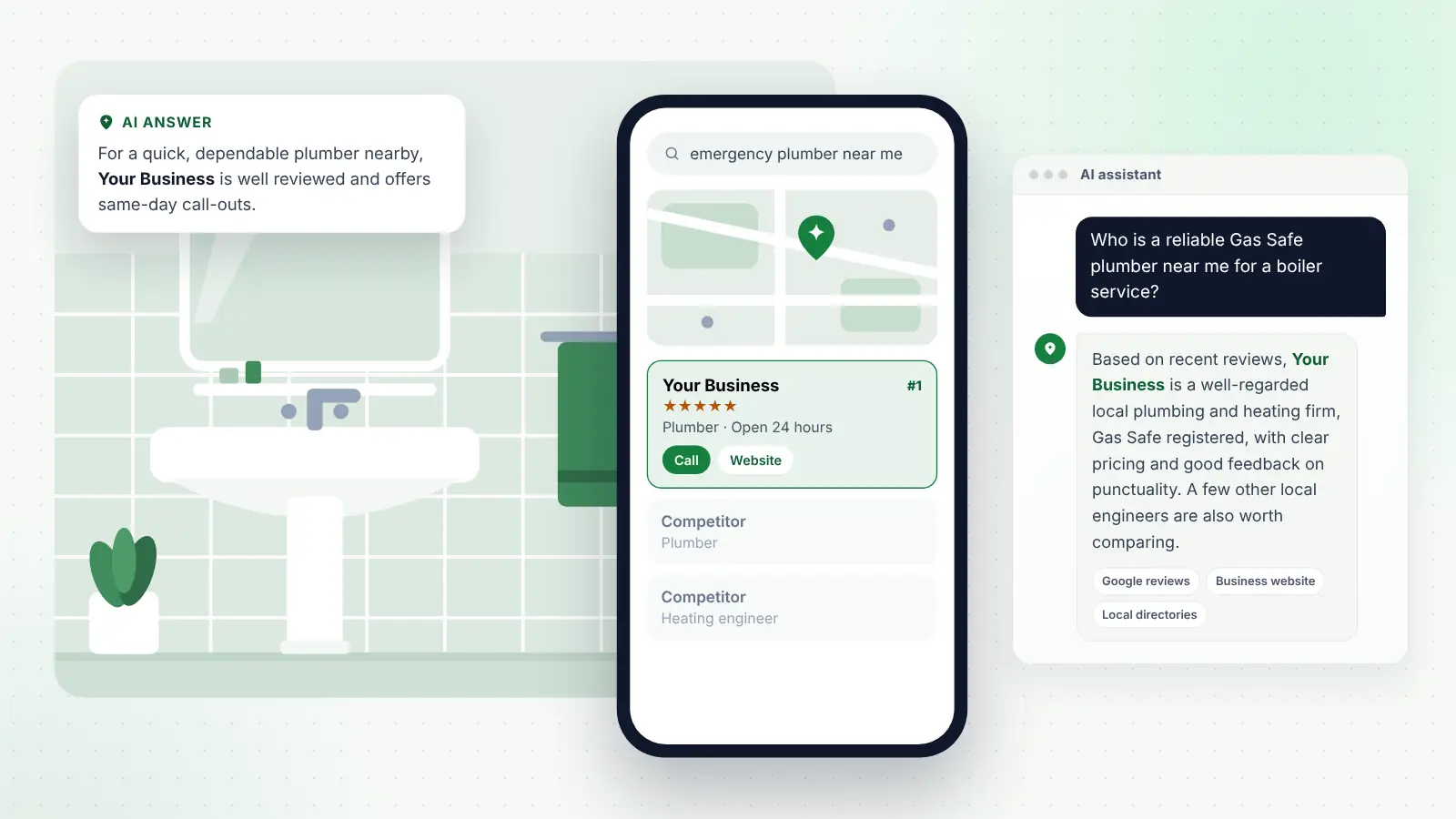
When someone has water coming through the ceiling, they do not spend twenty minutes researching. They search on their phone, look at the map results, and call one of the first two or three businesses that look credible. Local SEO is the work of making sure your business is one of those.
Typical searches include “emergency plumber near me”, “plumber in [town]”, “boiler repair near me”, “Gas Safe engineer [town]”, “blocked toilet plumber” and “bathroom fitters near me”. Each represents a slightly different type of customer, and the businesses that win them are usually those with the most complete and trustworthy online presence.
Set up your Google Business Profile properly
Your Google Business Profile is the listing that appears on Google Maps and in local results. It is free, and it is the single most important part of local visibility for a plumber.
- Choose the right categories. Your primary category should reflect your main work (for example “Plumber”), with secondary categories for other genuine services such as heating or boiler work.
- Set it up as a service-area business if you work from home. Your address stays hidden, and you list the towns or postcodes you cover. Be realistic — listing a whole county rarely helps.
- List every service you offer, with short descriptions, so Google can match you to specific searches.
- Keep hours accurate. Only say “Open 24 hours” if you genuinely answer calls at 3am. Customers who get no answer leave poor reviews.
- Add real photos of your van, your team and completed work. Stock images do nothing for trust.
Build a steady flow of reviews
Reviews influence both where you appear on the map and who customers choose to call. Recency matters as much as total count. Ask every customer, ideally by text with a direct review link on the evening the job is finished. Reviews that mention the job (“replaced our combi boiler”, “fixed a leak under the kitchen sink”) and the area help you appear for those specific searches. Never write fake reviews or offer incentives for them — it breaches Google’s policies and UK consumer law.
Keep your details consistent everywhere
Your business name, phone number and service area should be identical on your website, Google profile, social media and directories such as Checkatrade, Yell or Which? Trusted Traders. These consistent mentions, known as citations, help Google confirm that you are a real, established local business.
Give your website service and area pages
A one-page website with a phone number is better than nothing, but a site with separate pages for your main services (boiler servicing, emergency plumbing, bathroom installations) and the main towns you cover gives Google and customers much more to work with. Each page should explain what you do, roughly what it costs, how quickly you can attend and which registrations apply. Make sure it loads quickly on a phone and the number is tappable.
Earn local links and mentions
Links from local websites — a sponsored youth football team, a local business association, a builder you partner with, a community news site — signal that you are part of the area. A handful of genuine local links is worth far more than a pile of low-quality directory links.
All of this takes consistent effort over months, and results typically build over three to six months rather than overnight. If you would rather spend your time on the tools, specialists who provide SEO for plumbers and heating engineers can handle the profile, listings, content and links for you on a monthly basis.
AI search: how customers ask assistants for a plumber
A growing number of homeowners now ask AI assistants for help rather than typing a short search. Someone might ask ChatGPT, Gemini, Perplexity or Microsoft Copilot “Who’s a good Gas Safe engineer near me who can service a Worcester Bosch boiler?” or “My combi boiler is showing an F28 error — is it worth repairing, and who can fix it locally?” Google’s AI Overviews also now appear above many search results, summarising options before the customer sees the map.
These tools do not pick businesses at random. They tend to draw on information that is consistent across the web: your Google profile, your website, reviews on several platforms, directory listings and mentions on reputable local or trade sites. Answer engine optimisation (AEO) is the practice of making that information clear, accurate and easy for AI tools to use.
For a plumbing business, practical steps include:
- Describe your services in plain language. “We service, repair and install gas boilers, including combi and system boilers, across [towns]” is far easier for an AI tool to understand than a vague tagline.
- State your registrations clearly. Mention your Gas Safe registration, unvented qualification and any water scheme membership on your website and profiles, worded the same way each time.
- Add a genuine FAQ section. Answer the questions customers actually ask: how quickly you can attend, whether you charge a call-out fee, which boiler brands you work on, whether you offer guarantees.
- Collect reviews on more than one platform. AI assistants often reference what customers say about a business across several sites, not just Google.
- Get mentioned on trusted sites. Local news features, trade body directories and supplier “find an installer” listings all help confirm who you are and what you do.
The aim is not to trick an AI tool into recommending you. It is to make sure that when it looks for a trustworthy plumber in your area, the information it finds about you is complete, consistent and positive.
Growing beyond the first year
Once the basics are working, the most profitable growth usually comes from repeat and referral work rather than constantly finding new customers.
- Service reminders. Send customers a reminder a few weeks before their annual boiler service is due. It fills quiet months and leads naturally to repairs and replacements.
- Landlord and agent accounts. Annual gas safety checks and ongoing repairs provide predictable work, though agree payment terms upfront.
- Trade partnerships. Kitchen fitters, builders and property developers often need a reliable plumber they can call repeatedly.
- Specialisms. Heat pumps, underfloor heating or high-end bathrooms can command better margins. Heat pump installations funded through government schemes generally require MCS certification, so research the requirements before you commit.
- Your first hire. Many plumbers take on an apprentice or a second engineer once they are turning work away regularly. Check your insurance, set up payroll and plan how you will supervise quality.
Common mistakes new plumbing businesses make
- Pricing too low and then struggling to raise prices with existing customers.
- Letting registrations or ACS assessments lapse while busy.
- Not putting quotes and terms in writing, then disputing extras later.
- Relying entirely on one lead platform or one builder for work.
- Leaving the Google Business Profile half-finished, with no photos or reviews.
- Mixing personal and business money, which makes tax returns painful.
- Ignoring marketing when busy, then facing an empty diary two months later.
Tip
Block out one hour every Friday for admin: invoices, review requests, a quick update to your Google profile and next week’s quotes. Small, regular habits beat occasional bursts of effort.
Frequently asked questions
Do I need to be Gas Safe registered to start a plumbing business?
Only if you will work on gas appliances, gas pipework or flues. Many plumbers start with general plumbing, bathrooms and drainage and add gas later. However, it is illegal to carry out gas work without registration, and much of the higher-value heating work requires it, so most plumbers who want to grow do register eventually.
How long does it take to get established?
It depends on your existing contacts and how much effort you put into getting found. Some plumbers fill their diary within weeks through word of mouth and previous employers. Building steady enquiries from Google and AI assistants usually takes three to six months of consistent work on your profile, reviews and website.
Can I run a plumbing business from home?
Yes. Most small plumbing businesses are run from home with a van, and Google lets you set up a service-area profile that hides your address. Check whether your mortgage, tenancy or home insurance has conditions about running a business from home, especially if you store stock there.
Should I join a trade directory like Checkatrade?
It can help, especially in the early months. Directories bring some work directly, provide a place to collect reviews and act as useful citations for local SEO. Compare the membership costs against the work they realistically bring in your area, and do not rely on them alone.
What is the best way to get more boiler installation work?
Make boiler installations a clear, separate service on your Google profile and website, with photos of completed installs and reviews that mention them. Servicing customers’ boilers every year also builds trust, so when a boiler does need replacing, you are the first person they ask.
Next steps
Starting a plumbing business is very achievable if you approach it methodically. Get your registrations in order first, choose a sensible business structure, budget realistically and price your work so it actually pays. Then build your visibility from day one — a complete Google Business Profile, steady reviews, a clear website and consistent information across the web — so that when local customers search or ask an AI assistant for a plumber, your name is one of the first they see.