When someone needs a plumber, a hairdresser or somewhere for lunch, they rarely scroll through pages of results. They type a short search into Google or Maps, glance at the three businesses shown on the map, read a few reviews and make a decision. Local SEO is the work of making sure your business is one of those options, and that what people see when they get there persuades them to call, book or visit.
The good news for small businesses is that local search is one of the few areas of marketing where a well-run independent can compete with much larger firms. Google wants to show the most useful nearby option, not the one with the biggest budget. The less good news is that there is a lot of outdated advice around, and plenty of shortcuts that can do real damage to your listing.
This guide explains how local rankings actually work in the UK, what matters most, what you can safely do yourself, and how long it tends to take. It also covers the growing role of AI assistants, which now answer many of the same “who should I use?” questions that people used to type into Google.
Key points
- Google ranks local businesses on three broad factors: relevance, distance and prominence.
- Your Google Business Profile is the single most important listing, and many profiles are only partly complete.
- Steady, genuine reviews and consistent business details across the web build the trust that lifts rankings.
- Your website still matters: clear service pages and honest area pages support both the map and organic results.
- AI assistants draw on the same signals, so good local SEO also improves your chances of being recommended.
- Expect meaningful progress over three to six months rather than weeks, and be wary of anyone promising a top spot.
In this guide
- What local SEO is and who it is for
- How Google decides who ranks locally
- The map pack and organic results: two different races
- Your Google Business Profile: the most important listing you own
- Reviews: the signal customers and Google both read
- Citations and consistent business details
- Your website: service pages and area pages
- Local links and mentions
- AI search and what it means for local businesses
- Tracking progress and realistic timelines
- Frequently asked questions
- Next steps
What local SEO is and who it is for
Local SEO is the part of search engine optimisation that focuses on searches with a location attached, whether that location is typed (“electrician in Leeds”) or implied (“electrician near me”, or simply “electrician” on a phone). Google treats these searches differently from general information searches, showing a map with a small set of businesses above or alongside the normal website results.
It matters most for two kinds of business. The first has premises that customers visit: shops, cafes, salons, dental practices, gyms, garages. The second travels to the customer: trades, cleaners, mobile groomers, removals firms. Both rely on being found by people within a reasonable distance, and both can be won or lost on how they appear in that map.
If your customers come from anywhere in the country and never meet you, traditional national SEO is probably the bigger priority. For almost everyone else, local search is where the enquiries come from.
How Google decides who ranks locally
Google has said publicly that local results are based mainly on three things. Understanding them helps you ignore a lot of noise.
Relevance
Relevance is how well your business matches what someone searched for. Google judges this from your Business Profile categories, your services list, your business description, the content of your website and even the words customers use in their reviews. A business listed as “Plumber” with a detailed list of services and a website that clearly describes boiler repairs is far more relevant to “boiler repair near me” than one with a vague profile and a one-page site.
Distance
Distance is how far your business is from the person searching, or from the location they named. You cannot change where you are, and you cannot fake it. What you can do is make sure your address or service area is set up correctly so Google knows where you operate. For businesses that travel to customers, a profile will usually rank most strongly close to its base, even when a wider service area is set.
Prominence
Prominence is how well known and trusted your business is. Google looks at signals from across the web: how many reviews you have and what they say, links and mentions from other websites, coverage in local press, consistent listings on directories and the general strength of your website. This is the factor you can influence most over time, and it is where most local SEO work goes.
Tip
You cannot pay Google to rank higher in the free map results. Adverts can appear above them, but the organic map listings are earned, which is why steady, genuine work matters more than any single trick.
The map pack and organic results: two different races
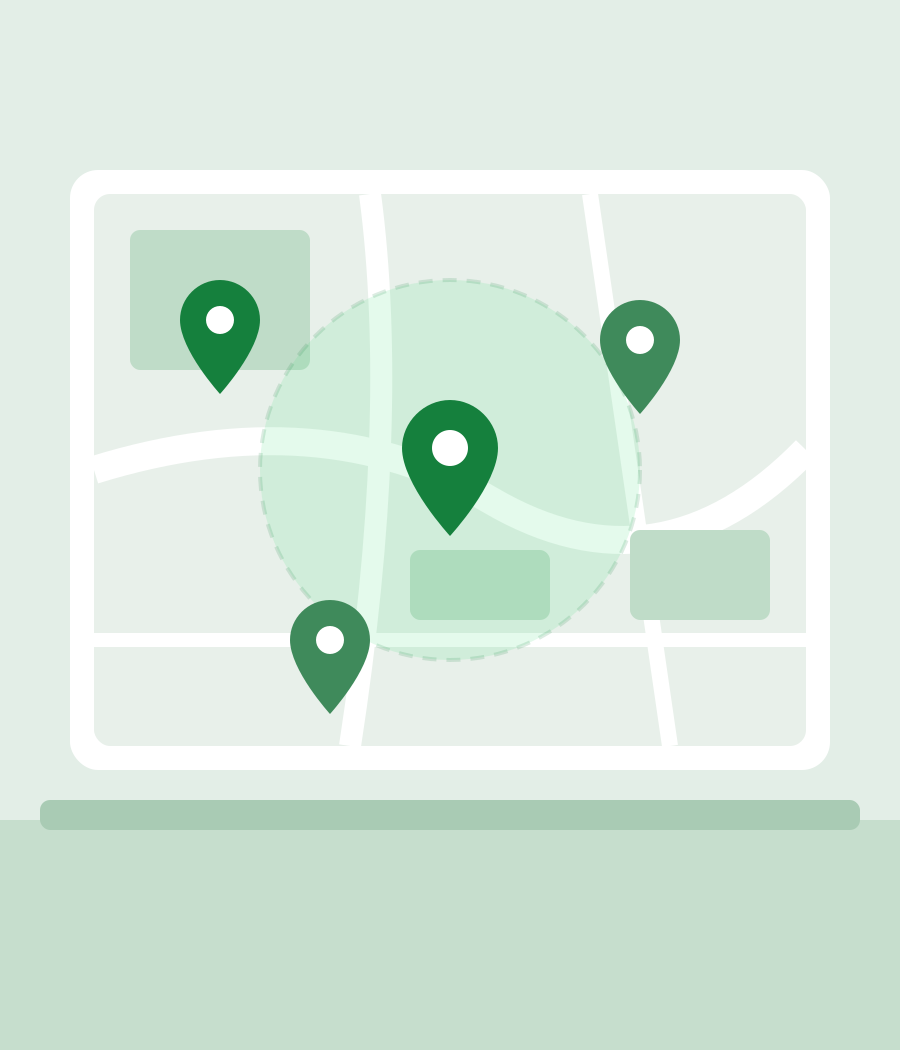
A typical local search page shows two sets of free results. The map pack (sometimes called the local pack) shows a map and three businesses. Underneath sit the organic results: a list of websites, which may include your own site, directories and comparison sites.
These are related but separate. A business can rank well in one and poorly in the other, because they lean on different signals.
| Map pack | Organic results | |
|---|---|---|
| What appears | Google Business Profiles | Web pages |
| Main drivers | Profile, categories, reviews, distance, prominence | Website content, links, technical health |
| Effect of distance | Very strong | Moderate |
| What people do | Call, get directions, check reviews | Click through to read more |
| Best supported by | Profile work, reviews, citations | Service pages, area pages, links |
For most local businesses, the map pack produces the most direct enquiries. Organic rankings still matter, particularly for searches where people want to compare and read before they choose, and because a strong website is one of the things that lifts your map ranking too. Treat them as two halves of the same job.
Your Google Business Profile: the most important listing you own
Your Google Business Profile is what appears in the map pack and on Google Maps. It is free, and it is often the first impression a customer gets of your business, before they ever see your website. Yet many profiles are set up once and then left alone, with missing services, old photos and the wrong opening hours.
The basics to get right:
- Business name. Use your real-world trading name exactly as it appears on your signage and paperwork. Adding keywords or locations to the name breaks Google’s guidelines and can lead to suspension.
- Primary category. Choose the most specific category that describes what you are. This is one of the strongest relevance signals. Add a small number of secondary categories only where they genuinely apply.
- Address or service area. Show your address if customers visit you. If you travel to customers and do not serve them at your premises, hide the address and set a service area of towns or districts you actually cover.
- Hours. Keep regular and holiday hours accurate. Being shown as open when you are closed is a fast way to collect poor reviews.
- Services or products. List what you offer in plain language, with short descriptions. This helps both relevance and customers.
- Description. Write a clear, factual summary of what you do and who you serve. Avoid stuffing it with keywords.
- Photos. Add genuine, recent photos of your premises, team and work, and keep adding them over time.
- Posts. Occasional updates about offers, events or recent work keep the profile looking active and give customers more to read.
It is also worth checking your profile every few months. Customers and Google itself can suggest edits to your details, and these are sometimes applied without you noticing. If you only do one thing after reading this article, make it a careful review of your profile against that list.
Reviews: the signal customers and Google both read
Reviews influence local rankings, and they influence whether people choose you once they find you. Quantity matters, but so do recency, the detail in the text and how you respond. A business with a steady flow of recent, specific reviews tends to look more trustworthy than one with a burst of five-star ratings from two years ago.
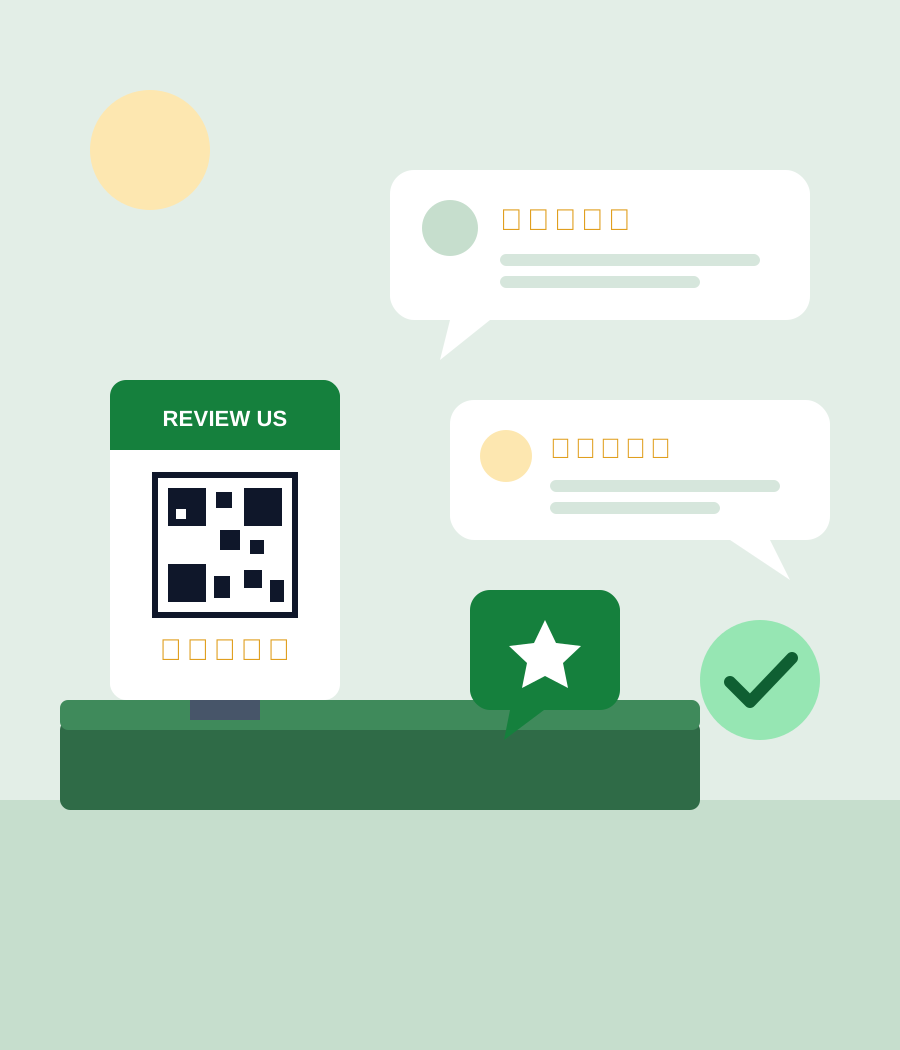
The most reliable way to get more reviews is simply to ask every customer, at the right moment, with a direct link that takes them straight to the review form. Your profile can generate that link and a QR code for you.
There are also firm rules. Google prohibits offering incentives for reviews, selectively asking only happy customers, and writing or buying fake reviews. In the UK, the Digital Markets, Competition and Consumers Act 2024 made fake reviews and concealed incentivised reviews a banned practice from April 2025, and the Competition and Markets Authority can now fine businesses directly. Shortcuts are not worth the risk.
Respond to reviews, good and bad. A short, polite, personal reply to a complaint often does more for your reputation than another five-star review, because prospective customers can see how you handle problems.
Citations and consistent business details
A citation is any mention of your business name, address and phone number online, usually on a directory or listing site. In the UK that includes general directories such as Yell, Thomson Local and Yelp, map and navigation platforms such as Apple Maps and Bing, and trade-specific sites relevant to your industry.
Citations help in two ways. They give customers more places to find you, and they help Google and other systems confirm that your business is real and that its details are correct. The second point depends on consistency. If one site shows an old address, another has a different phone number and a third spells your name differently, you are sending mixed signals.
A practical approach:
- Decide on one exact version of your business name, address and phone number, and use it everywhere.
- Find your existing listings by searching your business name, phone number and any old addresses.
- Correct or claim the important ones first: Apple Business (which replaced Apple Business Connect in 2026), Bing Places, Facebook, and the main UK directories.
- Add a handful of relevant industry and local directories rather than hundreds of low-quality ones.
- Remove or merge duplicate listings, especially on Google.
Your website: service pages and area pages
Your website supports local rankings in several ways. It is the link on your profile, it is a ranking factor in its own right, and it is where many customers go to decide. A thin, one-page site makes this harder.
The structure that works for most local businesses is simple:
- A clear homepage that says what you do and where, with your phone number easy to find.
- A page for each main service. A roofer might have separate pages for flat roofs, roof repairs, guttering and chimneys. Each page should explain the service properly, answer common questions and show relevant examples.
- Area pages where they are genuine. If you work across several towns, a page for each can help, but only if each page has real local substance: jobs you have done there, local considerations, travel and availability. Copying one page and swapping the town name rarely helps and can look spammy.
- Contact details that match your profile, plus a map or clear directions if customers visit.
- Fast loading on mobile, since most local searches happen on phones.
Tip
Write your service pages to answer the questions customers ask on the phone: how much it typically costs, how long it takes, what is included and what happens next. That content serves people, Google and AI assistants equally well.
Local links and mentions
Links from other websites remain one of the main ways Google judges prominence. For a local business, the most useful links come from sources that are both genuine and connected to your area or industry: the local newspaper website, a community group you sponsor, a trade association you belong to, a supplier’s stockist page, a local business network or a nearby business you work with.
These links are harder to get than buying them from a website that sells them, which is precisely why they carry weight. Paid link schemes and private blog networks break Google’s spam policies and can undo months of good work. A handful of real local links built over a year is worth far more than hundreds of irrelevant ones.
AI search and what it means for local businesses
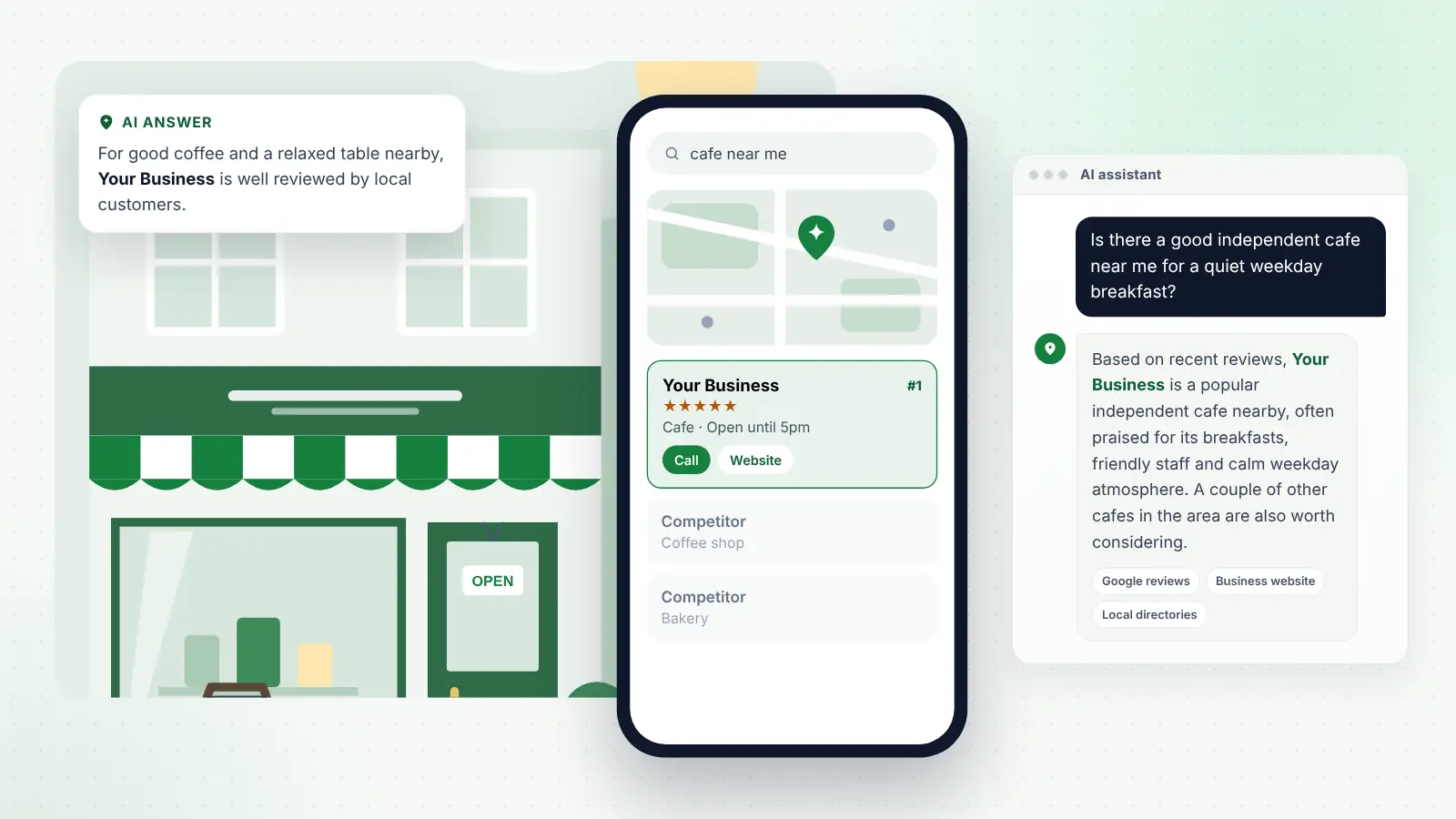
A growing number of people now ask AI assistants for local recommendations. Instead of typing “dog groomer near me”, they ask ChatGPT, Gemini, Perplexity or Copilot something like “Which dog groomer near me is good with nervous dogs?” Google’s own AI Overviews also appear above some local searches, summarising options before the normal results.
These tools do not have a secret list of recommended businesses. They pull together information they can find and trust: your Google Business Profile, your website, reviews on Google and other platforms, directory listings, and mentions on local and industry websites. That means the foundations described above serve AI search too.
A few things make a particular difference:
- Consistent facts everywhere. If your services, location and contact details agree across the web, AI tools can describe you confidently.
- Clear descriptions of what you do. Specific service pages and a detailed profile give assistants something concrete to quote.
- Reviews that mention specifics. Comments about punctuality, a particular service or a type of customer help AI tools match you to detailed questions.
- FAQ content on your site. Plain answers to real customer questions are easy for these tools to use.
- Mentions on reputable sites. Local press, associations and respected directories act as independent confirmation.
This field, often called answer engine optimisation or AEO, is still changing quickly, and no one can guarantee that an assistant will name a particular business. But a business that is well described and well regarded online has a far better chance than one that is not.
Tracking progress and realistic timelines
It is easy to feel that nothing is happening in local SEO, partly because rankings move gradually and partly because they vary depending on where the searcher is standing. A few simple measures give a clearer picture.
What to track
- Business Profile performance. Your profile shows how many people found you, how they searched, and how many called, asked for directions or visited your website.
- Calls and enquiries. Ask new customers how they found you, and keep a simple tally.
- Website visits from search. Google Search Console, which is free, shows which searches bring people to your site.
- Rankings from several points. Because results depend on location, check how you appear from different parts of your area rather than just from your own premises.
- Reviews. Track the number, average rating and how recently you received them.
How long it takes
| Timeframe | What usually happens |
|---|---|
| First month | Profile fixes, corrected listings and basic website changes are made |
| Months two to three | Reviews build, citations settle, early ranking movement in nearby areas |
| Months three to six | More consistent visibility, growing calls and enquiries in competitive areas |
| Six months onwards | Links, content and reviews compound; gains become more durable |
These are typical patterns, not promises. A business in a quiet market with a neglected profile may see changes within weeks once the basics are fixed. A business in a crowded city centre category may need longer. Anyone guaranteeing a number one position is either misunderstanding how local search works or planning shortcuts you would not want attached to your name.
Some owners enjoy doing this work themselves, and much of it is free. Others would rather spend their time running the business. If you fall into the second group, done-for-you local SEO services for UK small businesses can take on the profile, citation, content and link work and report back in plain English each month.
Frequently asked questions
Do I need a website to rank in the map pack?
You can appear in the map pack with only a Google Business Profile, and some businesses do. However, a website helps your profile rank, gives customers more confidence and supports AI search. For most businesses, a simple site with proper service pages is well worth having.
I work from home. Can I still use local SEO?
Yes. If customers do not visit your premises, hide your address on your Business Profile and set a service area of the towns or districts you cover. Your profile will still appear in local results, and your home address stays private.
Should I create a profile for every town I serve?
No. Google allows one profile per real business location. Creating extra profiles at addresses where you do not genuinely operate, such as virtual offices, breaks the guidelines and risks suspension. Use your service area settings and your website’s area pages instead.
How many reviews do I need?
There is no magic number. What matters is how you compare with the businesses you are competing against locally, and whether you receive reviews steadily. A regular flow of genuine, detailed reviews is more useful than a large one-off push.
Is local SEO a one-off job?
The setup is a one-off, but the results depend on ongoing activity: new reviews, fresh photos and posts, maintained listings, new content and occasional links. Competitors are working on theirs too, so a profile left alone for a year tends to slip.
Next steps
Start with the work that has the most effect for the least effort. Review your Google Business Profile line by line, fix your name, category, hours and services, and add some current photos. Check that your business details match on your website and the main directories. Then build a habit of asking every customer for a review.
Once those foundations are in place, improve your website’s service pages, look for genuine local links, and keep an eye on how you appear in AI tools as well as on Google. Local SEO rewards consistency more than cleverness, and the businesses that keep going for six months or more are usually the ones that see lasting results.