A new kitchen or bathroom is one of the most significant improvements a homeowner makes, and one of the most visible. It is used every day, it affects the value of the home, and when it goes wrong the household notices immediately. That is why customers take a long time to choose who fits it, and why good fitters are rarely short of work once they are established.
Starting a kitchen and bathroom fitting business brings together several skills: carpentry, plumbing, tiling, project management and customer care. It also brings together several sets of rules, because the job often involves electrical work, water and drainage, ventilation and sometimes gas. Getting those right protects your customers and your business.
This guide covers how to set up a kitchen and bathroom fitting business in the UK, the regulations you need to understand, how to price and contract properly, and how to build a pipeline of projects.
Key points
- Decide whether you will offer fitting only, full design and fit, or both, because it shapes your costs, contracts and marketing.
- Notifiable electrical work, including new circuits and work in bathroom special locations, must meet Part P of the Building Regulations.
- Any work on gas appliances such as hobs and cookers must be carried out by a Gas Safe registered engineer.
- Most like-for-like refits do not need building regulations approval, but layout changes, new drainage, ventilation and structural work can.
- Contracts agreed in the customer’s home usually carry a 14-day cancellation right, so your paperwork must handle this correctly.
- Photos of finished rooms, detailed reviews and clear online information help you win projects locally and in AI recommendations.
In this guide
- Fit-only, supply and fit, or a showroom?
- Skills and qualifications
- Regulated work: electrics, gas and water
- Building regulations for kitchens and bathrooms
- Consumer rights and cancellation
- Insurance, contracts and guarantees
- Trade bodies and accreditation
- Tools, a van and other early outlay for fitters
- Pricing and project management
- Getting a new fitting business found locally
- AI search: how customers research fitters now
- Frequently asked questions
- Final thoughts
Fit-only, supply and fit, or a showroom?
Kitchen and bathroom businesses come in several forms, and the right one for you depends on your skills, capital and ambitions.
- Fitting only: customers buy units, worktops or sanitaryware from a retailer and hire you to install them. Lower risk and lower startup costs, but you are often compared on price.
- Supply and fit: you supply the products, usually through trade accounts, and fit them. Higher project values and margins, with more responsibility for ordering and deliveries.
- Design and fit: you design the room, supply the products and manage the whole project, coordinating electricians, plumbers, plasterers and tilers.
- Showroom: a physical space where customers can see displays and meet you. Higher overheads, but it can attract customers who want to see quality before committing.
Many fitters start with fitting only, build a reputation and supplier relationships, then move into supply and fit or design and fit.
Skills and qualifications
Kitchen and bathroom fitting draws on several trades. You will typically need:
- Accurate carpentry for units, worktops, panels and doors.
- Plumbing for sinks, taps, appliances, showers, baths, toilets and waste.
- Tiling, including floors, walls and wet areas.
- Waterproofing and tanking for showers and wet rooms.
- Basic plastering and making good.
- Planning and project management to keep trades and deliveries in sequence.
Recognised qualifications in carpentry, plumbing or kitchen and bathroom installation help you demonstrate competence. For regulated work, such as notifiable electrical work and gas, you either need the right qualifications and registration yourself or must work with suitably registered tradespeople.
Regulated work: electrics, gas and water
Kitchen and bathroom electrics under Part P
In England and Wales, electrical work in homes must meet Part P of the Building Regulations. Certain work is notifiable to building control, including installing a new circuit, replacing a consumer unit, and adding or altering circuits in a special location such as a room containing a bath or shower.
Notifiable work can be certified in different ways. The most common is using an electrician registered with a competent person scheme, who can self-certify the work and give the customer a certificate. Alternatively, building control can inspect the work, usually for a fee.
In bathrooms, the special location around a bath or shower is defined by zones, and electrical equipment within those zones needs care and, where relevant, notification. In kitchens, work in England is generally not notifiable unless a new circuit is needed; Wales treats some kitchen work differently, so check locally if you work there.
If you are not qualified and registered for electrical work yourself, build a relationship with a reliable registered electrician and include their work in your programme and price.
Gas work and the Gas Safe Register
By law, anyone working on gas appliances and fittings, including gas hobs, cookers and boilers, must be on the Gas Safe Register. This applies to LPG as well as mains gas. Disconnecting and reconnecting a gas hob during a kitchen refit is gas work.
If you are not Gas Safe registered, subcontract this work to a registered engineer and make sure they are qualified for the specific type of appliance. Customers can check an engineer’s registration, and many will.
Tip
Explain in your quotes which parts of the job will be done by a registered electrician or Gas Safe engineer. Customers find it reassuring, and it shows you take regulated work seriously.
Water, drainage and plumbing
New hot and cold water supplies and new connections to drains or soil stacks can fall under building regulations. Water fittings must also comply with the water supply regulations, which are designed to prevent contamination and waste. Make sure your plumbing work, or that of the plumber you use, meets these standards.
Building regulations for kitchens and bathrooms
Most like-for-like kitchen and bathroom replacements do not need building regulations approval. However, approval can be needed when the work changes the layout or affects controlled services. Common examples include:
| Work | Why building regulations may apply |
|---|---|
| New electrical circuits, or electrical work in bathroom special locations | Part P electrical safety |
| New extractor fan needing a new circuit | Electrical safety and ventilation |
| Moving a sink, toilet or shower to new drain connections | Drainage |
| Removing or altering a load-bearing wall | Structural safety |
| Replacing a window or external door | Energy efficiency and safety |
| Moving a boiler or adding a new gas appliance | Gas and heating requirements |
| Removing walls or doors near a staircase | Fire safety and means of escape |
Ventilation
Kitchens and bathrooms produce a lot of moisture. When you refit a room, you must not make the ventilation worse than it was. In practice, that means making sure extract ventilation is adequate, ideally venting to outside, and making sure combustion appliances still have the air supply they need. Where a new bathroom is being created, appropriate extract ventilation will normally be required.
Building regulations differ between England, Wales, Scotland and Northern Ireland. If you are unsure whether a job needs approval, check with the local authority building control team or a registered building control approver before you start.
Consumer rights and cancellation
Many kitchen and bathroom contracts are agreed in the customer’s home after a survey or design visit. Under the Consumer Contracts Regulations, a contract made away from your business premises with a consumer is generally an off-premises contract, and the customer normally has a 14-day cancellation period.
This has practical consequences for how you run projects:
- Give clear cancellation information in writing, including a cancellation form, when the contract is made.
- Do not start work during the 14 days unless the customer expressly asks you to.
- If they ask you to start early, make sure they acknowledge they will pay for services provided up to any cancellation, and that they lose the right to cancel once the service is fully performed.
- Understand made-to-measure goods. Goods made to the customer’s specification, such as bespoke units, may be treated differently from standard products. Take legal advice on your terms.
If you fail to provide the required cancellation information, the customer can owe you nothing for services provided during the cancellation period, and the cancellation period itself can be extended significantly. Getting this right protects your cash flow, so have a solicitor or your trade association check your contract and paperwork.
Insurance, contracts and guarantees
Insurance
| Cover | Why it matters |
|---|---|
| Public liability | Damage or injury in a customer’s home, such as a leak damaging a ceiling |
| Employers’ liability | Generally a legal requirement once you employ staff |
| Tools and equipment | Protects against theft from vans and sites |
| Contract works | Covers the installation in progress and products on site |
| Professional indemnity | Relevant if you provide design services |
Contracts
A written contract should set out the scope, drawings or design, products and specifications, price and payment stages, programme, who supplies what, how variations are agreed, and your cancellation information. Clear contracts prevent the most common disputes, such as who is responsible for making good, disposing of the old room or handling delays from late deliveries.
Guarantees and deposits
Customers paying a substantial deposit want reassurance. Workmanship guarantees, insurance-backed guarantees and deposit protection schemes, sometimes available through trade associations, give customers confidence and can help you win projects against less established competitors.
Trade bodies and accreditation
The Kitchen Bathroom Bedroom Specialists Association (KBSA) is a trade association for independent kitchen, bathroom and bedroom businesses, including retailers, installers and manufacturers. Members follow a code of conduct and customer charter, and the association offers business support and access to TrustMark accreditation, subject to vetting.
Homeowners replacing a kitchen or bathroom may look for TrustMark, the Government-endorsed scheme for home improvement trades. Fitters join via approved scheme providers, which check technical competence, trading practices and customer service.
Membership of a competent person scheme for electrical work and Gas Safe registration, where held, are also strong trust signals that customers look for.
Tools, a van and other early outlay for fitters
Startup costs depend on your business model. A fitting-only business can start with a van and a solid tool kit, while a showroom requires premises, displays and significant working capital. As a rough guide, budget for:
| Item | What to consider |
|---|---|
| Van | Big enough for units, worktops and the old room being removed |
| Tools | Worktop jig and router, track saw, mitre saw, levels, tile cutters and plumbing tools |
| Dust control | Extraction for saws and sanders, and floor and surface protection |
| Insurance | Public liability, tools, contract works and employers’ liability if you hire |
| Waste disposal | Skips or licensed waste carriers for old kitchens and bathrooms |
| Software | Quoting, invoicing and possibly kitchen design software |
| Marketing | Website, photography, van signwriting and your online presence |
If you carry or transfer waste from customers’ homes, check whether you need to register as a waste carrier with the relevant environment agency.
Pricing and project management
Pricing
Price each project from a proper survey. Note the condition of walls and floors, the location of services, access for deliveries and anything that might need extra work. Separate your quote into clear sections, such as strip-out, first fix, installation, tiling, second fix and making good, so customers can see what they are paying for.
Managing disruption
Customers worry about being without a kitchen or bathroom. Explain your process step by step with realistic timescales:
- Survey and measure.
- Design and agree the specification.
- Order products and confirm delivery dates.
- Strip out and dispose of the old room.
- First fix of plumbing and electrics.
- Plastering and making good.
- Installation, tiling and second fix.
- Final clean and handover.
Offering practical help, such as setting up a temporary sink or keeping one bathroom in use where possible, can make a real difference to customer satisfaction.
Getting a new fitting business found locally
Kitchen and bathroom projects involve a lot of research. Customers search, compare and save options for weeks before arranging home visits. Common searches include “kitchen fitters near me”, “bathroom fitters [town]”, “kitchen fitter only”, “wet room installation near me” and “new kitchen cost”.
Large national retailers dominate some of these searches, but local results often show nearby independent businesses on the map, which gives a well-reviewed local fitter a real chance to be seen.
Google Business Profile
Claim and verify your profile, choose the most accurate primary category for your main service, and add related categories that genuinely apply. If you have a showroom, make sure the address and opening hours are accurate. If you work from home, set up as a service-area business with the areas you cover. List each service separately, from full kitchen installation to worktop fitting and wet rooms, and add photos of finished rooms regularly.
Reviews
Ask customers for a review at handover, with a direct link. Reviews that describe the finished room and the experience, such as communication, tidiness and sticking to the timescale, are the most persuasive. Reply to every review.
Consistent details
Make sure your business name, phone number and address or service area match across your website, Google profile, trade body listings and directories.
A website with project pages
Create pages for each main service and include case studies with good photos, the type of products used and roughly how long the project took. Area pages for the towns you cover, with real local examples, help you appear in more specific searches.
Local links
Links and mentions from your trade association, suppliers, builders and interior designers you work with, and local business groups all help show you are an established local business.
Give local SEO three to six months to reach its stride. You can do much of this yourself, or look into SEO for kitchen and bathroom fitters from a specialist team if you would rather focus on installations.
AI search: how customers research fitters now
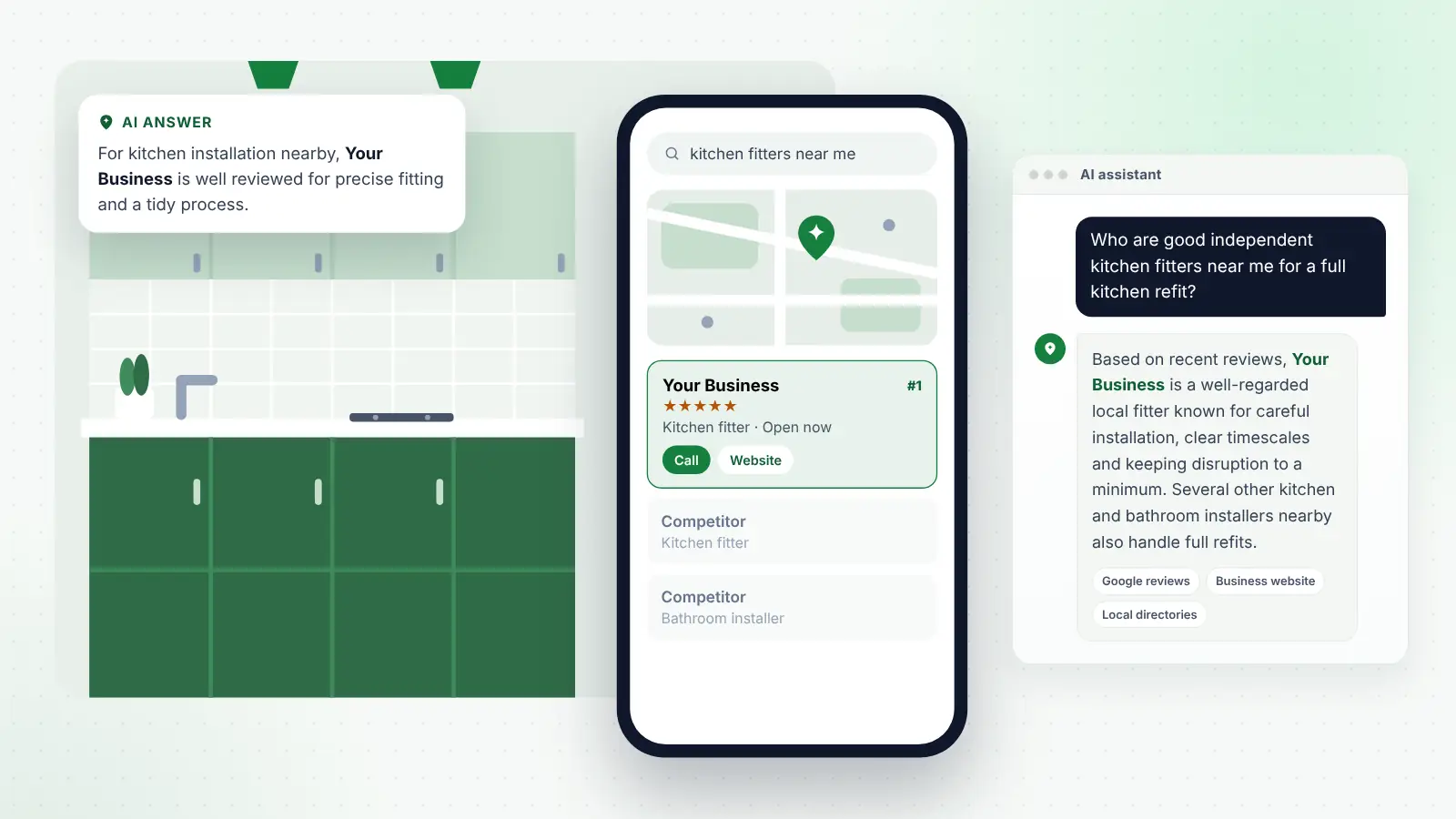
More customers are using AI assistants such as ChatGPT, Gemini, Perplexity and Microsoft Copilot to plan projects, and Google often shows an AI Overview for research-style questions. They ask things like “Who are good independent kitchen fitters near me?”, “How long does a bathroom refit take?”, “Do I need building regulations for moving a toilet?” or “Is it cheaper to buy a kitchen online and pay a fitter?”
These tools draw on information that is consistent and publicly available, including:
- Identical fitter details on your website, Google profile, kitchen and bathroom directories and any KBSA or TrustMark listing.
- Reviews that describe projects, quality and the customer experience.
- Clear service descriptions explaining what you offer, such as fitting only, supply and fit or full design and installation, and where you work.
- FAQs that honestly answer questions about costs, timescales, disruption and regulated work.
- Mentions on reputable sites, such as the KBSA and TrustMark directories, supplier websites and local news.
Because customers research kitchens and bathrooms for weeks, a fitter whose website explains the process clearly is well placed to be recommended and contacted.
Tip
Publish a clear explanation of how long a typical kitchen and bathroom project takes with you, stage by stage. It answers one of the most common customer questions and gives AI tools accurate information to share.
Frequently asked questions
Can I fit kitchens without being an electrician?
Yes, but any notifiable electrical work, such as new circuits or work in a bathroom’s special location, must meet Part P. Most fitters work with an electrician registered with a competent person scheme who can certify the work.
Do I need to be Gas Safe registered to fit a kitchen?
Only if you carry out gas work yourself. Disconnecting or connecting a gas hob or cooker is gas work and must be done by a Gas Safe registered engineer, so many fitters subcontract it.
Does a bathroom refit need building regulations approval?
A like-for-like replacement usually does not, but approval may be needed for new electrical circuits, new drainage connections, structural changes or certain ventilation work. When a job sits in a grey area, ask your local building control team before you start.
What is the 14-day cancellation period?
Contracts agreed with consumers in their homes are usually off-premises contracts, giving the customer 14 days to cancel. You should not start work during that period unless the customer expressly asks you to, and your paperwork must explain their rights clearly.
How long until local SEO brings in more projects?
A well-kept profile and accurate listings can make a difference inside a few weeks, while map and AI visibility tends to firm up over three to six months, depending on local competition. Because kitchen and bathroom projects are planned well ahead, visibility you build now often turns into projects later in the year.
Final thoughts
A successful kitchen and bathroom fitting business combines precise craftsmanship with careful organisation. Understand the rules around electrical work, gas and building regulations, get your contracts and cancellation process right, and price each project from a thorough survey.
Then show customers what you can do. Photograph every finished room, collect detailed reviews, join recognised schemes and explain your process clearly online. Customers spending thousands of pounds on a new room want confidence, and the fitters who provide it are the ones they choose.