Starting your own accountancy practice is one of the more accessible ways to run a professional services business. You can begin with a laptop, good software and a handful of clients, and grow at a pace that suits you. Many accountants and bookkeepers make the move after years in practice or industry, wanting more control over their work, their clients and their time.
That accessibility can be misleading, though. Although the title “accountant” is not protected in the UK, running a practice still comes with real obligations. You must be supervised for anti-money laundering purposes, you will usually need professional indemnity insurance, and if you belong to a professional body you will need its permission to practise. You will also need to register with HMRC to act for clients, under rules that are being tightened.
This guide covers the practical steps: deciding what kind of practice to build, meeting your regulatory obligations, setting up systems and pricing, preparing clients for Making Tax Digital, and making sure local businesses and individuals can find you on Google and through AI assistants. It is general information rather than professional advice, so check the details with your professional body, HMRC and your own advisers.
Key points
- The word “accountant” is not a protected title, but professional body designations are restricted to members, and clients increasingly check credentials.
- Every accountancy practice must be supervised for anti-money laundering purposes, either by a recognised professional body or by HMRC.
- Members of bodies such as ICAEW and ACCA generally need a practising certificate to work in public practice, and self-employed AAT members need an AAT licence.
- Making Tax Digital for Income Tax is being phased in from April 2026, which is prompting many sole traders and landlords to look for an accountant.
- Most clients search locally and compare reviews, so a complete Google profile, clear service pages and consistent listings are worth setting up from the start.
In this guide
- Who can call themselves an accountant
- Decide what kind of practice you want to build
- Professional body requirements and structure
- Registering with an AML supervisor
- Registering with HMRC as a tax adviser
- Insurance, engagement letters and continuity
- Software, pricing and Making Tax Digital
- Winning your first clients
- Local SEO: how clients find an accountant nearby
- When clients ask an AI assistant to suggest an accountant
- Frequently asked questions
- Next steps
Who can call themselves an accountant
In the UK, anyone can describe themselves as an accountant. There is no legal requirement to hold a particular qualification to offer bookkeeping, accounts preparation or tax return services. Some activities are restricted, such as statutory audit and insolvency work, which require specific authorisation.
Professional body designations are different. Titles such as chartered accountant, chartered certified accountant or AAT licensed accountant can only be used by members of the relevant body who meet its requirements. Those memberships matter to clients. Banks, lenders and many business owners actively look for them, and public guidance often encourages people to check an accountant’s membership before appointing them.
If you are already a member of a professional body, the practical question is what that body requires before you start working for clients on your own account. If you are not, think carefully about whether membership would strengthen your practice, because unaffiliated practices still have to meet the same anti-money laundering and tax agent requirements.
Decide what kind of practice you want to build
The most successful small practices are usually clear about who they serve. Rather than offering everything to everyone, think about:
- Client types. Sole traders, landlords, contractors, limited companies, charities or a mix.
- Sectors. Construction, hospitality, healthcare professionals, creative businesses, e-commerce or another area where you have experience.
- Services. Bookkeeping, payroll, year-end accounts, self assessment, VAT returns, management accounts, tax planning or advisory work.
- Working style. Fully remote, a local office for face-to-face meetings, or a mix.
A clear focus makes everything easier: pricing, marketing, software choices and even recruitment. It also helps prospective clients and search engines understand exactly what you do. Being known as “the accountant for local tradespeople” or “the landlord tax specialist” in your town is far more memorable than being one of many general practices.
Professional body requirements and structure
How you set up depends on your qualifications and memberships. The table below summarises the common routes.
| Your position | What you typically need before taking clients | AML supervisor |
|---|---|---|
| ICAEW member in public practice | An ICAEW practising certificate, with PII | ICAEW |
| ACCA member in public practice | An ACCA practising certificate, with PII | ACCA |
| Self-employed AAT member | An AAT licence, with PII and continuity arrangements | AAT |
| Member of another professional body | Check that body’s practice requirements | Usually that body, if it is a recognised supervisor |
| Not a member of a professional body | No practice licence, but supervision is still compulsory | HMRC |
Each body has its own rules on eligibility, experience and practice assurance reviews, and these change from time to time. Check the current requirements directly with your body before you launch, and do not start acting for clients until any certificate or licence is in place.
You also need to choose a business structure. Many practitioners start as sole traders for simplicity, while others form a limited company from the outset. Your professional body may have rules about firm ownership and names, so confirm those before you register anything with Companies House.
Registering with an AML supervisor
Accountancy service providers fall within the Money Laundering Regulations. That means your practice must be supervised for anti-money laundering (AML) purposes. If you are supervised by a recognised professional body, such as ICAEW, ACCA or AAT, you do not register with HMRC for AML. If you are not supervised by a professional body, you must register with HMRC for money laundering supervision.
Arrange supervision before you start acting for clients. Once you are supervised, you will need:
- A written firm-wide risk assessment covering your clients, services and delivery channels.
- Policies and procedures for client due diligence, including identity checks and understanding the nature of each client’s business.
- Ongoing monitoring, so that client information stays current.
- A procedure for reporting suspicious activity, with a nominated officer.
- Records of checks and training, kept for the required period.
Supervisors carry out reviews, and failing to meet AML requirements can lead to penalties. Building good habits from the first client is much easier than fixing gaps later.
Registering with HMRC as a tax adviser
To deal with HMRC on clients’ behalf, you will need an HMRC agent services account. The government is also introducing mandatory registration with HMRC for paid tax advisers who interact with HMRC on behalf of clients, starting in 2026, with existing agents moving across in stages. Registration is expected to involve meeting minimum standards, such as being supervised for AML purposes and having your own tax affairs in order.
The details are still being refined, so check HMRC’s current guidance when you set up. Leave enough time in your launch plan for registration to be completed before you need to file returns.
Tip
Get your AML supervision confirmed before you apply for HMRC agent registration. HMRC asks for your AML supervision details when you set up as an agent, so the order matters.
Insurance, engagement letters and continuity
Professional indemnity insurance
Professional bodies generally require members in practice to hold professional indemnity insurance appropriate to the services they provide. Even if you are not a member, PII is strongly advisable, because a single error on a tax return or set of accounts can be expensive. Consider cyber insurance as well, since accountants hold sensitive financial and personal data.
Engagement letters
Before starting any work, agree the terms in writing, usually through an engagement letter. It should set out the services you will provide, what the client is responsible for, your fees, deadlines, how you handle client information and how complaints are dealt with. Professional bodies strongly encourage this, and it protects both you and the client if expectations differ later. Review engagement letters when the scope of work changes, for example when a client joins Making Tax Digital.
Continuity and data protection
If you work alone, plan what happens if you are ill or unable to work. AAT, for example, requires licensed members to have continuity arrangements in place, and other bodies have similar expectations. You will also need to comply with data protection law and pay the data protection fee to the Information Commissioner’s Office if it applies to you.
Software, pricing and Making Tax Digital
Cloud accounting software is now central to most small practices. Choosing one or two main platforms and becoming expert in them makes onboarding and support far more efficient than trying to support everything.
Pricing
Fixed monthly fees have become common for small business clients, because they make costs predictable and encourage clients to talk to you year-round. Many practices offer tiered packages, for example bookkeeping, accounts and tax return together, with advisory work priced separately. Whatever you choose, publish at least guide prices or starting points on your website. It saves time on unsuitable enquiries and reassures people who are nervous about cost.
Making Tax Digital for Income Tax
Making Tax Digital for Income Tax requires people within scope to keep digital records and send quarterly updates to HMRC. It is being phased in based on qualifying income from self-employment and property combined:
| Start date | Qualifying income above | Based on tax year |
|---|---|---|
| 6 April 2026 | £50,000 | 2024 to 2025 |
| 6 April 2027 | £30,000 | 2025 to 2026 |
| 6 April 2028 | £20,000 | 2026 to 2027 |
For a new practice, this is a significant opportunity. Many sole traders and landlords who have handled their own tax returns for years are now looking for help with software, quarterly updates and record keeping. Clear content explaining what the changes mean, and a straightforward package to support it, can bring in clients who stay for many years. Always check HMRC’s latest guidance, as exemptions and details can change.
Winning your first clients
Most new practices grow first through relationships. Useful sources include:
- Former colleagues and clients, where your previous contracts allow you to approach them.
- Solicitors, mortgage brokers, financial advisers and estate agents, who are often asked to recommend an accountant.
- Banks’ local business teams and business networking groups.
- Local business support organisations and start-up schemes.
- Software partner directories, if you hold partner status with accounting platforms.
Turning one-off work into ongoing relationships is the key to a stable practice. A self assessment client might also need bookkeeping, quarterly updates or a short planning review each year. Offering these as natural next steps also spreads your workload, so January becomes less overwhelming.
Local SEO: how clients find an accountant nearby
Most small business owners and individuals still want an accountant they can call, and often meet, locally. They search with terms such as “accountant near me”, “small business accountant in [town]”, “tax return accountant near me”, “bookkeeper near me”, “accountant for landlords” and “Making Tax Digital help”.
Local SEO helps your practice appear in Google’s map results and local listings for those searches. The most important elements are:
- Google Business Profile. Choose accountant or a closely matching category as your primary category and add relevant secondary ones. List your services, add opening hours and photos, and include your professional body membership in your description. If you work from home and do not see clients there, set the profile up as a service-area business so your address stays private.
- Reviews. Ask your clients for a review after completing their accounts or tax return. Reply to each review professionally without disclosing any client information. Never buy reviews or offer rewards for positive ones, as fake and concealed incentivised reviews are now specifically prohibited under consumer law.
- Consistent details. Keep your practice name, address and phone number identical across your website, Google, Apple Maps, Bing, professional body directories and software partner listings.
- Service and sector pages. Create a page for each main service and each sector you specialise in, explaining what you do, who it suits and typical fee structures.
- Local links and mentions. Sponsorship of local events, articles in local business publications and membership of chambers of commerce all strengthen your local presence.
If you want to focus on client work, you might hand this to a team that offers SEO for accountants and bookkeeping practices as a dedicated service. Either way, it helps to start well before the autumn, so your practice is visible by the time self assessment searches increase ahead of the 31 January deadline. Allow three to six months for the effort to show fully, depending on how many practices compete locally.
When clients ask an AI assistant to suggest an accountant
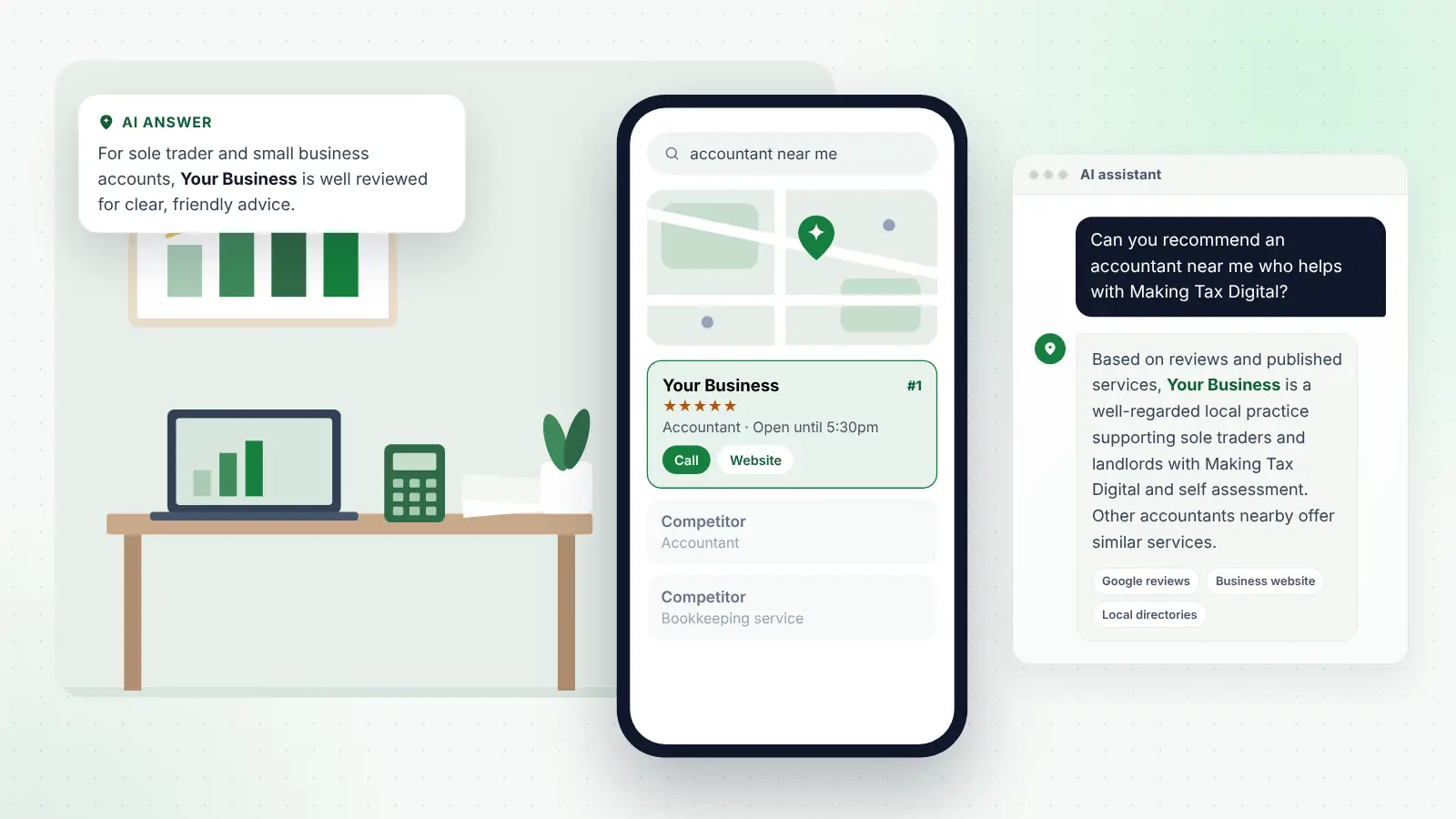
More people are asking AI assistants to help them find an accountant. They use ChatGPT, Gemini, Perplexity, Microsoft Copilot and Google’s AI Overviews, and they tend to ask detailed, specific questions:
- “Can you recommend an accountant near me who helps with Making Tax Digital?”
- “Which accountants in [town] specialise in landlords?”
- “Is there a local accountant who works with construction subcontractors on CIS?”
- “How much does a small business accountant usually cost, and who is well reviewed nearby?”
AI tools build their answers by drawing on information they can find and cross-check. Answer engine optimisation (AEO) is about making sure that information is clear, accurate and consistent. For an accountancy practice, focus on:
- Consistent practice details across your website, Google profile, professional body directory and other listings.
- Clear service and specialism descriptions, stating exactly who you help and where.
- Helpful, accurate FAQs on deadlines, Making Tax Digital, fees and what clients need to provide.
- Reviews that mention specifics, such as responsiveness, clear explanations or help with a particular situation.
- Credible mentions elsewhere, including local business sites, professional directories and reputable publications.
Accuracy matters here. Tax thresholds and deadlines change, and AI tools may repeat what they find on your website. Review your content regularly and date your guides, so both clients and AI tools can see they are current.
Tip
Write one plain-English page explaining what Making Tax Digital means for local sole traders and landlords, with a clear next step. It is useful to clients and gives search engines and AI tools a clear signal about what you offer.
Frequently asked questions
Do I need to be qualified to start an accountancy practice?
There is no legal requirement to hold a qualification to offer bookkeeping, accounts or tax return services, because “accountant” is not a protected title. However, you must still be supervised for anti-money laundering purposes and meet HMRC’s requirements for tax advisers. Many clients also look for professional body membership before they choose an accountant.
Who supervises my practice for anti-money laundering?
If you are a member of a recognised professional body, such as ICAEW, ACCA or AAT, and practise under its rules, that body is usually your supervisor. If you are not supervised by a professional body, you must register with HMRC.
Can I run an accountancy practice from home?
Yes, many practitioners do. If you do not meet clients at home, set up your Google Business Profile as a service-area business so your address is not shown. Check your mortgage or tenancy terms, home insurance and any local requirements before running a business from home.
When does Making Tax Digital for Income Tax apply?
It started on 6 April 2026 for people with qualifying income from self-employment and property above £50,000, and is due to extend to those above £30,000 from April 2027 and above £20,000 from April 2028. Exemptions and any updates to the timetable are covered in HMRC’s own guidance.
Should a new practice put its accountancy fees online?
Publishing guide prices or starting points is usually helpful. It reassures prospective clients, reduces unsuitable enquiries and gives AI tools clear information to work with. Make clear that the final fee depends on the client’s circumstances.
Next steps
Starting an accountancy practice can be done steadily and sensibly. Decide who you want to serve, confirm your professional body requirements, arrange AML supervision, complete your HMRC registration, put insurance and engagement letters in place, and choose software and pricing that suit your clients.
Then make your practice easy to find. A complete Google profile, accurate listings, clear service pages, honest reviews and practical guidance on topics like Making Tax Digital will help local clients find you, whether they search on Google or ask an AI assistant. Build those foundations early, keep them current, and your practice will be well placed to grow year after year.