Independent builders merchants have always competed on something the national chains find hard to copy: people. The counter staff who know which roofer always wants his battens treated, the yard manager who will squeeze an extra drop onto the afternoon lorry, the branch that answers the phone at 7am. That service is still the reason trades stay loyal, but it now has to be visible online, because the next generation of tradespeople and almost every homeowner starts with a search.
This guide is for established independents: general heavyside and timber merchants, plumbing and heating merchants, roofing specialists and landscaping suppliers, whether you run one yard or a handful of branches. It covers buying power, trade accounts and credit, getting your stock seen on Google, the product and timber rules as they stand in October 2026, delivery, supplier days, and how local search and AI assistants now influence where trades and homeowners buy.
Key points
- Buying groups and Builders Merchants Federation membership give independents purchasing terms, supplier access and industry support they could not get alone.
- Trade accounts are the backbone of the business, so make them easy to open and manage credit with firm, clearly written terms.
- Google Merchant Center lets you show in-store stock in free local listings, and click-and-collect is far more useful when customers can see what is on the shelf.
- As distributors, merchants must take care that construction products carry the right marking and documents, and the government’s 2026 reform plans will widen product safety duties over the next few years.
- Timber must be legally sourced under the UK Timber Regulation, and FSC or PEFC certification helps but is not a substitute for proper records.
- A clear page for each town you deliver to, accurate listings and detailed reviews help both Google and AI assistants recommend you.
In this guide
- Understand where your margin really comes from
- Use buying groups and trade bodies well
- Trade accounts and credit control
- Show your stock on Google and make click-and-collect work
- Construction products: marking and your responsibilities
- Timber: legal sourcing and certification
- Delivery: your service in action
- Supplier days, events and the trade counter
- Competing with national chains on service
- Local SEO: being found when trades search nearby
- AI search: how trades and homeowners now ask for recommendations
- Frequently asked questions
- Next steps
Understand where your margin really comes from
A merchant’s turnover can look healthy while the margin quietly drains away through delivery costs, bad debt and stock that does not move. Look at each part of the business separately.
| Department or channel | Typical pattern | Why it matters |
|---|---|---|
| Heavyside (bricks, blocks, aggregates, cement) | Heavy, low margin, delivery-intensive | Wins the account, but delivery costs must be priced in |
| Timber and sheet materials | Steady trade demand, cutting service adds value | A strong reason for trades to choose you over a shed |
| Plumbing and heating | Busier in autumn and winter, urgent spares | High repeat visits and loyal installers |
| Roofing | Weather-dependent, specialist knowledge | Advice and stock depth set you apart |
| Landscaping and paving | Peaks in spring and summer | Draws homeowners and landscapers, often by delivery |
| Tools, fixings and consumables | Year-round, impulse at the counter | Good margins on every visit |
Track margin after delivery, debtor days and stock-outs on key lines. They say more about the business than sales alone.
Use buying groups and trade bodies well
Independents rarely have the volume to negotiate national-level terms with the big manufacturers on their own. That is the reason buying groups exist.
Buying groups
Groups such as NBG, IBC and Fortis bring independent merchants together so that members benefit from collective purchasing. The detail differs between groups, but membership typically includes:
- Negotiated supplier terms and retrospective rebates across a wide range of manufacturers.
- Access to supplier programmes, promotions and marketing support.
- Events where members meet suppliers and each other, share ideas and compare performance.
- In some groups, shared services such as own-brand ranges, training or technology deals.
Fees, supplier lists and expectations differ, so talk to existing members and ask how rebates are calculated before choosing.
The Builders Merchants Federation
The Builders Merchants Federation (BMF) is the trade association for merchants and their suppliers. Membership gives you a voice in the industry’s dealings with government, along with training, guidance and networking events. Some buying groups have arrangements with the BMF that cover their members, so check whether your group membership already includes it.
Trade accounts and credit control
For most merchants, trade accounts are the business. A builder with an account visits more often, spends more and is less likely to drift to a competitor over a few pence.
Simplify new trade accounts
Many trades never open an account because the process looks slow. Make it simple:
- Offer a short application form online and at the counter.
- Explain what checks you carry out and how long a decision usually takes.
- Offer a cash or card account straight away while credit is assessed.
- Give every new account holder a named contact at the branch.
Protect your cash flow
Credit is where independents can come unstuck. A few practical habits help:
- Set a credit limit for every account and review it when spending patterns change.
- Put your payment terms, retention of title wording and delivery terms in writing.
- Chase overdue accounts promptly and consistently, before the next delivery goes out.
Under the Late Payment of Commercial Debts (Interest) Act 1998, you can usually claim statutory interest at 8% above the Bank of England base rate on overdue business invoices, plus fixed compensation of £40 to £100 depending on the size of the debt. The government’s Commercial Payments Bill, introduced in the House of Lords in May 2026, proposes further changes, including maximum payment terms of 60 days and automatic interest on late payment, but it was still going through Parliament at the time of writing, so check the latest position before relying on it.
Tip
Review your top 20 accounts every quarter: spending trend, days to pay, and which departments they buy from. An account that has stopped buying timber or heating spares from you is usually buying them somewhere else, and a call from the branch manager often wins it back.
Show your stock on Google and make click-and-collect work
The question trades ask most often is simple: have you got it? If they cannot find out without ringing, many will go to the merchant whose stock they can see.
Free local listings and local inventory
Google Merchant Center lets retailers show in-store products on Google through free local listings, at no cost. A customer searching for a particular boiler spare, sealant or paving range can see that it is in stock at your branch. Paid local inventory ads can promote the same products further. To take part you need product data and in-store inventory data linked to your Google Business Profile; your epos or merchant software supplier may be able to send it automatically.
Click-and-collect done properly
Click-and-collect saves tradespeople time, but only if it is reliable:
- Confirm orders quickly and tell customers when the order is ready.
- Set a dedicated collection point or bay so collections do not queue behind counter sales.
- State clearly whether it is same-day or next-day, and any minimum order or charges.
Google’s Pickup today feature can highlight same-day or next-day collection in local listings, but it has requirements, including showing the pickup option clearly on your website and notifying customers when orders are ready.
Construction products: marking and your responsibilities
Merchants are distributors of construction products, which brings responsibilities as well as sales. In Great Britain, products covered by a designated standard need a declaration of performance and a conformity mark. Both UKCA and CE marking are currently accepted, and the government has extended recognition of CE marking for construction products beyond its earlier deadlines.
As a distributor, you are expected to act with due care. In practice that means:
- Checking that products which need marking carry it, with the declaration of performance and instructions available.
- Not supplying products you have reason to believe do not conform.
- Storing products so their performance is not affected, for example keeping insulation and plasterboard dry.
- Not letting staff make performance or fire-safety claims beyond the manufacturer’s documents.
The regime is changing. In early 2026 the Ministry of Housing, Communities and Local Government published a Construction Products Reform White Paper. It proposes a general safety requirement covering all construction products, clearer duties for importers and distributors, digital product information and, in time, a single construction regulator. The government also said it intends to stay consistent with the new EU construction products regulation where that meets UK safety objectives. The detail is still being worked through, so keep an eye on the government’s construction products guidance and your buying group’s updates.
Timber: legal sourcing and certification
Timber is one of the areas where customers, specifiers and regulators increasingly ask questions.
The UK Timber Regulation
The UK Timber Regulation prohibits placing illegally harvested timber on the market. Businesses that first place timber on the market, usually importers, must carry out due diligence. Merchants that buy and sell timber already on the market are generally traders, and must keep records of who they bought from and who they sold to for five years. The Office for Product Safety and Standards enforces the rules.
FSC and PEFC certification
FSC and PEFC are the two main forest certification schemes. To sell timber as certified, a merchant normally needs its own chain of custody certification, showing that certified material is kept separate and correctly identified from purchase to sale. Certification helps, but as FSC UK explains, a certificate on its own is not an automatic route to meeting the timber regulation, so keep your records in order too. Make clear which products and branches your certificate covers, and never describe uncertified stock as certified.
Delivery: your service in action
For many merchants, the lorry is the most visible part of the business. A late or badly handled delivery loses an account faster than a price difference.
Get the basics right
- Publish delivery days and cut-off times for each area.
- Confirm delivery windows by text and send a message when the lorry is on its way.
- Ask for access details at the time of order: width restrictions, overhead cables, ground conditions and where the customer wants the load.
Crane offload
Lorry-mounted cranes let you place pallets over walls and into gardens, which customers value highly. They also bring legal duties. Lifting equipment must be thoroughly examined at the intervals set out under LOLER, drivers need suitable training, and each lift needs planning, including checks for overhead hazards and safe ground for the stabilisers. Explain any limits on reach and weight on your website so customers know what to expect.
Tip
Ask customers to send a photo of the drop location when they order a crane offload. It helps the driver plan the lift, avoids wasted journeys and shows the customer you take safety seriously.
Supplier days, events and the trade counter
Events give trades a reason to visit when they do not need anything urgently. Supplier days, breakfast mornings, product demonstrations and training sessions on new heating controls, roofing systems or paving products all bring people to the branch. Manufacturers will often support them, and following up with attendees who do not yet have an account turns a good day into new business.
Competing with national chains on service
Chains have buying power and brand awareness. Independents win on what customers feel at the counter and on site:
- Staff who know the products and give honest advice, including when something cheaper will do the job.
- Flexibility: splitting a load, cutting timber to length, or finding a special order quickly.
- A consistent contact who knows each customer’s jobs and preferences.
Make these visible. Name your branch managers and specialists on your website, explain services such as timber cutting and special orders, and ask happy customers to mention them in reviews.
Local SEO: being found when trades search nearby
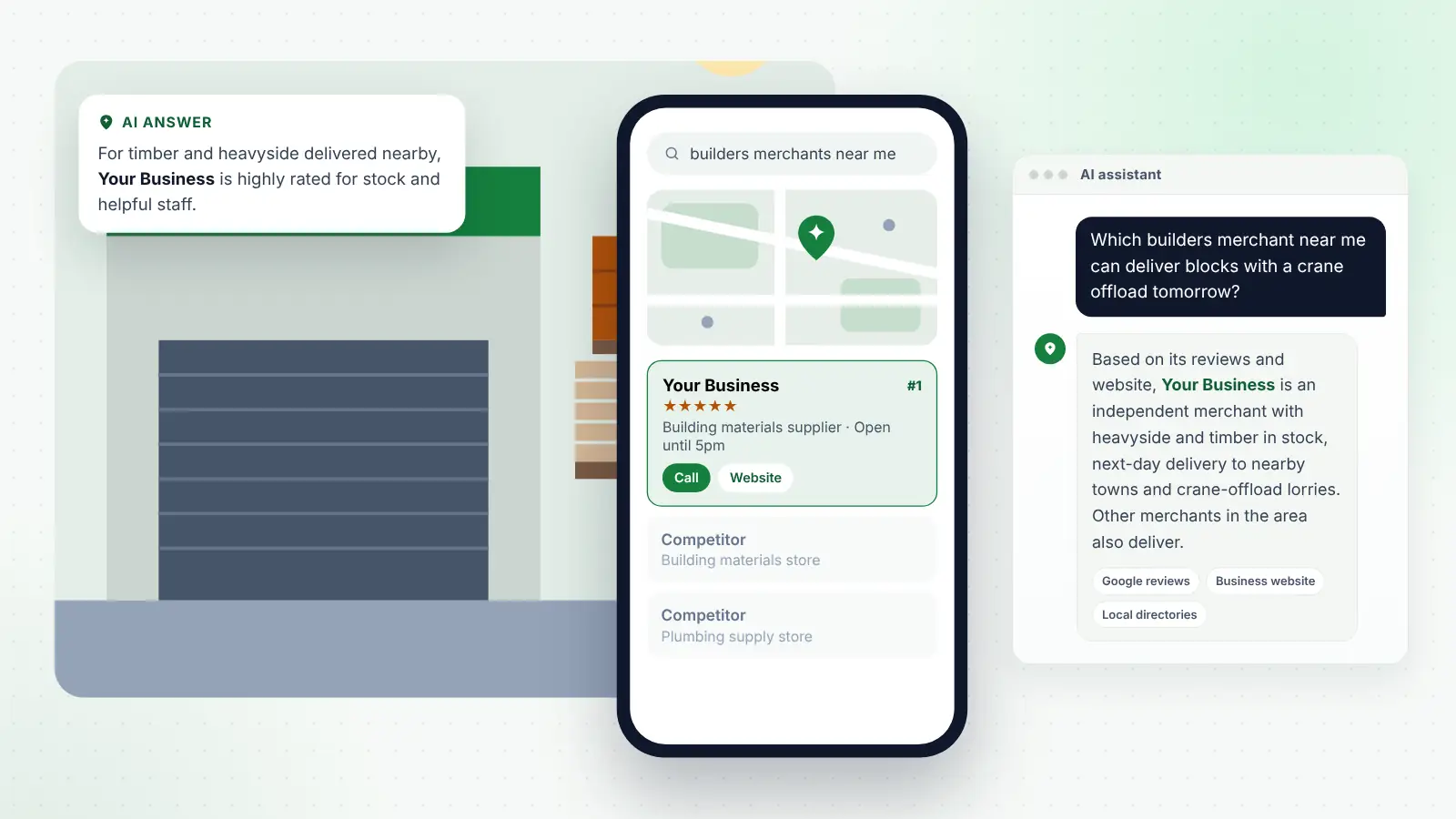
When a tradesperson needs materials, they usually search with their phone in the van. Typical searches include “builders merchants near me”, “timber merchant near me”, “plumbers merchant open now”, “roofing supplies near me”, “sand and cement delivered” and “paving slabs near me”. Homeowners search in a similar way, often for landscaping materials or delivered bulk bags. The merchants at the top of the map get far more calls and visits.
Local visibility for a merchant rests on six things:
- Google Business Profile. Choose accurate categories, such as building materials supplier, timber merchant or plumbing supply store, add your departments, trade counter hours and Saturday opening, and post photos of the yard, stock and delivery fleet. Each branch should have its own profile.
- Delivery area pages. Write a genuinely useful page for each town you regularly serve, with delivery days, lead times, crane offload availability and the branch that covers it. Avoid copying the same text and changing the town name.
- Department pages. Separate pages for heavyside, timber, plumbing and heating, roofing and landscaping help customers and search engines understand what you stock. Point to your plant hire and skip hire pages where you offer them, rather than repeating that content.
- Reviews. Ask trade and retail customers for reviews and reply to every one calmly. Reviews that mention delivery, stock and named staff help most.
- Consistent details. Your name, address, phone number and opening hours should match on your website, manufacturer stockist finders, buying group listings and directories.
- Local and industry links. Mentions from local trade associations, sponsored clubs, community projects and industry news build authority over time.
Expect three to six months for this to build. If you would rather have specialists handle this while you run the yard, a service such as SEO for builders merchants and building supplies can manage your profiles, listings, content and links for you.
AI search: how trades and homeowners now ask for recommendations
A growing number of people ask AI assistants as well as searching Google. They ask questions such as “Which builders merchant near me sells FSC timber?”, “Where can I get a combi boiler spare today near Leeds?” or “Who delivers paving slabs with a crane offload in my area?” in ChatGPT, Gemini, Perplexity or Copilot, and Google’s AI Overviews answer similar questions at the top of search results.
These tools build their answers from information they can cross-check across the web, so the same groundwork matters:
- Consistent information. The same name, address, hours and departments everywhere you are listed.
- Clear descriptions. Pages that state plainly what you stock, which towns you deliver to, whether you offer crane offload and click-and-collect, and which certifications you hold.
- Detailed reviews. Reviews that mention specific products, deliveries or staff give AI tools something concrete to summarise.
- FAQs in plain English. Short answers to questions customers ask, such as how to open a trade account, what the delivery cut-off is or what a pallet deposit is.
- Mentions on reputable sites. Supplier stockist pages, buying group directories, local news and community websites add weight.
Every couple of months, ask a few AI assistants about builders merchants in your area and note what they say. Inaccurate answers usually point to outdated or inconsistent information somewhere online.
Frequently asked questions
Is it worth joining a buying group?
For most independents, yes. Collective terms and rebates are hard to match alone. Compare groups carefully, though, as fees, supplier lists and expectations differ.
Are CE-marked construction products still accepted in Great Britain?
At the time of writing, yes. Both UKCA and CE marking are accepted for construction products in Great Britain, and the government has said it wants to remain consistent with the EU regime where appropriate. Check the latest guidance, as reforms are under way.
Should we create a separate page for every town we deliver to?
Only where you have something genuinely useful to say about each one, such as delivery days, lead times and the branch that covers it. A smaller number of useful pages works better than dozens of near-identical ones.
How do we stop trade customers going to the chains?
Compete on service the chains find hard to match: reliable delivery, knowledgeable staff, flexibility and quick decisions. Then make those strengths visible online, in reviews and at the counter.
Next steps
An independent builders merchant grows by doing the basics consistently well: good buying terms, firm credit control, reliable delivery and staff who know their products. Keep your timber and product records in order, and follow the construction products reforms as they develop. Then make sure customers can see what you stock and where you deliver. Start with your Google profiles and delivery area pages, and build steadily from there.