Cookery schools start in many ways. Some begin as a chef running evening classes in a hired kitchen once a week. Others grow out of a restaurant, a farm shop or a home kitchen with a long table, and some become dedicated teaching kitchens running day classes, children’s workshops, corporate events and online sessions all year.
Whatever the scale, the business is part hospitality, part teaching and part events. You handle food and allergens like a restaurant, look after groups of strangers like an events company, sell vouchers like a gift retailer and, if you teach children, take on safeguarding duties like an activity club.
This guide covers the practical steps to starting a cookery school in the UK: the registrations and checks you need, fair booking and voucher terms, pricing, corporate and gift sales, and how to get found when people search for a class.
Key points
- Most cookery schools supply food to the public and must register with their council as a food business at least 28 days before starting; registration is free.
- Ask about allergies at booking and plan each menu so you can adapt it safely, or say honestly when you cannot.
- Children’s classes bring extra duties: a safeguarding policy, the right criminal record checks and, for longer sessions with young children, possible childcare registration.
- Cancellation, rescheduling and voucher expiry terms are covered by consumer law, so make them fair and clear before people pay.
- Corporate team building, gift vouchers and Christmas demand can be the most valuable parts of the year, but need planning months ahead.
- Most students find classes through Google Maps, gift searches and, increasingly, AI assistants.
In this guide
- Decide what kind of cookery school you are starting
- Register your teaching kitchen with the council
- Handling allergies at a hands-on cooking class
- Premises, equipment and insurance
- Running children’s classes safely
- Booking terms, cancellations and gift vouchers
- Pricing classes and filling places
- Corporate team building
- Gift experience platforms and Christmas
- Local SEO: getting found by students nearby
- AI search: how people now ask for recommendations
- Frequently asked questions
- Next steps
Decide what kind of cookery school you are starting
“Cookery school” covers several business models, each with its own costs, customers and busy seasons.
- Leisure classes. Evening, half-day or one-day classes in a cuisine or skill, such as pasta, bread, curry or knife skills. The core of most schools, and often bought as a gift.
- Longer courses. Multi-week or intensive courses for keen home cooks and young adults leaving home. Higher value, but harder to fill.
- Corporate team building. Group sessions for companies, often with a meal at the end. Larger budgets and repeat bookings.
- Children’s classes. Holiday workshops, after-school clubs and parties, with extra safety responsibilities.
- Online classes. Live or recorded cook-alongs. Low venue costs and a national audience, but more competition.
Start with one or two you can run well, then add others once your menus, systems and reviews are established.
Register your teaching kitchen with the council
If you cook, prepare, serve or supply food as part of a business, you are a food business. That usually includes a cookery school, because students eat what they make, take food home and are often served a meal. You must register with the council for the premises where you teach at least 28 days before you start trading. Registration is free, and you can register a food business through the Food Standards Agency’s online service.
If you teach in a venue hired by the session, ask the venue and the council whether you need your own registration. If you only teach online and supply no food, registration may not apply, but check if you sell ingredient kits.
Food hygiene and inspections
An environmental health officer will usually inspect your kitchen. In England, Wales and Northern Ireland, you will receive a rating from 0 to 5 under the Food Hygiene Rating Scheme. Displaying the sticker is a legal requirement in Wales and Northern Ireland and voluntary in England. A cookery school in Scotland is instead judged under the Food Hygiene Information Scheme, which gives the kitchen either a pass or an improvement required result.
A teaching kitchen has risks a restaurant does not, because untrained students handle raw meat, knives and hobs. Your food safety management system, based on HACCP principles, should cover handwashing briefings at the start of every class, separate boards for raw and ready-to-eat food, chilled storage of prepared ingredients, safe packing of food students take home, and cleaning between back-to-back sessions. Chefs and assistants need suitable food hygiene knowledge for their role, usually shown through a recognised food hygiene course.
Handling allergies at a hands-on cooking class
Allergens are where cookery schools carry the most responsibility. Students book without knowing every ingredient, and a shared kitchen with flour, nuts, dairy and shellfish makes cross-contamination easy.
Every food business must be able to tell customers which of the 14 major allergens are in the food it provides: cereals containing gluten, crustaceans, eggs, fish, peanuts, soya, milk, tree nuts, celery, mustard, sesame, sulphites, lupin and molluscs. A good process looks like this:
- Ask at booking, including for voucher redemptions and every member of a corporate group.
- Publish each menu’s allergens on the class page.
- Plan substitutions in advance, such as a gluten-free pasta dough, rather than improvising.
- Brief the chef and assistants before each class.
- Be honest about limits. If you cannot safely accommodate a severe allergy in a class, offer another class or date.
- Keep ingredient records and check labels each time you restock.
If you sell products packed before the customer chooses them, such as spice blends or sauces, they need full ingredients labels with allergens emphasised.
Tip
Make the allergy question on your booking form mandatory and repeat it in the confirmation email. Group bookers often forget to ask their colleagues, and the confirmation is a useful second prompt.
Premises, equipment and insurance
Common starting points are your own home kitchen for very small groups, a hired commercial kitchen or community venue, a restaurant kitchen outside service hours, or dedicated premises with individual cooking stations and a dining area. Teaching from home means checking with your mortgage lender or landlord, home insurer and council planning team first.
Equipment costs depend on group size and whether each student has their own station. Many schools start with shared stations and invest as classes fill.
Insurance matters in a hands-on environment. A broker who understands food and teaching businesses can advise on:
| Cover | Why it matters |
|---|---|
| Public liability | Injury to students or visitors, such as cuts and burns |
| Product liability | Harm from food you supply, including allergic reactions |
| Employers’ liability | A legal requirement in most cases once you employ staff |
| Contents and equipment | Kitchen equipment, stock and fittings |
| Business interruption | Lost income if a fire or flood forces cancellations |
Check your policy covers teaching members of the public and, if relevant, children. You will also need to register with HMRC as self-employed or set up a limited company.
Running children’s classes safely
Children’s cookery classes are popular in school holidays, but bring extra responsibilities.
Safeguarding and criminal record checks
Write a safeguarding policy covering supervision ratios, collection, photography consent, first aid and how staff raise concerns, and name a person responsible for safeguarding.
In England and Wales, the level of Disclosure and Barring Service (DBS) check you can request depends on the role. People who teach, instruct or supervise children often enough, or overnight, are in regulated activity, which allows an enhanced check with a children’s barred list check. Since 1 September 2026, being supervised by someone else no longer takes a role out of regulated activity in England and Wales, so some assistants and volunteers who were previously outside it are now within it if they work with children often enough or overnight. If you run regular children’s classes, review which roles this affects. Northern Ireland checks are handled by AccessNI under its own rules, and Scotland uses the Protecting Vulnerable Groups (PVG) scheme run by Disclosure Scotland.
Childcare registration
In England, some activity providers must register with Ofsted. The official guidance on childcare registration exemptions lists activity areas that can be exempt, such as sport, performing arts and arts and crafts. Cookery is not named, and care of less than two hours a day per child is treated separately. If you plan longer holiday clubs or drop-off sessions, especially for younger children, check the guidance and ask Ofsted before taking bookings. Wales, Scotland and Northern Ireland have their own regulators.
Booking terms, cancellations and gift vouchers
Cancellation and rescheduling
Under the Consumer Contracts Regulations, the usual 14-day right to cancel online and phone bookings does not apply to services related to leisure activities when the contract is for a specific date or period, which covers most dated cookery classes. Your terms must still be fair and transparent under the Consumer Rights Act 2015.
Sensible terms include a clear rescheduling window, letting students send a friend in their place, a full refund or free transfer if you cancel, and any minimum numbers for a class to run stated upfront.
Gift vouchers
There is no single statutory minimum expiry period for gift vouchers in the UK, but expiry terms must be fair and clearly shown at the point of sale. A short or hidden expiry date is likely to cause complaints and poor reviews even if it is technically allowed. Decide:
- How long vouchers are valid, and print the expiry date on the voucher.
- Whether they are for a specific class or a money value, and what happens if a class is discontinued or prices rise.
- When you will extend an expired voucher, such as for illness.
- How to book, including how far ahead popular dates fill.
Open-dated vouchers bought online are less clear-cut than dated bookings when it comes to cancellation rights, so take advice on your terms. If you are VAT registered, ask your accountant how VAT applies to the vouchers you sell.
Tip
Email voucher holders a reminder a couple of months before expiry. It reduces disputes, fills quieter dates and often leads to a second booking.
Pricing classes and filling places
Price each class from the bottom up: ingredients per student, staff time including setup and cleaning, venue costs, consumables such as containers and recipe cards, card fees and booking software, plus a share of insurance, marketing and equipment replacement. Then work out how many places you need to break even and set a minimum number.
A full class is usually profitable and a half-full one is not, so filling places matters more than squeezing the price. Private groups, such as hen parties and birthdays, are usually priced per person with a minimum spend.
Corporate team building
One corporate booking can fill your kitchen at a price per head above public classes, and a good day often leads to summer socials and Christmas parties. To win this work:
- Create a dedicated corporate page with formats, group sizes, timings, menus and what is included.
- Show a “from” price per person so organisers can get budget approval.
- Offer different formats, such as a relaxed cook-and-dine or a competitive challenge.
- Make the admin easy, with proper invoices, dietary forms for every attendee and insurance details on request.
- Follow up with photos and a request for a review.
Hotels, event agencies, venue finders and local business networks can refer corporate clients if they know what you offer.
Gift experience platforms and Christmas
Gift experience websites sell cookery classes alongside driving days and spa breaks. They reach people who would never have found you, but take a commission and often keep the customer relationship. Many schools use them for part of their capacity, such as midweek dates, while building direct sales. Check the commission, payment timing, who handles customer service and how unredeemed vouchers are treated.
Christmas is usually the peak for voucher sales:
- Have your voucher page live and tested by early autumn.
- Offer instant email vouchers for last-minute buyers.
- Release next year’s dates before December so recipients can book straight away.
- Schedule enough classes for the wave of bookings in January and February.
Local SEO: getting found by students nearby
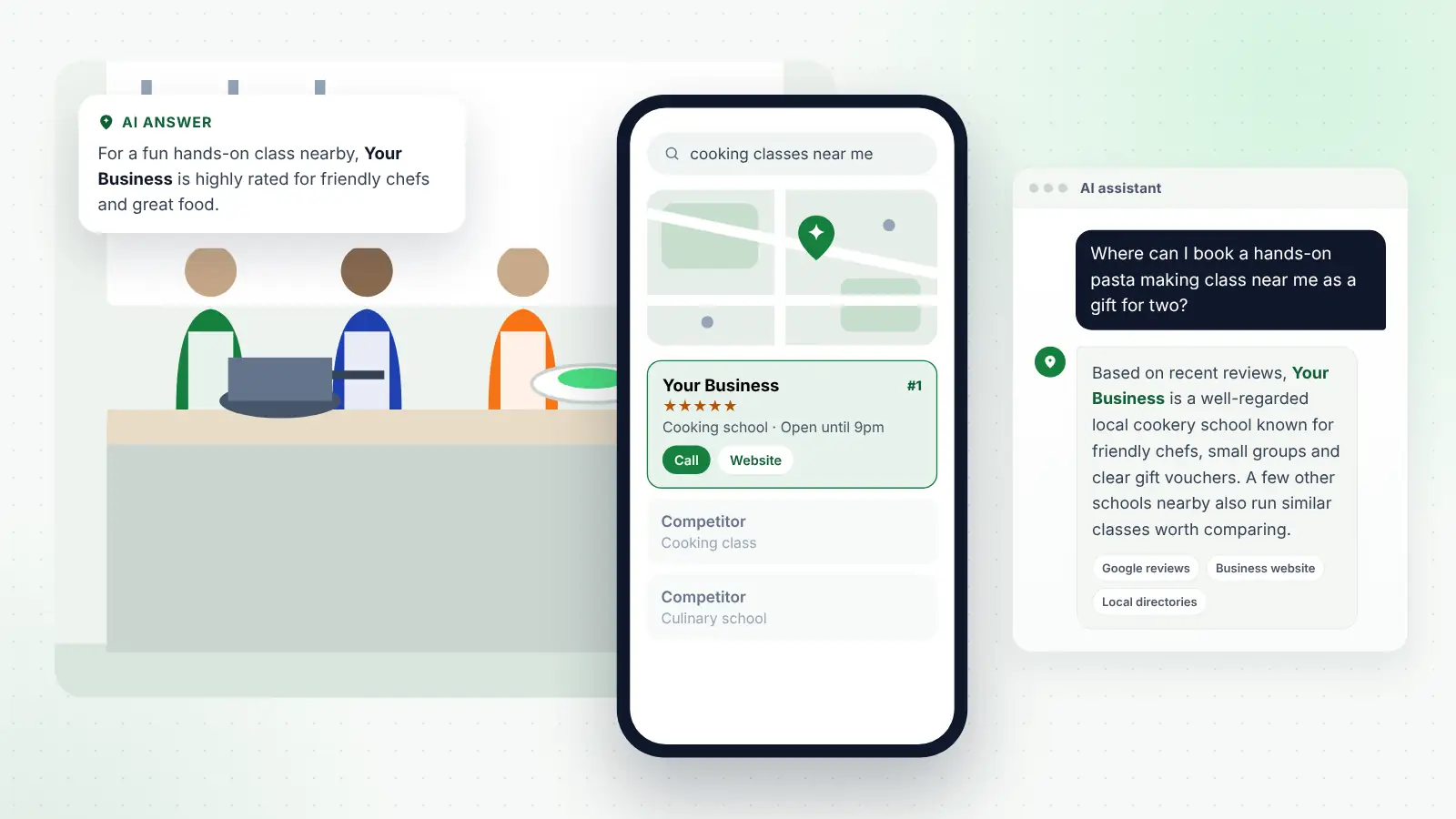
Most cookery school customers search locally: “cooking classes near me”, “pasta making class [town]”, “cookery school gift voucher”, “team building cooking class [city]” or “kids cooking classes near me”. They compare a few options on the map, look at photos and reviews, and book or buy a voucher.
Local SEO makes sure your school appears clearly for those searches and looks like the right choice when it does.
Google Business Profile
Choose the right primary category, such as cooking school, and keep class times, parking and accessibility details accurate. Add a booking link straight to your class calendar, list each class type with a starting price, and upload real photos of your kitchen, chefs, students cooking and finished dishes regularly.
Reviews
Ask every student for a review, with a QR code on the recipe card or a follow-up email the next day. Reviews that mention the chef, the cuisine and the occasion, such as “a brilliant team day” or “a lovely birthday present”, help both rankings and decisions. Reply to every review politely.
Consistent details, a clear website and local links
Your name, address, phone number and hours should match across your website, Google profile, social media, events listings and any gift platform. On your website, give each class type, corporate events, children’s classes and vouchers their own page, with menus, skill level, length, group size, allergens and dates. Mentions from local news, food bloggers, tourism sites and food festivals help establish you locally.
If you would rather spend your time teaching, specialists can take this on, for example through local SEO for cookery schools. Profile improvements can help within weeks, but stronger map rankings usually build over three to six months, so start well before the Christmas voucher season.
AI search: how people now ask for recommendations
More people now ask ChatGPT, Gemini, Perplexity, Microsoft Copilot and Google’s AI Overviews to suggest a class or gift. Their questions are detailed:
- “Where can I book a hands-on pasta making class near me as a gift for two?”
- “Which cookery schools in Manchester do team building for 20 people?”
- “Are there kids’ cooking classes in Bristol during half term?”
- “What’s a good vegan cookery class near Brighton for a beginner?”
Assistants piece together a class recommendation from details they can confirm in several places online. Improving that information is called answer engine optimisation, or AEO. They tend to rely on:
- Consistent information about your location, classes and booking details.
- Reviews that describe specific classes, chefs and occasions.
- Clear class descriptions naming the cuisine, skill level, group size and who the class suits.
- FAQs on your website covering vouchers, dietary needs, age limits, parking and what to bring.
- Mentions on reputable sites, such as local news, tourism guides and food blogs.
If you want to be recommended for team building, publish a detailed corporate page, show photos of group events and encourage corporate clients to mention it in reviews. AI tools cannot recommend you for something they cannot find evidence of.
Frequently asked questions
Do I need qualifications to run a cookery school?
There is no specific licence to teach cookery in the UK. You do need suitable food hygiene knowledge, insurance and food business registration, and students will want to know about your cooking background.
Can I run cookery classes from my home kitchen?
Often yes, for small groups, but you still need to register as a food business. Check with your mortgage lender or landlord, your insurer and your council’s planning team.
Can students cancel a class they booked online?
The 14-day cancellation right for online bookings does not apply to leisure services booked for a specific date. Your own terms must still be fair and clear, and many schools allow rescheduling or transfers.
Do my staff need DBS checks for children’s classes?
It depends on the role and how often they work with children. Staff who teach or supervise children often enough, or overnight, are likely to be in regulated activity and eligible for an enhanced check with a barred list check.
How long should a gift voucher last?
There is no fixed legal minimum in the UK, but terms must be fair and clearly shown. Many schools offer a year or more and print the expiry date on the voucher.
Next steps
Starting a cookery school rewards careful preparation. Register with your council early, build allergen and safeguarding processes before you need them, insure properly and write booking and voucher terms that are fair to students and sustainable for you.
Once classes are running, focus on filling every place. Keep class pages, photos and reviews fresh, plan for Christmas and corporate demand months ahead, and make it easy for people and AI assistants to understand what you teach, who it suits and how to book.