A bridal boutique sells one of the most emotional purchases most people ever make. A bride may visit several shops, bring her mother and best friend, try on a dozen gowns and still go home to think about it. The boutique that wins is rarely the one with the most rails. It is the one that makes the appointment feel special, explains the process honestly and leaves her confident that the dress, the fit and the timing will be right on the day.
That decision now starts long before she walks through your door. She saves dresses on social media, searches for designers, reads reviews and increasingly asks an AI assistant which boutiques nearby suit her style and budget. If your shop is hard to find, or your website says little about what you stock and what it costs, she books somewhere else.
This guide is for independent bridal shops that want to grow steadily. It covers appointments, designers, sample sales, pricing, alterations, lead times, deposits and consumer rights, reviews, wider wedding-party ranges and how to appear in local search and AI recommendations.
Key points
- Treat the appointment as your product: make it easy to book, explain what happens and protect your busiest slots.
- Describe the designers you stock accurately, and only call yourself an official or authorised stockist when that is true.
- Price ranges, honest lead times and clear alteration costs help brides book with confidence.
- Deposit and cancellation terms must be fair, and charges should reflect your real losses, even for made-to-order gowns.
- Bridesmaid and mother-of-the-bride ranges raise the value of each wedding and bring in more of the wedding party.
- A strong Google profile, detailed reviews and clear collection pages feed both Google Maps and AI assistants.
In this guide
- Make the appointment your product
- Choosing and describing your designers
- Price ranges and honest expectations
- Sample sales and off-the-peg dresses
- Lead times, deposits and consumer rights
- Alterations and fittings
- Bridesmaids, mother of the bride and accessories
- Bride reviews and wedding-party recommendations
- Local SEO for bridal shops
- AI search: how brides ask for recommendations
- Frequently asked questions
- Final thoughts
Make the appointment your product
Brides compare the experience as much as the dresses, and they talk about it afterwards, in reviews and to friends who are getting married next. Offer online booking from your website and Google Business Profile, confirm each appointment by email or text, and say clearly:
- How long an appointment lasts and whether there is a fee.
- How many guests the bride can bring.
- What to bring, such as suitable underwear, shoes of a similar height and inspiration images.
- How far ahead of the wedding she should start looking.
- Whether you offer private or after-hours appointments, and accessibility details.
Saturday slots are usually in high demand, and a no-show can cost you a sale. Some boutiques take a small redeemable booking fee for peak times, while others ask brides to confirm a few days before. Either way, explain it politely on the booking page. A short pre-appointment questionnaire about the wedding date, venue, budget and preferred styles lets your consultant pull suitable gowns in advance and makes the bride feel looked after from the start.
Tip
Send a short message the day after every appointment, whether or not the bride bought. Thank her, remind her of the dresses she liked and say how long you can hold her preferred sample. Many brides decide in the days after their visit.
Choosing and describing your designers
Many brides search for a designer by name, then look for a shop nearby where they can try the dresses on, so your designer list is one of your most important marketing assets. When choosing labels, think about the price points local brides can afford, minimum order commitments, delivery reliability and whether a nearby competitor already stocks the same collection. Two or three core designers with a clear style, plus an accessible range for tighter budgets, is usually easier to market than a long list of names.
Take care with designer names and trade marks
Designer names are usually registered trade marks, and many stockist agreements set out how names, logos and images can be used. In general, it is reasonable to state accurately which designers you stock and to describe genuine gowns by name. Problems arise when a shop:
- Calls itself an “official” or “authorised” stockist without that status.
- Uses logos, campaign photographs or lookbook text without permission.
- Keeps advertising a designer after it has stopped stocking them.
- Describes lookalike gowns using a designer’s name, or uses the name in its own business name or domain.
Check your agreements for rules on online advertising, sample sales and discounting, and take advice if you are unsure.
Price ranges and honest expectations
A complete absence of prices often stops brides booking at all, because they assume the shop is out of their budget. Prices vary widely by designer, fabric and area, and gowns can range from a few hundred pounds for samples to several thousand for designer collections. You do not need to price every gown:
| What to show | How to present it | Why it helps |
|---|---|---|
| Gown prices | A range for the shop and for each designer | Brides know whether to book |
| Sample and off-the-peg dresses | A “from” price and how they differ | Attracts tighter budgets and short timescales |
| Alterations | Typical ranges, or how quotes work | Avoids surprises after the dress is chosen |
| Accessories | Starting prices for veils and headpieces | Encourages add-ons at the right time |
| Appointment fees | Any fee, and whether it is redeemable | Sets expectations before booking |
Make sure headline prices are honest. Under the Digital Markets, Competition and Consumers Act 2024, rules in force since 6 April 2025 require the price shown to include any mandatory charges.
Sample sales and off-the-peg dresses
Sample sales clear ex-display stock, make room for new collections and attract brides who might never have booked a full-price appointment. Run well, they also bring new names onto your mailing list.
- Check your stockist agreements, as some designers have rules on discounting and advertising samples.
- Describe each gown honestly, including size, condition and any marks or repairs, and point out faults before the bride buys.
- Explain whether alterations, cleaning or steaming are included.
- Use timed booking slots so the shop does not become overcrowded.
- Give a receipt that records the condition of the gown.
Under the Consumer Rights Act 2015, goods must be of satisfactory quality, but a bride generally cannot later complain about a fault that was specifically pointed out to her before she bought. That is why a written condition note matters. Labelling a dress “sold as seen” does not remove statutory rights, so avoid wording that suggests it does.
Lead times, deposits and consumer rights
Most designer wedding dresses are made to order once a deposit is paid, and production can take several months depending on the designer and season. Clear terms protect both the bride and your business.
Be clear about lead times
Tell brides when to order, how long their chosen designer usually takes and when fittings will happen. Build in time for delivery and alterations, and say plainly if a wedding date is too close for a made-to-order gown, offering sample or off-the-peg options instead. Chase suppliers proactively and update the bride before she has to ask.
Deposits and cancellation charges
Your terms should explain how much deposit is paid and when, when the balance is due, and what happens if the bride changes her mind or the wedding is postponed. The government’s guide to cancelling goods or services says businesses cannot rely on unfair terms, that non-refundable deposits should only be a small percentage of the total price, and that cancellation charges should be a genuine estimate of the business’s direct loss.
Once a gown has been ordered from the designer, your real loss may be significant, which is a fair reason to explain that cancellations after ordering are likely to cost more. Before the order is placed, a large non-refundable sum is much harder to justify.
In-store, online and phone orders
The statutory 14-day right to cancel applies to online, phone and other distance sales, and to off-premises contracts such as orders taken at a bride’s home, not to purchases made in your shop. If you take orders remotely, the Consumer Contracts Regulations 2013 usually give customers 14 days to cancel, but there is an exception for goods made to the consumer’s specifications or clearly personalised. Whether an order falls within it depends on the facts: a standard-size gown from a designer’s range may not be treated in the same way as one with bespoke changes, so take advice when drafting your terms.
A made-to-order dress must still match its description and be of satisfactory quality when it arrives. If it does not, the bride has statutory remedies, which can include rejecting it or a repair or replacement, whatever your terms say.
Tip
Give every bride a one-page order summary showing the designer, style, size, colour, deposit paid, expected delivery window, fitting plan and cancellation terms. It prevents most disputes before they start.
Alterations and fittings
Alterations are where a good dress becomes the right dress, and they are a common source of complaints when costs or timescales are unclear.
- Explain how alterations work. Say whether they are done in-house or by a partner, how many fittings are usual and when to book the first.
- Quote before you start. Give a written estimate after the first fitting and confirm before doing anything that costs more.
- Be realistic about timing. Summer fills up quickly, so tell brides early.
- Consider altering dresses bought elsewhere if you have capacity. It brings new customers into the shop.
Alterations are a service, and under the Consumer Rights Act 2015 services must be carried out with reasonable care and skill. Keep notes and photographs of what was agreed at each fitting.
Bridesmaids, mother of the bride and accessories
Bridesmaid dresses, mother-of-the-bride outfits, flower girl dresses and accessories increase the value of each wedding and bring more people into your shop. Give each range its own page, mention it in your Google profile and offer group bridesmaid appointments. Mothers of the bride often search separately, sometimes months after the bride has chosen, so a page with styles, sizes and price ranges helps them find you.
Veils, headpieces and belts are best offered once the gown is chosen, when the bride can see how they complete the look. She will often return for them closer to the wedding.
Bride reviews and wedding-party recommendations
A detailed review describing a patient consultant, a relaxed appointment and a perfect final fitting is far more persuasive than a row of stars. Ask after the final fitting, at collection or shortly after the wedding, with a direct link to your Google review form. With her permission, ask whether you can share a wedding photograph, crediting the photographer.
Don’t reward brides for glowing reviews, don’t post reviews yourself or ask your consultants to, and answer every review graciously, even an unhappy one. The Digital Markets, Competition and Consumers Act 2024 bans fake reviews, so a genuine, steady flow is the only safe approach. Relationships with venues, photographers, planners, florists and hair and make-up artists can also bring regular referrals.
Local SEO for bridal shops
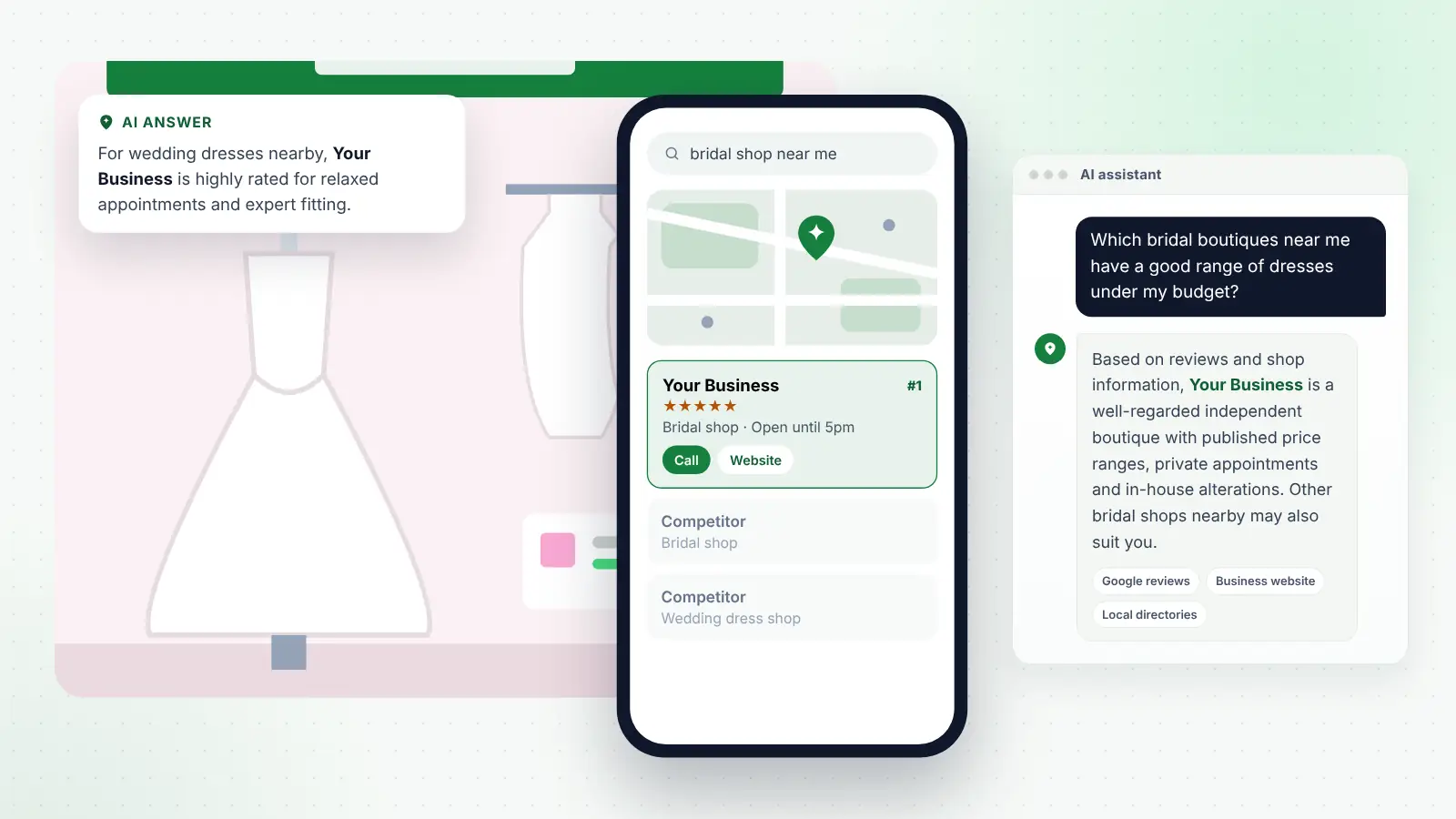
When a bride searches for “bridal shop near me”, “wedding dress shops in [town]” or “plus-size bridal boutique near me”, Google shows a map with a small number of businesses. Brides want to try dresses on before buying and will travel a reasonable distance, so those map positions are where many shortlists begin. Searches such as “mother of the bride outfits near me” and “wedding dress alterations near me” are often made by people who have never heard of you.
The essentials of local SEO for a bridal shop are:
- A complete Google Business Profile. Choose the most accurate primary category, such as Bridal shop, add an appointment link, hours, accessibility details and a description based on what you are known for.
- Real photographs, added regularly. Your shop front, fitting rooms, team and brides in your gowns with their permission, not only designer campaign images.
- Steady, detailed reviews. Genuine reviews arriving after each fitting or collection, each with a reply, count for more than a flurry after one sample sale.
- Consistent details everywhere. Name, address, phone number and hours should match across your website, Google, Apple Maps, Bing and wedding directories.
- A page for each collection and service. Bridal gowns, each designer, sample sales, plus-size bridal, bridesmaids, mother of the bride and alterations, each with price guidance and how to book.
- Local and wedding links. Mentions on wedding blogs, venue supplier lists, local news and business groups.
If you would rather have specialists handle this, our local SEO for bridal shops and wedding dress boutiques covers your profile, listings, collection content and links on a rolling monthly plan.
Things bridal shops commonly get wrong
- Listing designers they no longer stock.
- Showing only designer photography and nothing of the shop or experience.
- Leaving out prices entirely.
- Forgetting to update hours for bank holidays and sample sale days.
- Never mentioning the towns brides travel from.
AI search: how brides ask for recommendations
Many brides now ask AI assistants such as ChatGPT, Gemini, Perplexity, Copilot and Google’s AI Overviews for help, with long, specific questions: “which bridal boutiques near me stock this designer?”, “where can I try on wedding dresses in a size 20 near [town]?” or “how far in advance should I order my wedding dress?”
A chatbot recommending wedding dress shops relies on details it can verify, and leans towards boutiques with matching listings, specific bride reviews and clear websites. For a bridal shop, that means:
- Clear collection descriptions. The designers you stock, the styles and size ranges you carry and your typical prices.
- Helpful FAQs. Lead times, appointment fees, alterations, deposits and when to start looking.
- Current information. Out-of-date designer lists and old sample sale dates can be repeated back to brides.
- Mentions on reputable sites. Wedding blogs, venue supplier lists, local news and directories.
- Detailed reviews. Reviews such as “they found me a dress that suited my budget and my shape” help AI tools match you to similar questions.
No one can guarantee an AI assistant will recommend you, but the work that helps brides choose you is what these tools rely on. Ask a few common questions yourself every few months to see how your boutique is described.
Frequently asked questions
Can brides cancel a wedding dress they ordered in the shop?
The statutory 14-day right to cancel applies to distance and off-premises contracts, not purchases made in your shop. What happens if a bride changes her mind depends on your terms, which must be fair, with charges reflecting your real losses.
How much deposit should a bridal shop take?
There is no single legal figure. Many boutiques take a deposit when the gown is ordered and the balance before collection. Government guidance says non-refundable deposits should only be a small percentage of the total price, and cancellation charges should be a genuine estimate of your loss.
Can I say I stock a designer on my website?
Generally, you can state accurately which designers you stock. Do not call yourself an official or authorised stockist unless you are, do not use logos or campaign images without permission, and remove designers you no longer stock.
How long does local SEO take to work for a bridal shop?
Profile and directory fixes can bring extra try-on bookings within weeks, while higher map positions and AI mentions tend to take three to six months, so start well before the post-Christmas engagement season.
Final thoughts
Independent bridal shops do not need the biggest showroom to thrive. They need a memorable appointment, honest prices and timescales, fair terms, careful alterations and a reputation brides share with friends. When your Google profile, website and reviews tell that same story, brides and AI assistants are far more likely to point people to your door. Start with an up-to-date designer list, clear price ranges and a simple review request.