Health and safety training is one of the few services almost every employer needs, whatever their size or sector. Offices need first aiders and fire marshals, warehouses need forklift operators and manual handling training, construction firms need supervisors with recognised safety qualifications, and a growing number of employers want mental health first aiders alongside their physical first aid cover. The work is steady, much of it repeats on a fixed cycle, and a good trainer quickly builds a loyal base of local clients.
It is also a business where credibility is everything. The person booking a course is usually an office manager, HR lead or site supervisor who needs to show that their staff have been trained properly. They want to know that a certificate will stand up to scrutiny from an insurer, a client or an inspector, and they rarely have time to research the difference between awarding bodies, accreditation schemes and course approvals. The providers who explain that clearly tend to win the work.
This guide covers how the regulatory side works for first aid, IOSH and NEBOSH courses and lift truck training, how to build a course range and pricing model, the costs to plan for, VAT and funding, and how to use local search and AI search to reach employers in your area. It assumes you already have, or are working towards, the technical knowledge to teach; the focus is on building a business around it.
Key points
- HSE stopped approving first aid training providers on 1 October 2013, so employers must now check a provider’s competence themselves, and your job is to make that easy for them.
- Most new first aid businesses deliver regulated qualifications through an awarding organisation such as Qualsafe Awards, Highfield or First Aid Awards, which handles much of the quality assurance.
- IOSH and NEBOSH courses each require their own approval: approved IOSH training provider status and accredited NEBOSH Learning Partner status respectively.
- Lift truck training accreditation is voluntary, but bodies such as RTITB, AITT and ITSSAR are widely recognised by employers and insurers.
- First aid at work certificates last three years, so every course you run creates a future renewal you can plan for.
- Clear course pages, visible credentials and detailed reviews help employers and AI assistants find and recommend you.
In this guide
- Decide what kind of training business you are building
- First aid training: how the rules work
- IOSH and NEBOSH courses
- Forklift, plant and workplace transport training
- Fire marshal and manual handling courses
- Startup costs and planning
- VAT and the business side
- Local SEO for health and safety training providers
- AI search: how employers choose a training provider now
- Common mistakes new training providers make
- Frequently asked questions
- Final thoughts
Decide what kind of training business you are building
“Health and safety training” covers a wide range of courses with very different setups, customers and rules. It is worth deciding early which you will offer at launch and which you will add later.
| Course area | Typical customer | What sits behind the certificate | Delivery |
|---|---|---|---|
| Emergency first aid at work and first aid at work | Any employer with first aiders | Regulated qualification or provider meeting HSE criteria | Open courses or on site |
| Paediatric first aid | Nurseries, childminders, schools, parents | Regulated qualification | Often evenings and weekends |
| Mental health first aid | Offices, public sector, larger employers | Licensed programme or regulated qualification | Classroom or virtual |
| Fire marshal and fire warden | Offices, shops, schools, care homes | Usually provider certificate or regulated award | Half day, often on site |
| Manual handling | Warehouses, care, retail, logistics | Usually provider certificate or regulated award | Short sessions on site |
| IOSH Managing Safely and Working Safely | Supervisors and managers | Approved IOSH training provider status | Classroom or virtual |
| NEBOSH certificates | Safety officers, managers, career changers | Accredited NEBOSH Learning Partner | Longer courses, exams |
| Lift truck and workplace transport | Warehouses, distribution, manufacturing | Voluntary accreditation body | On site or at a training centre |
Many independent trainers start with first aid, because the setup costs are modest and demand is constant, then add fire marshal, manual handling and mental health first aid as natural extensions. IOSH, NEBOSH and forklift training each bring more demanding approvals and equipment, but also higher-value bookings and a different type of client.
First aid training: how the rules work
The Health and Safety (First-Aid) Regulations 1981
The Health and Safety (First-Aid) Regulations 1981 require employers to provide adequate and appropriate first aid equipment, facilities and people, based on an assessment of their workplace. The regulations do not set a fixed number of first aiders for every business; employers decide what is appropriate for their own risks, size and circumstances.
Until 2013, HSE approved first aid training providers directly. That changed on 1 October 2013, when amendments to the regulations removed HSE’s approval role. Providers can no longer describe themselves or their courses as HSE approved. Instead, employers have more choice over who trains their staff, and they are expected to carry out due diligence to satisfy themselves that the provider is competent.
This matters for how you describe your business. Phrases such as “HSE approved first aid course” are out of date and can mislead. You can say that a course follows the HSE syllabus for first aid at work, or that it leads to a regulated qualification, but not that HSE has approved you.
What HSE expects of a competent provider
HSE’s guidance sets out what a competent first aid training provider should be able to show. In broad terms, it covers:
- Trainer and assessor qualifications. Your trainers and assessors should hold suitable first aid and teaching or assessing qualifications.
- Quality assurance. A system for monitoring trainers, gathering feedback, handling complaints and maintaining equipment.
- Standards of teaching and practice. Training that follows current Resuscitation Council (UK) guidelines and the first aid manual of the voluntary aid societies, or guidance consistent with them.
- Syllabus content. Emergency first aid at work and first aid at work courses that cover the required topics.
- Certification. Certificates that clearly identify the course or qualification and show its three-year validity.
HSE’s page on first aid training and qualifications explains these points and is worth reading in full before you design your courses.
Course lengths and certificate validity
According to HSE, a first aid at work course involves at least 18 hours of training over a minimum of three days, and an emergency first aid at work course at least six hours over a minimum of one day. First aid at work certificates last three years, and a first aider needs to requalify before the certificate expires to continue in the role. HSE also strongly recommends, though does not require, an annual refresher of around half a day during each three-year period.
For a training business, that cycle is valuable. Every first aider you train is a renewal in three years’ time, and a refresher opportunity in between.
Regulated qualifications or your own certificates
Employers choosing a provider typically look for one of several things: a regulated qualification issued through an awarding organisation recognised by Ofqual, SQA Accreditation, Qualifications Wales or CCEA Regulation; membership of a voluntary accreditation scheme or trade body; delivery by one of the voluntary aid societies; or an independent provider whose credentials they check themselves.
For most new businesses, becoming an approved centre with an awarding organisation is the most practical route. Well-known first aid awarding organisations include Qualsafe Awards, Highfield Qualifications and First Aid Awards (FAA), among others. The awarding organisation approves your centre, sets out requirements for your trainers and assessors, provides or approves course materials, and carries out external quality assurance. In return you register learners and pay certification fees. Compare a few before you commit, looking at:
- Centre approval fees and per-learner certification costs.
- Trainer and assessor requirements, and whether they accept your existing qualifications.
- The range of qualifications, such as paediatric, outdoor or mental health courses, you could add later.
- How quickly certificates are issued, and how easy their systems are to use.
- The support and quality assurance visits you can expect.
Tip
Write a short, plain-English page called something like “Is this course right for my workplace?” explaining the difference between emergency first aid at work, first aid at work and paediatric first aid. It is one of the most common questions employers ask, and it makes excellent content for search.
Mental health first aid
Mental health first aid courses have grown quickly. There is no legal requirement for employers to have mental health first aiders, and you should not suggest otherwise, but many employers include mental health in their wider wellbeing and first aid planning. You can deliver these courses through a licensed programme, such as becoming a licensed instructor with MHFA England, or through a regulated mental health first aid qualification offered by an awarding organisation. Either way, describe clearly what the course covers and what it does not, as attendees are not being trained as counsellors or clinicians.
IOSH and NEBOSH courses
IOSH and NEBOSH are the two names employers most often recognise for workplace safety courses, and each has its own route for providers.
Approved IOSH training provider
IOSH courses, such as Managing Safely and Working Safely, are delivered by approved IOSH training providers. According to IOSH, your organisation needs at least one trainer who is a Technical Member of IOSH, keeps up to date with continuing professional development, holds a level 3 adult training qualification on a regulated framework or has completed IOSH’s own train the trainer course, and has at least two years of substantial face-to-face training experience. Some courses have additional requirements. Once approved, you manage courses, order workbooks and request certificates through IOSH’s provider portal. The IOSH page on delivering its courses sets out the current requirements.
Accredited NEBOSH Learning Partner
NEBOSH qualifications, such as the National General Certificate, can only be delivered by accredited NEBOSH Learning Partners. The process starts with an accreditation enquiry, and NEBOSH then invites suitable organisations to make a formal application, which carries fees and a validation visit. NEBOSH expects applicants to meet its Learning Excellence Principles at Silver level or above, to have qualified tutorial staff for each qualification, and to have suitable course materials in place before applying. It also asks new Learning Partners not to use agents or booking sites for NEBOSH services during their first year.
NEBOSH accreditation is a bigger step than IOSH approval, so many smaller providers start with IOSH Managing Safely and first aid, then consider NEBOSH once they have the staff and volume to support it.
Forklift, plant and workplace transport training
Lift truck training is governed by HSE’s approved code of practice for rider-operated lift trucks, which expects operators to be trained to a recognised standard, whether by in-house instructors or external providers. Accreditation is voluntary, and HSE no longer runs its own accrediting bodies scheme. In practice, though, many employers, insurers and agencies expect to see training accredited by one of the established bodies, such as RTITB, AITT, ITSSAR or NPORS. Each sets standards for instructors, training centres and courses, registers instructors and carries out audits.
If you want to offer forklift training, plan for:
- An instructor who has completed an accredited instructor course and is registered with your chosen body.
- Suitable trucks and a safe training area, or a clear process for training on the employer’s own equipment and site.
- Separate courses for novice operators, experienced operators and refresher training.
- Clear explanations of basic training, specific job training and familiarisation, which employers often confuse.
Construction clients and CITB grants
If you train construction workers, CITB grants can make your courses more attractive. CITB-registered employers who are up to date with their levy returns can claim short course grants for eligible training. When the provider is a CITB Approved Training Organisation or a member of the Training Provider Network, the provider reports the achievement and the grant is processed automatically; with other providers, the employer applies themselves. CITB changed its funding arrangements from January 2026 and has been introducing new plant training standards, so check the current CITB short course grants rules for each course before you mention grants in your marketing.
Fire marshal and manual handling courses
Fire marshal and manual handling courses are short, widely needed and easy to combine with first aid on the same visit. Under fire safety law, the responsible person for a workplace must appoint competent people to help with fire safety measures, and manual handling training supports employers’ duties to reduce the risk of injury from lifting and carrying. Neither course needs a central approval, but offering a regulated award or a clear, documented syllabus gives employers more confidence.
These courses work best when they are tailored. A fire marshal course for a care home should cover evacuation of residents who cannot move unaided; manual handling for a warehouse should use the loads staff actually lift. Ask about the workplace before you quote, and say on your website that you do.
Startup costs and planning
Costs vary widely by course range, area and whether you rent a venue or deliver mainly on site. Use this as a planning checklist rather than a price list.
| Item | What to consider | Notes |
|---|---|---|
| Trainer qualifications | First aid, teaching or assessing, IOSH or instructor courses | Budget for time away from paid work |
| Awarding organisation | Centre approval, annual fees, per-learner certification | Compare several before you commit |
| Equipment | Adult, child and infant manikins, defibrillator trainers, bandages, hygiene supplies | Manikins need regular cleaning and replacement parts |
| Venue | Training room hire or your own centre | Many start on site only, then add open courses |
| Forklift setup | Trucks, training area, accredited instructor | Often the largest single cost |
| Insurance | Public liability, professional indemnity, employers’ liability if you hire staff | Specialist training cover is worth comparing |
| Booking and records | Online booking, learner records, certificate tracking | Must support awarding body audits |
| Marketing | Website, Google Business Profile, photography | Real photos of your sessions build trust |
Pricing open and on-site courses
Most providers run two pricing models. Open courses are priced per delegate, with a venue the employer sends staff to. On-site courses are priced per group, with a minimum and maximum number of learners and a travel area. Be clear about what each price includes: certificates, manuals, registration fees, refreshments and any travel charge. Small employers often want only one or two first aiders trained, so open courses with published dates are an important part of the mix.
Tip
Keep a renewal list from day one. Record each client’s certificate expiry dates and contact them three or four months beforehand. A provider who reminds an employer before a certificate lapses is far more likely to get the rebooking than one who waits to be found again.
VAT and the business side
VAT is a common question for new training providers. Some education and vocational training is exempt from VAT, but the exemption mainly applies to eligible bodies such as colleges, universities, local authorities and certain non-profit organisations, along with a few narrow cases. A commercial training business will generally need to charge VAT on its courses once it is VAT-registered. The registration threshold is currently £90,000 of taxable turnover in a rolling 12-month period.
This affects your pricing. Many of your clients will be VAT-registered businesses that can reclaim the VAT, but charities, schools, sole traders and individuals often cannot, so be clear whether your prices include VAT. Speak to an accountant about your own position before you set your prices.
Also think about the structure of your business. Will you work alone, use freelance trainers, or employ staff? If you use freelance trainers, your awarding organisation and accreditation bodies will still expect you to check their qualifications, observe their teaching and keep records.
Local SEO for health and safety training providers
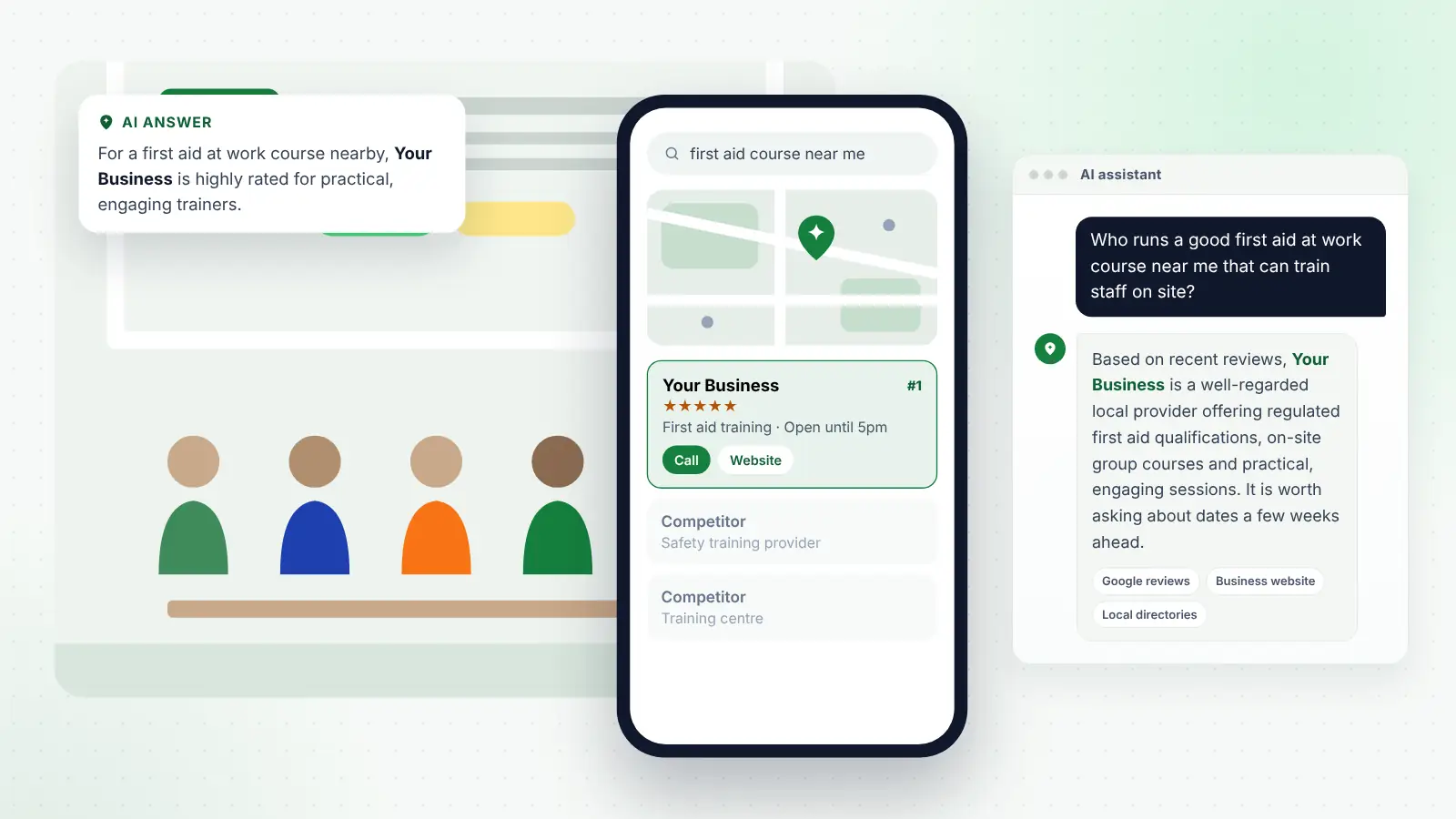
Most bookings start with a search. An office manager types “first aid course near me” or “emergency first aid training [town]”, a warehouse supervisor searches “forklift training near me”, and a care home manager looks for “fire marshal training on site”. Many of them compare three or four providers on the same screen, and the ones in the Google Maps results get the most attention.
Local search suits this business because location genuinely matters. Employers want an open course their staff can reach without a long journey, or a trainer who covers their area for on-site delivery.
Google Business Profile
Choose a primary category that matches your main work, such as first aid training or safety training, and add relevant secondary categories. List each course as a service, with a short description of who it is for and how long it takes. Add real photos of your training room, equipment and sessions in progress (with permission from learners), set accurate opening hours and link straight to your course dates or booking page. If you deliver mainly on site, set a service area that reflects where you actually travel.
Reviews
Ask every learner for a review after each course, and make it easy with a direct link in your follow-up email or a QR code on the course handout, without pressuring anyone to post one there and then. Reviews that mention the course, the trainer’s approach and how practical and relevant the session felt are far more persuasive than a star rating alone. Ask the person who booked for a review too, as their perspective on organisation and communication matters to other employers.
Consistent details
Your business name, address and phone number should match exactly on your website, Google profile, Apple and Bing listings, business directories, and any awarding body or accreditation directories that list you. Inconsistent details make it harder for search engines and AI tools to be sure which business they are describing.
A website with course and area pages
Build a separate page for each course: emergency first aid at work, first aid at work, requalification, paediatric, mental health first aid, fire marshal, manual handling, IOSH Managing Safely and each forklift course. Each page should explain who it is for, course length, what qualification or certificate learners receive, how long it is valid, prices and dates. Add pages for the towns you serve, but only where you have something genuinely local to say, such as your nearest venue or on-site work for local employers. If you would rather have specialists handle this, our local SEO for health and safety training providers service covers the profile, listings, content and links.
Local links
Useful links often come from relationships you already have: chambers of commerce and business groups, local sports clubs and charities you train, childcare networks, community events where you run CPR awareness sessions, and partner businesses such as defibrillator suppliers or HR consultants. A genuine mention on any of these sites tells search engines you are an established local business.
AI search: how employers choose a training provider now
More people now ask an AI assistant before they search. An office manager might ask ChatGPT, “How many first aiders do we need and who runs courses near me?” A warehouse manager might ask Gemini, “Which forklift training providers near Northampton are accredited?” A charity coordinator might ask Copilot or Perplexity, “Where can our volunteers do a mental health first aid course?” Google AI Overviews also summarise answers at the top of many searches.
Assistants draw on whatever trustworthy information about local course providers they can locate. They tend to favour businesses whose details are consistent across the web, whose reviews describe specific experiences and whose websites answer common questions clearly. For a training provider, that means:
- Course pages that state the length, certificate, validity and who the course is for.
- An FAQ section answering the questions employers really ask, such as whether emergency first aid at work is enough for their workplace, how long certificates last and whether you can train on site.
- Accurate statements about your credentials, such as the awarding organisation you work with, your IOSH or NEBOSH status, or your lift truck accreditation body.
- Up-to-date information, because AI tools repeat outdated claims such as “HSE approved” if they find them.
- Mentions on reputable local and industry websites, such as business groups, partner organisations and local news about community training.
AI visibility usually builds alongside local SEO rather than separately. The work that helps you appear on Google Maps, such as reviews, consistent details and clear content, also makes an assistant more confident recommending you.
Common mistakes new training providers make
- Describing courses as “HSE approved”. HSE stopped approving providers in 2013, and the phrase can mislead.
- One page for every course. A single “our courses” page cannot rank well for first aid, fire marshal and forklift training at once.
- Hiding what is included. Employers want to know about certificates, manuals, registration fees and VAT before they book.
- Ignoring renewals. Losing track of expiry dates means losing the easiest bookings you will ever get.
- Generic sessions. Training that ignores the employer’s actual workplace leads to forgettable courses and weak reviews.
- Stock photos. Employers want to see your real trainers, venue and equipment.
Frequently asked questions
Do I need HSE approval to run first aid courses?
No. HSE stopped approving first aid training providers on 1 October 2013. Employers now carry out their own due diligence, so you need to show that you meet HSE’s criteria for a competent provider, usually by delivering regulated qualifications through an awarding organisation or by belonging to a recognised accreditation scheme.
Which awarding organisation should I choose?
There is no single right answer. Qualsafe Awards, Highfield Qualifications and First Aid Awards are well-known options, among others. Compare their centre fees, certification costs, trainer requirements, range of qualifications and the support they offer before deciding.
Can I deliver IOSH courses as a sole trader?
IOSH approval depends on your organisation having at least one trainer who meets its requirements, including Technical Membership of IOSH, a recognised training qualification and at least two years of substantial face-to-face training experience. Check the current criteria with IOSH before you apply.
Is forklift training accreditation compulsory?
No. HSE says accreditation of lift truck training is voluntary, and operators must be trained to the standard in its approved code of practice. In practice, many employers and insurers prefer providers accredited by a recognised body such as RTITB, AITT, ITSSAR or NPORS.
How long does it take for local SEO to bring in bookings?
A complete Google profile and tidy course listings can start bringing enquiries in the first few weeks. Stronger map rankings and AI visibility usually build over three to six months, depending on reviews, content and how competitive your area is.
Final thoughts
A successful health and safety training business rests on three things: the right approvals for each type of course, honest and detailed information about what every course includes, and a steady flow of employers who find you and come back when certificates are due. Get the credentials and quality assurance right first, then make your courses, trainers and delivery options easy to see and understand online. Employers, learners and AI assistants all reward the same thing: a provider that is clear, credible and well reviewed.