Groundworks and demolition sit at the very start of almost every building project. Before a single brick goes down, someone has to take down what is already there, clear the site, dig and pour the foundations, lay the drainage runs and get the levels right. If that work is late or wrong, every trade that follows feels it.
That makes a reliable groundworks contractor valuable, but the work is competitive and uneven. One month you are turning work away; the next, a large package finishes and the diary is empty. Main contractors lean on subcontractors they know, and private clients often have no idea how to find a groundworker at all.
This guide covers what clients check before they hire you, the legal duties that come with excavation and demolition, how to get onto tender lists and how to make your firm easy to find when projects are being planned.
Key points
- Clients and main contractors check competence first: cards carrying the CSCS logo, CPCS or NPORS for plant, CCDO for demolition, insurance and accreditations.
- CDM 2015 applies to every job, including domestic work, and demolition must be planned with the arrangements recorded in writing before work starts.
- Before demolition you normally need a refurbishment and demolition asbestos survey and, in most cases, a section 80 notice to the local authority.
- You need to be registered to carry construction and demolition waste, and you must follow the waste duty of care.
- Constructionline, CHAS and other SSIP schemes make it easier to get onto approved supplier lists.
- Local SEO and AI search visibility help self-builders, developers and builders find you early, before the work is given to someone else.
In this guide
- Understand who hires groundworks and demolition contractors
- Get the cards and competence right
- Know your duties under CDM 2015
- Asbestos surveys before demolition
- Demolition notices to building control
- Waste, carriers and duty of care
- CIS and getting paid properly
- Get on tender lists with Constructionline and CHAS
- Price and quote groundworks jobs well
- Local SEO for groundworks and demolition contractors
- AI search and how clients now ask for recommendations
- Frequently asked questions
- Next steps
Understand who hires groundworks and demolition contractors
Your clients fall into a few distinct groups, and each finds and judges contractors differently.
- Homeowners and self-builders need foundations, a garage demolished or a plot cleared. They rarely say “groundworks” and often search for the job itself.
- Small builders and developers subcontract the package and want someone who keeps to programme and leaves the site ready for the next trade.
- Main contractors run tenders, check accreditations and use approved supplier lists.
- Architects, engineers and self-build package companies are often asked to recommend a contractor.
- Commercial and public sector clients need demolition, clearance and civils work, usually through formal procurement.
Knowing which of these you want more of shapes the accreditations worth paying for, the plant you invest in and how you describe your services online.
Get the cards and competence right
CSCS and partner card schemes
On most commercial sites, every operative is expected to hold a card proving their training and qualifications. CSCS is the main scheme, and partner schemes cover specialist trades with cards that carry the CSCS logo. Site managers increasingly check cards electronically.
For groundworks firms, that usually means:
- CSCS cards for groundworkers, labourers and supervisors, matched to their role and qualifications.
- CPCS or NPORS cards for plant operators, covering the specific categories of machine they operate, such as excavators, dumpers and rollers.
- CCDO cards for demolition operatives, supervisors and managers. The CCDO scheme is owned by the National Federation of Demolition Contractors and the cards are issued through its training group.
Keep a register of every operative’s cards and expiry dates. An expired card can leave a machine idle for a day.
NFDC membership for demolition
The National Federation of Demolition Contractors (NFDC) is the main trade body for demolition in the UK. Membership involves meeting its standards, including regular site audits under its own accredited audit scheme and holding SSIP-approved health and safety accreditation. For commercial and public sector demolition, NFDC membership is one of the first things many clients look for.
Tip
Put your card types, NFDC membership and accreditation logos on your website’s service pages and on your quotes, not just on a “certifications” page. Clients and AI tools both look for credentials beside the service they are asking about.
Know your duties under CDM 2015
The Construction (Design and Management) Regulations 2015 apply to all construction work in Great Britain, including domestic projects and demolition. Excavation and demolition are among the higher-risk activities on any site, so it pays to understand exactly where you fit.
- Contractors must plan, manage and monitor their own work, make sure workers have the right skills and training, and provide suitable welfare facilities.
- Principal contractors are appointed where there is more than one contractor on a project. If you take on a whole site clearance and foundation package with your own subcontractors, that may be you.
- Domestic clients have their duties passed to the contractor, or to the principal contractor where there is more than one, unless they agree in writing for the principal designer to take them on.
- A construction phase plan is needed for every project, scaled to its size and risk.
- Notification to HSE, using the F10 form, is needed when work is expected to last more than 30 working days with more than 20 workers on site at the same time, or to exceed 500 person-days.
Demolition has its own requirement: the arrangements must be planned and recorded in writing before work begins. For excavation, locating buried services before you dig and supporting trenches properly should be routine.
HSE’s guidance on what you need to know about CDM 2015 is a useful plain-English starting point to share with domestic clients.
Asbestos surveys before demolition
Any building put up before 2000 may contain asbestos. Before demolition or major refurbishment, a refurbishment and demolition survey is needed to locate asbestos-containing materials in the areas affected. This is a more intrusive survey than the management survey a building may already have.
Where asbestos is found, it normally has to be removed before demolition begins, and some materials can only be removed by a contractor licensed by HSE. Asbestos waste is hazardous waste and must be handled, packaged and disposed of accordingly.
Homeowners often do not know about this step. Explaining it on your website, and having a trusted surveyor to recommend, avoids delays later.
Demolition notices to building control
In England and Wales, section 80 of the Building Act 1984 requires anyone intending to demolish a building, or part of one, to give notice to the local authority before work starts. There are exemptions, including buildings with a volume of no more than 50 cubic metres, but most demolition of a house, commercial building or larger outbuilding needs a notice.
In practice, councils usually ask for:
- A site location plan showing the building to be demolished.
- Details of drains and sewers that will need to be sealed or disconnected.
- Confirmation that notices have been sent to adjoining occupiers and the utility companies.
- Proposed start and finish dates.
The council can respond with a counter-notice under section 81 setting conditions, such as how adjoining buildings are protected, how drains are sealed and how dust and debris are controlled. Demolition generally cannot begin until the council has responded or the waiting period has passed, which is usually six weeks. Requirements and fees vary between councils, so check your local authority’s building control pages. Planning permission or prior approval may also be needed, which is a separate process.
| Before demolition | Who usually handles it | Why it matters |
|---|---|---|
| Refurbishment and demolition asbestos survey | Accredited asbestos surveyor | Asbestos must be identified and usually removed first |
| Section 80 notice to the local authority | Demolition contractor or client | Required for most demolition work |
| Planning permission or prior approval check | Client or their agent | Some demolition needs consent |
| Services disconnected and drains sealed | Contractor with utility companies | Prevents gas, electric and drainage incidents |
| Written demolition plan under CDM 2015 | Demolition contractor | Legal requirement before work begins |
| Waste carrier registration and waste plan | Contractor | Waste must go to authorised sites with records kept |
Waste, carriers and duty of care
Groundworks and demolition produce large volumes of spoil, rubble and mixed waste. If you carry construction or demolition waste, you need to register as an upper-tier waste carrier with the Environment Agency in England, Natural Resources Wales or SEPA in Scotland, or the equivalent body in Northern Ireland.
Under the waste duty of care, you must:
- Store and transport waste safely and securely.
- Describe it accurately on a waste transfer note, or a consignment note for hazardous waste such as asbestos.
- Only pass it to someone authorised to receive it, such as a permitted site.
- Keep your records for the required period, which is at least two years for waste transfer notes and longer for hazardous waste paperwork.
Two changes are under way. In England, new regulations made in July 2026 will move waste carriers, brokers and dealers from registration to a permit-based regime, with the main changes due to take effect in July 2027 and most existing upper-tier carriers moving across when their current registration expires. Separately, digital waste tracking became mandatory for waste receiving sites in England, Wales and Northern Ireland in October 2026, and is due to become mandatory for waste carriers and other collectors from October 2027. Check gov.uk for the details that apply to you.
Tip
Show your waste carrier registration number on your website, vans and quotes. It is a quick check for clients worried about fly-tipping, and it marks you out from operators who cut corners.
CIS and getting paid properly
Most groundworks contractors work within the Construction Industry Scheme. If you are paid by a main contractor or builder, you will normally be a subcontractor under CIS, and if you pay your own subcontractors, you will also be a contractor.
As a contractor, you must register with HMRC, verify each subcontractor before paying them, make the right deductions and send monthly returns. Subcontractors who are registered usually have 20% deducted, and those who are not registered have 30% deducted. Firms that meet HMRC’s tests can apply for gross payment status, which means no deductions are taken and makes a real difference to cash flow on large packages.
HMRC tightened the rules further from 6 April 2026. It can now remove gross payment status with immediate effect where fraud is identified, and a business that loses it must wait five years, rather than one, before reapplying. Contractors can also face penalties if they knew or should have known that payments in their supply chain were linked to fraud, so keep records of the checks you make on subcontractors. Late or incorrect returns attract penalties too, so work with an accountant who knows construction.
Get on tender lists with Constructionline and CHAS
Main contractors, local authorities and larger clients rarely invite subcontractors to tender without pre-qualification. Rather than filling in a different questionnaire for every client, many use central schemes.
- Constructionline is a widely used pre-qualification register, with membership levels that cover company details, health and safety, environmental management and more.
- CHAS is one of the best-known health and safety accreditation schemes, and is a member of SSIP, which allows mutual recognition between schemes.
- SSIP membership through any recognised scheme, including NFDC’s own, helps show that your health and safety arrangements have been assessed.
Choose the schemes your target clients actually ask for; tender documents and supplier portals usually say which they accept. Once you are on a list, keeping to programme and producing clean paperwork keeps you there.
Price and quote groundworks jobs well
Ground conditions make groundworks harder to price than most trades, and that is where margins are won or lost.
- Visit the site or review a ground investigation and state your assumptions about soil and depth.
- Price spoil removal separately and say what happens if contamination or obstructions are found.
- List exclusions, such as rock breaking, dewatering or utility diversions.
- Agree how variations will be priced before work starts, not when a foundation needs to go deeper.
Itemised quotes help private clients see why your price differs from a cheaper one.
Local SEO for groundworks and demolition contractors
Many groundworks firms rely entirely on word of mouth, which works until a key client goes quiet. Local search is how self-builders, developers and homeowners find you without an introduction, and existing clients often search your name before they call.
Typical searches include “groundworks near me”, “demolition contractors near me”, “garage demolition and removal”, “foundation contractors for extension”, “site clearance company” and “basement excavation contractors”. People searching these are usually close to starting a project, and the firms near the top of the map are the ones they call.
Google Business Profile
Choose the most accurate primary category, such as excavating contractor or demolition contractor, and add secondary categories that match your work. List each service separately: foundations, excavation, demolition, site clearance, drainage runs and basements. Set yourself up as a service-area business with realistic areas rather than a whole region.
Add photos regularly: machines on site, trenches before concrete, finished slabs and cleared plots. They show the scale of jobs you take on and that you run safe, organised sites.
Reviews
Ask every client for a review, including builders you subcontract for. Reviews that mention the job, the town and how well you kept to programme carry far more weight than “great job”. Reply to each one briefly.
Company details, job pages and links
Keep your business name, address, phone number and website identical on Google, Bing, Apple Maps, UK directories and trade body listings. Give each main service its own page explaining the work, plant, paperwork and timescales, and add area pages with genuine local projects. Links from trade associations, suppliers, architects you work with and local news coverage help your visibility. If you would rather have specialists handle this, our local SEO for groundworks and demolition contractors covers your profile, listings, content and links.
AI search and how clients now ask for recommendations
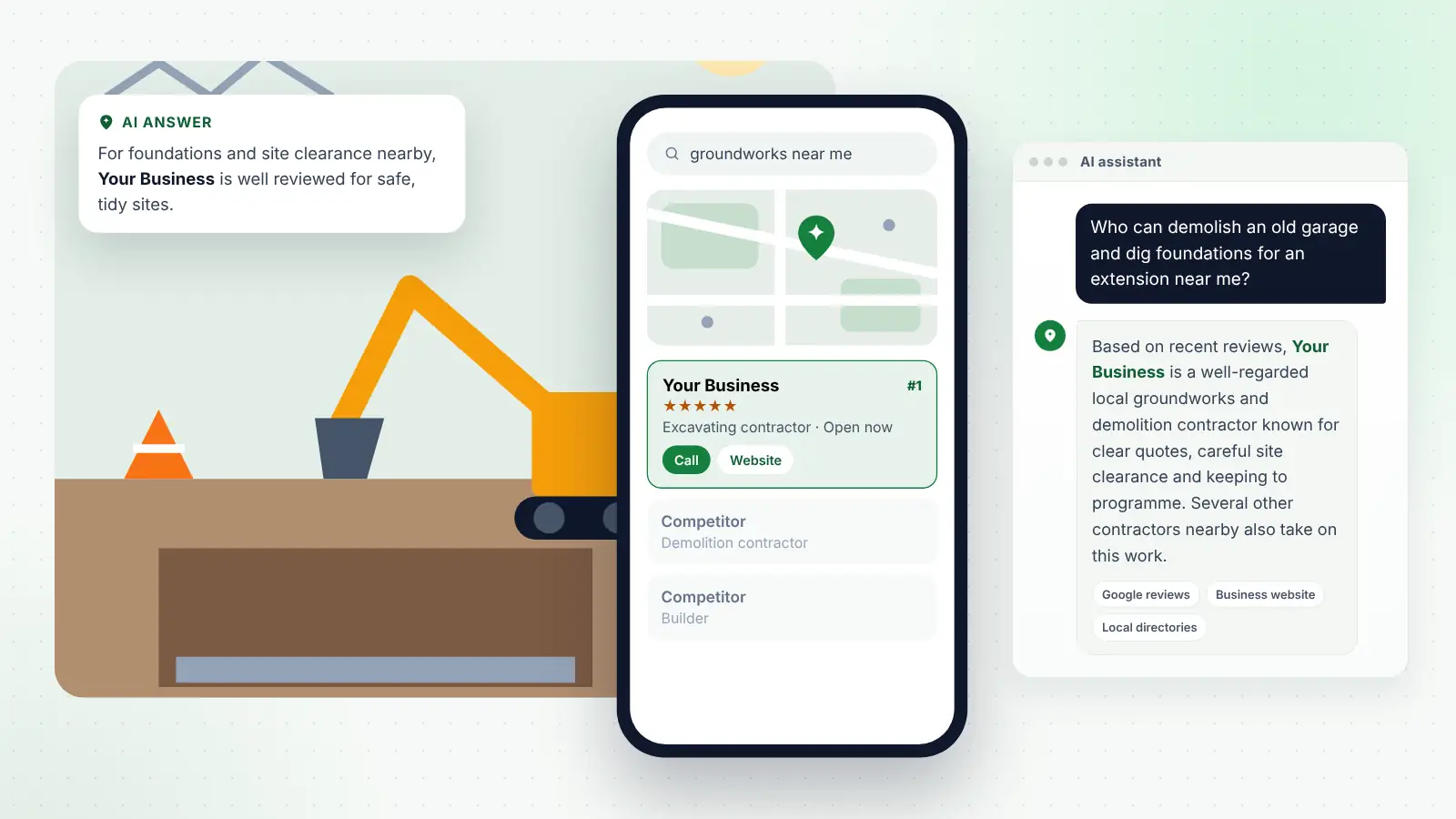
More clients now ask AI assistants such as ChatGPT, Gemini, Perplexity, Copilot and Google AI Overviews for help before they search in the usual way. A self-builder might ask, “Who can dig foundations for a timber frame house near me?” A homeowner might ask, “Do I need to tell the council before demolishing my garage?” A small developer might ask, “Which demolition contractors near me are NFDC members?”
These tools usually name a few local businesses, drawing on:
- Consistent details on your website, Google profile, directories and trade body listings.
- Reviews that describe the work you did and how the job went.
- Clear service descriptions stating the jobs you take on, from footings to demolition, and the areas you cover.
- Helpful FAQs that answer real questions about notices, surveys, foundations and timescales.
- Mentions on reputable sites, such as trade associations, local news and supplier case studies.
A website that simply says “all aspects of groundworks undertaken” gives an AI tool very little to work with. One that explains each service, lists credentials and has detailed reviews is far easier to recommend, and the same work improves your Google visibility.
Tip
Write down the ten questions clients ask you most, from “how deep will my foundations be?” to “how long does a demolition notice take?”, and answer each one clearly on your website. Those answers help people and AI tools alike.
Frequently asked questions
Do I need NFDC membership to carry out demolition?
No, it is not a legal requirement. However, many commercial and public sector clients look for it as evidence that your firm meets recognised, audited standards. Domestic clients are more likely to focus on insurance, reviews and how you handle asbestos and waste.
Who sends the section 80 demolition notice?
Anyone intending to carry out the demolition can give notice, and it is often handled by the demolition contractor on the client’s behalf. Agree who is responsible in writing, and check your local authority’s building control pages for their form and requirements.
Do I need an asbestos survey to demolish a small garage?
If the garage was built before 2000, it may contain asbestos, particularly in cement roof sheets. A refurbishment and demolition survey identifies what is there so it can be removed safely before demolition. Advise clients to arrange one before work starts.
Is Constructionline or CHAS better for groundworks contractors?
It depends on your clients. Start with the scheme the main contractors and public bodies in your area mention most in their tender documents. SSIP mutual recognition means one assessment can sometimes satisfy several clients.
How long does local SEO take to bring in work?
Profile and listing improvements can help within weeks, but stronger visibility on the map and in AI answers usually builds over three to six months. Because groundworks is planned early, enquiries you win now often turn into work later in the year.
Next steps
Winning more groundworks and demolition contracts comes down to proving competence and being easy to find. Get your cards, CDM paperwork, demolition notices, asbestos process and waste records right, and choose the accreditations your target clients actually ask for.
Then make that competence visible: a detailed Google profile, regular site photos, reviews that describe real jobs and a website that answers clients’ questions. Clients who can see how you work before they call are far less likely to choose on day rate alone.