Starting a recruitment agency appeals to many experienced consultants. The barriers to entry look low: you need no premises to begin with, no stock and no formal qualification. Many people set up after years of billing for someone else and realise they could keep more of the fee, choose their own clients and build something of their own.
The reality is that a successful local agency is a demanding business. You are serving two sets of customers at once — the employers who pay you and the candidates who make the placements possible — and you work under a specific set of rules on how agencies treat both. If you supply temporary workers, you also become responsible for paying them every week, often long before your client pays you.
This guide covers what you need to know to start an independent recruitment or staffing agency in the UK: choosing a model and a niche, the legal framework, right to work and vetting, temp payroll and cash flow, umbrella companies and IR35, pricing, technology, and how to use local search and AI search to win clients and candidates in your area.
Key points
- Agencies in Great Britain are governed by the Employment Agencies Act 1973 and the Conduct of Employment Agencies and Employment Businesses Regulations 2003, which set rules on terms, fees, information and suitability checks.
- You generally cannot charge work-seekers a fee for finding them work, and temporary workers must receive a Key Information Document before you agree terms with them.
- Supplying workers into agriculture, shellfish gathering or the processing and packaging of food requires a gangmasters licence, now issued by the Fair Work Agency, which took over from the GLAA in April 2026.
- Since 6 April 2026, an agency that contracts with an umbrella company can be jointly and severally liable for that umbrella’s unpaid PAYE and National Insurance, so supply chain checks matter more than ever.
- Temp recruitment needs working capital or invoice finance, because you pay workers weekly while clients pay on credit terms.
- Local employers and jobseekers both search on Google Maps and increasingly ask AI assistants, so a complete profile, two-sided reviews and clear sector pages help you win on both sides.
In this guide
- Choose your model: permanent, temporary or both
- Pick a niche and a patch
- The legal framework for agencies
- Right to work, vetting and safeguarding
- Temp payroll, cash flow and insurance
- Umbrella companies and IR35
- Pricing your services
- Membership, trust and partnerships
- Local SEO for recruitment agencies
- AI search and recruitment agencies
- Common mistakes new agencies make
- Frequently asked questions
- Next steps
Choose your model: permanent, temporary or both
The first decision shapes almost everything else, from your cash flow to your compliance work.
Permanent recruitment. You find candidates for roles your clients employ directly, and you charge a fee when the candidate starts, usually a percentage of first-year salary. In law, this makes you an employment agency. Cash flow is lumpy: you may wait weeks for a placement to complete and then receive a single invoice payment. Overheads are low, but income can be unpredictable early on.
Temporary and contract staffing. You supply workers to clients for shifts or assignments and charge an hourly rate that covers the worker’s pay, holiday pay, employer’s National Insurance, pension contributions and your margin. In law, this makes you an employment business. Income is more predictable once you have regular clients, but you carry payroll, compliance and credit risk.
Temp-to-perm and mixed agencies. Many local agencies do both: steady temp work for industrial, care or hospitality clients, plus permanent placements in office and skilled roles. This spreads risk, but it means getting both sets of rules right.
| Model | How you earn | Cash flow | Main risks |
|---|---|---|---|
| Permanent | One-off fee on placement | Irregular, paid after start | Long gaps between fees, rebates if candidates leave early |
| Temporary | Margin on every hour worked | Weekly costs, client pays later | Funding payroll, bad debt, compliance |
| Contract | Margin on longer assignments | Steadier, higher value | IR35 and umbrella supply chain risk |
| Mixed | Both | More balanced | More processes to manage |
Pick a niche and a patch
Generalist agencies find it hard to stand out. Clients and candidates both prefer an agency that clearly understands their world. Choose one or two sectors where you have contacts and knowledge, and a geographic area you can genuinely serve.
Common local niches include:
- Industrial and logistics: warehouse operatives, pickers and packers, forklift drivers, production staff.
- Driving: HGV and van drivers, often at short notice.
- Care and support work: care assistants and support workers for care homes and home care providers.
- Office and commercial: administrators, receptionists, accounts staff and customer service roles.
- Hospitality and events: chefs, kitchen porters, waiting and bar staff, event crew.
Your niche affects your compliance load. Care staffing involves enhanced vetting, food production may need a gangmasters licence, and driving roles need licence checks. Research the local market too: which employers use agencies, who the existing agencies are, what their reviews say and where clients feel underserved.
The legal framework for agencies
You do not need a general licence to run a recruitment agency in Great Britain, but you must follow the Employment Agencies Act 1973 and the Conduct of Employment Agencies and Employment Businesses Regulations 2003, usually called the Conduct Regulations. Northern Ireland has its own equivalent legislation. Enforcement in Great Britain now sits with the Fair Work Agency, which launched on 7 April 2026 and brought together the Employment Agency Standards Inspectorate, the Gangmasters and Labour Abuse Authority and the Director of Labour Market Enforcement.
The main obligations include:
- No fees to work-seekers for work-finding. With narrow exceptions, such as some entertainment and modelling work, you cannot charge candidates for finding or trying to find them work. If you offer other paid services, such as CV writing, using them must never be a condition of finding work.
- Agree terms before you start. You must agree terms with work-seekers before providing work-finding services, and with hirers before introducing or supplying anyone. Terms must cover specific points, and if you charge a transfer fee when a client takes a temp on permanently, it must be set out clearly in your client terms with an alternative extended hire period offered.
- The Key Information Document. Employment businesses must give temporary workers a Key Information Document before agreeing terms. It sets out who will pay them, the minimum rate they can expect and any deductions or fees, with an example of how their pay is calculated.
- Suitability checks. Before introducing or supplying someone, you must get enough information from the hirer about the role and its risks, and check that the candidate has the experience, training, qualifications and authorisations the role needs.
- Extra steps for vulnerable people. Where workers will care for or work with children or vulnerable adults, you must take further steps, including seeking references and appropriate DBS checks.
- Records. You must keep records that show you comply, generally for at least a year after you create them and after you last provided services to that person or client.
Employment law changes are also on the way. The Employment Rights Act 2025 received Royal Assent in December 2025, and measures such as guaranteed hours offers and rules on shift notice and cancellations are expected to extend to agency workers. Most of these changes are not expected until 2027 and depend on regulations still being written, so keep an eye on official guidance and your trade body’s updates.
Gangmasters licensing
If you supply workers into agriculture, horticulture, shellfish gathering, or the processing and packaging of food and drink derived from agricultural products, fish or shellfish, you need a gangmasters licence before you supply anyone. Licensing is now run by the Fair Work Agency rather than the GLAA, but the scope is the same. Operating without a licence is a criminal offence with serious penalties, and so is using an unlicensed provider, so food and farming clients will ask to see your licence. The gov.uk guidance on who needs a gangmasters licence explains the scope in detail.
Tip
If you plan to supply a food factory or packhouse, apply for your gangmasters licence early. Licence applications involve an assessment and can take time, and you cannot supply workers into those roles until the licence is granted.
Right to work, vetting and safeguarding
Right to work checks are central to staffing. When you employ temporary workers as an employment business, you are their employer for this purpose and must check that every worker has the right to work in the UK before they start, using the methods the Home Office sets out. Employers who fail to carry out proper checks face substantial civil penalties for each illegal worker, and repeated failures can lead to criminal prosecution.
Build a consistent registration process:
- Check identity and right to work in line with current Home Office guidance, including online checks where they apply.
- Record qualifications, licences, cards and certificates relevant to the role, such as forklift certificates, driving licences and driver CPC cards, food hygiene certificates or care training.
- Seek references and DBS checks where the role requires them.
- Record the worker’s availability, preferred locations and transport, so you can match shifts sensibly.
- Keep notes of the information each client gave you about the role and its health and safety risks.
A tidy, well-documented process protects you if anything goes wrong and also reassures clients, many of whom will audit their agencies.
Temp payroll, cash flow and insurance
Temp recruitment is a cash flow business. You typically pay workers weekly, while clients pay on 14, 30 or even 60-day terms. A modest temp desk can tie up a large amount of money in unpaid invoices.
Most new staffing agencies use one of the following:
- Invoice finance or factoring. A lender advances most of the value of each invoice, often with payroll and credit checking included.
- A back-office or funding partner. Some providers handle payroll, invoicing and funding in return for a share of your margin. This can be a practical way to start, but read the contract carefully, especially restrictions on moving clients or workers later.
- Your own capital. Possible for very small desks, but it limits how quickly you can grow.
Whatever you choose, credit check new clients, agree payment terms in writing and chase overdue invoices promptly. One large unpaid client can sink a young agency.
Insurance usually includes employers’ liability insurance, which is a legal requirement for most employers and applies to temps you employ, plus public liability and professional indemnity cover. Some clients will specify minimum levels in their supplier terms. Speak to a broker who understands recruitment.
| Startup cost | Rough guide | Notes |
|---|---|---|
| Company set-up and accountant | A few hundred pounds upwards | Many agencies trade as a limited company |
| Recruitment software (CRM/ATS) | Monthly subscription, varies widely | Choose one with compliance and timesheet features |
| Job board advertising | Varies by board and volume | Start with one or two that suit your sector |
| Insurance | Varies by sector and turnover | Care and industrial work usually cost more to insure |
| Office | Optional at first | A staffed local branch helps with walk-in registrations |
| Working capital | Depends on temp volume | Often the largest cost for temp agencies |
Costs vary widely by area and sector, so treat these as categories to budget for rather than fixed figures.
Umbrella companies and IR35
If you supply contractors, you need to understand how they are paid and engaged.
Umbrella companies. Some temporary and contract workers are employed through an umbrella company, which runs their payroll. Since 6 April 2026, the recruitment agency that contracts with an umbrella company can be held jointly and severally liable for any PAYE and National Insurance the umbrella fails to pay. Where there is no agency in the chain, the liability can fall on the end client. This means you need a documented due diligence process for any umbrella you work with: check who they are, how they calculate pay, whether payslips match what workers should receive, and review this regularly. Many agencies now restrict which umbrella companies they will use, or avoid them where they can by putting workers on their own PAYE payroll.
IR35 and off-payroll working. Where contractors work through their own limited company, the off-payroll working rules decide whether they should be taxed like employees. For public sector clients and medium or large private sector clients, the client decides the contractor’s status, and the party paying the contractor’s company — often the agency — may need to deduct tax and National Insurance. Small private sector clients follow the older rules, where the contractor’s company decides. Get specialist advice before placing limited company contractors.
Tip
Write down your umbrella due diligence process and the date of every check. If HMRC ever looks at an umbrella in your supply chain, a clear record of what you checked and when is far more useful than a general assurance that you knew the provider.
Pricing your services
For permanent placements, agencies usually charge a percentage of the candidate’s first-year basic salary, with a rebate or replacement period if the candidate leaves early. Rates vary by sector, seniority and competition, so research what local agencies charge rather than relying on national averages.
For temporary work, build your charge rate from the bottom up:
- The worker’s hourly pay, at or above the National Minimum Wage or National Living Wage.
- Holiday pay for the hours worked.
- Employer’s National Insurance and pension contributions where they apply.
- Apprenticeship Levy if your pay bill is large enough to pay it.
- Your costs, including insurance, software, vetting and funding fees.
- Your margin.
Many new agencies underprice to win clients and then find their margin disappears in holiday pay and on-costs. Be clear with clients about what the charge rate covers. Where clients push hard on rate, compete on fill rate, reliability, response time and quality of vetting instead.
Membership, trust and partnerships
Trade body membership is voluntary but helps. The Recruitment and Employment Confederation (REC) is the best-known body for UK agencies, and members agree to a code of professional practice and pass a compliance test. Specialist bodies exist in some sectors. Clients, particularly larger employers and public bodies, often prefer accredited agencies.
Other ways to build trust locally:
- Join your local chamber of commerce and attend business networking events.
- Build relationships with jobcentres, colleges and training providers who can refer candidates.
- Work with local employers on recruitment days or open days at their sites.
- Publish clear information on your vetting, insurance and compliance, so procurement teams can see it quickly.
Local SEO for recruitment agencies
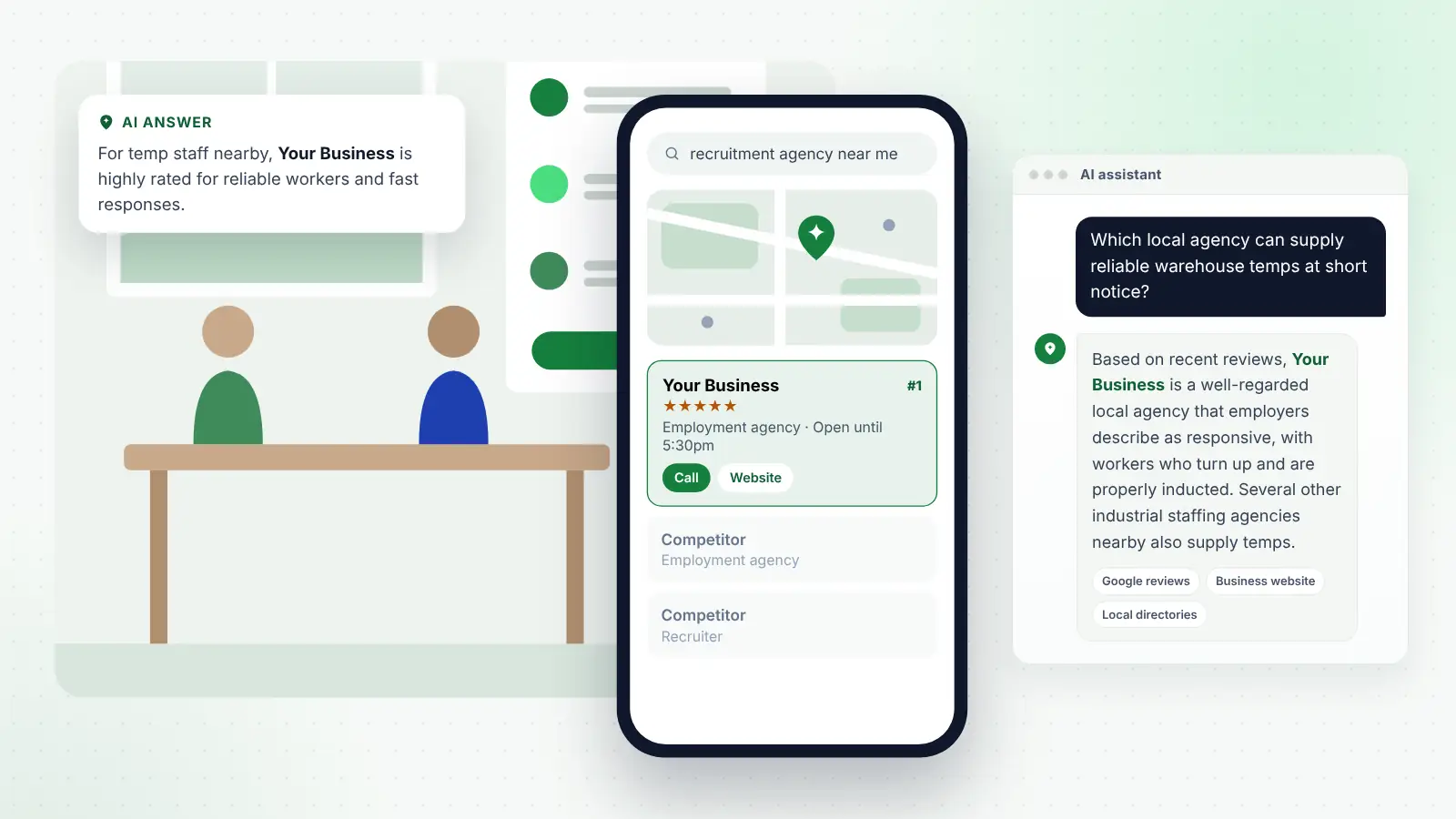
Local search is unusual for recruitment because two different groups are searching for you. Employers search for “temp agency near me”, “warehouse staffing agency” or “care staffing agency” when they need people quickly. Jobseekers search for “agency jobs near me”, “temp work this week” or “recruitment agencies in” their town when they want work. Both groups look at Google Maps, compare reviews and phone or visit the agencies at the top.
If you have a staffed branch that people can visit to register or meet, a Google Business Profile is one of your most valuable assets. Google’s guidelines require profiles for genuine, staffed locations, so a virtual office or a mail-forwarding address is not eligible, and the business name must match your real name without extra keywords. If you work from home and visit clients, you can set up as a service-area business with your address hidden.
The essentials:
- Complete your Google Business Profile. Choose the most accurate primary category, such as an employment agency or a more specific category if one fits, and add secondary categories where they genuinely apply. Add your opening hours, phone number, branch photos, team photos and a description of the sectors and areas you cover.
- Collect reviews from both sides. Ask clients for feedback after a successful assignment and ask workers after their first few weeks. Reviews that mention reliable workers, quick responses, fair treatment and accurate pay help both groups decide. Never offer incentives for reviews.
- Keep your details consistent. Your agency name, address and phone number should match across your website, Google, Bing, Apple Maps, business directories, trade body listings and job boards.
- Build pages for each sector and area. A page for warehouse staffing, one for care staffing and one for office recruitment will work better than a single “our services” page. If you serve several towns, create genuinely useful pages for each one.
- Publish vacancies on your own site. Job listings on your own website, with the correct job posting structured data, can appear in Google’s job search experience. This brings candidates to you directly rather than through job boards.
- Earn local links. Sponsoring a local event, being listed by your chamber of commerce, or contributing to local business news all help your website look like the established local agency it is.
If you would rather concentrate on clients and candidates, a specialist service in local SEO for recruitment agencies and staffing businesses can handle your profile, listings, sector pages and links for you.
Tip
Add a short “how to register” section to your Google profile description and website, listing what candidates should bring, such as ID and certificates. It reduces wasted visits and shows jobseekers that you are organised.
AI search and recruitment agencies
More employers and jobseekers now ask AI assistants for help. A warehouse manager might ask ChatGPT, “Which local agency can supply forklift drivers at short notice?” A care home owner might ask Gemini or Copilot to “recommend care staffing agencies near” their town. A jobseeker might ask Perplexity, “Which agencies in my area have warehouse jobs with weekly pay?” Google’s AI Overviews increasingly answer similar searches above the normal results.
These tools do not choose agencies at random. They draw on information they can find and trust across the web, such as:
- Consistent business details on your website, Google profile, directories and trade body listings.
- Reviews that describe specific strengths, such as quick cover, reliable workers or good communication.
- Clear descriptions of what you do, including the sectors you cover, the types of roles you fill, the areas you serve and whether you provide temporary, contract or permanent staff.
- Helpful answers to common questions, such as how registration works, how quickly you can supply staff, how holiday pay is calculated and what checks you carry out.
- Mentions on reputable sites, including local news, chamber of commerce listings, industry associations and employer partners.
In practice, that means writing plainly about what you do. A page that explains “we supply vetted warehouse operatives, forklift drivers and production staff to employers across the town and surrounding area, often within 24 hours” gives an AI assistant something specific to work with. A vague page about “people solutions” does not.
AI visibility builds on the same foundations as local SEO. If your details are consistent, your reviews are genuine and your website answers real questions from clients and candidates, you give both Google and AI assistants good reasons to mention you.
Common mistakes new agencies make
- Starting without enough working capital for temp payroll, or without a funding arrangement in place.
- Using template terms that do not meet the Conduct Regulations or do not include a clear transfer fee clause.
- Skipping the Key Information Document or giving workers one that does not match how they are actually paid.
- Not checking umbrella companies in the supply chain, which now carries direct financial risk.
- Trying to cover every sector, which makes your marketing vague and your candidate pool thin.
- Ignoring candidate experience. Workers who are paid late or treated poorly will not return, and they leave reviews.
- Relying entirely on job boards for candidates, which is expensive and gives you no lasting visibility.
Frequently asked questions
Do I need a licence to start a recruitment agency?
Not in general. Most agencies in Great Britain do not need a licence, but you must comply with the Employment Agencies Act 1973 and the Conduct Regulations. The main exception is supplying workers into agriculture, shellfish gathering or food processing and packaging, which requires a gangmasters licence from the Fair Work Agency.
Can I charge candidates to register with my agency?
Generally no. Agencies and employment businesses cannot charge work-seekers for finding or trying to find them work, apart from narrow exceptions in sectors such as entertainment and modelling. Make sure your website, adverts and registration process make this clear.
How much money do I need to start a temp agency?
It depends mainly on how many temps you expect to have working. The largest cost is usually funding weekly payroll while you wait for clients to pay. Many new agencies use invoice finance or a funding partner to bridge that gap, so speak to providers and an accountant before you sign your first client.
Should I join the REC?
Membership is voluntary, but it can help you win clients who prefer accredited suppliers, and it gives you access to legal guidance and compliance updates. Weigh the cost against the types of clients you want to work with.
How do I find candidates when I am just starting?
Combine job boards with sources you control: vacancies on your own website, a complete Google profile, local community groups, jobcentres, colleges and referrals from workers you place. Candidates who have had a good experience are often your best source of new registrations.
Does local SEO work for recruitment agencies?
It can help, because both employers and jobseekers search locally and compare agencies on Google Maps. Results build gradually over three to six months and depend on competition in your area, but a complete profile, two-sided reviews and clear sector pages give you a strong foundation.
Next steps
Start by deciding your model and niche, then get your compliance foundations in place: your terms of business, Key Information Document, registration and vetting process, insurance and, if you need it, a gangmasters licence. Arrange funding before you take on temp clients, and set up a clear process for checking any umbrella companies in your supply chain.
Then make sure the people you want to serve can find you. Set up your Google Business Profile properly, ask every client and worker for a review, and build a website with clear pages for each sector you cover. Those steps help local employers and jobseekers choose your agency, whether they search on Google or ask an AI assistant.