Running a local taxi or private hire firm can look simple from the outside: a few cars, a phone number and some drivers. In practice it is one of the more regulated small businesses in the UK. You need the right licences from the right authority, drivers who pass enhanced checks, vehicles that meet local standards, insurance that covers hire and reward, and a booking system that keeps records your licensing authority can inspect.
The market has also changed. Ride-hailing apps have made booking instant, airport transfers are sold through brokers and comparison sites, and many councils now buy school and social care transport through formal tendering. At the same time, there is steady demand for firms that do the basics well: turn up on time, give a fair fixed price for the 5am airport run, and send the same trusted driver to collect an elderly passenger from hospital.
This guide explains how to set up a taxi or private hire firm in 2026, from licensing and the reforms now under way in England to costs, contracts, VAT, and how passengers now find firms through Google Maps and AI assistants.
Key points
- Decide early whether you will run private hire (pre-booked only), hackney carriages (which can be hailed and use ranks) or both, because the licensing and business model differ.
- Outside London you need an operator licence from your district or unitary council; in London it comes from TfL, and Scotland and Northern Ireland have their own systems.
- England is moving towards national minimum standards for taxi and private hire licensing, so check your council’s current policy and expect requirements to tighten.
- VAT treatment depends on whether you act as agent or principal, and the rules changed in 2025 and 2026, so take advice from an accountant who understands the trade.
- Airport transfers, corporate accounts and council contracts can give steadier income than street work and app jobs.
- A strong Google Business Profile, detailed reviews and consistent details across the web help both Google and AI assistants recommend your firm.
In this guide
- Private hire or hackney carriage: choose your model
- Licensing: who issues what
- Safeguarding, standards and the reforms under way
- Vehicles, insurance and premises
- Startup costs
- VAT and how you contract with passengers
- Airport runs, accounts and school contracts
- Running a firm passengers trust
- Local SEO: getting found by local passengers
- AI search: how passengers now ask for a taxi
- Frequently asked questions
- Next steps
Private hire or hackney carriage: choose your model
The first decision shapes everything else. In England and Wales there are two distinct types of licensed vehicle.
Hackney carriages (often just called taxis) can be hailed in the street and can wait on ranks within the area where they are licensed. Fares within that area are usually set by the council as a maximum tariff, and the vehicle normally carries a roof sign and a meter.
Private hire vehicles must be pre-booked through a licensed private hire operator. They cannot be hailed or wait on ranks for passengers, and a driver who picks up an unbooked passenger risks prosecution and invalidating their insurance. In return, operators have more freedom over pricing and can take bookings by phone, app, website or account.
Many local firms run both: a fleet of private hire cars taking pre-booked work, plus some hackney carriages working ranks and taking bookings too. For a new business, private hire is usually the simpler starting point, because some councils limit the number of hackney carriage licences they issue, and the most valuable work for a small firm (airport runs, accounts and contracts) is pre-booked anyway.
| Feature | Hackney carriage | Private hire |
|---|---|---|
| Can be hailed in the street | Yes, in its licensed area | No |
| Can use taxi ranks | Yes | No |
| Must be pre-booked | No | Yes, through a licensed operator |
| Fares | Usually a council-set maximum tariff | Set by the operator |
| Licences needed | Driver and vehicle | Operator, driver and vehicle |
Licensing: who issues what
Private hire works on a three-licence system. The operator (the firm taking bookings), each driver and each vehicle must all be licensed, and outside London the driver, vehicle and operator licences must come from the same licensing authority.
Council licensing in England (outside London) and Wales
Private hire operator licences are issued by your district or unitary council. The council must be satisfied that you are a “fit and proper person”, will usually require a basic criminal record check for the operator, and will set conditions on things such as record keeping, complaints handling, insurance and your booking premises. Licences can last up to five years. The government summarises the process on its private hire operator licence page.
When you renew, you will need to complete an HMRC tax check, which confirms you are registered for tax. The same applies to driver licences.
Each council publishes its own taxi and private hire licensing policy. These vary considerably: vehicle age limits, colour or livery rules, emissions requirements, driver knowledge tests and medical standards all differ from one area to the next. Read your council’s policy in full before buying any vehicles.
London
In London, Transport for London (TfL) licenses private hire operators, drivers and vehicles, as well as black cab drivers and vehicles. TfL has its own requirements for operators, including a fixed booking-taking arrangement and detailed record keeping, and its vehicle standards include emissions rules that affect which cars you can license.
Scotland and Northern Ireland
Scotland licenses taxis and private hire cars under its own legislation, and the operator equivalent is a booking office licence issued by the local council. Northern Ireland uses a different system run by the Driver and Vehicle Agency, with its own classes of taxi licence and an operator licence. If you plan to work in either nation, start with the relevant authority’s guidance rather than assuming English rules apply.
Tip
Talk to your council’s licensing team before you spend money. Ask about vehicle age and emissions limits, how long driver applications are currently taking, and whether there are any planned policy changes. A car that meets one council’s standards may not be licensable in the next district.
Safeguarding, standards and the reforms under way
Passenger safety drives most taxi and private hire regulation, and it has tightened over the past few years.
Statutory taxi and private hire standards
In 2020 the Department for Transport published statutory standards for licensing authorities in England, focused on protecting children and vulnerable adults. They cover enhanced criminal record checks against the barred lists for drivers, subscription to the DBS update service, safeguarding training, and checks on operators and the staff who take bookings. Councils must have regard to them, so most local policies now reflect them closely.
The 2022 Safeguarding and Road Safety Act
The Taxis and Private Hire Vehicles (Safeguarding and Road Safety) Act 2022 requires licensing authorities in England to record when they refuse, suspend or revoke a driver’s licence for safeguarding or road safety reasons, using a national database, and to check that database when considering applications. It also means a council that has serious concerns about a driver licensed elsewhere must report them to the council that issued the licence. For operators, the practical effect is that a driver with a poor record elsewhere is much harder to license, and your own conduct records matter.
Cross-border hiring and national minimum standards
Cross-border or out-of-area working, where drivers and vehicles licensed by one council work mainly in another, has been a long-running concern. Since 2015, operators in England and Wales have been allowed to subcontract bookings to operators licensed elsewhere, and drivers licensed in one area can legally carry pre-booked passengers anywhere. Critics argue this lets drivers license wherever standards are lowest.
The English Devolution and Community Empowerment Act, which became law in April 2026, gives the government powers to set national minimum standards for taxi and private hire licensing in England and to let officers take action against drivers licensed elsewhere who work in their area. Ministers have also discussed moving licensing to fewer, larger authorities and further limits on out-of-area working. As of October 2026, the detailed standards are being worked out through regulations and consultation rather than being in force, so check with your council and trade body for the latest position. Plan on the basis that driver checks, training and vehicle standards will become more consistent and, in some areas, stricter.
Vehicles, insurance and premises
Choosing vehicles
Pick vehicles that meet your council’s standards and suit the work you want. A typical starting fleet for a small private hire firm might include:
- Reliable saloons or estates for everyday local work and airport runs with luggage.
- At least one seven-seat or eight-seat vehicle for families, groups and golf trips.
- A wheelchair accessible vehicle, which opens up hospital, care and council work and meets a genuine shortage in many areas.
- An executive car if you plan to offer chauffeur or corporate work.
Hybrid and electric vehicles are increasingly common because of lower running costs and tightening emissions policies, but check charging access, range for airport runs and any licensing rules on vehicle type.
Insurance
You will need hire and reward insurance for every vehicle, which costs far more than private car cover. Most firms also need public liability insurance, employer’s liability insurance if you employ staff (including office staff and controllers), and cover for your premises and equipment. If drivers use their own vehicles, make sure your policies and theirs match the way work is actually allocated.
Premises and booking systems
Many councils require operators to have a base in their area where records are kept, even if most bookings come through an app. You will need a booking and dispatch system that records each booking (passenger, pick-up, destination, time, driver and vehicle) in the way your licence conditions require. Modern systems combine phone bookings, a passenger app, online booking, account management and driver tracking.
Startup costs
Costs vary widely by area, fleet size and whether drivers bring their own vehicles. Treat the figures below as rough guides only.
| Item | Typical cost | Notes |
|---|---|---|
| Operator licence | Varies by council | Fees differ widely; check your council’s fee schedule |
| Driver and vehicle licences | Varies by council | Plus DBS checks, medicals and knowledge or safeguarding training |
| Vehicles | Roughly £8,000–£35,000 or more each | Used saloons cost far less than new, accessible or executive vehicles |
| Hire and reward insurance | Typically several thousand pounds per vehicle a year | Depends on driver age, area, claims and vehicle |
| Booking and dispatch system | Monthly fee per driver or vehicle | Usually includes an app, online booking and tracking |
| Base and phone line | Varies by area | Some firms start from a small office or shared premises |
| Signage, livery and uniforms | £500–£3,000 | Check council rules on signs and livery |
| Website and branding | £1,000–£5,000 | Online booking adds cost but saves call handling |
Many small firms keep startup costs down by working with self-employed drivers who supply their own licensed vehicles and pay a weekly or commission-based fee. Others own the fleet and employ or rent to drivers. Each model has different tax, insurance and employment law implications, so take advice before you choose.
VAT and how you contract with passengers
VAT has been one of the most contested issues in the trade, and the rules changed recently.
Outside London, many operators act as an agent: the passenger contracts with the self-employed driver, and the operator charges the driver a fee or commission. A VAT-registered operator working this way typically accounts for VAT on its commission rather than on the full fare. In London, operators have been required to act as principal since a 2021 High Court decision, which means a VAT-registered London operator accounts for VAT on the whole fare.
A case brought by Uber against Sefton Council raised the possibility that operators outside London would also have to contract as principal. Uber won in the High Court, but the Court of Appeal reversed that decision in 2024, and in July 2025 the Supreme Court ruled that operators outside London are free to choose, so the agency model remains available there. In the Autumn Budget 2025 the government did not require all operators to act as principal, but it did remove taxi and private hire services from the Tour Operators’ Margin Scheme from 2 January 2026, so operators acting as principal now account for VAT on the full fare rather than on their margin.
For a new firm the practical points are:
- Decide whether you will act as agent or principal, and make sure your terms with drivers and passengers reflect that clearly.
- Monitor your turnover against the VAT registration threshold, which is currently £90,000.
- Use an accountant who understands taxi and private hire VAT, because the details of your contracts determine what you owe.
Airport runs, accounts and school contracts
A healthy firm usually mixes several types of work so the cars are busy across the week.
Local pre-booked journeys
Station runs, hospital appointments, shopping trips and evenings out make up the bulk of everyday work. Regular passengers value a firm that answers the phone, remembers their address and sends a confirmation with the driver’s details.
Airport and long-distance transfers
Airport runs are higher-value journeys that are often booked days or weeks ahead. Publish clear fixed prices to your nearest airports, explain how you handle flight delays and meet-and-greet, and be aware that airports often charge for pick-ups and drop-offs, which you will need to build into your prices.
Corporate accounts
Local businesses, solicitors, hotels, care homes and GP surgeries often need regular, reliable transport billed monthly. Account work fills weekday daytime hours that would otherwise be quiet. Offer clear monthly invoicing, booking by email or online, and a named contact.
School and council contracts
Many councils buy home-to-school transport, special educational needs transport and social care journeys through tendering. These contracts can provide stable term-time income, but they come with strict requirements on driver checks, passenger assistants, vehicle types and safeguarding training. Register on your council’s procurement portal and keep your paperwork up to date so you can bid when opportunities appear.
Executive and chauffeur work
Weddings, events, corporate visitors and VIP travel pay more but require premium vehicles, smart presentation and flexible timing. Executive work is usually still licensed as private hire, so the same operator, driver and vehicle rules apply.
Tip
Fill the quiet hours deliberately. Most firms are busy on Friday and Saturday nights and quiet on weekday afternoons. Account work, hospital runs and pre-booked airport transfers are the most reliable way to keep cars and drivers earning across the whole week.
Running a firm passengers trust
Trust is what makes passengers book a local firm rather than whichever app shows a car nearest. The firms with the best reputations tend to get these things right:
- Punctuality. Arrive on time and tell passengers if a car is running late.
- Confirmations. Send the driver’s name, vehicle and registration by text or app before pick-up.
- Clean, well-presented cars and drivers. These come up again and again in reviews.
- Fair, clear pricing. Explain fixed fares and when higher rates apply.
- Accessibility. Offer accessible vehicles where you can, train drivers in disability awareness, and carry assistance dogs as the law requires.
- Child seats. Explain your policy clearly so parents can plan.
- Complaints and lost property. Have a simple process and respond quickly.
Recruiting and keeping good drivers is often the biggest operational challenge. Fair settlement terms, a steady flow of work, prompt payment and respect from controllers keep drivers loyal, and loyal drivers give the consistent service passengers notice.
Local SEO: getting found by local passengers
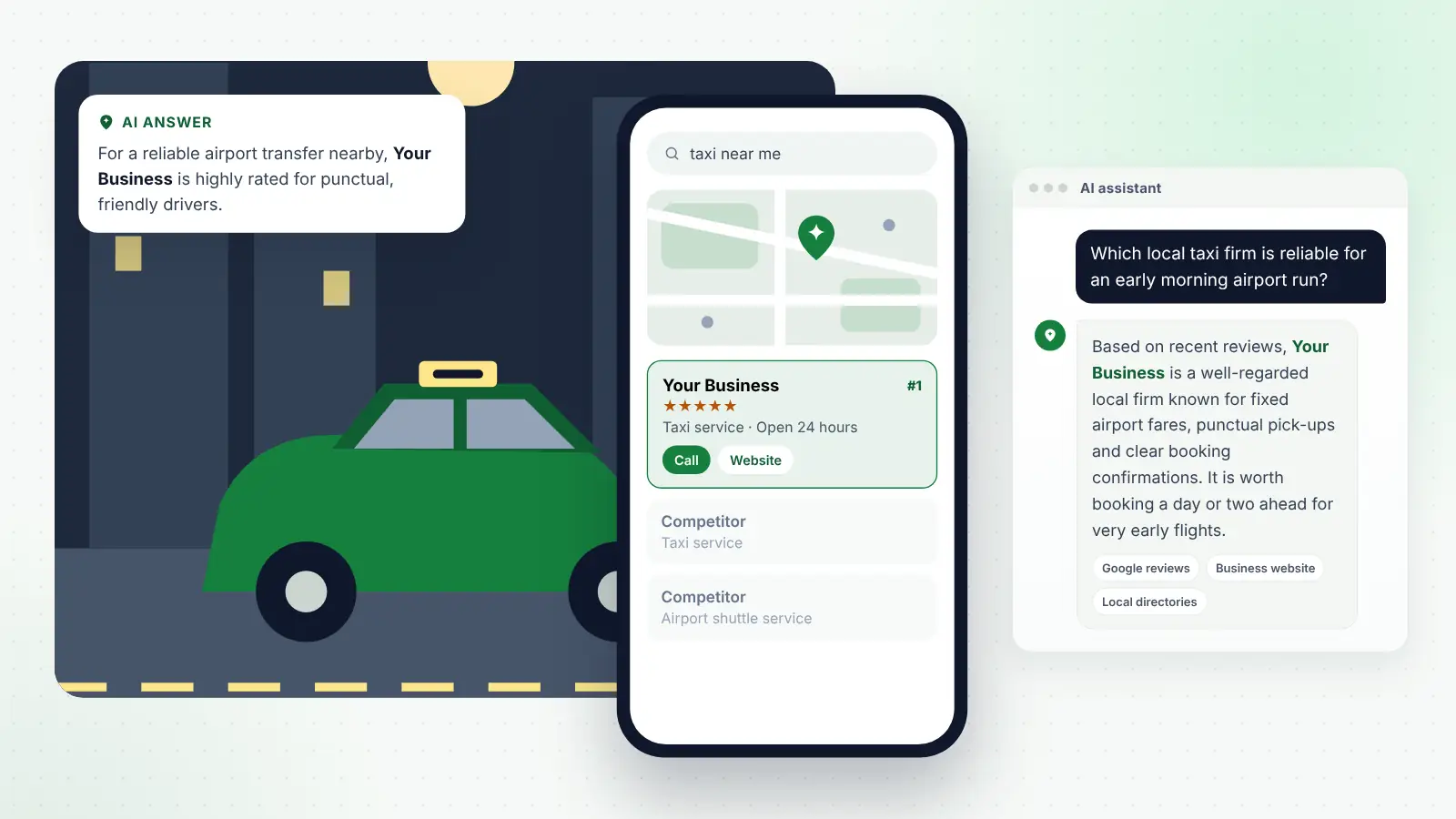
When someone needs a taxi, they usually search on their phone: “taxi near me”, “airport taxi Leeds Bradford”, “8 seater taxi” or “taxi to the station”. Google shows a map with three local firms, and those three take most of the calls. For pre-booked work such as airport transfers, people also compare websites and reviews before choosing.
Ranking in that map depends on how relevant your listing is to the search, how close you are to the person searching, and how prominent your firm appears from its reviews, links and mentions across the web.
Google Business Profile
Your Google Business Profile is the single most important local listing. Set it up carefully:
- Choose the most accurate primary category, usually “Taxi service”, and add relevant secondary categories such as “Airport shuttle service” or “Chauffeur service” only where you genuinely offer them.
- Use your real trading name. Adding keywords to your business name breaks Google’s guidelines and can get your profile suspended.
- Set your service area to the places you actually cover and show your base address if passengers can visit or if your licensing requires a public office.
- Add accurate hours, including whether you take bookings 24 hours a day.
- Upload real photos of your vehicles, drivers (with their permission) and office.
- Add booking links, your app download links and a clear description of your services.
Fake taxi listings have been a known problem on Google Maps, so a genuine, well-maintained profile with real photos and steady reviews helps you stand out as a legitimate firm.
Reviews
Reviews influence both your ranking and whether passengers choose you. Ask regular passengers, account customers and airport travellers for reviews, perhaps with a link in your booking confirmation or receipt. Reviews that mention specific things, such as “picked us up on time for a 5am flight” or “driver helped with the wheelchair”, are especially persuasive. Respond to each one courteously, and if someone complains about a late pick-up, apologise and say what you have changed.
The same firm name and booking number everywhere
Make sure your firm name, phone number and address appear in exactly the same format across directories, travel and local sites, your booking app listing and social media. Inconsistent details confuse both passengers and search engines.
Pages for airport routes, accounts and the towns you cover
Your website should have separate, useful pages for each main service (local taxis, airport transfers, corporate accounts, school and contract work, executive cars) and for the main towns and airports you serve. Each page should explain prices or how fares are calculated, vehicle options, how to book and your licensing details. Thin pages that only swap a town name are unlikely to help.
Local links
Links and mentions from local businesses, hotels, venues, community groups and sponsorships help Google see your firm as an established part of the area. A wedding venue listing you as a recommended transport partner is worth far more than dozens of low-quality directory links.
Some firm owners handle this themselves; others prefer specialists to manage it, which is where services such as local SEO for taxi and private hire firms come in. Either way, map rankings usually build over three to six months rather than weeks.
AI search: how passengers now ask for a taxi
More people now ask AI assistants for recommendations instead of, or as well as, searching Google. Travellers now type questions like these into ChatGPT, Gemini, Perplexity or Microsoft Copilot, or read Google’s AI Overviews for them:
- “Which taxi firm near me is reliable for an early airport run?”
- “Is there a local taxi company with wheelchair accessible cars?”
- “What does a taxi from Coventry to Birmingham Airport usually cost?”
- “Can you recommend a chauffeur service for a wedding in Harrogate?”
An assistant recommending a cab firm draws on details it can verify across reviews, listings and websites. For a taxi firm, that usually means:
- Consistent information across the web. The same name, services, coverage area and contact details on your website, Google profile and directories.
- Reviews. Detailed reviews that mention punctuality, safety, airport runs or accessible vehicles help AI tools describe what you are good at.
- Clear service descriptions. Pages that state plainly what you offer, where you operate and which vehicles you have.
- FAQs. Straightforward answers to the questions passengers ask, such as how flight delays are handled, whether you carry child seats, and how far ahead to book.
- Mentions on reputable sites. Local news, venue and hotel recommendations, business groups and industry directories.
AI assistants are cautious about recommending transport, so being clear that you are a licensed operator, naming your licensing authority and explaining your driver checks gives them, and passengers, more confidence.
Tip
Ask an AI assistant about your own area. Try asking a few assistants which taxi firms they would recommend for airport transfers in your town. If they do not mention you, or describe you inaccurately, that tells you which information is missing or inconsistent online.
Frequently asked questions
Do I need my own licence if I only take bookings for other drivers?
Yes. Taking private hire bookings and dispatching them to drivers is the core activity that needs an operator licence. Taking bookings or supplying drivers without one can lead to prosecution, and the drivers and vehicles must also be licensed.
Can my private hire drivers work outside our council area?
A properly licensed private hire driver and vehicle can carry a pre-booked passenger to and from other areas, and operators in England and Wales can subcontract bookings to operators licensed elsewhere. They cannot ply for hire or be hailed anywhere. The rules on out-of-area working in England are under review, so check your council’s current guidance.
How long does it take to get licensed?
It varies by council and by how quickly checks come back. Driver licences often take longest because of enhanced DBS checks, medicals, knowledge or safeguarding tests and any driving assessments. Ask your council for current timescales before setting a launch date.
Do I have to charge VAT on fares?
Only if you are VAT registered, and how much you account for depends on whether you act as agent or principal. Outside London many operators account for VAT on their commission rather than the full fare, while London operators act as principal. Take advice from an accountant who understands the trade.
Is it worth offering wheelchair accessible vehicles?
In many areas, yes. Accessible vehicles are in short supply, they open up hospital, care and council contract work, and passengers who need them tend to become loyal regular customers. Check the vehicle standards your council applies to accessible vehicles before buying.
Next steps
Start by reading your council’s taxi and private hire licensing policy, then decide whether you will run private hire, hackney carriages or both, and how your drivers will work with you. Get your operator licence, insurance, booking system and first drivers in place, and take advice on VAT and employment status before you launch.
Once you are trading, focus on the work that keeps cars busy across the week: airport transfers, accounts and contracts alongside everyday local journeys. Build a genuine, well-reviewed presence on Google and across the web so that passengers, businesses and AI assistants can see you are a reliable local firm worth booking.