Most established salons and barbershops are not short of skill. What they are short of, on a bad week, is predictability. A Saturday that is booked solid sits next to a Tuesday afternoon with three empty chairs, a regular who used to come every five weeks has quietly drifted to every nine, and a no-show at half past four wipes out the profit on a colour appointment. None of these problems is dramatic on its own, but together they decide whether a salon feels comfortably busy or permanently stretched.
The good news is that the fixes are mostly about systems rather than marketing spend. How you handle the last two minutes of an appointment, how easy it is to book at eleven at night, how your cancellation policy is worded, what happens after a new client’s first visit, and how you manage the relationship between your stylists and their clients all have a bigger effect on your diary than another round of social media posts.
This guide is for salons and barbershops that are already trading and want to fill chairs more evenly and keep the clients they win. It covers rebooking, online booking, fair and lawful no-show policies, the new-client journey, quiet weekdays, stylists’ personal followings and chair renters, and finishes with how local search and AI assistants bring new clients through the door.
Key points
- Rebooking at checkout is one of the most reliable ways to keep a column full, so make it a standard part of every appointment rather than an awkward question.
- Online booking should show real availability, clear prices and your policies before the client commits, and any unavoidable fees must be in the price you display.
- Deposits and no-show fees are generally fine if they are clear, agreed in advance and proportionate to your genuine loss; calling something non-refundable does not make it fair.
- A new client’s second visit matters more than their first, so plan a simple follow-up journey for the weeks after.
- Agree in writing who holds client data and how client contact works when a stylist leaves or a renter moves on, and make sure renter arrangements genuinely reflect self-employment.
- Clients looking for a new hairdresser or barber search by need and by time, so your Google profile, reviews and website should answer both.
In this guide
- Find out where your chairs are leaking
- Make rebooking at checkout the default
- Online booking that clients actually finish
- No-shows, deposits and cancellation fees without falling foul of consumer law
- Design the new-client journey from search to third visit
- Fill quiet weekdays without cheapening your work
- Stylists’ personal followings: protect the relationship and the salon
- Chair renters: filling chairs without blurring the lines
- Local SEO: being found when someone needs a new hairdresser
- AI search: what assistants say when asked for a good local salon
- Frequently asked questions
- Next steps
Find out where your chairs are leaking
Before changing anything, look at your booking data for the last three to six months. Most salon software can report the figures below, even if nobody has opened that screen for a while. The aim is to see where the gaps actually come from, because the fix for “not enough new clients” is very different from the fix for “regulars coming less often”.
| Measure | How to work it out | What it tells you |
|---|---|---|
| Rebooking rate | Clients who book their next visit before leaving, divided by all clients seen | Whether your checkout routine is working |
| Visit interval | Average weeks between visits for regular clients, by service | Whether regulars are stretching their appointments |
| New client retention | New clients who return within, say, 90 days | Whether your first-visit experience converts |
| No-show and late cancellation rate | Missed or short-notice appointments as a share of bookings | Whether your reminders and policy are doing their job |
| Utilisation by day and time | Booked hours divided by available chair hours | Where your quiet periods really are |
| Source of new clients | What new clients said or which link they booked through | Which channels are worth your effort |
Look at these by stylist as well as for the whole salon. It is common to find that one stylist rebooks most of their clients while another rebooks very few, and the difference is usually habit rather than talent. That is a coaching conversation, not a marketing problem.
Make rebooking at checkout the default
A client who leaves without a next appointment is relying on their own memory and good intentions. Most will come back eventually, but “eventually” tends to drift. A cut that should be redone every five weeks becomes seven, then nine, and over a year that is one or two fewer visits per regular.
The most effective salons treat rebooking as part of the service rather than a sales moment. A few habits make the difference:
- Recommend the interval in the chair. Before the client stands up, the stylist explains when the cut or colour will need attention and why, for example “your fade will look sharp for about three weeks” or “your roots will show at around six weeks”.
- Offer a specific slot, not an open question. “Shall I put you in for the same time on the 14th?” works far better than “Do you want to book again?”.
- Let the stylist book it. If the client walks to a separate desk, the moment is often lost. A tablet or the stylist’s own booking app at the station keeps it simple.
- Make changing easy. Clients hesitate to commit weeks ahead because they fear being stuck. Tell them they can move it online, within your policy, and send a reminder a couple of days before.
- Record why people decline. “I’ll check my shifts” is a reason to send a booking link the next day, not to give up.
For barbershops that run partly on walk-ins, rebooking still works. Many regulars like a guaranteed slot on a Saturday morning, and fixed standing appointments every two or three weeks suit people who hate waiting.
Tip
Set a rebooking target for each stylist and review it together monthly. Celebrate the habit, not just the takings, because rebooked clients are next month’s takings.
Online booking that clients actually finish
Many clients now expect to book a haircut the way they book a table or a train ticket, often in the evening and on a phone. If your online booking is hard to find, shows no availability for weeks, or asks too many questions, people give up and book somewhere that makes it easy.
What a good booking flow includes
- Real availability. If stylists hold back slots for regulars, be honest about that, and offer a waiting list or “message us” option for anyone who cannot find a time.
- Service names clients understand. “Restyle with consultation”, “Skin fade and beard tidy” and “Root colour and cut” are clearer than internal codes.
- Duration and price. Show how long each service takes and the price or starting price. If prices vary by stylist level, say so and explain the difference.
- Your policies before payment. Deposits, cancellation notice, late arrivals and patch test requirements should be visible before the client confirms, not hidden in a confirmation email.
- One clear link everywhere. Use the same booking link on your Google Business Profile, website, Instagram and Facebook so clients do not end up on an old page.
Prices and fees must be upfront
Since April 2025, the Digital Markets, Competition and Consumers Act 2024 has required businesses to include unavoidable fees in the headline price they show consumers. If your booking system adds a compulsory booking fee or card fee at the end, that fee should be built into the price shown from the start. Optional extras, such as a deep conditioning treatment, can still be added separately. Check how your booking platform displays any fees it charges clients, because it is your price that the client sees.
Marketplaces versus direct booking
Booking marketplaces can bring in new clients, but many charge commission for clients they introduce and some encourage clients to browse competitors. A sensible approach is to use them for discovery if they suit you, then encourage repeat clients to rebook directly through your own system at checkout. Read the terms on who can contact the client and who holds their data before you sign up.
No-shows, deposits and cancellation fees without falling foul of consumer law
No-shows hurt salons more than most businesses, because a missed hour cannot be put back on the shelf and sold later. A clear policy is reasonable, and most clients accept it. The important thing is to make the policy fair, because consumer contract terms in the UK must meet the fairness and transparency requirements of the Consumer Rights Act 2015.
Principles that keep a policy fair
- Tell clients before they book. A term the client only sees after paying, or that sits in small print, is much harder to rely on. Show it on the booking page and in the confirmation.
- Make it specific. State what triggers a charge, how much notice you need, and how much the charge is. “We may charge an appropriate fee” is vague and likely to cause disputes.
- Keep charges proportionate. A fee or retained deposit should reflect your genuine likely loss, such as the stylist’s time and the chance of refilling the slot. Taking the full price of a long colour appointment for a cancellation made a week ahead, when you could easily rebook the slot, is harder to justify.
- Do not lean on the word “non-refundable”. Calling a deposit non-refundable does not make keeping it fair in every situation. If you cancel or cannot provide the service, the client should normally get their money back or an agreed alternative.
- Get clear authority to charge a card. If you store card details to charge no-show fees, the client must have agreed to that charge and its amount.
Clients who book online or by phone may also have cancellation rights under the Consumer Contracts Regulations, depending on how and when they book. Booking platforms handle this in different ways, so if you take sizeable deposits for bridal, extensions or long colour work, it is worth checking your terms with a solicitor or a trade body such as the NHBF.
Reduce no-shows before you need to charge
Charging is a last resort. Most no-shows are forgetfulness, so automated reminders two days and two hours before an appointment prevent many of them. Asking new clients for a deposit on longer services, while trusting established regulars, is a common and fair middle ground. Many salons waive the first missed appointment for a good regular and apply the policy consistently after that, which keeps goodwill while protecting the diary.
Design the new-client journey from search to third visit
Winning a new client costs time and money. Keeping them is where the return comes from, and the critical moment is not the first appointment but the second. A client who comes back twice is much more likely to become a regular.
A simple journey might look like this:
- Before the visit. A confirmation that tells them where to park, how long the appointment takes and what to expect, plus any allergy alert test arrangements for colour. If they need a test, explain why, because it shows you take their safety seriously.
- The consultation. New clients need a few minutes of real conversation about their hair, routine and what went wrong last time. Record notes, formulas and preferences so the next visit picks up where this one left off.
- Before they leave. Recommend the interval, offer the next slot and give them a card or text with their stylist’s name.
- A few days later. A short message asking how the cut or colour is settling in, with an easy way to reply if something is not right. Fixing a small problem quickly often turns a doubtful client into a loyal one.
- Around the due date. If they did not rebook, send a friendly reminder with a booking link when their interval comes round.
- After the second visit. Ask for a review. Clients who return are often your most enthusiastic reviewers.
Keep messages personal and few. Under UK data protection and electronic marketing rules, appointment reminders and service messages are different from marketing, and you need the right basis before sending promotional texts or emails. Your booking system should let clients choose whether they want offers.
Fill quiet weekdays without cheapening your work
Every salon has quiet periods, typically early in the week and mid-afternoon. Discounting heavily can fill them, but it often attracts bargain hunters who never return at full price, and it can train regulars to wait for offers. The better approach is to give quiet slots a purpose.
- Offer something extra rather than money off. A free deep conditioning treatment, a beard oil or a longer consultation for bookings on Tuesday and Wednesday keeps your prices intact.
- Use quiet time for newer stylists. Junior stylists and graduates can build columns at a lower price point on quieter days, which gives clients a genuine reason to choose those slots.
- Target groups who are free on weekdays. Retired clients, shift workers, parents during school hours and students often prefer weekdays. A lunchtime express service near offices, or a midweek senior rate, suits real behaviour.
- Run consultations and colour correction assessments. Longer, lower-pressure appointments for planning big changes fit naturally into quieter periods.
- Keep a waiting list. Clients who wanted a Saturday but could not get one are often happy to take a Wednesday evening if you offer it.
Look at your utilisation figures before deciding. If your “quiet” Tuesday is actually 70 per cent booked, the problem might be the late afternoon on Thursday instead.
Stylists’ personal followings: protect the relationship and the salon
In hairdressing, clients often follow a person rather than a building. That is good for the salon while the stylist is there, and a real risk when they leave. Owners who handle this badly tend to discover it only when a senior stylist opens down the road and half their column follows.
Agree the rules early
- Client data. Be clear about who controls client records, how they are used and what happens when someone leaves. For employed staff, the salon is normally the data controller. Under data protection rules, staff should not take client lists for their own use.
- Restrictive covenants. Some employment contracts include restrictions on soliciting clients for a period after leaving. These must be reasonable to be enforceable, so take employment law advice rather than copying a template.
- Social media accounts. Decide whether stylists promote their work on the salon’s accounts, their own, or both, and what happens to content when they go.
- Tips. Since 1 October 2024, the Employment (Allocation of Tips) Act 2023 has required employers to pass on all tips, gratuities and service charges to workers fairly, in line with a statutory code of practice, and, where tips are received regularly, to have a written policy on how they are handled. Getting this right is part of keeping a team that wants to stay.
Make the salon worth staying for
The best protection is a salon that clients value in its own right. If the booking experience, the welcome, the consultation notes and the follow-up all belong to the salon, a client who loses their favourite stylist has a reason to try another one in the same team. Introduce regulars to other stylists for some services, for example a colour specialist, so clients have more than one relationship with your business.
Chair renters: filling chairs without blurring the lines
Renting chairs to self-employed stylists can fill space you could not otherwise staff, and it suits experienced people who want independence. It also creates grey areas around clients, marketing and employment status.
Status is decided by how the arrangement works in practice, not by what the agreement says. HMRC considers factors such as who sets prices and hours, who controls how the work is done, whether the person can send a substitute, and who provides equipment and products. If you set a renter’s prices, give them your clients and require them to work your rota, the arrangement may look like employment. HMRC’s Check Employment Status for Tax tool and an accountant can help you test the set-up.
For filling chairs, the practical points are:
- Keep bookings separate. Renters usually manage their own bookings and client records, even if they use the same software as the salon.
- Agree how walk-ins and enquiries are shared. If the salon passes on new clients, put the terms in writing so nobody feels shortchanged.
- Agree how renters appear online. Renters can be listed on your website as independent stylists working from your premises. Be accurate in how you describe them on your Google profile and website.
- Plan for departures. Because the clients belong to the renter, expect them to leave with the renter. Do not rely on a renter’s following for your long-term salon income.
Local SEO: being found when someone needs a new hairdresser
Most of your new clients are people who are already looking. They have moved house, fallen out with their old salon, want a specialist service, or need a cut today. Their searches reflect that: “barbers open now”, “hairdresser near me taking new clients”, “balayage [town]”, “men’s haircut Saturday [area]”, “salon good with curly hair near me”. Local SEO is about showing up for those searches and making the decision easy when you do.
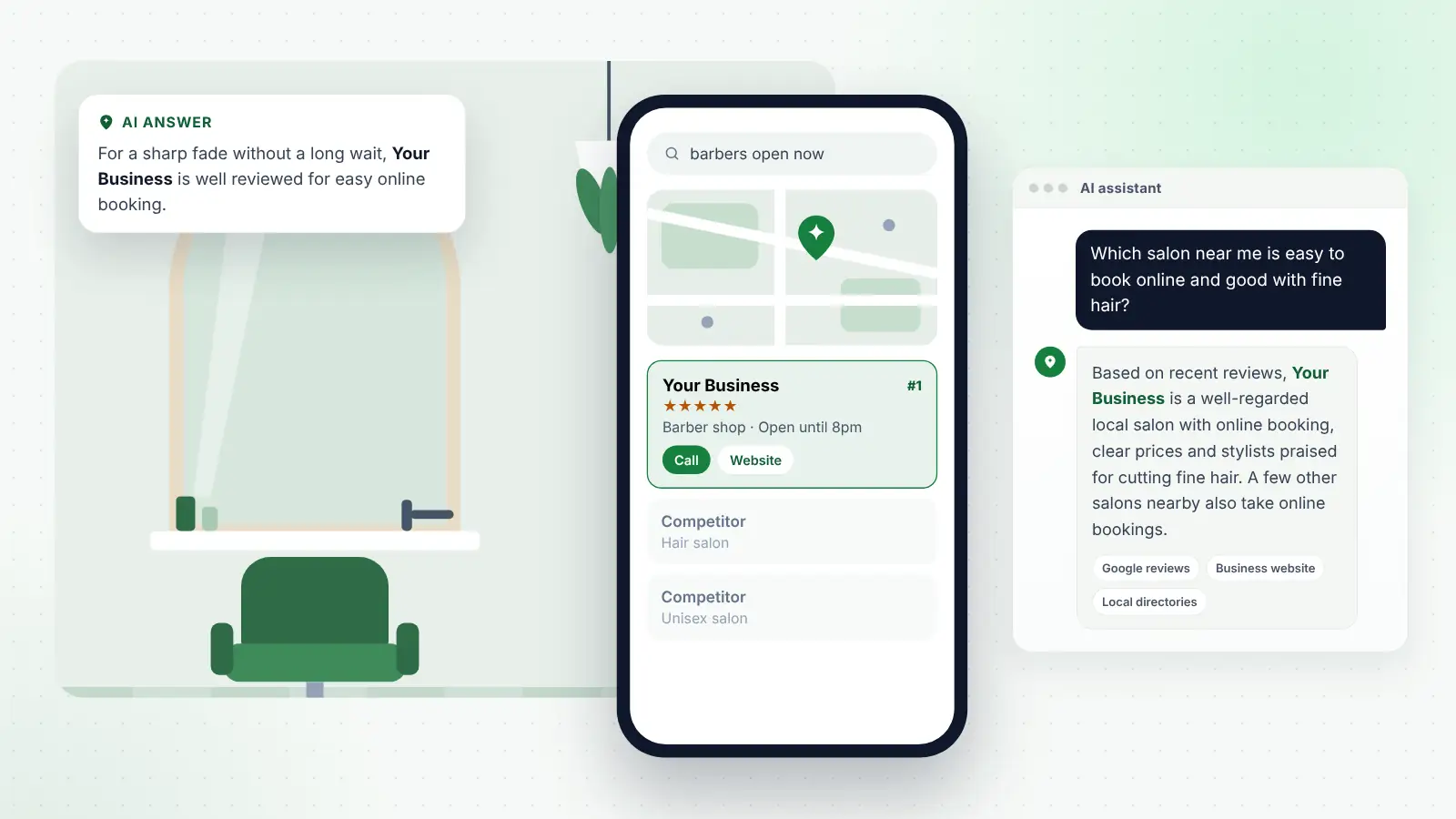
People usually see the Google Maps results first, with ratings, photos and opening hours side by side. That is where a new client compares you with two or three other salons in seconds.
Keep your Google Business Profile accurate and active
Choose the right primary category, such as “Hair salon” or “Barber shop”, and keep your hours exact, including late nights, bank holidays and Christmas. If you take walk-ins, say so. Add your services with prices or starting prices, link your booking page so people can book straight from Maps, and post real photos of your work every week. A profile that says “Open now” with a “Book” button gives a new client far more confidence than one with outdated hours.
Reviews that mention services and stylists
Ask clients at the moment they are happiest, often when they see the finished result, and send a review link after the second visit as part of your new-client journey. Reviews that mention “fine hair”, “skin fade”, “colour correction” or a stylist’s name help you appear for those searches and reassure people with the same need. Reply to every review, calmly and specifically.
Consistent details and a website with real service pages
Your name, address, phone number and booking link should match on Google, Apple Maps, Bing, Facebook, Instagram, booking platforms and local directories. Your website should have pages for your main services, explaining what is included, how long it takes, the price and who it suits, plus a page introducing each stylist and what they specialise in. A page answering “Are you taking new clients?” with an honest yes and how to book is surprisingly useful.
Local links
Links and mentions from local sites, such as a business association, local events, a school or charity you support, or a wedding supplier directory, help show that you are an established local business.
Results from this work usually build over three to six months rather than overnight. If you would prefer to spend that time with clients, specialist local SEO for hair salons and barbers can look after your profile, reviews strategy, listings and service pages.
AI search: what assistants say when asked for a good local salon
More people now ask AI assistants for a recommendation before they book. Someone might ask ChatGPT “Which salon near me is good with fine hair and easy to book online?”, ask Gemini for “a barber in [town] that does good skin fades on Sundays”, ask Perplexity “where can I get my curly hair cut properly in [area]?”, or ask Copilot which salons nearby are taking new clients. Google’s AI Overviews often summarise local options at the top of search results too.
These tools try to give a confident answer, so they lean on information they can find and cross-check:
- Consistent details across your Google profile, website, directories and booking platforms, including opening hours.
- Reviews that describe specific services and experiences, such as “great with fine hair”, “easy to book” or “fixed my colour”.
- Clear service and stylist descriptions, so the tool can match a particular request to your salon.
- Honest FAQs on your website, such as how far ahead to book, whether you take walk-ins, how your deposit policy works and whether you offer allergy alert tests.
- Mentions on reputable local and industry sites, such as local news, awards and trade body directories.
Being the salon an assistant feels safe suggesting is the aim of answer engine optimisation (AEO). The link with this guide’s theme is direct. The same things that help clients book and return, such as clear prices, visible policies, accurate hours and a stream of detailed reviews, are the things AI assistants use to decide whether your salon is a safe recommendation. A salon whose information is vague or out of date is simply harder to recommend.
Tip
Ask a few AI assistants the questions your clients ask, such as “best barber near [your street] open late”. Note what they say about you and your competitors, then fix any gaps in your profile and website.
Frequently asked questions
What is a good rebooking rate for a salon?
It varies with your services and clients. A barbershop with fortnightly regulars and a salon focused on occasional colour changes will look very different. The most useful benchmark is your own trend: measure it monthly by stylist and aim to improve it steadily.
Can I charge clients who do not turn up?
Generally yes, if the charge was clearly explained and agreed before booking and is proportionate to your genuine loss. Vague or hidden terms, or charges far above what you actually lose, are more likely to be unfair under the Consumer Rights Act 2015. Take advice if you are unsure about larger deposits.
Should I offer discounts on quiet days?
Small added-value offers usually work better than large discounts, because they fill slots without lowering your normal prices. Using quieter days for junior stylists or for groups who prefer weekdays is often more effective than money off.
What happens to clients when a stylist leaves?
Clients are free to follow whoever they like, but employed staff should not take the salon’s client data. Clear contracts, a sensible data policy and a salon experience that clients value in its own right all reduce the impact.
Do chair renters help or hurt my salon’s reputation online?
They can help if they are good at what they do and are described accurately. Make sure reviews, your website and your Google profile do not give a misleading impression of who employs whom, and agree in writing how renters are promoted.
Next steps
Pick one area to fix this month. For most salons the quickest win is rebooking at checkout, followed by clearer online booking and a fair, visible cancellation policy. Then build a simple follow-up journey for new clients and look properly at where your quiet hours are.
Alongside that, keep your Google profile, reviews and service pages accurate and current. A salon that is easy to find, easy to book and easy to come back to fills its chairs more evenly, and that steady diary is what makes the business enjoyable to run.