Plenty of cleaning businesses reach the same point. The domestic round is full, the team is reliable, reviews are good, and the owner wants work that is bigger, steadier and less exposed to holidays and house moves. Commercial cleaning looks like the obvious next step: one office contract can be worth as much as a dozen weekly homes, and it is usually invoiced monthly.
The catch is that commercial buyers buy differently. A homeowner chooses a cleaner they like and trust. An office manager, practice manager, school business manager or facilities manager is buying a service they will be held responsible for. They want evidence: a proper site survey, a written specification, risk assessments, COSHH records, staff vetting, insurance, references and a clear plan for what happens when your cleaner is off sick. The firms that win are the ones that make that evidence easy to give.
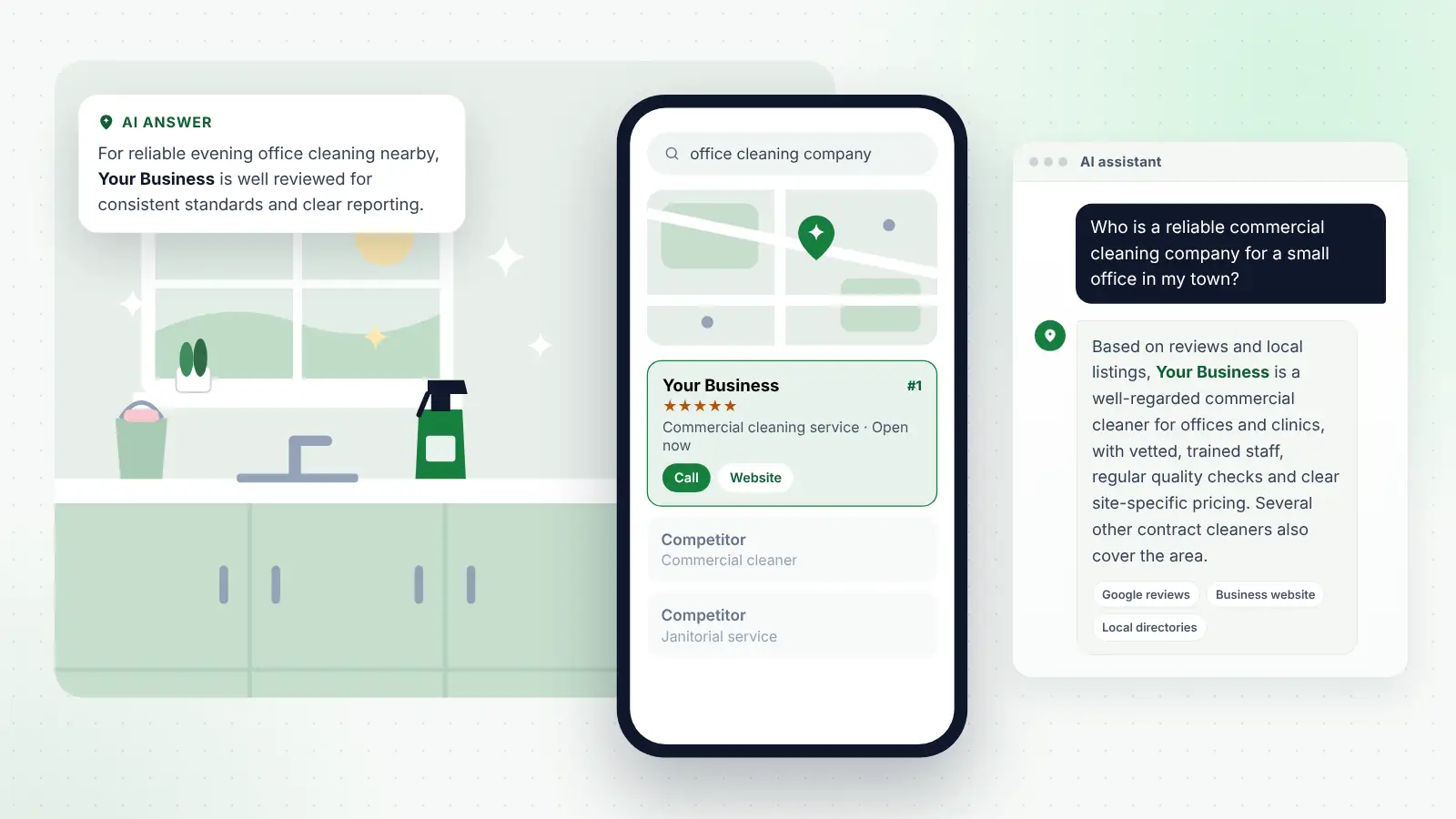
This guide is written for cleaning businesses that are already trading and want to win and keep commercial contracts. It covers choosing sectors, finding opportunities, surveying sites, pricing, the paperwork buyers expect, vetting and accreditations, tenders, taking over contracts under TUPE, and keeping clients for years. It also covers how facilities managers search for contractors and what an AI assistant is likely to say when asked for a reliable commercial cleaner in your town.
Key points
- Pick one or two commercial sectors that suit your team and hours, rather than chasing every type of building at once.
- Always survey the site before pricing, and build your quote from measured areas, tasks, frequencies and realistic production rates.
- Have a standard pack ready: insurance certificates, method statements, risk assessments, COSHH assessments, training records, vetting policy and references.
- Schools, medical premises and public sector buyers often ask for more, such as enhanced vetting, recognised cleaning standards or an SSIP health and safety assessment.
- When you take over a contract from another cleaner, TUPE may mean existing staff transfer to you, so ask the right questions before you price.
- Contracts are kept through consistency, visible quality checks and regular contact, not just low prices at renewal.
In this guide
- Choose the commercial sectors that suit you
- Where commercial contracts come from
- The site survey: where contracts are won or lost
- Pricing commercial cleaning: per hour, per square metre and per visit
- Method statements, risk assessments and COSHH
- Vetting, training and accreditations
- Responding to tenders and formal quotes
- Taking over a contract: TUPE and mobilisation
- Keeping the contracts you win
- Local SEO for commercial cleaning: how buyers find you
- AI search: what an assistant says when asked for a reliable commercial cleaner
- Frequently asked questions
- Next steps
Choose the commercial sectors that suit you
“Commercial cleaning” covers buildings with very different needs. Choosing one or two to focus on makes your pricing sharper, your paperwork more relevant and your marketing more convincing.
| Sector | Who usually buys | Typical hours | What they tend to ask for |
|---|---|---|---|
| Small and medium offices | Office manager, owner, managing agent | Early morning or evening | Reliability, security of keys and alarms, consistent staff |
| Schools and nurseries | School business manager, trust, council | After school, holidays | Safeguarding checks, holiday deep cleans, flexibility around events |
| GP, dental and other clinics | Practice manager | Evening or early morning | Infection control knowledge, colour coding, recognised cleaning standards |
| Retail and hospitality | Store or area manager | Before opening or overnight | Speed, floor care, visible standards for customers |
| Communal areas in flats | Managing agent, residents’ company | Daytime | Photo reporting, communication with residents |
Think about your team as much as the buildings. Evening and early morning shifts suit some staff and not others. Holiday deep cleans for schools require extra people for short, intense periods. Medical premises need staff who are comfortable with more detailed procedures. Moving into a sector that fits your existing team is usually easier than recruiting a new one from scratch.
Where commercial contracts come from
Most small and medium commercial contracts are not advertised in a formal tender. They come from a mix of sources:
- Direct approaches to local businesses with a short, specific letter or email offering a free site survey.
- Referrals from existing domestic clients who own or manage businesses.
- Managing agents and facilities management companies, who subcontract cleaning across many buildings and keep approved supplier lists.
- Business networks, chambers of commerce and local business parks.
- Search and AI assistants, when a manager whose current cleaner has let them down looks for someone new, often urgently.
- Public sector tenders for schools, councils, health bodies and housing associations.
Public sector opportunities in England, Wales and Northern Ireland have been published on the government’s central Find a Tender service since the Procurement Act 2023 came into force on 24 February 2025, including many lower-value contracts, with Welsh notices also appearing on Sell2Wales. You need to register as a supplier to take part. Many academy trusts and councils also run their own portals and frameworks, so check the procurement pages of the bodies you want to work with.
Timing matters. Many contracts run for a fixed period with a notice clause, and plenty of offices review suppliers in the run-up to a new financial year. Keeping a simple list of local businesses you have approached, and when their contract might be up, turns cold approaches into well-timed ones.
The site survey: where contracts are won or lost
A commercial quote without a site survey is a guess, and buyers can tell. The survey is also your first chance to show you are organised and knowledgeable.
What to record
Walk the whole building with the person responsible, and record:
- Each area and its floor type, such as carpeted offices, vinyl corridors, tiled toilets, kitchens, stairs and entrances, with approximate square metres.
- Fixtures and touchpoints, including the number of toilets, basins, urinals, kitchen points, desks and meeting rooms.
- What the client expects in each area, and how often, for example daily toilets and kitchens, desks twice weekly, high-level dusting monthly.
- Access and security, including opening hours, alarm codes, key holding, lone working and where staff can store equipment and products.
- Waste and recycling arrangements, including who supplies bags and consumables and where waste goes.
- Anything unusual, such as server rooms, labs, clinical rooms, glass partitions, occupied areas, or a lift that is out of service at night.
Ask about the current arrangement
Ask politely why they are looking. Missed cleans, inconsistent staff, poor communication or a lack of checks are common answers, and your proposal should address them directly. Also ask whether there is a current contractor and whether cleaners work on site now, because that affects whether TUPE is likely to apply.
Tip
Send a short written summary of the survey within a day or two, listing the areas, tasks and frequencies you noted. It shows you listened and are organised before you have even priced the job, and it gives them a chance to correct anything before you price.
Pricing commercial cleaning: per hour, per square metre and per visit
Most commercial cleaning prices are built from labour hours, even when they are presented as a monthly fee or a rate per square metre. The method matters less than getting the hours right.
Build the hours from the survey
For each area, estimate how long the specified tasks will take at the frequency agreed. Many firms use production rates, meaning how many square metres a trained cleaner can clean per hour for a given floor type and task, then adjust for clutter, access and the standard expected. Toilets, kitchens and fixtures are often timed per item rather than by floor area. Test your rates against jobs you already do: time a few real cleans rather than relying on generic figures.
As an illustration only, if your survey shows an office that needs around two hours of cleaning per evening, five evenings a week, you are pricing roughly ten labour hours a week, plus periodic tasks such as carpet cleaning, window cleaning or deep cleans priced separately.
Turn hours into a price
A price that holds up for the length of the contract needs to cover:
- Wages at or above the legal minimum. The National Living Wage for workers aged 21 and over has been £12.71 an hour since 1 April 2026, and some clients, including some councils and universities, ask contractors to pay the voluntary Real Living Wage.
- Employer costs, including holiday pay, employer National Insurance where it applies and workplace pension contributions.
- Statutory Sick Pay, which since 6 April 2026 has been payable from the first day of absence, and the cost of cover when someone is off.
- Supervision and quality checks, which are real time even if nobody is cleaning.
- Products, consumables if you supply them, equipment and its replacement.
- Travel between sites, insurance, uniforms, training, vetting checks and software.
- Your margin.
Presenting the price
Present the price the way the client buys. An office manager usually wants a fixed monthly fee with a clear specification. A facilities manager with several buildings may prefer a rate per hour or per square metre so sites can be compared. Whatever the format, show what is included, what is extra, and how and when the price will be reviewed, particularly when wage rates change each April.
The most common mistake is pricing commercial work by copying a competitor’s rate per hour without checking whether your costs fit inside it. The second is promising a frequency of cleaning that the hours you have priced cannot deliver.
Method statements, risk assessments and COSHH
Commercial buyers will often ask for written evidence of how you work safely. Having a standard set of documents that you tailor for each site saves time and looks professional.
Method statements and specifications
A method statement describes how each task will be done: the equipment, the products, the steps and the safety measures. A cleaning specification lists what will be cleaned and how often. Together they let the client see exactly what they are paying for, and they give your staff a clear standard.
Risk assessments
Employers must assess the risks to their staff and others affected by their work, and businesses with five or more employees must record the significant findings. For commercial sites, that usually means a site-specific risk assessment covering things like slips and trips, working alone at night, manual handling, using ladders or steps, electrical equipment and any hazards particular to the building.
COSHH
The Control of Substances Hazardous to Health Regulations apply to the products your team uses. Buyers will often want to see your COSHH assessments and safety data sheets, particularly in schools and medical premises. Keep them organised by site, use the least hazardous product that does the job, and make sure staff are trained on correct dilution, storage and personal protective equipment. Products should be kept in labelled containers and stored securely, which matters especially in schools.
Medical and healthcare premises
Clinical environments need extra care. Use clear colour coding for cloths and equipment, agree in writing who is responsible for clinical waste and sharps, and make sure staff understand infection prevention basics. In England, NHS organisations work to the National Standards of Healthcare Cleanliness, most recently updated in 2025. Not every private clinic will expect you to follow them in full, but understanding the approach to risk categories, frequencies and audits will help you talk confidently to practice managers.
Vetting, training and accreditations
Commercial buyers need to know who will be in their building, often out of hours and unsupervised.
Staff vetting
Have a written vetting policy covering identity checks, right to work checks, references and criminal record checks where appropriate. Basic DBS checks are widely used for cleaning staff. For schools, the school is responsible under statutory safeguarding guidance for satisfying itself about the checks on contractors and their staff, and many will ask for enhanced checks for anyone with regular access to the site during school hours. Ask each school what it requires before you price, and never promise a level of check your staff are not eligible for. In Scotland and Northern Ireland, checks come through Disclosure Scotland and AccessNI.
Training
Keep records of the training each person has completed: induction, COSHH, manual handling, equipment use and any site-specific procedures. Recognised cleaning training, such as courses from the British Institute of Cleaning Science, can help you stand out, especially for schools and healthcare clients.
Health and safety accreditations
Larger buyers, facilities management companies and public bodies often ask suppliers to prove their health and safety competence through a recognised assessment. Safety Schemes in Procurement (SSIP) is an umbrella body whose member schemes, such as CHAS, recognise each other’s assessments through a “deem to satisfy” arrangement, so one assessment can save you completing different questionnaires for every buyer. You can find more on the SSIP website. Some buyers also ask about ISO standards for quality, environmental or health and safety management. These take time and cost money, so work towards the ones your target buyers actually ask for.
Responding to tenders and formal quotes
Whether it is a three-page request for a quotation from a dental practice or a full tender from an academy trust, the same principles apply.
- Read everything before you start. Note the deadline, the questions, the word limits, the scoring weightings and the documents required.
- Ask clarification questions early, through the route the buyer specifies.
- Answer the question asked. Use the buyer’s headings, give specific examples, and explain how you will deliver the service at their site, not just in general.
- Show how you handle problems. Cover cleaner absence, complaints, missed tasks, key loss and out-of-hours emergencies.
- Include evidence. References from similar sites, sample audit reports and your standard documents carry more weight than adjectives.
- Check the pricing schedule carefully. Make sure your hours and rates are consistent with your method statement.
- Submit early. Portals can be slow on deadline day.
If you are unsuccessful, ask for feedback. Public buyers usually give scores and comments, which tell you exactly what to improve.
Tip
Build a “bid library” of your best answers on staffing, quality control, health and safety and mobilisation. Updating a strong existing answer is much quicker than writing a new one against a deadline, and your answers improve with every bid.
Taking over a contract: TUPE and mobilisation
When an office or school changes cleaning contractor and the cleaning work carries on in much the same way, the Transfer of Undertakings (Protection of Employment) Regulations, known as TUPE, are likely to apply. Office cleaning is a classic example of a “service provision change”. In practice, that can mean the cleaners currently working on the site transfer to your employment on their existing terms, with their length of service.
This has to be priced in. Before submitting your price, ask the client whether staff are likely to transfer, how many, their hours and pay rates. The outgoing employer must give the new employer employee liability information at least 28 days before the transfer. Acas guidance on TUPE explains the process and your obligations to inform and consult. Taking specialist HR or legal advice is sensible the first few times.
Mobilisation is the period between winning the contract and the first clean. A short written plan builds confidence:
- Confirm the start date, keys, alarm codes and access arrangements.
- Meet transferring staff, if any, and explain how you work.
- Deliver equipment, products and COSHH information to site.
- Brief staff on the specification, site risks and reporting.
- Arrange an early review, usually in the first two weeks, to catch anything missed.
Keeping the contracts you win
Winning a commercial contract is expensive in time. Keeping it is where the profit is.
- Consistency. The same cleaners on the same site whenever possible, with trained cover when someone is absent.
- Visible quality checks. Regular inspections by a supervisor against the specification, with simple reports shared with the client.
- Fast response. Acknowledge complaints quickly, put them right and tell the client what you changed.
- Regular contact. A short review meeting or call every few months, before problems build up.
- Honest price reviews. Explain increases clearly, linked to wage and cost changes, and give notice well ahead.
- Proactive suggestions. Propose periodic deep cleans, carpet cleaning or washroom improvements where they would genuinely help.
Most contracts are lost because the client stops noticing the good work and starts noticing small failures. Regular reporting keeps the good work visible.
Local SEO for commercial cleaning: how buyers find you
Commercial buyers search differently from homeowners. A practice manager or office manager whose cleaner has just let them down is likely to search “office cleaning company [town]”, “commercial cleaners near me”, “school cleaning contractors” or “dental surgery cleaning [area]”, then check the businesses that appear in the map pack and on page one before making a few calls. Facilities managers comparing several contractors will look at your website in more detail, looking for proof you can handle their type of building.
The essentials are the same as for any local business, but the emphasis changes:
- Set your Google Business Profile up for commercial work. Choose an accurate primary category, such as commercial cleaning service, and list each commercial service separately, such as office cleaning, school cleaning and medical premises cleaning. Use your description to mention vetting, insurance and quality checks.
- Ask commercial clients for reviews. A review from a practice manager mentioning reliable evening cleaning and clear reporting is exactly what another practice manager wants to read. Reply to every review professionally.
- Keep your details consistent. Your business name, phone number, website and service area should match across Google, your website, LinkedIn, business directories, local chamber listings and any accreditation directory you appear in.
- Build sector pages, not just a services list. Separate pages for office cleaning, school cleaning, medical and dental cleaning and retail cleaning, each explaining how you work in that type of building and what documents you can provide, help you rank for those searches and answer buyers’ questions before they call.
- Show proof on the website. Accreditations, insurance levels, vetting policy, training and anonymised examples of sites you clean all help, as long as you have permission to mention clients.
- Earn local business links. Chamber of commerce membership, business park directories, local business awards and supplier pages are all relevant for commercial work.
Done consistently, this means you are visible at the moment a buyer decides to change contractor. If you would rather concentrate on running contracts, our page on local SEO for cleaning companies and commercial cleaners explains how specialists can help. Expect it to take three to six months to build, which fits the long lead times of contract tenders.
AI search: what an assistant says when asked for a reliable commercial cleaner
Facilities managers and business owners increasingly ask AI assistants such as ChatGPT, Gemini, Perplexity, Microsoft Copilot and Google’s AI Overviews for help shortlisting suppliers. Their questions tend to be specific:
- “Who are reliable commercial cleaning companies in [town] for a small office?”
- “Which cleaning companies near me are experienced with dental surgeries?”
- “What should I ask a cleaning contractor before signing a contract?”
- “Which school cleaning contractors in [county] have good reviews?”
These tools assemble answers from information they can find and cross-check across the web. Answer engine optimisation, or AEO, is about making sure what they find about your business is clear, consistent and credible. For commercial cleaning, that means:
- Clear sector descriptions. Say plainly which types of building you clean, where, and how, on your website and Google profile.
- Specific reviews. Reviews that mention the type of premises, reliability and communication give AI tools concrete evidence.
- Visible credentials. Accreditations, insurance, vetting and training stated consistently in several places.
- Useful FAQs. Answers to questions buyers ask, such as how you cover absence, how often quality checks happen, how keys are managed and what happens at the start of a contract.
- Mentions on reputable sites. Accreditation directories, local business organisations, trade press and local news.
An assistant asked for a reliable commercial cleaner in a town is likely to favour businesses it can describe confidently, for example as an office and clinic cleaner with vetted staff and good reviews. There is no guarantee of being mentioned, but consistent, specific information makes it much more likely.
Frequently asked questions
Do I need to be a limited company to win commercial contracts?
Not necessarily. Many smaller commercial clients are happy to work with a sole trader who is well organised and insured. Some larger buyers prefer or require a limited company, and public sector tenders may ask for financial information. Speak to your accountant about what suits your business as it grows.
How much public liability insurance do commercial clients expect?
It varies by client. Many ask for a specific level of cover in their tender or contract, and public sector and facilities management buyers often ask for more than a small office would. Check the requirement before you bid and speak to your insurer about increasing cover if needed.
Should I price per hour or per square metre?
Use whichever your client finds easiest to understand and compare, but build the price from realistic labour hours either way. Rates per square metre only work if the production rates behind them reflect the actual building and specification.
Is an SSIP assessment worth it for a small cleaning company?
If you are targeting facilities management companies, larger buyers or public bodies that ask for one, it can save you time and open doors. If your clients are small offices and shops that never ask, focus first on clear documents, vetting and reviews.
What happens if I win a contract and the existing cleaners transfer to me?
If TUPE applies, the cleaners usually transfer to your employment on their existing terms and conditions, with their continuous service. You will receive employee liability information from the outgoing employer and have duties to inform and consult. Take advice early, and make sure your price reflects their pay and hours.
Next steps
Moving from domestic into commercial cleaning is less about cleaning differently and more about proving you can be relied on. Choose the sectors that fit your team, survey every site properly, price from real hours and real costs, and keep a ready pack of insurance certificates, method statements, risk assessments, COSHH records, vetting and training evidence.
Then make it easy for buyers to find and check you. Sector pages on your website, a commercial-focused Google Business Profile, reviews from business clients and consistent credentials across the web help you show up when a manager searches or asks an AI assistant for a reliable cleaner, and give them reasons to call you first.